What’s that in the way?

‘All those meetings you have tomorrow – they were just cancelled.  The boss wants you to do something productive instead.

What would yo do with that time?  What would you initiate?’*

Ken Mogi writes about the flow people experience in their work when they focus on the here and now, telling the story of Japanese whisky being produced in a country that has no barley or peat.  Apparently theses weren’t big enough obstacles to interrupt a passion.

‘Time is eternity living dangerously.’**

Says John O’Donohue.

Flow isn’t about size but about pursuing something that’s exceptional and exquisite, and when something gets n the way then we need to remove it.

Elle Luna writes of this:

‘it starts as a whisper, a call from somewhere far away’.^

A year before I had read these words, I’d found myself wondering whether there are two whispers: the one from inside and the one from outside.  What is calling to you and what are you calling and responding to?

Friedrich Nietzsche wrote about how we must not let anything get in the way of this:

“The essential thing ‘in heaven and earth’ is […] that there should be a long obedience in the same direction; there thereby results, and has always resulted in the one run, something which has made life worth living.”^^

We’d grab the chance of having the unimportant being cancelled by someone else, but the reality is we have the opportunity to do some of the cancelling ourselves.

(*From Seth Godin’s blog Cancelled.)
(**From John O’Donohue’s Anam Cara.)
(*From Elle Luna’s essay The Crossroads of Should and Must.)
(^^Frierich Nietzsche, quoted in Eugene Peterson’s A Long Obedience in the Same Direction.)

It’s not a race

‘Winning a yoga race.

It makes no sense, of course.

The question this prompts is: Are there places you feel like you’re falling behind where there’s actually no race?’*

‘Like the discovery of neorogenisis and neural plasticity, the discovery that biology thrives on disorder is paradigm-shifting. […] Chaos is everywhere […].  Like a cloud, life is highly irregular, disorderly and more or less unpredictable.”‘**

I really like Seth Godin’s idea of a yoga race.  And I also like Jonah Lehrer pointing to the impact of retrotransposons on individuality: ‘junk genes that randomly jump around the human genome’.**  Many of the finishing lines we see are ones we have created, and many of us are running races we don’t need to.

John O’Donohue introduces a thought that shifts our thinking about Life  with a capital L and our life:

‘Friendship is the sweet grace which liberates is to approach, recognise and inhabit the adventure.’^

Turning “the competition” into a friend in order to enter the adventure is not a bad idea.  This is to play the infinite game, though, I am not unrealistic.  There are times when we have to play finite games but that’s quite different to thinking it’s the only game – and wherever possible we can defer to the infinite – to include as many as possible for as long as possible, and when the rules threaten this, to change the rules.

Here are some ways we can turn the competition into the friend:

Be a mind-opener, introducing others to new thinking.

Be a navigator, helping others to steer through challenges or crises.

Be a collaborator, working with others.

Be a champion, watching their backs.

Be an encourager, being a positive space for others to enter.

Be a builder, helping others to develop.

Be a connector, introducing others to other others who may help them.

Be a companion, getting together just for being together.^^

Life makes much more sense as friendships than it does as a race.

(*From Seth Godin’s blog Winning a yoga race.)
(**Froom Jonah Lehrer’s Proust was a Neuroscientist, quoting Karl Popper.)
(^From John O’Donohue’s Anam Cara.)
(^^From Tom Rath’s Vital Friends.)

What are you waiting for?

Two people are deep in conversation, sharing what they are up to, moving beyond the small talk, exploring something that has moved one and then both of them.  It doesn’t have to be a big something big to be something deep.  In this mutuality of sharing there is a waiting on each other, giving and receiving.

‘We must remain attentive in order to be able to receive.’*

John O’Donohue is suggesting there needs to be openness for this kind of interaction to take place.  A conversation yesterday explored compassion in which we considered compassion for self.  Was this the in-thing it appears to have become?  My memory went to some graffiti I’d spotted on a bridge spanning the Arno river as it flowed through Florence: “I am mine, before I am ever anyone else’s.”

‘Every day each one of us is given the gift of new neutrons and plastic cortical cells; only we can decide what our brains will become.’**

Jonah Lehrer is writing about how we are codes needing contexts:

‘Our human DNA is defined by its malleability of possible meanings, it is a code that requires context.’**

We are who we are in interaction with our environments, and I think particularly of human environments:

‘What makes is human and what makes each of us his or her own human is […] how our cells, in dialogue with out environment, feed back to our DNA, changing the way we read ourselves.’**

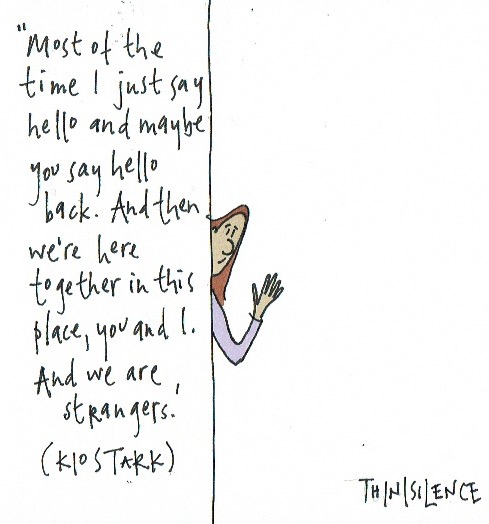
This context people includes strangers.  Our interactions with those around us, Kio Stark argues, may be some of the most hopeful things that happen in our experience in this world.  She’s helping me to understand compassion in a different way: compassion is what happens between me and my context, especially with people:

‘Everything really interesting that happens between strangers begins when you bend invisible rules in positive ways.’^

These rules are how we may stare, gaze, and pay civil inattention and attention to one another.  One such bending of these rules is in the use of triangulation.  Instead of directly interacting with someone, we use something else to test the waters:

‘A point of triangulation such as a funny child, a musician playing […] can prompt an exchange […].  Suddenly its a space of interaction.’

Stark continues:

‘Learning to see what has been hidden from you carries the thrill of secret knowledge.  It’s also practical knowledge. […] It helps you to pull yourself into a transformed social landscape, one that is open and rich with surprising, fleeting, affirming connections.’^

Some might say that this positing of compassion being everywhere is to demean it.  Others believe compassion to be something too soft as to be useful in their work of thinking and actioning.  Stark brings the truth home, that it’s only invisible, but it’s a basic way of operating for all of us:

‘So much of this happens beneath the level of logic and reason.  It’s all gut, instinct, memory. sensory information, and fantastically subtle cues.’^

This also carries a warning about the dangers we meet though our technology:

‘In networked spaces – online, in apps, in games – this all goes to hell.  The body is missing.’^

Maggie Berg and Barbara Seeber underline the impossibility of separating ourselves from what I am suggesting is an existence we can only experience through compassion:

‘even if it were possible to maintain a disembodied brain, that brain would not be able to think

[…]

“far from being a cold engine for processing information, neural connections are shaped by emotion”‘.^^

If I go back to the original conversation I mention, there seems to be no possibility of compassion for self without compassion from others.  In my understanding of my talents, my teacher for an amazing day of discovery, Chip Anderson, taught us as a group that there is no understanding of our own talents without an understanding of one another’s.  Berg and Seeber tell of how,

‘it is not an illusion when a class goes well, we all think better; recent research agrees that weare all more clever’.^^

My understanding and experience is, openness is a key skill to becoming more aware of, and developing, our compassion: opening our mind, our heart, and our will.

Then I read this from Karen Armstrong:

‘Compassion requires us to open our hearts and minds to all others.’*^

It does appear to be that increasing our openness is the key.

(*John O’Donohue, quoted in the Northumbria Community‘s Morning Prayer.)
(**From Jonah Lehrer’s Proust was a Neuroscientist.)
(^From Kio Stark’s When Strangers Meet.)
(^^From Maggie Berg and Barbara Seeber’s The Slow Professor, including a quote from David Brooks.)
(*^From Karen Armstrong’s Twelve Steps to a Compassionate Life.)

I just happened to be here

Turning up and doing what we do is the beginning of everything that turns out to matter.

Brian McLaren describes this beginning in three words: Here!  Now!  O!*

If we turn up doing the things we do best, maybe something wonderful will ensue.

Ken Mogi reflects on the accidental production of the beautiful yohen tenmoku bowls:

‘The beauty of the starry bowls is so sublime precisely because these items were produced out of unconscious endeavour.’*

I understand what Mogi is getting at.  The people who made these bowls couldn’t point to them and say, I knew what I was doing when I made that.” People are still trying to replicate the results.  But these crafts-people turned up every day doing what they do best.

Sometimes happy accidents happen.  But they happen because we turn up giving our best:

‘Being in the flow is all about treasuring the being in the here and now.’**

Richard Sennett “adds” an interesting point – the callus is the symbol of turning up:

‘By protecting the nerve endings in the hand, the callus makes the art of probing less hesitant […] the callus both sensitises the hand to minute physical spaces and stimulates the sensation at the fingertips.’^

Turning up and doing our work provides us with calluses, the possibility of doing finer work more deeply, opening us to the complex and perplexing – the latter being the challenge in life we must respond to.

(*From Brian McLaren’s Naked Spirituality.)
(**Fom Ken Mogi’s The Little Book of Ikigai.)
(^From Richard Sennet’s The Craftsman.)

We’re not done yet

‘A drab looking cage produces a drab looking brain.’*

‘We are anxiety-ridden animals.  Our minds are continually active, fabricating an anxious, usually self-preoccupied, often falsifying veil which partially conceals the world.’**

One of the things I have appreciated since having an operation to remove a cataract is how colours are way brighter and sharper than I thought they were.  I find myself closing one eye and then the other, playing between the foggy image of the world my left eye can make out and the brightness of the world in right.

I’d been told to expect this but thought my world wouldn’t have been affected this much.  There’s something revelatory about what lies beyond the veil.

Iris Murdoch writes about humans being ‘anxiety-ridden animals,’ continues to write about beauty:

‘The surprise is a product of the fact that, as Plato pointed out, beauty is the only spiritual thing which we love by instinct.’*

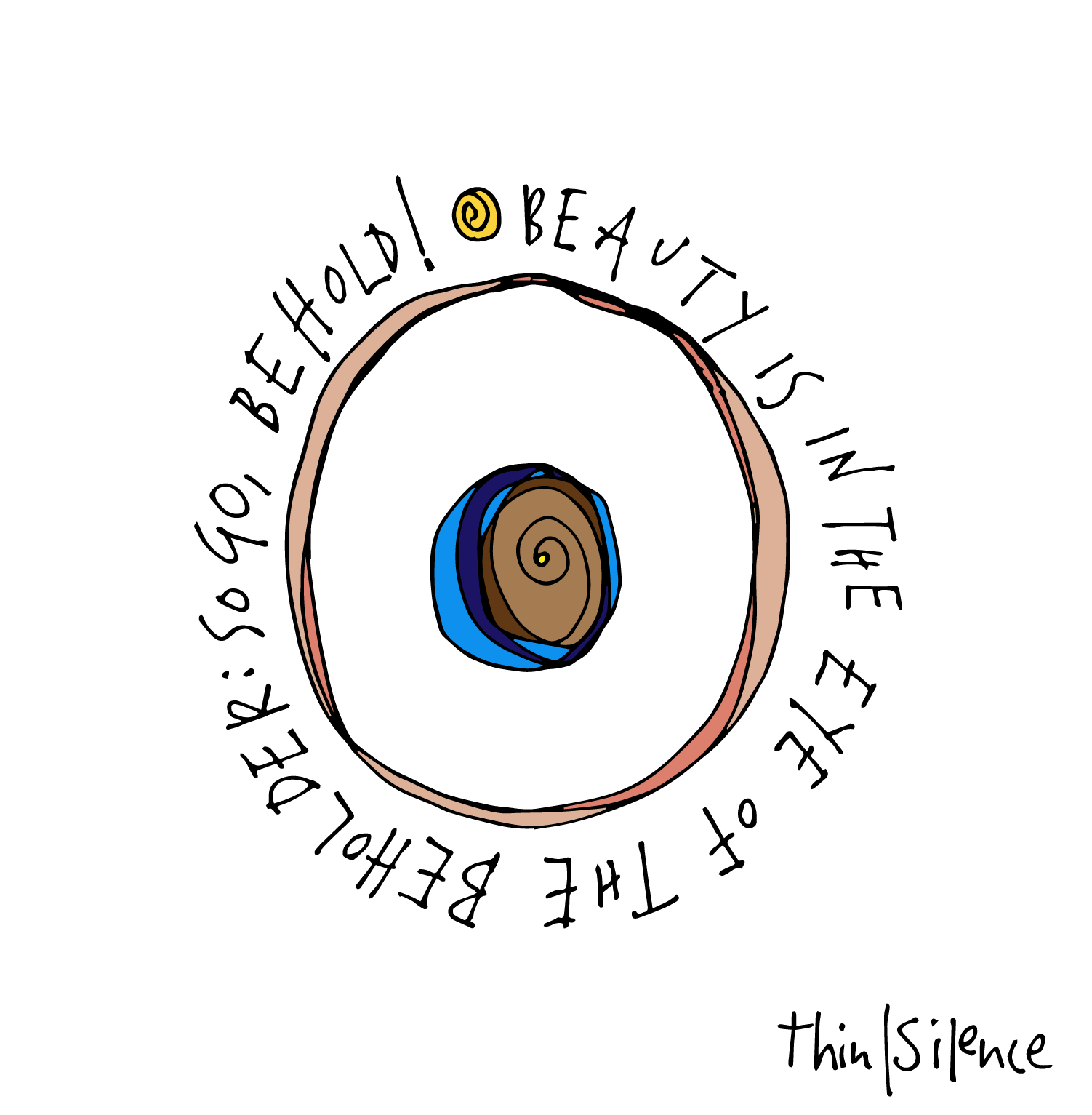
Do we know there is something more beyond our drab cages?   I don’t think we intend this drabness for one another.  We don’t design our education systems and life expectations and work environments in this way, but we underestimate the value of beauty for our brains.  As I suggest in my doodle, beauty is in the eye of the beholder – I’m not trying to tell someone what is beautiful and what is not.  The only condition I would hope for is that our kind of beauty improves the lives of those around us.

‘Unless there is an obvious reason to do otherwise, most of us passively accept decision problems as they are framed and therefore rarely have an opportunity to discover the extent to which our preferences are frame-bound rather than reality-bound.’^

We need to take a closer look, not only around us, but inside too.  Erwin McManus warns us that our sense of identity is critical when it comes to the future:

‘Sometimes, though, it’s not people who keep its in the past; it’s our own sense of identity.’^^

Just as Murdoch speaks of spiritual things, so does McManus at this point:

‘The most spiritual thing you will do today is to choose.’^^

Today, I choose beauty.  Let me see where that takes me.

(*From Jonah Lehrer’s Proust was a Neuroscientist.)
(**From Iris Murdoch’s The Sovereignty of Good.)
(^From Daniel Kahneman’s Thinking Fast and Slow.)
(^^From Erwin McManus’ The Last Arrow.)


yoking

‘We were living the process as we created it.”*

Joseph Jaworski is articulating the experience I’ve come to value deeply, namely to live in the process of creating together what is being anticipated as a goal:

‘At the very core of our union as partners is a shared passion for using our skills for positive change in our world, as well as having fun while doing excellent work.’**

Lisa Arora and Robert Mittman won’t be forming a company together anytime soon but they often bring together Arora’s graphic facilitation and Mittman’s strategising work with companies in collaborations.

What they’re exploring on a professional level is available on different levels.  I’m grateful to those who have helped me develop an idea through informal partnering, and sometimes formally in one-off or a series of actual ventures – some of these have had financial implications and others not.  They’re all marked by playfulness.

This is one of the qualities these partnerships are marked by.  Playfulness is respected by all concerned as a means of moving from stuckness to movement.  It means partnership-yokes are easy, making the burden of work lighter.   I’ve worked in partnerships where the opposite has been the case – the yoke is awkward and “rubbing,” and the load feels as if it’s doubled not reduced.  This kind of yokefulness means both or all are working as hard when apart as together.  It’s a generative thing, it’s like being born over and over together:

‘[George] Eliot was right: to be alive is to be ceaselessly beginning.’^

(*From Joseph Jaworski’s Source.)
(**Lisa Arora and Robert Mittman in Drawn Together Through Visual Practice.)
(^From Jonah Lehrer’s Proust was a Neuroscientist.)

Forgive your past

Perhaps the person who won’t allow you to move forward into the future is you.

You tried something : it didn’t work.

You related to someone badly: you won’t try that again.

You made things worse for those you love by taking a risk: nothing is worth messing up again.

You showed yourself to be a fraud when it came to your role: you’ll keep your head down and simply get on with things in the background now.

Forgiveness, though, has a remarkable way of opening life up.  Otherwise we pace back and forth within a decreasing space in life. Jonah Lehrer picked something up from George Eliot which is very helpful for us:

‘She believed that the most essential element of human nature was its malleability, the way each of us can “will ourselves to change.”‘*

Unforgiveness does not allow change to happen, forgiveness does.  And it comes to us fresh each day.  Okay, yesterday, we messed up.  Learn from it, imagine how you would or should have done it, start over.

(*From Jonah Lehrer’s Proust was a Neuroscientist.)


These are my most favourite words of all

This library, it
is a people portkey of
possibilities,
where imagination and
reality join and scheme.*

Who spoke to us our favourite words?  Words that changed something, still change something, hold us in this way of change?

Seth Godin introduces me to samizdat:

‘Samizdat (Russian: самизда́т; IPA: [səmɨzˈdat]) was a key form of dissident activity across the Soviet bloc in which individuals reproduced censored and underground publications by hand and passed the documents from reader to reader. This grassroots practice to evade official Soviet censorship was fraught with danger, as harsh punishments were meted out to people caught possessing or copying censored materials. Vladimir Bukovsky summarized it as follows: “Samizdat: I write it myself, edit it myself, censor it myself, publish it myself, distribute it myself, and spend jail time for it myself.”[1]‘**

I may pass forward subversively-good words but there’s a point at which I must begin to form my own:

‘But writing it–writing it is the true disruption. Because the act of saying it, saying it clearly, saying it aloud, this is what galvanizes people and leads to action.’^

Perhaps, from an unusual source, Tom Hodgkinson helps us to see there are at least two parts too this prooduction.  Hodgkinson, co-founder of The Idler Academy writes some practical things about spreadsheets for running a business:

‘There are two types of cost: the cost of actual materials […] and the cost incurred every month to run things […] called ‘overheads.’^^

Our words come from our changing lives.  We have to invest in the things which make change at the deepest levels of our lives – then we’ll have something worth saying.

It’s always more about ‘the direction of depth rather than distance.’*^  And if we look deep, we might find more than we expected already there.

(*Some tanka for a #libraryofawesome exploration – a library of the future in which the people bring the resources and together create something new.)
(**Samizdat article, from Wikipedia.)
(^From Seth Godin’s blog Samizdat is in the writing.)
(^^From Tom Hodgkinson’s Business for Bohemians.)
(*^From Kosuke Koyama’s Three Mile an Hour God.)

Today could change everything

“Drink in the silence. Seek solitude.

Listen to the silence.

It will teach you. It will build strength
Let others share it with you.
It is little to be found elsewhere.”*

Today is why the future and the past exist.

The past leads us to today – we are not meant to be trapped in the past.

Imagining the future makes for a better today the future is not a place to escape to or be lost in its endless possibilities.

Today is where we find our purpose in life.  Ken Mogi’s book on ikigai – the Japanese way to purpose, brings our attention to the small things in life and the here and now when he describes the life of Sei Shōnagon who was serving in the Japanese court around the year 1000 when she wrote The Pillow Book, a collection of essays:

‘Sei Shōnagon does not use grandiose words to describe life.  She just pays attention to the small things she encounters in life, understanding instinctively the importance of being in the here and now.  Sei Shōnagon also does not talk about herself.’**

In noticing the small things, Sei Shōnagon became present to them, one with them.  Paying attention to the small things is the first pillar of ikigai, leading to the second pillar of releasing oneself:

Releasing oneself  is very much related to being in the here and now.’**

There’s something in this finding our life-purpose that requires what Sherry Turkle names “sacred space.”  In describing how we are so wired to our technology, Turkle reflects on Henry David Thoreau’s consideration of “where I live and what I live for”:

‘A sacred space is not a space to hide out.  It is a place to recognise ourselves and our commitments.

When Thoreau considered “where I live and what I live for,” he tied together location and values. Where we live doesn’t change how we live; it informs who we become.  Most recently, technology promises us lives on the screen.  What values, Thoreau would ask, follow from this new location?  Immersed in simulation, where do we live, and what do we live for?^

Frances Roberts words, which open this post, encourage us to enter the silence.  This for me is not some empty place of emptiness, but a full place of what is fullness.

The question is stimulated, then, whether it is possible to become this silence?  (Many of these Thin|Silence posts are not about “This is how it is!” but “What if?”)

“I and this mystery, here I stand.”^^

Walt Whitman reminds me that me and my body – we are one.  I do not deaden my senses in silence but bring them to aliveness and to oneness.  In the moments of such wonder I too fleetingly have, I have noticed I am not thinking about myself in some separated way.  And I get it that this sense of having everything allows us to move from opening our hearts to opening our wills, the threshold we face that lies between fear and courage, or selfishness to selflessness – when I am one with what I must  do.  This is what I understand to be releasing oneself.

Perhaps another word for this, provided by Charalampos Mainemelis, is “engrossment,” being here, now:

“What we need is “engrossment,” which mobilises one’s entire attention, resources and physical energy toward only one stimulus which is the present-moment activity.”*^

It seems we are “built” for this.  Even an analogy from the film world acknowledges that we can’t be everywhere, taking everything in, but we can be somewhere:

‘When we watch a film, what is in the frame is only a selective view of a wider fictional world … the act of framing an action presents the film-maker with a whole range of choices, including what is revealed and what is withheld from the sudience.’^*

If we’re preoccupied with the past, our escaping to the future, then we cannot take hold of the fullness of the present.  Both can be held in the present, and we know, when we compress energy, there’ll be an explosion.

Creativity.

(*Frances Roberts, quoted in the Northumbria Community‘s Morning Prayer.)
(**From Ken Mogi’s The Little Book of Ikigai.)
(^From Sherry Turkle’s Alone Together.)
(^^Walt Whitman, quoted in Jonah Lehrer’s Proust was a Neuroscientist.)
(*^Charalampos Mainemelis, quote in Maggie Berg and Barbara Seeber’s The Slow Professor.)
(^*From Charlotte Bosseaux’s Dubbing: Film and Performance.)


Noticed and noticing

“Some people who came in just for a moment were all there, completely in that moment.”*

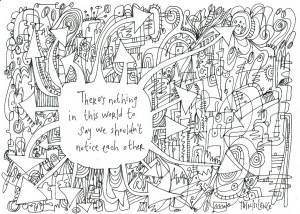
What an incredible thing it would be if it were possible for people to fully turn up in their lives.  There’s nothing in the world or universe that dictates otherwise, it’s only what we have created as orders and patterns and cultures and societies that prevent it.

And, if we want to, we can create better ones.

Waste is a part of our human stories.  It’s something only humans have managed to create.  It has a life all of its own:

‘Waste is the antiproperty that becomes the possession of losers.  It is the emblem of the untitled.’**

Waste and leftovers.  Who wants to be at the end of queue?  Unfortunately, there isn’t too much of a jump in human thinking between waste as material and waste as people.

In his book Helping, Edgar Schein identies three forms of helping: informal – when we just get on and help each other, semi-formal – when we go to people with skills, and, formal – when help is professionally provided with “appropriate” contracts in place.  It feels like we’ve been moving more towards the formal kind of helping, expecting government and organisations to take on the yoke, but this can feel more stifling than helping.

Maybe there’s a shift.  Perhaps we’re becoming more imaginative with the semi-formal in social enterprises of one kind or another, and people simply forming themselves into cooperatives that provide more choice when it comes to helping, even moving more towards the mutuality of the informal.

When more people are included rather than excluded as losers, creativity goes up.  Douglas McWilliams brings some fascinating insights from the resurgence of London’s economy.  Writing before the frothy headlines of Brexit, McWilliams records:

‘When these skilled and energetic young people from all around the world started to work together, another virtue of the migrant economy became apparent.  Not only did migrants provide skills but they also stimulated creativity.  People with different backgrounds and ways of thinking spurred each other on to produce ideas.’^

Dubbed the Flat White Economy because of the favoured beverage in the particular area of London where they lived and worked, these people brought sheer hard graft and imagination together:

The people at the heart of the Flat White Economy are very different from those who worked in the burgeoning city of London a few years earlier.  The Ferraris, champagne and mansions of Kensington and Notting Hill have been replaced by Oyster cards, bicycles and shared flats in Hackney.’^

Maybe they wouldn’t even be noticed by some who counted themselves as successful but they’re there for one another, helping in “informal” and “semi-formal” ways, and not asking each other to jump through bureaucratic hoops.

Erwin McManus tells the story of how his mum Alby, at the age of twenty with two small children, was helped to escape a dangerous marriage by a Swiss chef who worked in the kitchens of the hotel where she worked in El Salvador, to take up the offer  to work as an air stewardess with Pan Am; Erwin reflects on what this man had made possible, which was more than simply the $250 he had given her:

‘This man became for her the voice that gave her permission to leave her past behind and go create a better future.’^^

Erwin continues to reflect:

‘I have learned from her that if you live in the past you die to your future.’^^

My wife Christine and I have had the privilege of meeting the remarkable person Alby is.  We’ve very fond memories after sharing her home in Florida and learning something of the life she eventually found herself able to choose:

‘The important point not to miss here is that no one can tell you your future.  You have to decide what future you want, what future you will pursue, what future you must create.’^^

Tom Gunning works on problems of film style and interpretation, and here helps us to anticipate the uncanny – uncanny being those things which take us out of our comfort zone and threaten to change us.:

“The uncanny is always crouching, ready to spring.”*^

This is the universe we live in, full of uncanny possibilities for everyone, not just for the privileged.  We only need to begin noticing what is already in our lives and, often with the help of others, to do something different with what we find.  We have choice … options.

Seth Godin writes about how more of what we do is being set up for machines to read, but we are capable of coining up with what is unreadable by machines:

‘What happens if your work becomes machine unreadable?

So new we don’t have a slot for it.

So unpredictable that we can’t ignore it.

So important that we have to stop feeding the database and start paying attention instead…’.^*

Notice yourself.  Notice others.  It could change the world.

(*Anne Morrow Lindbergh, quoted in the Northumbria Community‘s Morning Prayer.)
(**From James Carse’s Finite and Infinite Games.)
(^From Douglas McWilliams The Flat White Economy.)
(^^From Erwin McManus’ The Last Arrow.)
(*^From Charlotte Bosseaux’s Dubbing: Film and Performance.)
(^*From Seth Godin’s blog Machine unreadable.)