rhino world

when ideas collide

Someone has actually sat down and worked out how the more densely populated a city, the more actual collisions take place, leading to more patents being registered – roughly speaking, the moe people we encounter, the more ideas we have, the more new things happen.

I love this.  The industrial mindset removes such collisions, making it possible for you to stay focused for long periods so you’ll be more productive.  But our work spaces are changing, they are becoming more creative.

The industrial workspace is often single location, fixed spaces, isolational, routinised.  Creative workspaces are multiple, adaptable, communal, freewheeling.

Yesterday morning I sat down with a plethora of entrepreneurial* and imaginative people from a  range of businesses and interests who’d gathered in an artisan coffee shop because they wanted to meet other people like them – not knowing what might happen, they were willing to invest one to two hours in order to do this.  Interesting.

I find myself imagining the possibility of adaptable space being made available where people like these can bring their laptops and iPhones and cameras, plug in for a few hours and also meet others doing the same – bring on the collisions.  (And it’s doesn’t have to be only those who earn their income in these ways, but also people who are pursuing something in their free time which matters to them.)

If you’re anticipating a meeting with someone, try a different space.  If you have some work to do, why not find a cafe somewhere … or the museum or art gallery?  If you have some spare space, why not open it to people who would normally work alone but could pay you something to work in a communal environment for a while?  If you normally work alone, why not google out some possibilities for meeting with others?  If there’s nothing around, why not start it?

Rhinos can run at thirty miles-an-hour but can’t see thirty one feet in front of their horns.  That’s why they’re collectively called a crash.  Brilliant.  We could name them the mascot for entrepreneurs in the creative age.

(*I like Mitch Joel’s definition of an entrepreneur – it’s big and wide and potentially includes everyone who’s ever had an itch about anything: ‘A true entrepreneur is someone who has an uncanny desire to create the future; someone who sees inefficiencies in the work we’re doing – day in and day out.’
place the mask over your nose and mouth

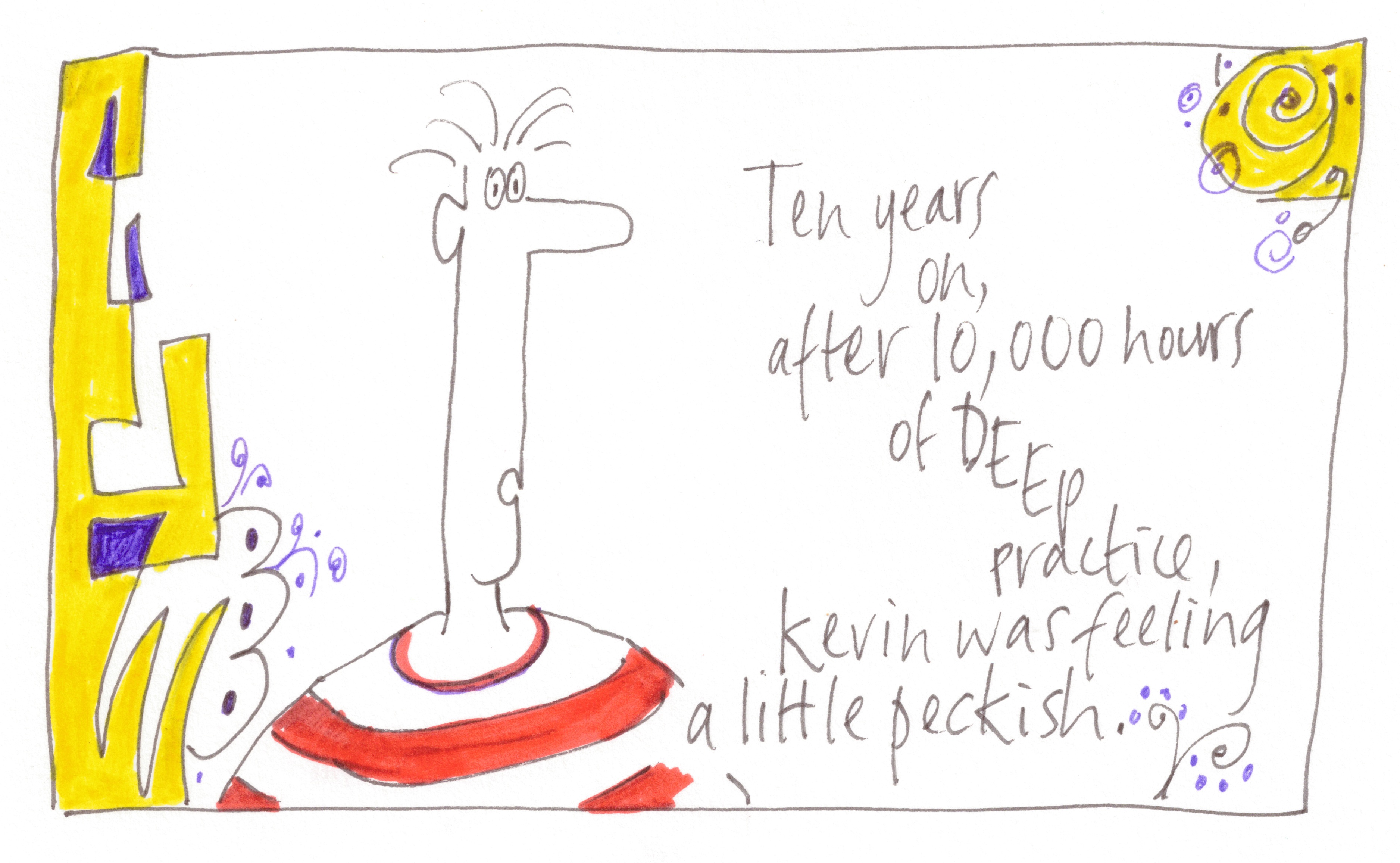
ten years on, after 10,000 hours ...

Yesterday, I wrote how finding your voice is important for others to find theirs.  Today, I thought to sketch out a little of offer some of the thinking behind this.

Steven Covey‘s eighth habit for becoming highly effective people is about finding our voices and helping others to find theirs – something akin to the flight safety presentation reminding us, if oxygen masks are deployed, we must secure our our own before helping others to secure theirs.  The presentation, presented by a bodiless voice or video, reminds you of what you must do

Who helped you find your voice? Or, who is helping you?

Mitch Joel offers six ways to become more digital; he’s really offering six ways to find your voice:

Learn it
Read more
Create more
Love it
Live it
Practice it

The first two catch my attention.  Learn it and Read more are about finding help from outside of ourselves – because when it comes to finding our voice, being creative, no one is an island.  Something captures our attention and we want to know more, so set out to learn about it, we read as much as we can (or watch as many TED videos as we can – so we involve as many people as possible in this exploration.  Then we can push on and begin playing with new possibilities and Create more, trying and trying and trying, but only if we Love it.   So we begin to Live it and breathe it, and we get to where we we put our art out there and see what others make of it as we daily Practice it.

Within this, but I pull it out here in order to underline it, is the truth that finding your voice won’t come easily or comfortably.  It will become a quest thousands of hours long, trudging through the tedious and multiple failures but then trying again (this is why you have to love it).

Another things to draw out from this is, whilst we need others to help us, they cannot choose what it is for us; many have been pushed in a direction which is not of their choosing, by parents, friends, teachers, employers, or something more numinous like culture or society – what comes from outside must resonate with what lies at the centre of who you are.  Your authentic voice can only be identified and developed by you.

In this post are hidden five great books – all of which can be seen as help from outside; here’s a quote from a sixth book:

Anyone who would spend ten years absorbing the
technologies of their field, trying them out,

mastering them, exploring and personalising
them, would inevitably find their authentic
voice and give birth to something unique
and impressive.

By the way, the benefit of ending your voice?  You’re not waiting to be picked; you’ve just picked yourself.

(Here’s a seventh, because my cartoon is often inspired by Hugh Macleod.)

finding your voice

the world is a choir of beautiful voices

Your voice can be recognised by your family, friends, and colleagues in what feels like a fraction of a second.  It’s your unique signature. 

So here’s a few things about voices.

We talk about finding your voice to mean identifying your unique and authentic contribution.  This is where we get the idea of vocation and calling from.

I can recognise your distinct voice from the things which you’re curious about, from the skills you hone, from your personal touch, and your approach to life, no matter what you’re doing.  It’s your life signature.

But what if you couldn’t recognise your own voice?

You may be trying to impersonate someone else, to “sound” like the person your parents or partner or employer wants you to be.

Hear of voice development?  Just like your speaking voice can be developed, so can your life-voice.  But if you don’t know your voice, you can’t develop it.

Finding our voices and developing them excite me a lot, but the third thing excites me even more.  When we find our voices, we help other to find theirs.  And that can change the world.

Someone once said, the world doesn’t need a second someone else, it needs the first you.

(*vo·ca·tion  (vō-kā′shən)

n.

1. A regular occupation, especially one for which a person is particularly suited or qualified.
2. An inclination, as if in response to a summons, to undertake a certain kind of work, especially a religious career; a calling.

[Middle English vocacioun, divine call to a religious life, from Old French vocation, from Latinvocātiō, vocātiōn-, a calling, from vocātus, past participle of vocāre, to call; seewekw- in Indo-European roots.])

the ancient art of dreamwhispering

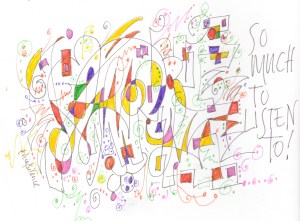
so much to liste to

This is the title I’ve given to what I’ll be sharing at an event for the free sharing of knowledge.

Dreamwhispering is ancient art with a timeless dynamic in Human development, listening deep within – though we’ve lost the art in modern life.

Here’s a short initiation into the mastery of this ancient art of listening more deeply.

First there is our normal listening – this is the “same old same old” listening many people are trapped in – listening only to what confirms the things already known.

To go deeper we must cross a threshold, suspending the way we see and understand.  (We must allow for this to be disorientating, as we’ll discover there is much more to know about everything, and everything is way more complex than we know.)

This brings us to factual listening – we understand there is far more to the world, to the people around us and to our selves than we thought.

To go deeper we must cross another threshold, redirecting our listening from the outside of things to the inside – this too is disorientating for us as our thinking includes the thinking and feeling of others.

This brings us to empathic listening – we’re seek to understand from the perspective of another (another person, another species even, and our planet).

There is another threshold to cross, letting go of our old ways of seeing, understanding,and behaving, in order to take hold of one which is more satisfying and fulfilling to ourselves and makes a dent for good in our world and universe.

This brings us to generative listening – we identify the emerging future we’ll be involved in bringing into being through a connected collaborative.

Admittedly, the ancient art of dreamwhispering is not an easy journey, and to complete it – if we can ever say we do – requires us to find the things which motivate and energise us.  When we do, we find we have something unique to accomplish through our lives, we have all we need to do this, and, we can go further than we ever thought we could … we may even have to rethink what we mean by life.

The times before us are exciting because we are rediscovering this ability to hear what our lives are saying to us, as well as the lives of others, and the world in which we live.

people from the future

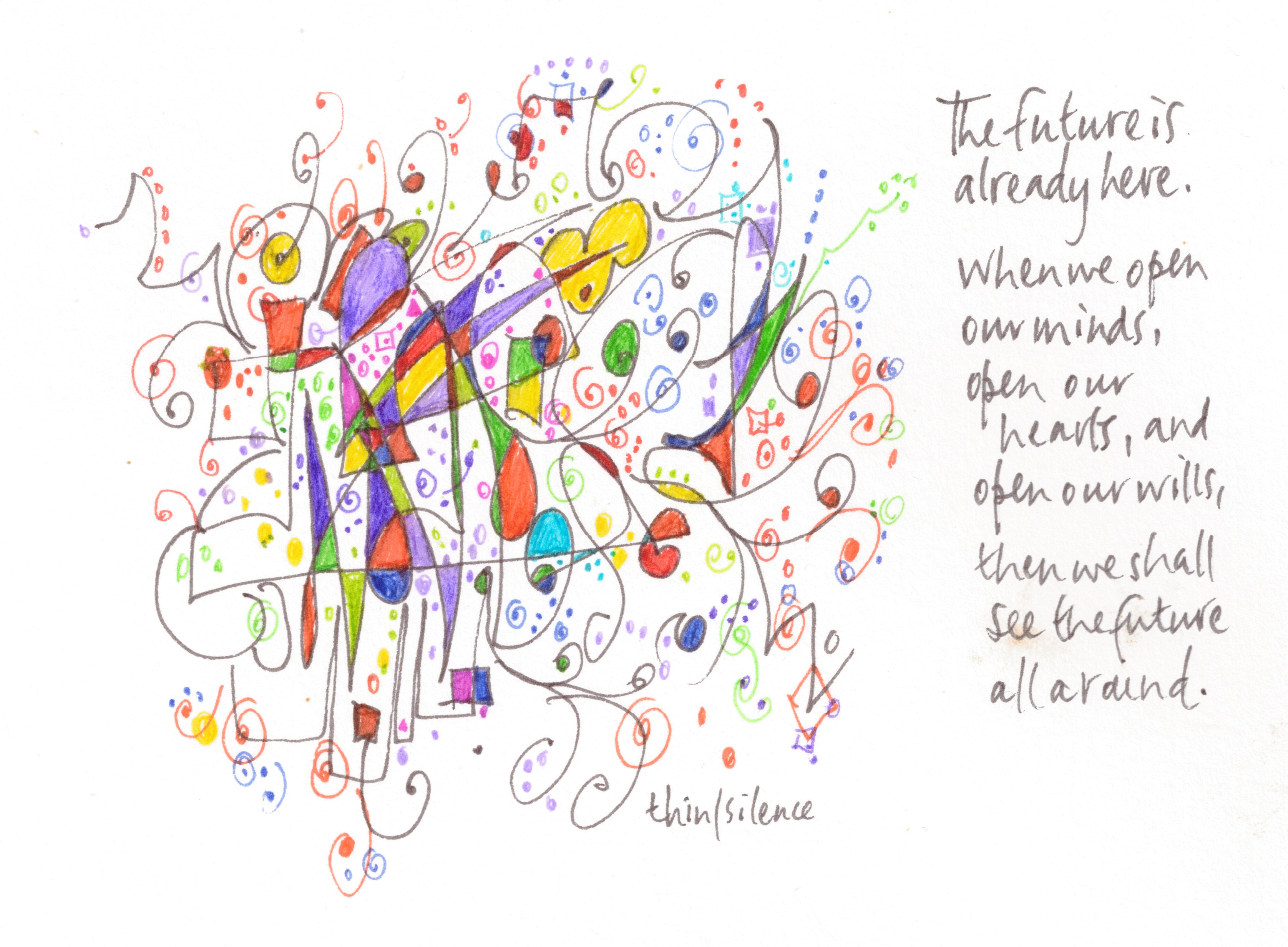
The future is already here

We are shaped by something which does not exist.

I’m rushing as I write.  Why?

I know I’m going to be heading out on a hike through the Pentland Hills in a little while – a 50th birthday trek for a friend.  And there’s loads to do first, so I’m rushing.

It hasn’t happened yet.  I’m just imagining it.  We are shaped by the future which doesn’t exist.

We can only live now, but we cannot live well now without the future.  And there isn’t just one future, there are multiple futures, which means there are multiple nows.

We are describing what it is to be Human.  As far as we know, we are the only species to see and understand life as past, present, and future; we are able to imagine what does not exist, but we can miss how amazing a thing this is.

The future is the fuel for what makes us feel more alive or engaged in our lives – autonomy (freedom and choice), competency (skills and mastery), and relatedness (purpose beyond ourselves) – we are people of the future.

The future is already here: when we look more closely and we open our minds, when we step into the worlds of others, when together we begin to see what the world can be and within this know what it is we must do, when we are willing to try and fail and keep trying, the future will appear amongst us and we will call it “Now”.

developing doubt and uncertainty

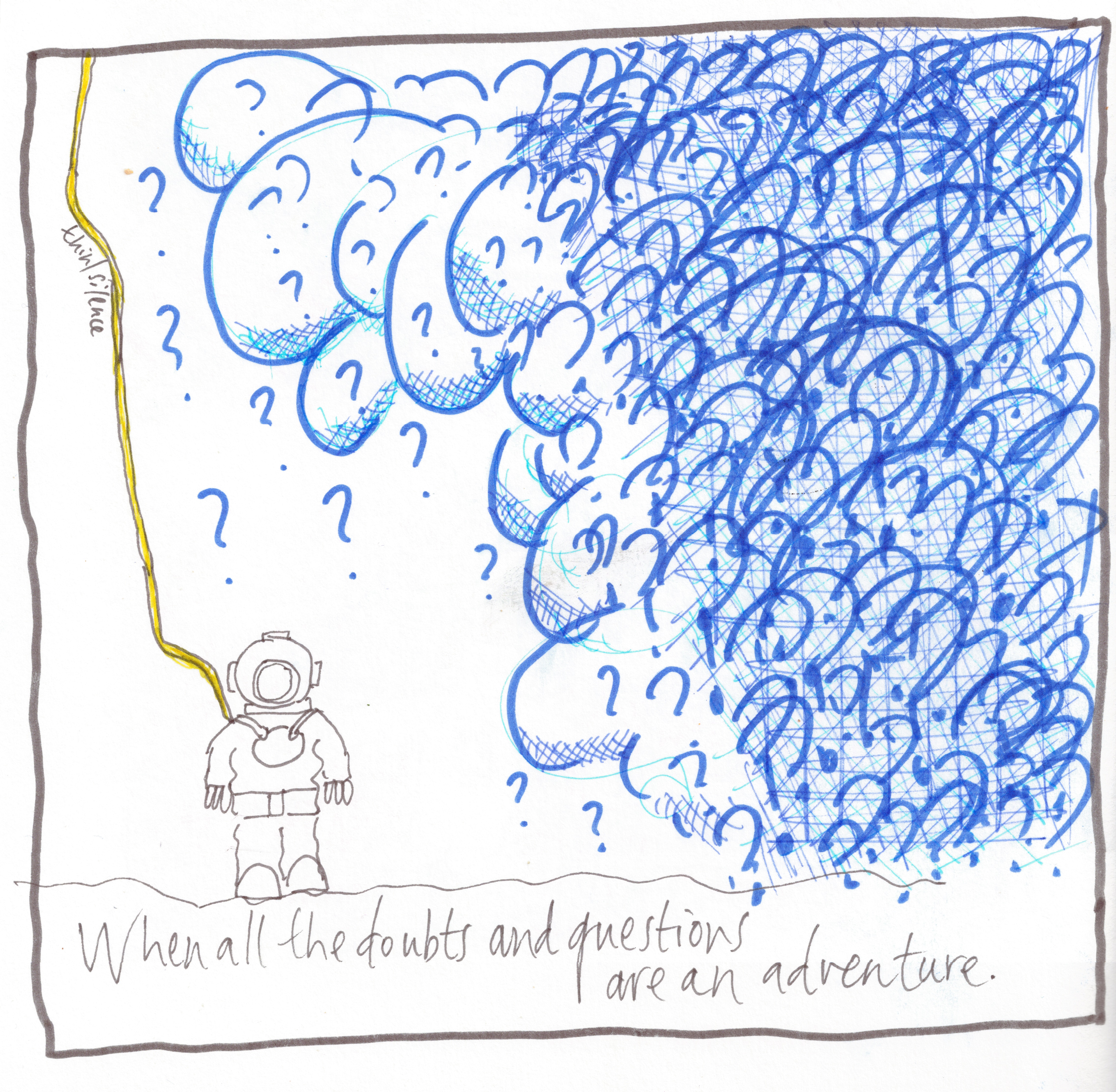
When all the doubts and questions are an adventure

It’s better to avoid having doubts and questions about your art,* right?

Wrong.  If you’re already producing and contributing your art,  doubts and questions become points of development and growth.**

I found myself coming away from an inspiring and challenging event last night, with many doubts and questions about my art, my work.  I won’t be ducking these, or passing over them quickly.  I find myself to be drawn deeper into innovation and will remain open to these doubts and questions as long as I can and as long as I need to.

This workout for the mind and heart makes it better for our art to get better, and, as with any exercise, there’s pain.

Stay with it.  We need your art to make a dent in the universe for good.

(*Art here is the creative contribution you must produce out of your life, out of your passions and skills.)

(**I’m not thinking of those who can’t get started or who find themselves unproductive – my answer would be different to you.)

two resistances

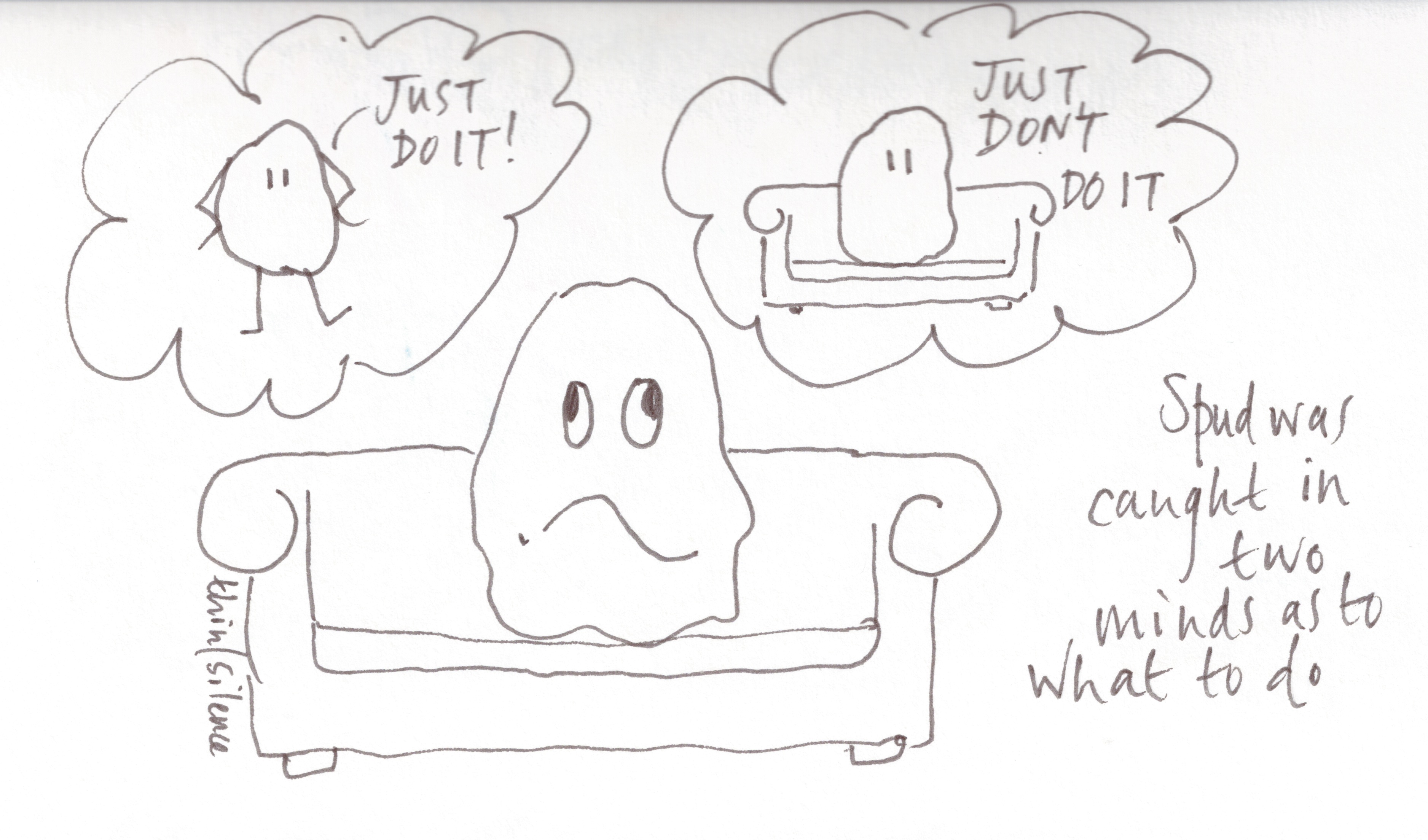
Spud was caught in two minds

As a Human, you’re meant for great journeys and challenges and adventures, beyond borders and boundaries, into greater connections with our world and universe, with others, and with your future Self.

It’s in your nature.

We know Mohandas Gandhi’s eponymous saying, “Be the change you want to see.”  He could say this because you are the change you want to see; this is what you’re made for.

The bad news?  There are two major resistances to overcome.  (The following is a little of the background stuff to what we face in life every day.)

You and me, we’re lazy.  It’s  just that we don’t know it.

A lot of the time we allow our information-gathering and storing mind and thinking to guide us – let’s call this our first-brain thinking.  Once upon a time it made sure we escaped from trouble and chose the right mate, and followed the food.  But we have a second brain – the one that uses all the information and takes considered decisions and calculations.  You’d think this Human attribute would make sure we make great decisions, and accomplish brilliant work.  What’s been found, though, is this second brain is lazy, prone to take shortcuts.  It wants to make judgements quickly.  It wants to avoid failure – putting more effort into reaching par, than going beyond it.  The good news is, it can be trained to be open, ask questions and deal with uncertainty for longer so we can make better decisions and go further.

The second resistance comes in the form of Human vulnerability to being controlled by externalities and made to feel ineffective.

If you don’t recognise your skills and passions, you’re vulnerable to the “tyranny of others” – what others think you should do and push you towards.  To know our skills and our passions – making it possible to connect with our future Self (therefore, to be the change we can be), provides us with the power to resist this control and tyranny, and even more.  When systems and people try to squeeze us to their way, we refuse to succumb, we maintain our integrity, and even more – using these experiences to grow, to be the force of nature we’re meant to be, each person around those things which fascinate and absorb us for a lifetime.

Follow your passions.

where sameness comes from

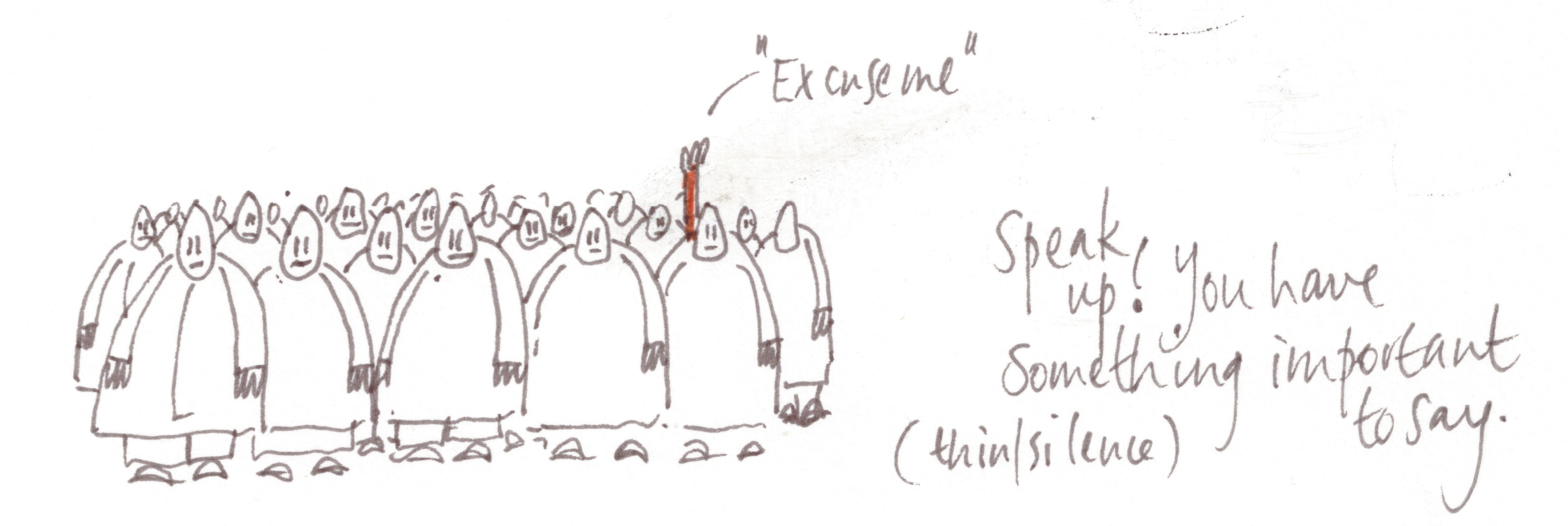
excuse me 2

When you remain quiet, perhaps unsure of who you are or how to make your contribution, sameness wins.

The same voices, the same ideas, the same votes, the same outcomes.

You know there is a cost to offering your opinion, your idea, your art, and the fear* keeps you quiet, hidden, compliant.

The antidote to sameness is found deep within you, the way you see and understand the world, the skills and the passions you have.

These last two – skills and passion – are really important.  Skills, or, competencies, aren’t enough on their own – we can be a competent puppet.  Having passion isn’t much good on its own either – it creates dust storms and when the dust settles, everything’s the same.  But when skills and passion get together, sameness better watch out.

Produce your art, put an end to sameness.  I’m excited to see what you do.

(Otto Scharmer mentions three voices we have to overcome: the voice of cynicism questions anything outside its small world- you’ve already overcome it; the voice of judgement questions whether you have anything to offer – you know your talents and passions; the voice of fear tries to stop you doing what you must do – now’s the time to jump.)

before you live

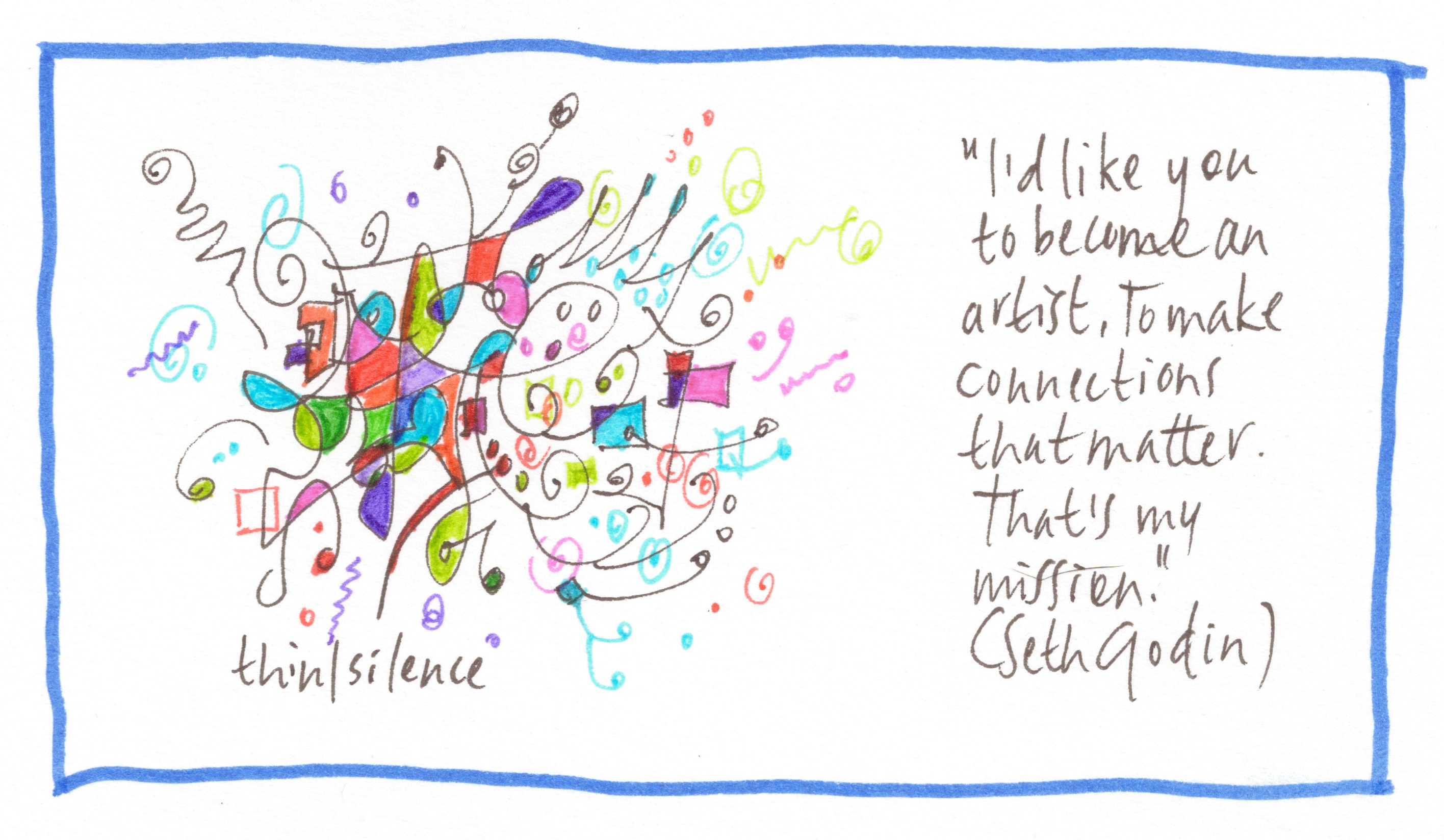
i'd like you to become an artist

Two opposing thoughts?

First thought: there were five elemental truths passed on in traditional imitation rights:

Life is hard
You are not as important as you think
Your life is not about you
You are not in control
You are going to die

Second thought: Humans have a great desire to live with freedom: to be autonomous, the develop competency, and to have a purpose.  This means living courageously (to do what we MUST for the sake of others); generously (to develop a pay-it-forward culture out of our “wealth”), and to live wisely (all we know, our skills, and our imagining of the future connecting up).

On the surface, these appear to be saying different things.  However, the intention of the elemental truths is to free up young people entering adulthood to die up front so that they are free to live as contributing members of their societies and cultures.  We shortcut these at our peril: when an Australian aboriginal boy was about to enter adulthood, the final rite would be to leave the village for a particular location where he would source flint and fashion an axe, which he’d then bring back as symbol of his contribution to his community.  When the British and Irish arrived, they distributed steel axes – I’ll leave it to you to imagine what this did.

But with this meaning of freeing, the five statements can be added to.  Here’re some possibilities; you’re welcome to add your own:

Life is hard but we can help one another
You are not as important as you think but neither are you unimportant and you have something unique to contribute
Your life is not about you but in focusing on helping others you’ll be more fulfilled and satisfied than you can imagine
You are not in control of many things but you are in control of your choices over who you are and what you have and what you do with these
You are going to die but every day until then you have an opportunity to live with creativity, enjoyment, and generosity

the myth of life/work balance

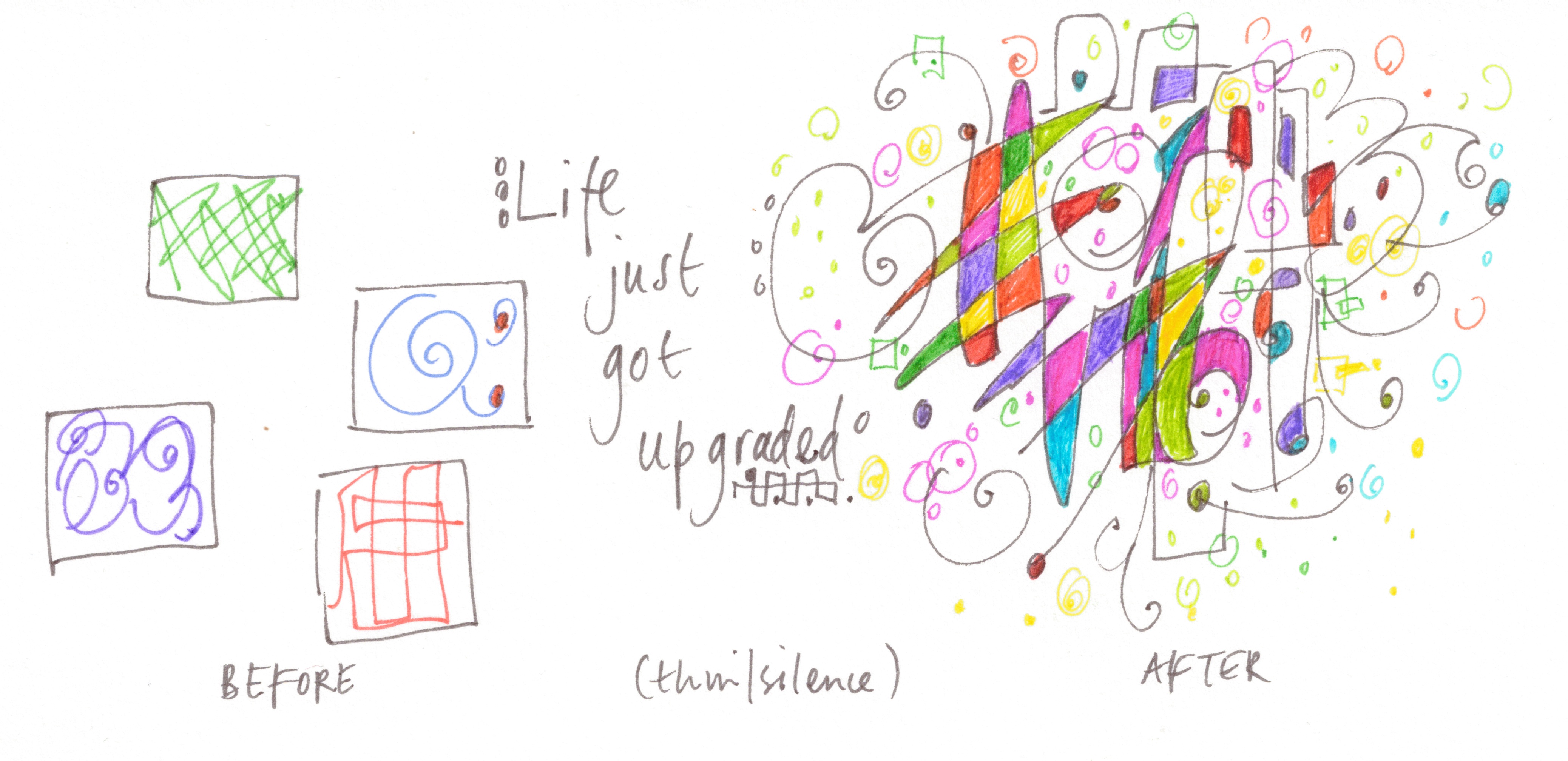
life just got upgraded

I don’t think life/work balance exists.   I offer two reasons from personal experience.

One: For sixteen years, I tried to make a particular job work.  I had three goes at doing this in this time but, if I’m honest, failed each time.  It’s now almost eight years since I left this behind.  In moments of weakness I sometimes miss being at the centre of everything, of knowing everything that’s happening and often having a final say in things – but I quickly get over it.  It’s all been replaced by pursuing the work* my life has been whispering to me about for such a long time.

Two: What we often mean by life/work balance is, the job we get paid for is put in this box, leisure time in that box, and so on … and then we patrol the borders.  But I love my work and I struggle to contain it within this box or that box: it’s simply life – ideas and energies and excitement come to me in different places and at unexpected moments and I need to respond to these (I do admit, I still have a lot of honing of this to do).

“Two” won’t make sense if you haven’t got “One” sorted out, but when you do you can begin what Mitch Joel calls “blending,” mixing up work and leisure and dreaming and resting and running and (well, fill in the rest).

Life has a rhythm, or rhythms, to it, more like a piece of music with fast and slow and rests and crescendos and whispers.

(*A definition might be helpful at this point.  By my job, I mean what I get paid for, a specific role.  By my work, I mean the art of creativity I produce (I think in terms of there being four major ways: creative thinking, creative relationships, creative influencing, creative actioning).  We may or may not be paid for our work, but it is the stuff we MUST do.)