wunderkammern

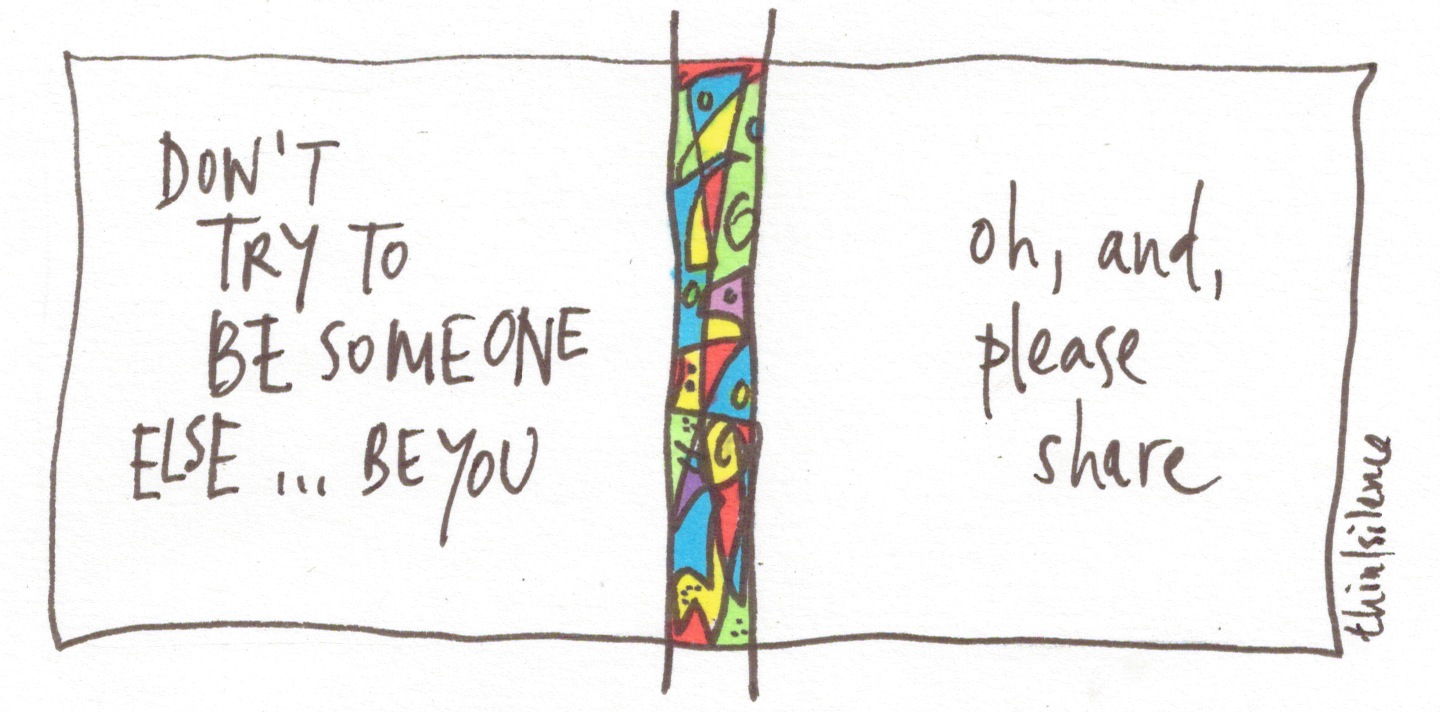
5 don't try to be somone else ...

Wonder chamber: a room or cabinet filled with the gathered objects and curiosities by the wealthy and educated 16th and 17th century European.

Every person is a wunderkammern, throughout their life capable of revealing* more of the wonder and uniqueness of who they are and what they have to contribute.  Not only a wonder to others but also to themselves – people are full of surprises and we need to keep surprising ourselves, too.

Some years ago, Christine and I were taken by some friend’s to visit collector Alex Jordan‘s eclectic House on the Rock in Wisconsin – a hideaway he built around a rock, and which grew and grew to house Tiffany glassware to carousels, ship’s propellors and gatling guns.  It is awe-inspiring and unnerving in equal measure (there was an orchestra of mannequins dressed up as celebrities, including Queen Elizabeth and Burt Reynolds!).  Jordan never intended the public to see what he was doing and collecting, and when some people began to ask how much it would cost to have a look around, he came up with an amount which was meant to turn them away.  It didn’t and he began to share his collectings.

It’s a great reminder for how we are all collectors of disparate and unusual and inspiring artefacts and thoughts, but we cannot keep them to ourselves, we must share them in new ways with others.  Austin Kleon writes:

We all love things that other people think are garbage.  
You have to have the courage to keep loving your
garbage because what makes us unique is the diversity
and breadth of our influences, the unique ways in
which we mix up parts of culture others have deemed
as high and low.

John O’Donahue asks his readers to ponder what life might have been like if they were born next door, how different our lives might be.

This brings out intriguing thoughts about how life is not as accidental as we think.  In some way, we were chosen into existence by our parents, directly and sometimes indirectly; these choices have a direct bearing on when and where and who we would be born to be and live.  With this comes a sense of destiny: ‘When you begin to decipher this, your gift and giftedness come alive.’

This is more about deciphering forward, unravelling the future, rather than saying this is what you have to do (because you were born when and where and who you are).  This is about who and what we are becoming, a revealing of our future Self (never fully known): a destiny formed of decisions from our future, not our past.

Humility, gratitude, and faithfulness then become primal attitudes or practices for us towards this destiny.  I am chosen but not because of anything I have done but for the possibility of my unlived future.  I am grateful to others that I am – I had nothing to do with this; and, I have the freedom to create and make something with all of this.

I am grateful to Austin Kleon and John O’Donahue for their thoughts, which I’ve now collected in my  wunderkammern.  By the way, this wunderkammern experience is on loan for maybe eighty years.  No pressure.

(*John O’Donahue points out that ‘the word revelation come from re-valere, literally to veil again.  ‘Behind each human face there is a hidden world which no one can see.  Interesting, we catch glimpses of more in each others lives but never see the full picture.)
mindfulness

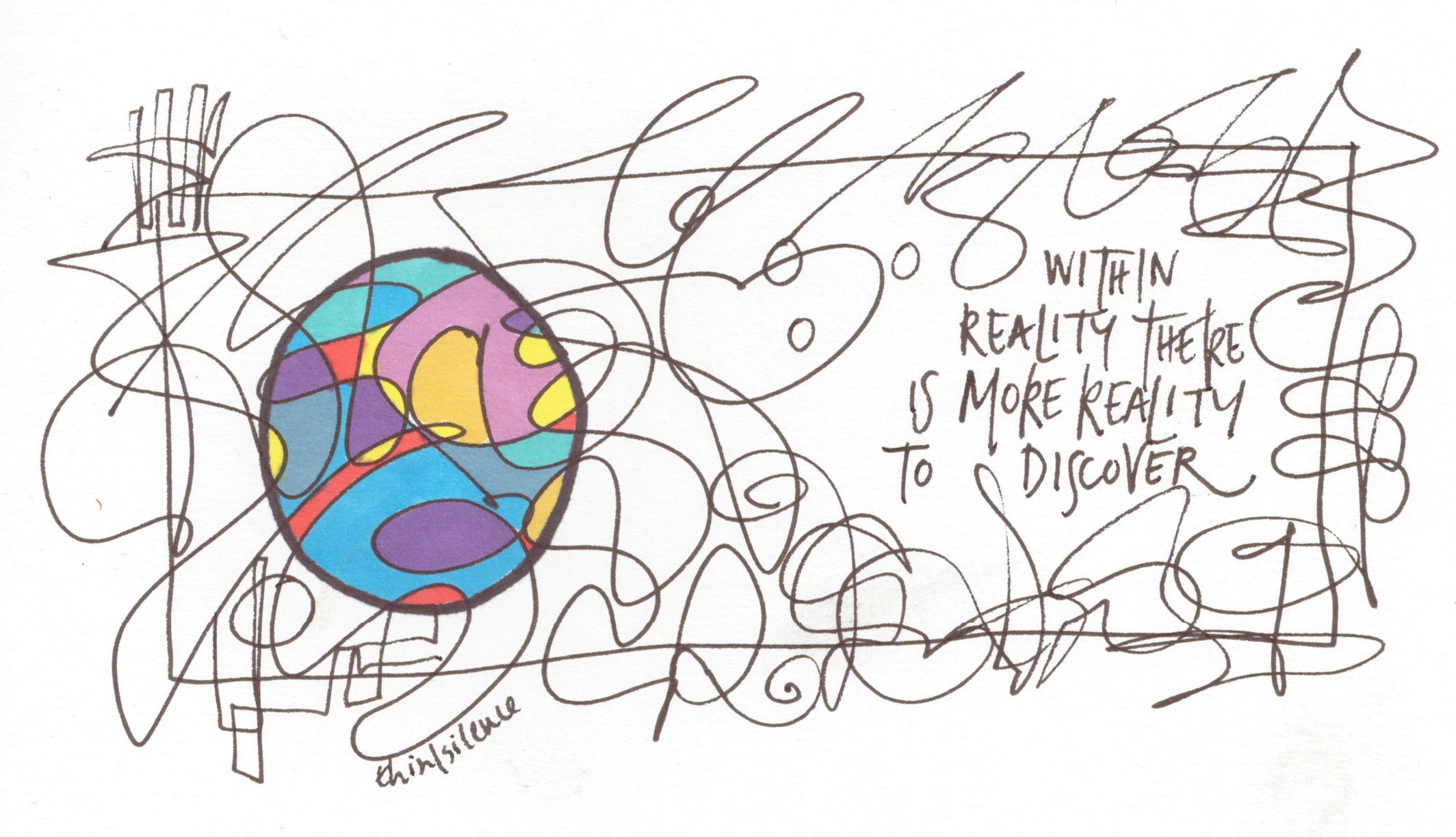
4 within reality ...

A definition of mindfulness for the purpose of this blog: to be increasingly open and connected to the Other – people, the world, our future Self – through all our senses.

There is a moment in the Star Trek movie Insurrection,* when Jean Luc Picard is arrested by the magic of a moment as seeds are lifted on the breeze by a breath as time appears to stand still.

These moments are always available to us through mindfulness, reflection, presence, meditation – whatever we may term or mnlabel it.  We forget this in the rush and necessity of daily life, but it’s always there – life’s gift to us.  Waiting to be entered into, a reality within a reality, to then be carried into the speed and demand of a day.

Perhaps we need the poet and artist and filmmaker and storyteller to capture this most sharply for us.  Activist and author Jane Jacobs didn’t see the cram of buildings in her neighbourhood, rather she saw ‘a vessel of empty spaces in which people interacted with other people.’  Jacobs saw a dance; we can all be involved in the dance, a different way of seeing the invisible city, and the invisible life.

There’s a hugely valuable game for improv (theatre and comedy): “yes and”.  You cannot say “no and,” “no but,” or “yes but.”  You have to say “yes and” and see where it leads you and the one proposing.  This recognises life is best played as an infinite game.

When have you been arrested by something which has caused you to wonder for a moment – an image, a story, a film, an action, take it as an impro moment: “yes and.”  You can’t say “no and,” “no but,” or “yes but.”  You have to say “yes and” and see where it leads you and the one proposing.  

(*Check out moment “3” in this youtube video.  As with many sci-fi movies, we are exploring what is available to us right now through the lens of the future.)


wide listening and thin silences

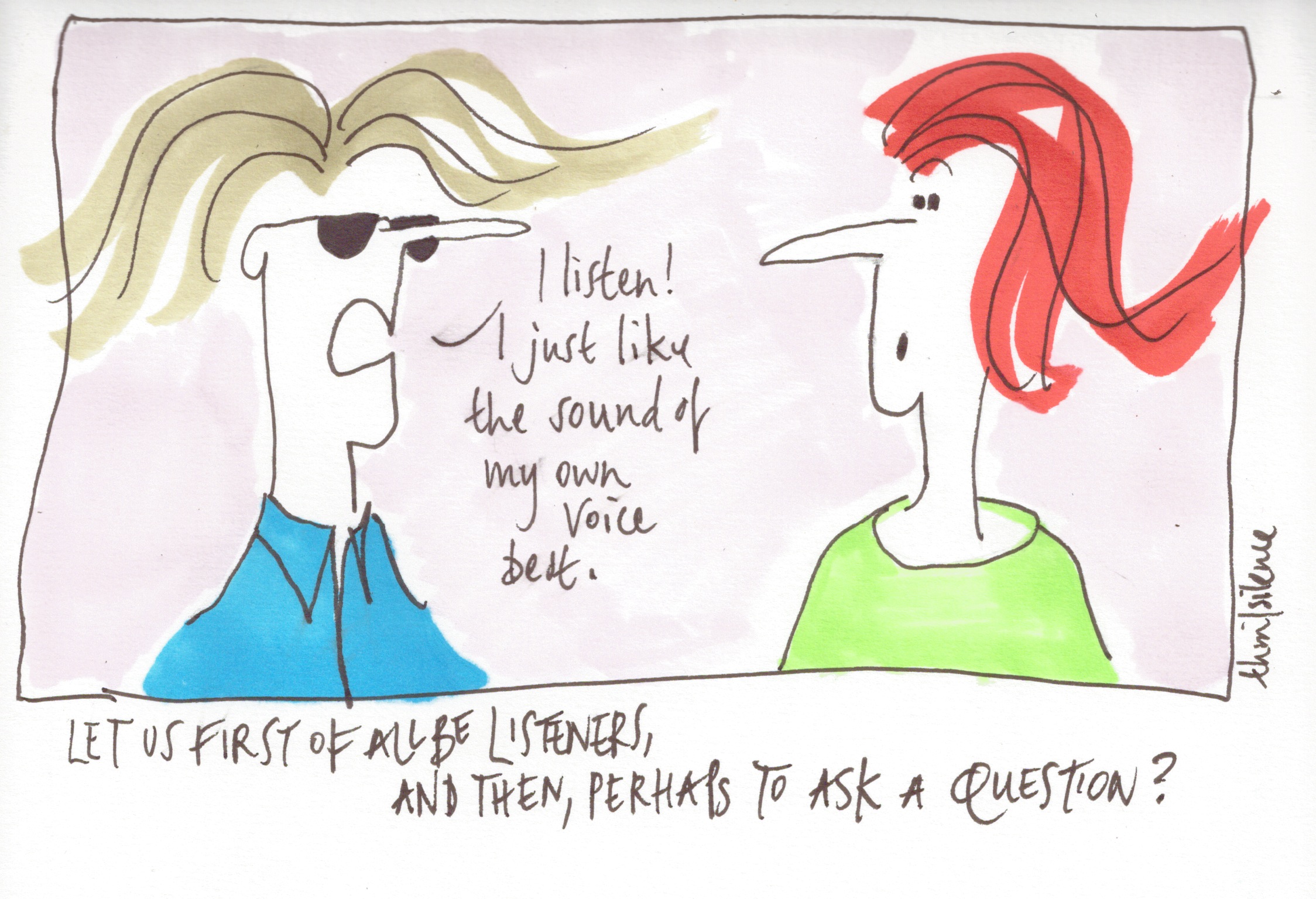
3 may we first of all be listeners ...

Our senses are wider than we imagine, the means by which we cross thresholds into each other’s worlds, into the world, into our future Self, and, if we have a god, into our god too.

The wide sense of listening not only allows us to hear the sounds but also the silences which exist between the sounds.  These words from John O’Donahue caught my attention when I came upon them at the birthing of today:

All good sounds have silence near them, behind and within them.

Do you listen for the silences?

In a conversation shared with a friend, each is listening to the silences within the other?

When the sounds of traffic and manufactured things abate and the silence of nature breaks in, listening to you, its child?

When all the talking inside your head ceases and you lean into the thinness?

When the bad noise fills our lives to excess we are aged before our time.

But if we can catch the silences and learn the new things which come to us, tee might find ourselves renewed, able to renew others through our listening to them.

This wide sense of listening is slow, or deep.  It mustn’t be hurried because there’s something else to be listened to.  How many times have we misunderstood another, or undervalued nature because we have not slowly listened?

Whilst this may all sound magical or mystical, truth is, it’s all held in small habits which we form – and which we love – in ways we are able to inhabit daily.


whatcha looking at?

6june

Something visible and you’re need to focus on?  You can’t look up, no distractions

Or maybe something invisible you’re trying to find?  This might help.  Here’s a camera which makes the invisible visible.  Except you need to know where to point it and you don’t always know which way to look.

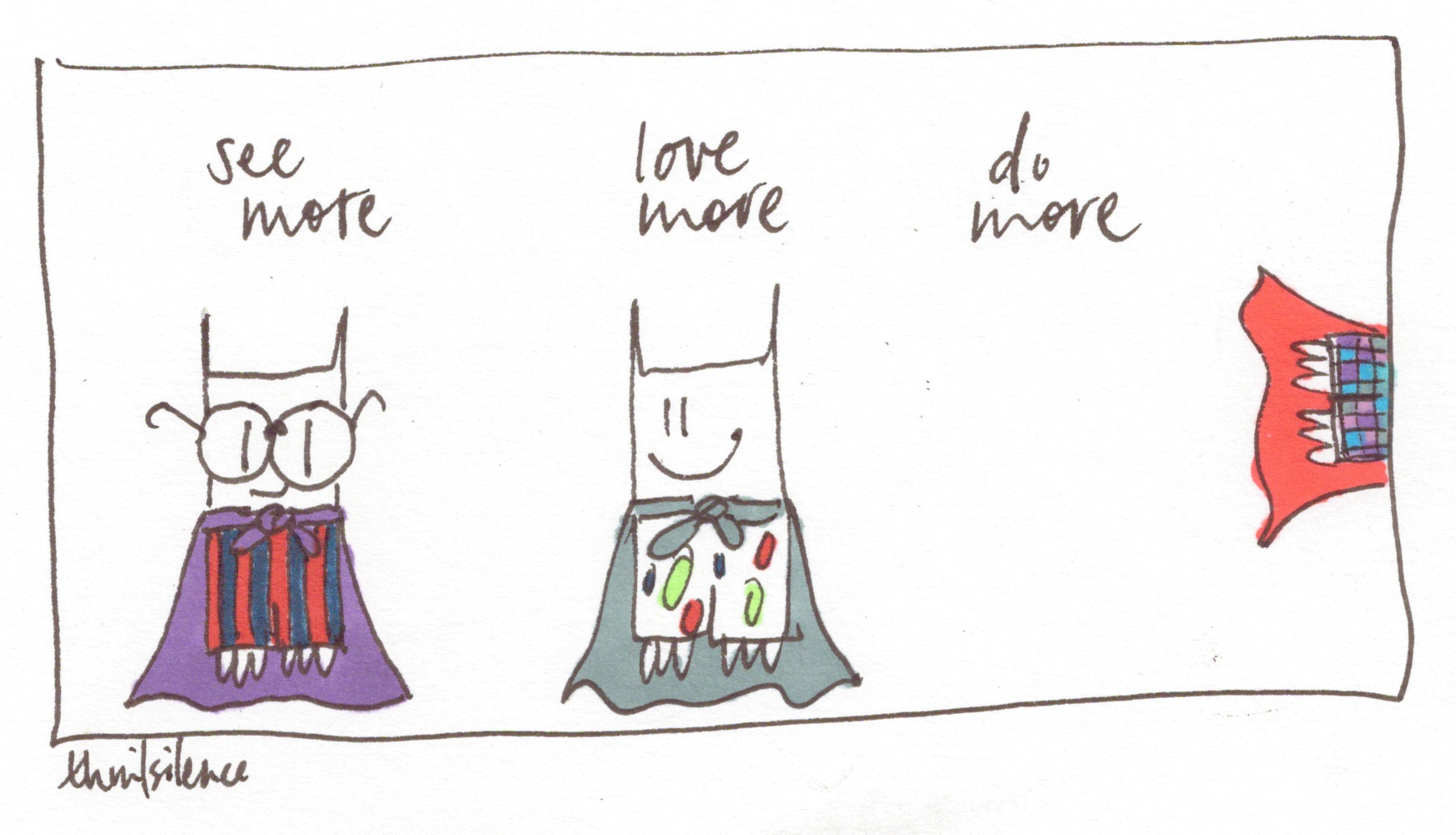
When we’re looking at something, we’re not looking at something else.  No-one can see everything all at once.  Take a walk along your street and see how much is real but you do not “see it,” being on the periphery of your vision.  You’d have to turn towards it in order to see it.

What if we are walking through life and missing a whole load of things which would change the way we live our lives?

There’s always been so much to see; we simply have more ways of seeing everything now, and all of this is delivered through people.

We often need others to see more things – including the things which are right under our noses.  And life just seems to get bigger when we invite people into our lives who don’t see things the way we do.  We’re exploring more and more ways of becoming visible to each other – through online and onsite means: Facebook, Pinterest, Twitter, LinkedIn, Meetup, Tumblr.*

We’re still playing with these but they promise greater seeing; Austin Kleon makes the plea: ‘Don’t show your lunch or your latte; show your work.’

At least show me your work as well as  your latte, because it may just help me to see something that excites me, it may just help me to stop focusing on something that is taking up too much of my attention making me miss something more important.  Sometimes we need to be distracted.  As Seth Godin would want to remind us, the future is connected.

There are at least three ways of seeing:

I can see and understand something more … but I’ll likely forget a lot of this and it won’t shape my life.

I can see something deeply by feeling it … something excites and it becomes part of me.

I can see and feel and see what I must do with it… and then I can show what I have made to you.

To the loving eye, everything is real.

 (*Just today I received a request from someone through change.org, asking me to sign a petition for recognition and commemoration of all those who lost their lives in building the football stadia for this year’s World Cup.  The daughter of one of those killed says nothing was offered at the opening to remember them.  I remember the story vaguely from some time ago of the roof at Sao Paulo’s stadium collapsing, but this brings it all closer to home; you can sign the petition here if you wish.)


(more) invisible lives

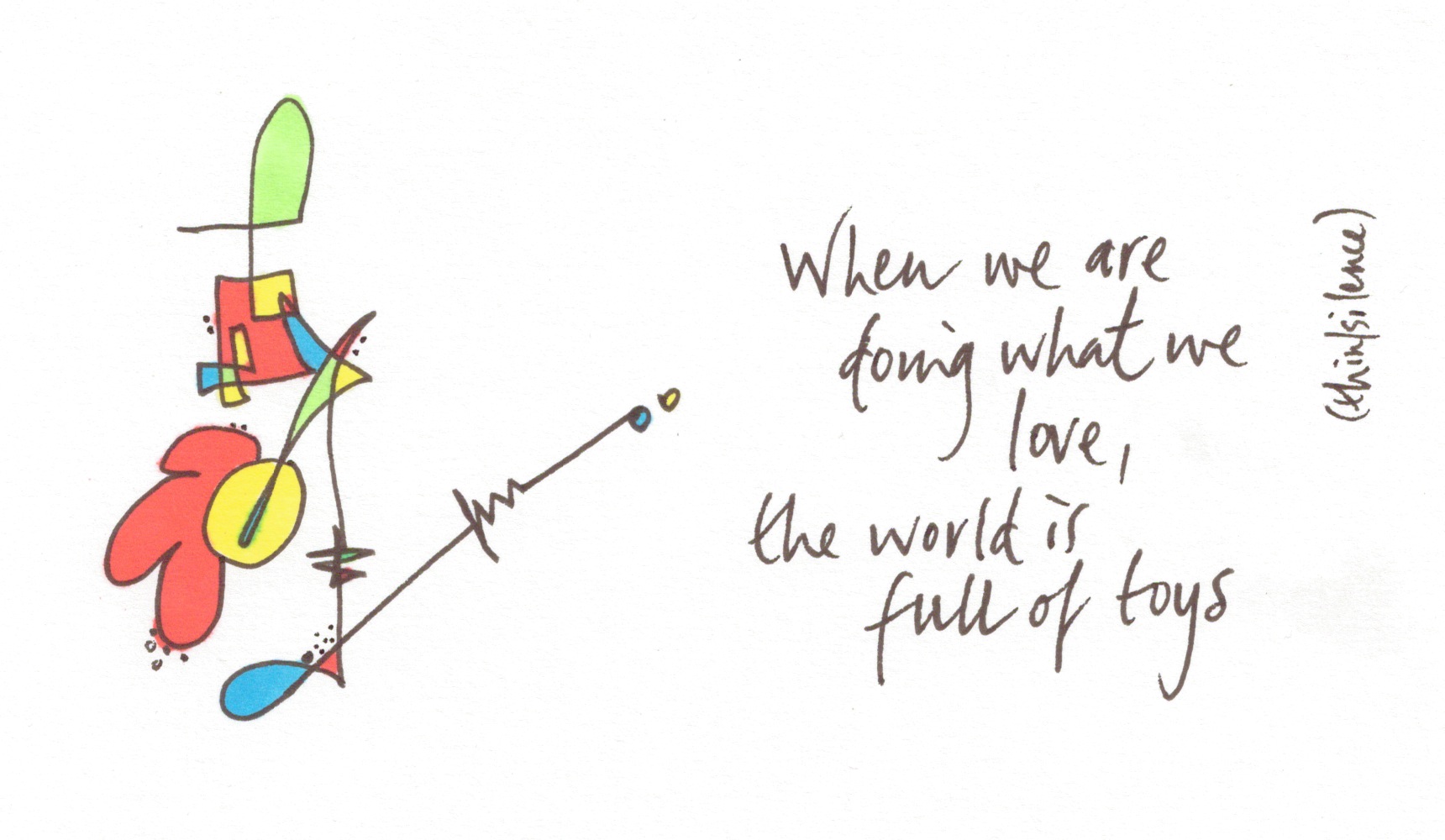
1 when we are doing what we love ...

What if there was a city in which it was possible for us to pursue our dreams, to live out the natural rhythms of our lives full and strong, being fully present to one another, our world, and to our future Self?

We’d probably want to move there – city of opportunity.

Avatar audiences could be heard remarking on what an amazing planet Pandora was – not realising this amazing planet was Earth.  And the city we’ll be able to live out the fullness of our lives in is most likely the one we are already living in.

Our journeys to other places and cities, whether in movies or life, are a kind of pilgrimage, helping us journey deeper into our own life and context, not apart from the difficulties and challenges we face in life but a part of them.

It is in this journey that we become.

It isn’t a fictional journey but a daily one.

In the offering of something to someone, out of each one of our days, we only discover more of what we can be and what we can do.

Austen Kleon encourages such a sharing of something small from every one of our days:

Focus on days.  The day is the only unit of time that
I can really get my head around.  Seasons change,
weeks are completely human-made, but the day has
a rhythm.  The sun goes up; the sun goes down.  
I can handle that.

What will it be today?

sweat it

30 no one flies all the time 1

When it comes to creativity, popular culture can offer a picture of gifted people being inspired and followed by a swoosh of activity to produce what they have in mind.  Thinking it doesn’t quite look this for us, we don’t follow the ideas we have and the energies we feel.

We see the product but not the process of blood, sweat, and tears.

When we give ourselves to the graft of process something very beautiful can emerge.

Italo Carvalo tells the story of Fedora, a city in which there is a museum wherein each of it’s rooms there is a glass sphere containing someone’s dream of what the city might have become – ‘the ideal city, but while he constructed his miniature model, Fedora was no longer the same as before.’

What if this were a picture of our lives, a museum of rooms containing missed opportunities for living out the things we have dreamed about?

What if, instead of creating perfect little models of what would have to be to begin, we go ahead and create the real thing in some little and imperfect and incomplete way?

Whoever it is who inspires you, behind the products of their creativity will be found sweat, desperation, blank expressions, frantic activity, all contributing to the process which eventually ends in some scrubbed, highly coloured and glossy, boxed something or other.

Every morning, I get up early, hide myself away to read and reflect and journal: paper and fountain pen, trying not to come to conclusions, trying to let whatever may come emerge from the spaces between many books and scripts and thoughts.  Then, before the urgent things of the day, I force myself to write some extract and abstract into a “new post” for my blog.  I press the save button and walk away to begin thinking about some cartoon to accompany it, gt on with other work – emails, “to-do” lists, and then, later in the day, a third attempt to write something, include the cartoon, and press “publish” (which is just a grand word WordPress uses to make me feel better).

I have no delusions about what I am doing, it’s simply my challenge not to not do anything.  It took me to 54 years of age before realising I need to sweat it to push forward something I love, and each day to repeat.

A year ago, I scribbled out the following thought in my “Backlog” (ideas I might come back to).  I’m indebted to Hugh Macleod for unknowingly pushing me to blog and cartoon about the stuff I love.

30 backlog

Here are some helpful reads from my ra-ra! cheerleaders (in addition to those you’ll find hyperlinked in my posts – gratefulness flowing to all of them):
Ignore Everybody by Hugh Macleod
Poke the Box by Seth Godin
Accidental Genius by Mark Levy
The Writing Life by Annie Dillard
Bird by Bird by Anne Lamott
Steal Like an Artist by AustinKleon


invisible lives

29 slow

John O’Donahue tells the story of a journalist who wanted to interview a native South American chief.

Before acceding to this request, the chief asks to have time for the two to be together beforehand.  On meeting he begins to stare intently into the journalist’s eyes.  At first deeply unnerved, the journalist enters into this deep gazing and for two hours the two look upon each other in silence.  The interview then didn’t needed to follow.

O’Donahue makes the intriguing allusion, ‘In the human face, the anonymity of the universe becomes intimate.’

We are the strangest of animals thrown out by a universe which appears to be accidental in nature: the Human face looks out on the vastness of the universe and ponders the “infinity of interiority” amongst the many infinities of the macroscopic and the microscopic, many worlds and universes.

It is perhaps in the coming to see and understand these worlds we find in one another’s lives, we come to see and understand our own life.

Italo Carvalo has his two characters Kublai Khan
and Marco Polo at the end of a day ‘silent, their eyes
half-closed, reclining on cushions, swaying in hammocks,
smoking long amber pipes,’ each in a train of thought,
sometimes meeting across a presence they inhabit together.

Polo has been describing to the Khan the cities he has visited which turn out to be one, or one part of a city where he was born (I share this at length because it’s a lovely, illuminating passage):

Marco Polo imagined answering (or Kublai Khan imagined his answer) that the more one was lost in unfamiliar quarters of distant cities, the more one understood the other cities he had crossed to arrive there; and he retraced the stages of his journeys, and he came to know the port from which he had set sail, and the familiar places of his youth, and the surroundings of his home, and the little square of Venice where he gambled as a child.

Can it be, in the meeting of many new lives into which we gaze intently, we come to know and understand our own life?  If it is so then it is a strange thing, in a universe as cold and indifferent as we believe ours to be, there should be found such shocking warmth and intimacy – hardly yet explored.

Arriving in each new city, the traveller finds again
a past of his he did not know he had: the foreignness
of what you no longer are or no longer possess lies
in wait for you in foreign, unpossessed places. …  
“Journeys to relive your past?” was the Khan’s question
at this point, a question which you have been formulated:
“Journeys to recover your future?”


life after death

28 elemental rule 5

Austin Kleon admits to reading obituaries each morning: ‘Obituaries aren’t really about death; they’re about life.’

He’s making sure he does something half-decent with his life, like the people he’s reading about

Many people who’ve had near-death experiences tell of how different life looks like afterwards, how they’re going to make the most of it – the old obstacles won’t get in the way, what people think no longer matters.

I was reminded of when I went to swim at a pool – a euphemism for something extremely inelegant on my part – and, not being a very good swimmer, panicked when I couldn’t touch the bottom of the pool. I began floundering but no one noticed; I didn’t want this to be “it” and somehow struggled my way to the edge and pulled myself out of the pool – still no-one had noticed (I like to think someone eventually would have noticed).

For some time afterwards everything seemed sweeter.

Life after death.

In ancient rites of passage, one of the elementary truths a youngster faced would be: You are going to die.  The thinking was, they would face death upfront and then live life fully  as a contributing member of their society.

We get to live one life; the trick is not to waste it.  Whether we read obituaries as a way of having near-death experiences or we write one for our own life,* or we get really focused from the first moment of the day around what it is we must do to make a difference, what if we train ourselves to be life-after-death people who make it possible for others to live again?

Here are three questions which make me wonder more:

Who is my song for?
What is my question?
Where is my itch?

When you make a dream come true for yourself,
it’ll be a dream come true for someone else too.

(*You might want to try a ten-minute writing exercise, when you time yourself to create your own obituary, imagining the things you;d most want to be said about you, or, go to the future and write a letter to yourself in the present, about how your life has changed and what you are doing.)

blank spaces

27 lots of blank spaces ...

The unknown areas displayed on maps were once filled with images of fearsome creatures but then came Jean Baptiste Bourguignon and his companions, and, ‘a blank on a map became a symbol of rigorous standards; the presence of absences lent authority to all on the map that was unblank.’

The blanks became spaces for exploration; as it were, spaces to believe in and then to see.  There are in existence more blank spaces than you know, spaces you can explore and make the contribution only you can make, and they may be under your nose, .

Austin Kleon advises, ‘Find a scenius, pay attention to what others are sharing, and then start taking notice of what they’re not sharing.  Be on the lookout for voids you can fill with your own efforts, no matter how bad they are at first.’

Between all the things that are happening, because of the efforts and skills of others, there are blank spaces for you to fill with that thing you do.  When you believe in them, you will begin to see them.

Don’t try and copy what others are doing, then: do what others are not doing.


you love more, you win

26 you're a absolute amateur

These are “Ahmad’s” words; he lost everything, including his restaurant, in an Israeli airstrike on Beirut in 2006.  Now forced to work in someone else’s restaurant, he’d just been asked if he was bitter and angry at someone.*

He repeated his reply in his broken English, “You love more, you win.”

If he’s right then maybe we can turn this around: You love less, you lose?

I don’t want to cheapen the context in which these words were spoken, but I think Ahmad is right on many levels.  Ahmad is grasping the beauty of the infinite game: to include as many as possible, to keep the game open-ended (who knows where it will take us … and then more), and when the rules threaten to exclude or end the game, change them.

To love more, is to be able to love more, is to be able to love more.

We’re in need of open-ended games or journeys or story to know more of what we are capable of, and capable of together.  Since learning of the Johari window‘s fourth “window-pane” (“Pane 1” – What I know about myself and like to reveal to others; “Pane 2” – What I know about myself but conceal from others; “Pane 3” – What I don’t know about myself but others do know) has intrigued me: What I don’t know about myself and others also don’t know.  I’m wondering whether these things only begin to emerge through the unfamiliar and the stranger – liminal people and places in which we help and support each other to discover more about one another and ourselves (including our future Self) more – everyone is blind to something about themselves.

Our means of venturing into this unknown is often what we love.  Here, though, I don’t want to do wrong by Ahmad, but to do more of what you love is to win.

Amateur is French for lover, Austin Kleon‘s definition fitting really well in our infinite game: ‘Because they have little to lose, amateurs are willing to try anything and share the results (David Weinberger comments, ‘The new abundance makes the old abundance look like scarcity’).  Amateurs (meaning lovers) are delivering more creatively than professionals (think Steve Jobs, Steve Wozniak, and the Homebrew Computer Club over IBM, or my friend Julie Dodsworth over Royal Doulton, or BrewLab over Starbucks).

There has never been a better time for you to pursue what you love.**  Leah Robb’s triangle theory of art suggests craftsmanship, substance, and innovation are important elements for delivering great art – and they’re all available to the amateur in just about any field.  The means to develop skills, to connect with others, to deliver what we create has never been so available as now, and everything suggests these will only increase.

The shortage is in people willing to do it.  To
take a leap. To walk onto the ledge and start.

You love more, you win, as Ahmad said.

(*”Ahmad” also works as a loan officer with Al Majmoua (“the Group”), a partner organisation with micro finance charity Kiva, seeking to help rebuild the lives of others whilst also rebuilding his own.)
(** There are many things which the amateur probably is not able to pursue easily: you’re not going to pursue your ideas about the Higgs Boson without access to the Large Hadron Collidor.)