cities and scenii

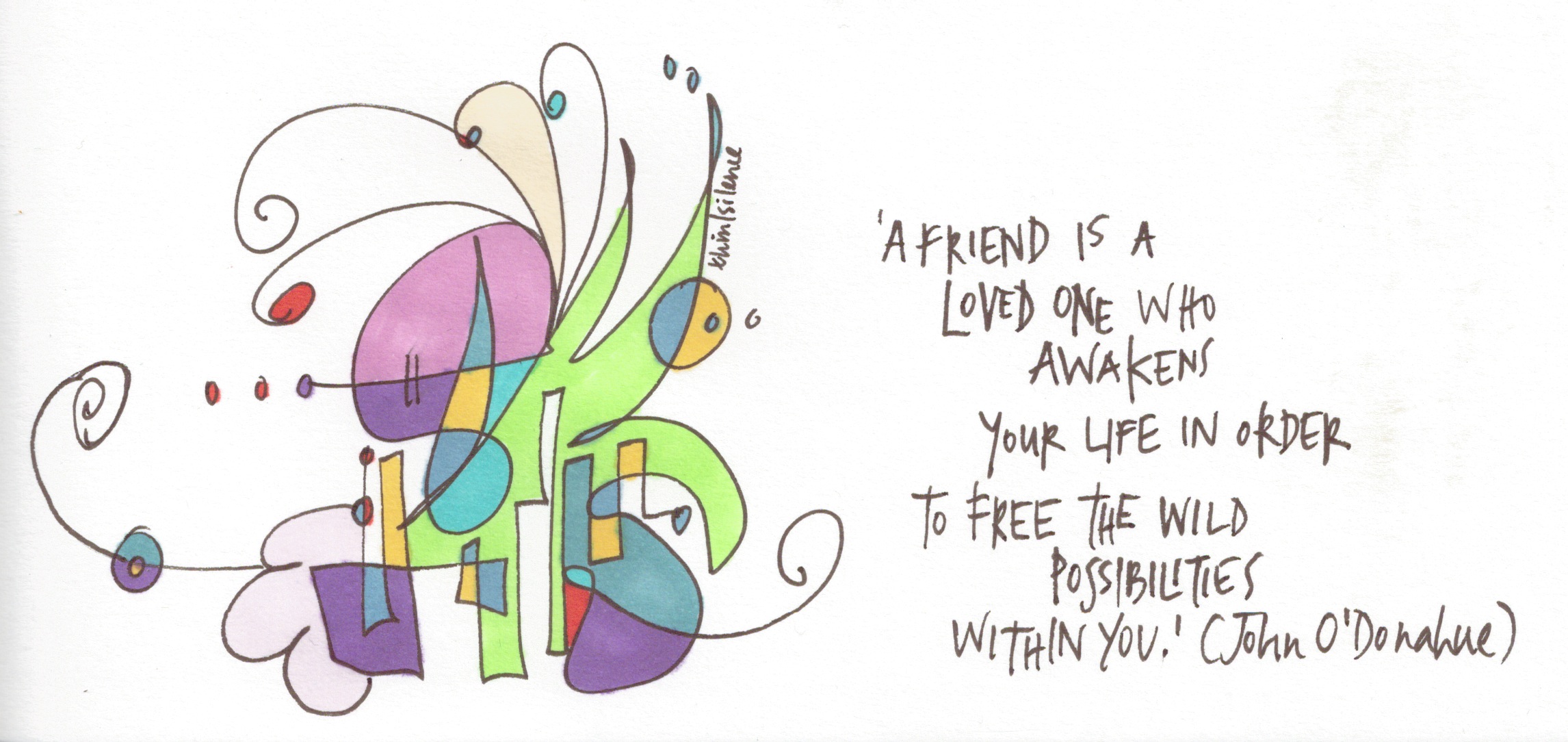
25 a friend is a loved one ...

Scenii?  Is this the plural of scenius,* Brian Eno’s word for ‘a scene of people supporting each other – a mini-city of sorts.**

Invisible Cities is Italo Carvelo’s masterful tale of Marco Polo‘s descriptions to Kublae Khan of many cities, gradually revealing the one city he is revealing again and again to be Venice.

That a city is not one story but many is true for all cities.^  A city can be described over and over again, each time differently – thin-sliced as another story, rich and telling, even to the point where it becomes your story, where you are the city.  What I’m trying to say is that your story, your contribution is important.  Whether we call it scenius or city, this is an environment in which your way of relating, of seeing, of thinking, of doing, is important – there are no strangers in a city which understands itself in this way:

The stranger does not come accidentally;
he brings a particular gift and illumination.

We each have something to contribute which another do not.  A scenius begins with two people – so you can be the founding mother or father, welcoming and encouraging the contribution of everyone who brings their gift.  Then there is yet another story of the city, the place, in which you live.

A scenius can be anything from people coming together to explore the idea that everyone has something to share, through to people working on projects in parallel or a project together.

Time to tell another story of the city.

(*The plural of genius is genii, so I guess this may be right.)
(**David Weinberger’s Too Big To Know is a fascinating look at how we have come to know what has always been true: there is too much to know – now the “smartest person in the room is the room.”)
(^I use the word city to describe how people decide to live in close proximity to one another, rather than a densely populated conurbation.)
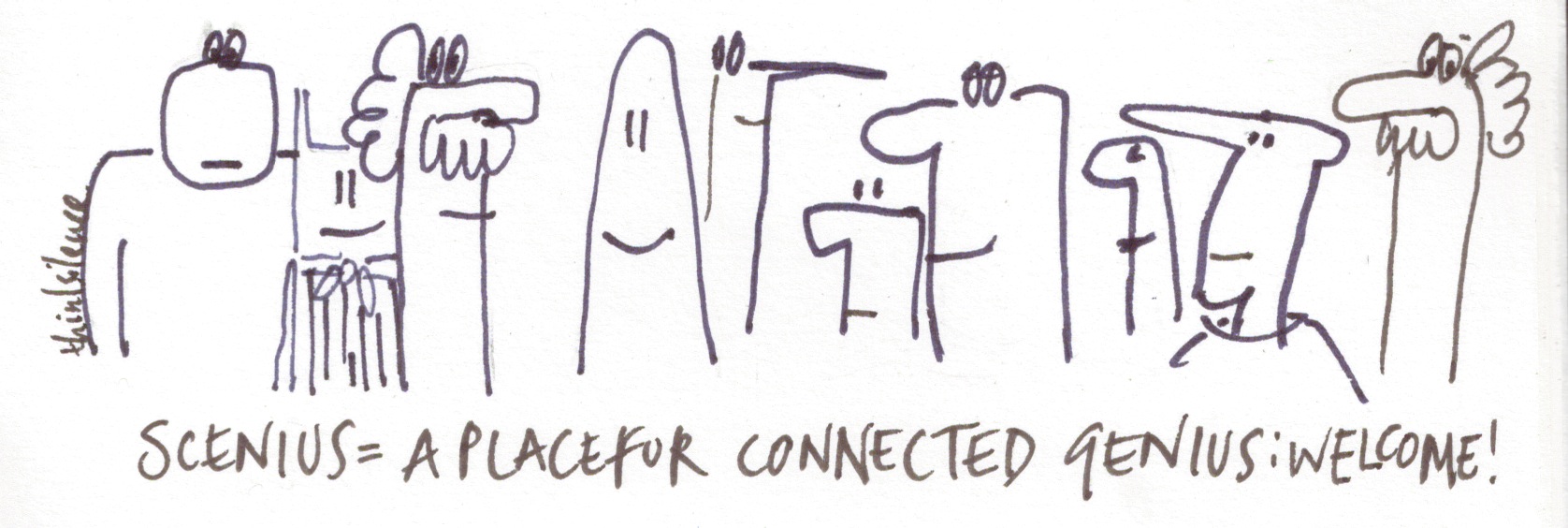
scenius

24 scenius ...

This is Brian Eno‘s word for where genius lies – not in the individual, but in ‘a whole scene of people who were supporting each other, looking at each other’s work, copying from each other, stealing ideas, and contributing ideas.’

Whether acknowledged or not, every “genius” of mythical proportion has some kind of scene of people.

Scenius requires openness – openness towards ideas, towards others, and towards what we can contribute (action) within, or as a result of, the scene.

Another word for openness is awareness: to be aware of what we have been previously blind to.

Another word for openness and awareness is presence: open and aware in ways which allow deep connection.

The first hurdle is to see and understand there is more than we see and know – we have to suspend our usual ways of seeing and understanding.

The second hurdle is to see and understand the Other, through whom we can see and understand more.

The third hurdle is to put into action what we are experiencing as change within.

Everyone and anyone gets to be included in a scenius, even geniuses – it is an infinite game.

The alternative to openness and awareness and presence is to miss out: ‘Sadly, it is often loss that awakens presence.’

the future is (more) connected

23 i still peel a banana ...

With literacy came letters and postal services.  Then the telegraph came along and telegrams passed urgent messages to and and fro; the telephone followed soon afterwards and reduced the costs and urgent messages were overtaken by people phoning up for a chat (and if you couldn’t have a phone in your home, there was one on the street corner).

Even if we were to pause here we might conclude: Humans love to be in touch, and turn whatever method of communication into a means of connecting.

But then came the internet and the world wide web – and we’re just beginning to discover what we can do with this.

Yesterday I was listening to someone in their seventies describe how she was being taught to use a computer she’d been given – she didn’t really want it.  She was delivering a brilliant stand-up comedy routine on the arguments she was being fed for messaging and using Skype.  Fair to say these weren’t very good, much like the efforts to take any kind of picture on a new camera just to be able to use it: the coffee table, the half-drunk cup of tea, the disinterested cat licking its bum.

This scales up into having hundreds of friends on Facebook (Facebook knows we’ll only connect with a small group regularly*) and a race to get to 100, 500, and 10,000 followers on Twitter, but we love connecting and something quite astonishing promises to emerge from this, ways and means of delivering courage and generosity.

John O’Donahue offers:

Though the human body is born complete, the human
heart is never completely born.  It is being birthed in
every experience of your life.  Everything that happens
to you has the potential to deepen you.  It brings to
birth within you new territories of the heart.

We already know there’s more information in the world wide web than we can deal with, but beginning to appear are connections of hearts, like-hearted people finding each other and dreaming of making a difference in a world of need.

We have another way to do what we’ve always wanted to do as a species: connect.

(*’80 percent of our phone calls are to the same four people’.  It’s the way the groups of friends form which is interesting – friends, friends’ friends, friends’ friends’ friends.)


tribute to friendship

22 okay … better … boom

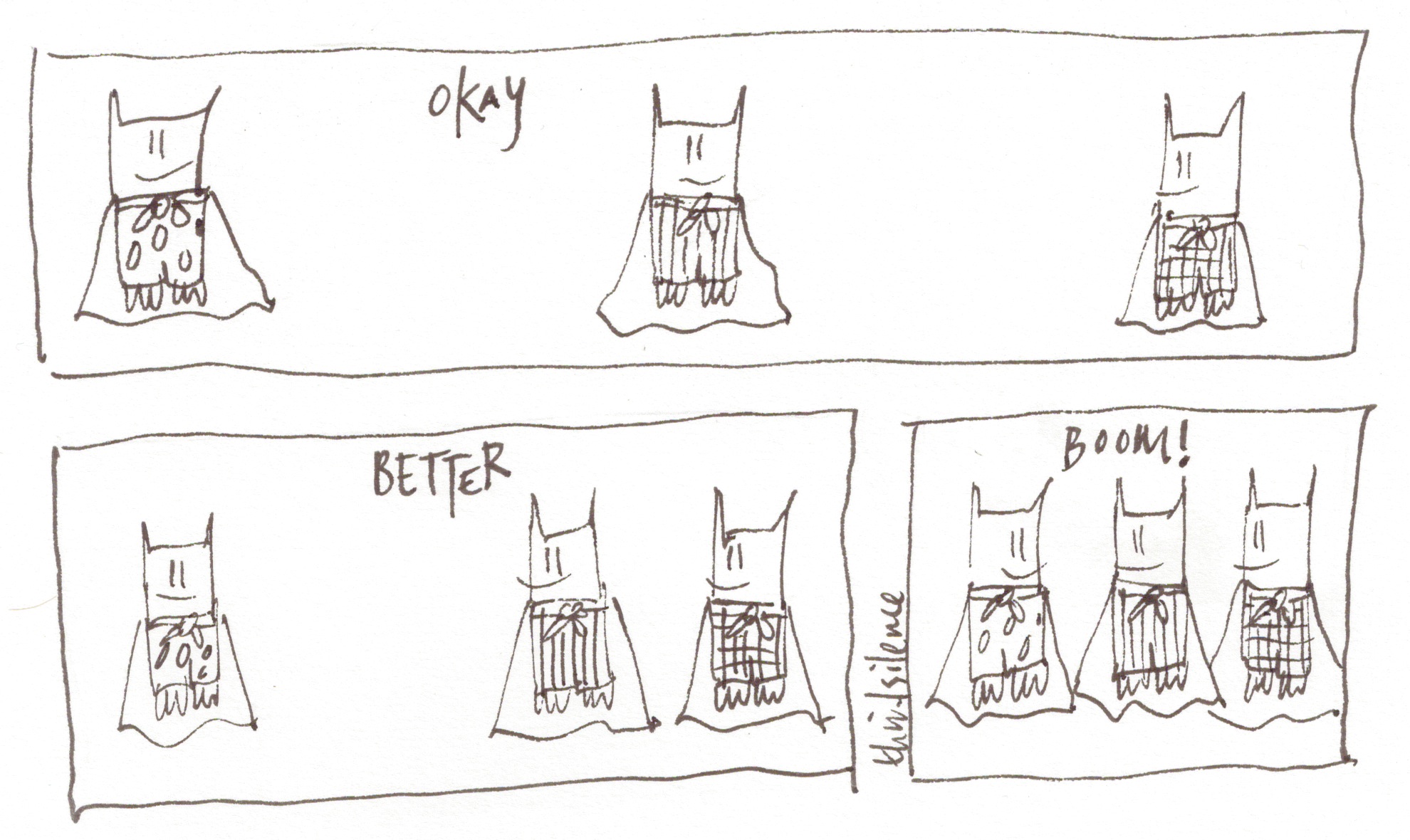
In his very readable book Makers, Chris Anderson lists three of the free benefits for 3D printing.*  Whilst 3D printing is not scalable – each item costs the same – it does make it possible to offer variety, complexity, and flexibility without extra cost.

And so does friendship.

If that’s a crazy leap to make, let me backfill a little.

Last night my wife and I were out with a group of people whose friendship we value.  Then, this morning, I read the John Donahue’s suggestion that ‘Friendship is a creative and subversive force.  It claims that intimacy is the secret law of life and universe.’

Some of last night’s friends are working together on an initiative.  Some might think this is a risky thing to do – what do you do if something goes wrong?   Others may say it’s about completing the work: “I’m not here to make friends!”

Of course, we can’t be friends with everyone we meet – this cheapens what we mean by friends.  Most of our “friends” on Facebook aren’t really friends.  Yet, if we were to meet any of them, we could express friendship towards them.

One source suggests there are different kinds of friendship we can offer: building people up in their talents, being companions through the problems of life, mind-openers to new possibilities, navigators through challenges and circumstances, collaborators on projects, champions standing up for others, connectors joining people up in significant ways, and, energisers creating positive environments.  There’s a lot of possibility in these friendships, and they all come free with variety, complexity, and flexibility.

Friendship is the sweet grace which liberates us to
approach, recognise and inhabit the adventure.

(*Anderson’s book argues for the new industrial revolution being with us because of new means of production make it possible for the designer of a “product” owns this through to production.)

the opening life

  21 questions open up spaces for listening

Determinism is the idea or notion that the universe has some purpose or destination towards which we are moving.

Some believe it has, others do not.  Whichever side of this we fall, we find ourselves in the thick of pondering determinism, our minds served by what William James termed “teleological mechanisms.”

What James has identified as a philosopher, those with the heart of a poet have added colour and shape to:

And when your eyes
freeze behind
the grey window
and the ghost of loss
gets into you,
may a flock of colours,
indigo, red, green,
and azure blue
come to awaken in you
a meadow of delight.

I was undone by these words this morning, and few more besides, halted a poet’s vision, word-smithing what is Thin|Silence for me:

It is strange to be here.  The mystery never leaves you
alone.  Behind your image, below your words, above
your thoughts, the silence of another world waits.  
A world lives within you.

The infinite artist lives an opening life.  It is the opposite of closing down creativity and possibility with an explanation – like the up-and-coming artist my friend Leah Robb mentions, closing down the conversation about his work by comparing his work with that of artists whose credentials could not be argued with.

The enemies of the opening life are closer than we think, inhabitants of everyday life: to win an argument, to take over shared office space, to monolopise conversation, to abuse holiday/sick day systems, to bully with “I say it as it is” – all closing life behaviours.

I am still learning the opening life: an open mind, an open heart, and open will.

This life suggests the only thing determined is an openness which means we do not know what we can be yet.

ability and capacity

20 ability+capacity

A couple of definitions, firstly, for the purpose of this thought.

Ability is a person’s talent for doing amazing things and Capacity is being able to respond positively and innovatively in a random universe.

If I had to pick one or the other I’d probably go for capacity.  Ability can be developed but capacity can be more of a struggle.

Either/or is scarcity perspective,* though, and we’re exploring living with an abundant worldview.

Both ability and capacity are necessary for a better world, so let’s aim for both/and.

Capacity is developed in our connectedness to others and to our planet, and from what we have not from what we have not, from which emerges our capacity to go further and do more.

When ability and capacity come together we become disruptive in ways which can help to shape a better world.

(*Ability on it’s own in a world of scarcity can lead to extreme haves/have nots, such as how the 200 richest people have wealth exceeding the annual income of the world’s 2,500,000 people poorest, or, 200:one third of the planet’s population.)


primed for inaction

19 your choice …

I’m really struggling to understand a book I’m trying to read at the moment.  After several days it’s not getting any easier and I found myself wondering about this.  An interesting thing then occurred.

I turned to one of my favourite writers with whom I don’t have these kinds of problem and am usually straight onto their wavelength … and I struggled to focus on what he was writing about.

This is a case of priming and there’s a lot of it about.

I’d noticed that by page 54 I was still struggling with topic of the first book and this set me up to struggle with the second.

I had to interrupt this thinking, tell myself what was happening, remember I’m not completely inept* at grasping the meaning of something, and started over.

This more commonly happens when we look at what others are able to do and don’t try to do something with our own talents and passions.  The thing is, we can admire the skill and aptitude of others without being primed into giving up on what we can do – which may well be something others are not able to do or are not interested in doing: you can develop this in a masterful way.

I just thought to share this today in case you were in danger of discounting the amazing thing you can do.

(*Almost but not quite.)

infinite inquiry

18 the curious art of speaking ...

We do not know if we are alone in this galaxy – or the universe – as those with higher consciousness.  It is possible that we are the only creatures asking questions about our existence and the existence of all things.  As such, Humans are the inquiring animal and it is a humbling position to have and maybe ultimate Human life can be described as the art of humble inquiry.

Those who inquire make space for listening to take place, and in listening resonance occurs – with one another, with the world we are a privileged element of, and with our future Selves.  There is always more to know, more to feel, more to do.  Answers are swallowed up by more questions.

Who are the inquirers in our lives, in our organisation, those who make us think beyond the normal, the usual, the WYSIATI?  They are the universe’s gift.

The infinite listener makes it possible for the voices of the many others to be heard, knowing the conversation has hardly begun and everything is still to be said.

bye, again

17 onward 1

Because you’re leaving, again.

You know life is in the journey and not in the arriving – arriving are part of the journey.  Some speak of this journey as a gift to unwrap, others as a responsibility for every Human to figure out.

It is the Human story: the migration of inquiry and thought and community and invention:

Indeed, the very liveliness of a culture is determined not
by how frequently these thinkers discover new continents
of thought but by how frequently they depart to seek them.

We are seekers more than finders, always hunting for the edges, the patterns of existence.  It’s more than knowing, it is experiencing.  We might act upon what we know, but we might not.  We are more likely to act when what we know resonates within us and we experience or participate in rather than observe.

We offer explanations for why something is the way it is, but we tell our stories to remind ourselves and others why we have to do what we do:

Knowledge is what successful explanation has led to;
the thinking that sent us forth, however, is pure story.

Check out the myths and legends which survive the test of time and we will see it is ever so.

Each of us has a story whispering to us, it just may not be the one we’re hearing.

lead something

16 the einstein club

Don’t be a follower all your life.

The dynamics for following and leading is changing.  We can’t all be leaders all of the time, but we can all lead something at least once, something the world would love to have you contribute.

When someone demands to lead all the time they produce waste.  The waste is in terms of people who think because they are not the top thinkers, creators, artists, politicians, sportspeople, musicians, business-people … they have nothing to contribute.

This morning I was arrested by just how huge an invention the clock.  Fire is a huge “invention,” so too the wheel and the printing press, changing the way we live.  And now I’m going to include the clock.

When I think about it, time doesn’t only regulate my life, it can rule it – my dad never possessed a watch, he worked his market garden from morning till night and he loved it, but my day can be broken down into minutes.  Before the clock, ‘the presumption that time could not be sold since time was a gift held in common’ held true, but afterwards, canny people realised clock-time would not only better regulate a day but was a commodity they could by and sell.  Many made a fortune out of this, whilst many more missed out.  We may be living in a time of change, though, when the balance of the is moving towards the seller.

In truth, it’s more about what we do with our time.  The printing press used to be useful to the few who were literate, but with increased literacy the world has changed again.  Literacy allows us to hold on to thoughts by writing them down, to ponder and develop them.  Printing allows us to share our thoughts with others.  I once sat in a space reflecting the impact of the printing press: the wall was covered with columns of newsprint, and the space was filled with people’s thinking in the forms of books – piles and piles of them.  The writers didn’t have to be there to orally pass on their ideas, and I can read them whenever I have the time to.

If you are reading this, you’re reading something I’ve published.  We may never meet but you know what I think and it may urge you to do that thing you do in some brilliant way (this is my hope).

Mark Levy combines the power of the clock and literacy when he suggests seeing what we’re capable of in ten minutes of explosive writing: set a timer (non-ticking type preferable) and write down your ideas or dreams as quickly as possible, not stopping for grammar, spelling, or punctuation corrections, finishing only when the timer goes off (even if you want to continue).

What you’ve done is a powerful thing; it is far more likely to come about now you’ve written it down.  (If you want to share it with someone, I’m all ears.)

Set the timer again – ten or maybe fifteen minutes – and re-write what you’ve put down, developing it as well as tidying it up.  You’ve just used up less time than it takes to watch one episode of a TV soap, come up with an amazing idea (I really want to hear it), and used more than double the calories!*

Now ideas and permission and technology (including maker technology) are aligning, making it possible for each of us to become a leader of something we’re passionate about.**

(*It’s estimated watching 30 minutes of TV uses around 30 calories, and light office-work double that – you may be perspiring as well as inspiring after your writing, though.)
(** Whether you intend making this your paid work or the work you do beyond the job.)