’cause i’ve gotta have faith

22 until he has

As George Michael would say.

We all have faith; it’s more than a religious word and concept.

Faith is how we sense, open, and begin to form the future in a universe more random and beautifully chaotic than Modernism ever allowed.

Faith makes it possible for us to make the vulnerable journey, because the future is about what cannot be seen, often because it doesn’t exist, yet.

Faith is not an idea or concept, it’s movement.  Nassim Taleb is right to say, ‘A prophet is not someone who first had an idea; he is the one to first believe in it – and take it to its conclusion’ – to “put skin on it.”*

Faith makes it possible for imperfect and incomplete people to move with deep grace when others believe themselves unable.

The proud person never receives enough recognition, the greedy person never has enough resources to move very far beyond their present world, but, faith-people have velocity provided by a recognition of who they are in relation to others, their world, and their future self.

Faith is dynamic stuff and you have enough, right now.  What will you make?

(*From Nassim Taleb’s Antifragile.)

the third imaginarium

21 will she?

A new word for me: Richard Rohr describes the imaginarium as ‘the unconscious container inside of which each group does its thinking for many people’.*

To borrow and develop Rohr’s concept: the third imaginarium lies between the first and the second.  It is imaginative thinking in the liminality which lies between two or more alternatives.

Thomas Kuhn wrote about scientific breakthroughs coming from young people who’d spent time learning the domain and connecting with the field who didn’t know it couldn’t be done.**  Rohr offers a sweet little phrase for this: we ‘must learn the rules so they will know how to break them properly’.*

One resonse to an inherited view or system, which we believe is outdated or dysfunctional, is acquiescence, a second is to resist or rebel.  A third way, though, chooses neither, knowing the tackling of something head-on rarely works.  (I confess I’ve learnt this the hard way.)

Whatever the imaginative new view or idea, it won’t be welcomed with open arms – it is neither proven nor disproven – but, then, if it is possible to establish it somehow and somewhere, something new can develop, be tested, and establish itself; the old view will then crumble and dissolve.

Those who inhabit the third imaginarium are difficult to dissuade or buy out because they value creativity over power, imagination over possessions, and concern for others over concern for self.  They have a panoramic worldview bigger and more colourful than the alternatives.

I do not have this but I seek it.

I often refer to Nassim Taleb’s writing about the alternatives normally seen when it comes to encountering stress: those of fragility and robustness.^  His proposition is robustness is not the opposite of fragilility, rather antifragile is: antifragility is the ability to grow in response to stressors – up to a point.  In the context of the idea in this post, fragility is acquiescence to what is, whilst robustness is to maintain what is.  I’d thought of antifragile lying beyond robustness, but I wonder whether it lies between what is fragile and what is robust: a third way of imagining.

Here’s some advice from Michael Heppell for becoming people of the third imaginarium:

‘Read, look into other areas, use different learning mediums, ask better questions, reflect, be open to ideas, be surrounded by learners, and prioritise learning.’^^

(*From Richard Rohr’s Eager to Love.)
(**Thomas Kuhn’s significant work respected more than four decades later is The Structure of Scientific Revolutions.)
(^Nassim Taleb’s Antifragile.)
(^^From Michael Heppell’s The Edge.)

hypotheses

securedownload

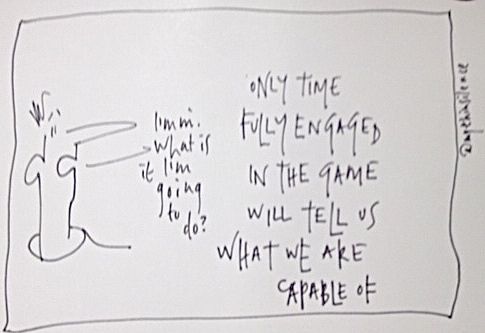
We do not know what Humans are fully capable of.

Technology and genetics and pharmacology promise (or threaten) to open up new ways of living.

Life throws out an invitation or challenge to see how far we can take it.

We adapt to our environments, or, is it, we shape our environments to suit us best?  The space, the people in our lives, what we, with thousands of things in-between.  When we step out of these we can feel lost, the proverbial fish out of water.  We prefer certain things because we feel competent, in control, and relaxed.  Why would we ever want to step outside of this?

In past posts I’ve described the infinite game, which includes as many as possible, prolonging and open-ended  game for as long as possible, and when the rules threaten these two dynamics, infinite players change the rules.

In contrast, the finite game includes a few and excludes the many, is played for a certain time towards a specific goal, and sticks to the rules.  (The infinite player knows they must sometimes play finite games, but the finite player can mistakenly think there is only the finite game.)

The infinite game provides a daily invitation, to which we must respond.  Those who say “Yes” are, perhaps, firstfruit-people of a new kind (kinds) of Human.*

We’ll only know if we take hold of the invitation with all our heart, soul, mind, and strength.

We are the hypotheses who’ll prove or disprove what we are imagining it possible to become.

(*History will remind us, there is always a push-back to Human advances and development; Otto Scharmer points to how people can react by closing themselves to (blinding) possibilities, de-sensing themselves, and absenting themselves from the possibilities.)

vulnerable

19 adventures

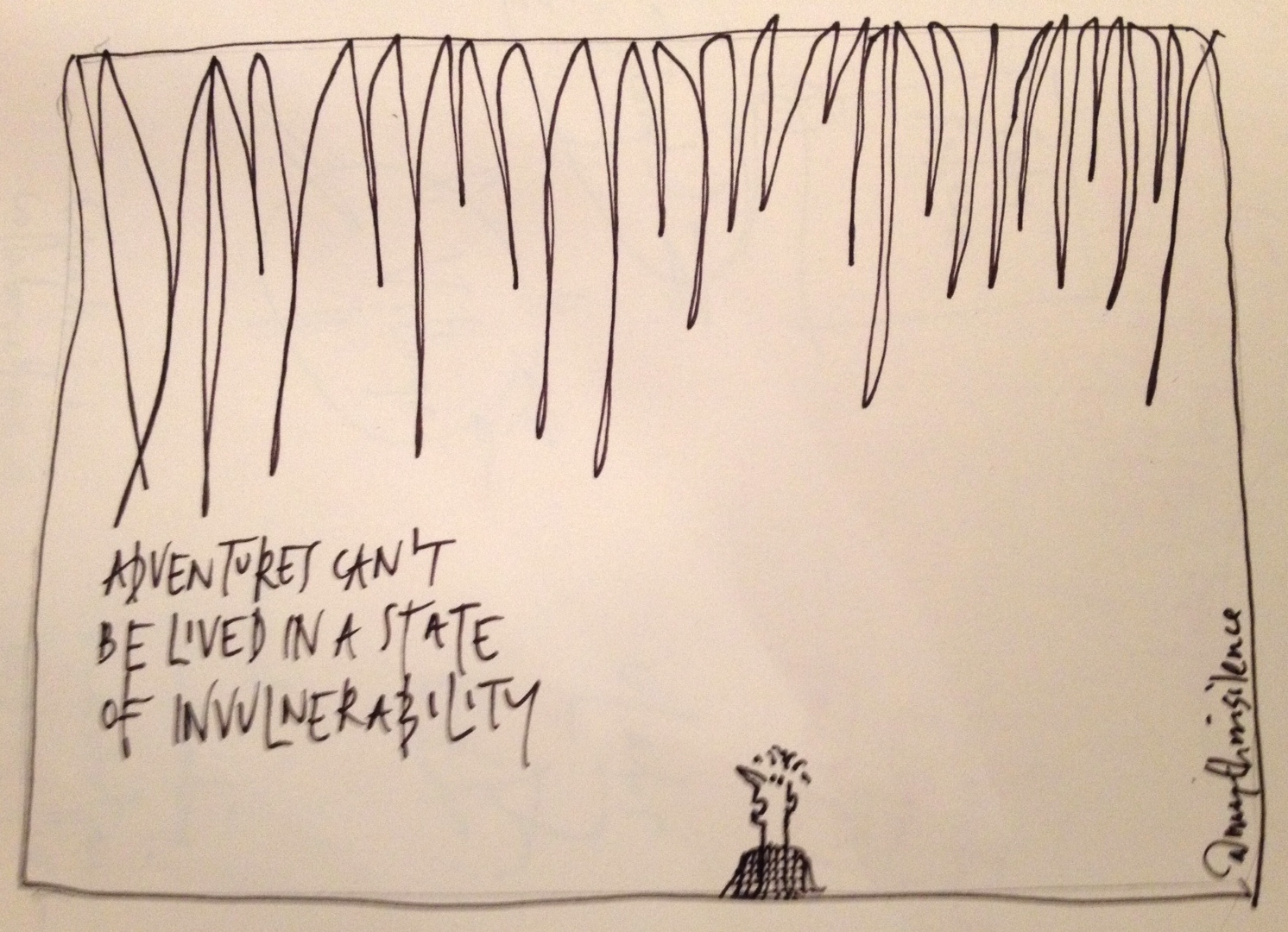
I wish it would be otherwise, but I’m realising the greatest gains come through vulnerability.

I’d rather fail trying to make a difference in someone’s world, than succeed at something which doesn’t add beauty or goodness.*

In 1910 Theodore Roosevelt spoke these words:

‘It is not the critic who counts; not the man who points out how the strong man stumbles, or where the doer of deeds could have done them better.  The credit belongs to the man who is actually in the arena … who strives valiantly, who errs, who comes up short again and again, because there’s no effort without error and shortcoming; but … who spends himself in a worthy cause; who at the best knows in the end the triumph of high achievement, and who at worst, if he fails, at least fails by daring greatly.’**

This is different to the world’s wisdom, which struggles to understand how success and failure not only can live in tension, but need to be present for the transformative and the transcendent to happen.

I’m half alive, half-Human if I’m not vulnerable: vulnerability is about being engaged in what we might describe as life-in-all-its fullness.^

Vulnerables see risks differently, knowing they are the only way to move forward.

Nassim Taleb puts this well when he says, ‘A halfman is not someone who does not have an opinion, just someone who does not take risks for it.^^

We’ll risk to connect with others, risk to connect with the world we must steward, and we’ll risk to connect with our future Self.⁺

(*My next attempt is on the 28th November when a group of people have identified people to support, hired a space, brought in musicians, crafted things to make a difference for others, and brought together stories, put out the invitations, and now must wait to see if people come.  If you’re in town, you’re welcome to come.)
(**Quoted in Brene Brown’s Daring Greatly.)
(^Equals life including the positive
and the negative.  It’s interesting how even people of faith are conceiving of a vulnerable god, who, being unable to do all things, moves forward to engage through the positive and negative.)
(^^From Nassim Taleb’s Antifragile.)
(
⁺When I’m dreamwhispering, I’m mentoring from the future, from things I haven’t done yet, except how to explore the future.)

paradoxical

i share

Each of us is, most of the time

We walk the earth but dream of travelling to the stars.

We eat and shelter and reproduce, yet we create things of great beauty which have no value as tools or food.

We are on a journey from the little self to the big Self.*

We are not what we crave, we are the one watching the self who craves.

We seek to connect with others in order to discover and to be more our self.

‘I share, therefore I am.’**

When we cannot connect with another because of something we do not like about them, the truth is often this thing we do not like is already in us.

We are becoming our future self: connected and focused, crossing thresholds which demand much of us.

Without any evidence, we open our minds, believing we are more than we are in the moment.

We dive deeply into the worlds of others, which are so unfamiliar to us.

Through costly and demanding connection life, we come to see most clearly what our contribution MUST be, and then let go of everything else, including position and possessions so we might live the adventure.

The old and the new exist in us at the same time, of course; we are always paradoxes moving toward the future.

(*The little self is the ego, the self which seeks expression in positions and possessions, but in doing so, gives away freedom.)
(**Gary Vaynerchuk on social media, in Jab, Jab, Jab, Right Hook.)

mapmakers

17 four maps of engagement

Every day, we use dozens, maybe even hundreds of maps.

Most of these are mental rather than physical maps, but without them we wouldn’t be able to get to where we want or need to be.

Yesterday, I mentioned the ritual I use each day to get me to where I need to be, like using a map, which I follow with another, and another.

These are the maps we make.

Most maps have a lot of blank space on them: by design (so we can focus on particular details) or through a lack of knowledge.

Blank space allows for exploration within our routines, but I know I can’t get to everywhere I want to using the same old maps.

I’ll have to create new ones.

What goes for my personal maps holds true for the maps we create together.

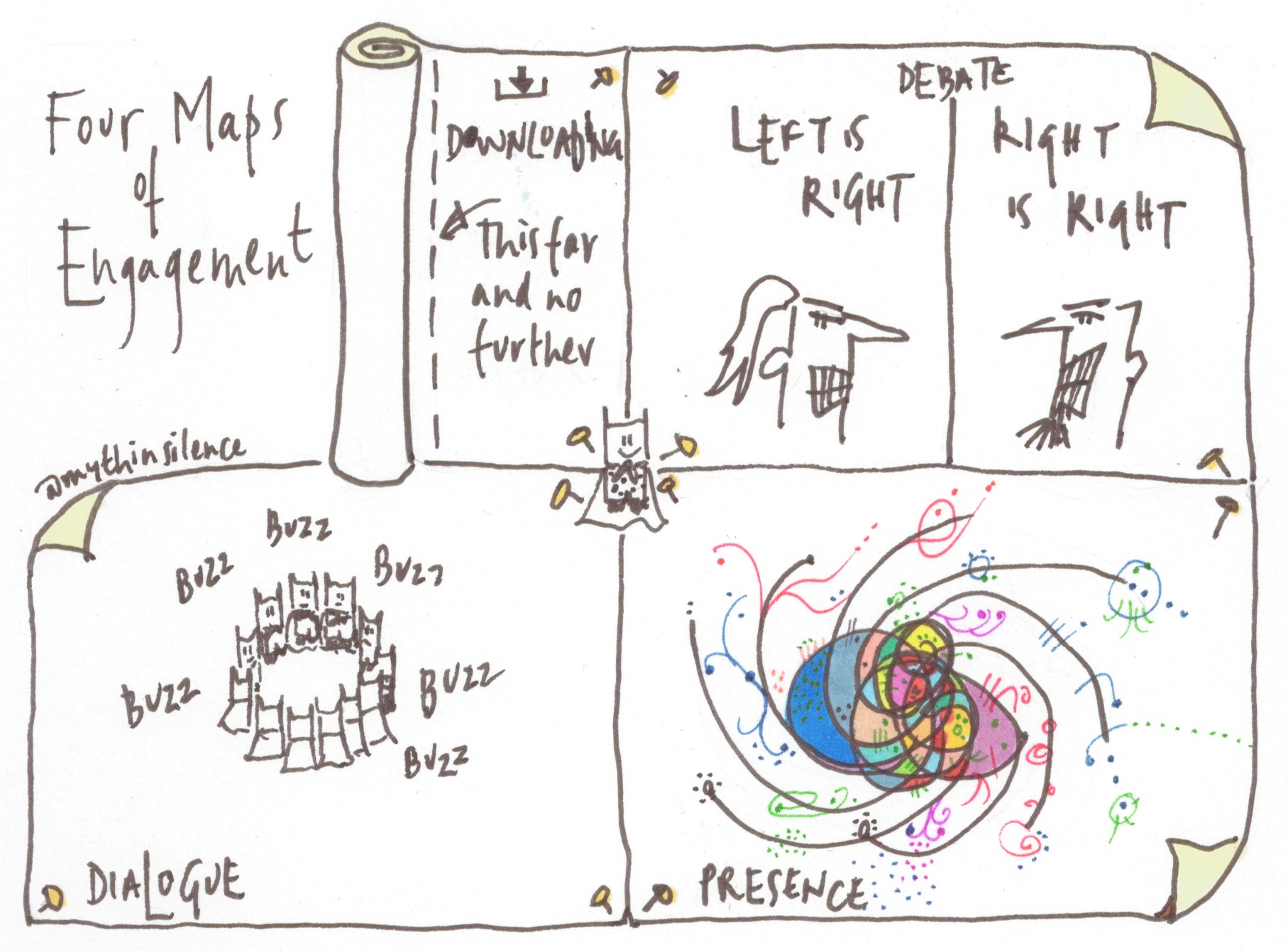
We can’t debate what is and isn’t by using a downloading map (closed to new input and data), we can’t arrive at a dialogue by using a debating map, and we can’t arrive at a new future of being present to one another, the world, and to our future Self, by using a dialogue map.*

It doesn’t matter if we haven’t got the maps we need.

We are Humans and Humans are mapmakers.

(*These are Otto Scharmer’s four levels of attention: presence is deeper than dialogue which is deeper than debate which is deeper than downloading.  In The Different Drum, Scott Peck names similar maps for relationships: shallowness, conflict, submitting, and glory; Brian McLaren too in Naked Spirituality: simplicity, complexity, perplexity, and harmony.)

here i am

16 the future begins

I’ve turned up.

This is often the bigger battle.

Twyla Tharp describes her morning ritual as a choreographer: out early each morning to hail a taxi to take her to a gym for a two hour workout: the ritual is not the gym, she says.  It’s hailing the cab.

We need to build the rituals which get us to where we need to turn up.

These can be fun to shape and form, and then, on a day when we don’t feel so eager, they help us to turn up.

It reminds me of why, every morning, I go through the same rituals which take me into the same space, with the chair, the journal and pen, and the books with which I begin every day.

And when I am away from home, I’ll look for a way to replicate as many elements of this as possible.

I love dreams and big pictures of the future and what can be, but I know there’s graft to be done to arrive at these.

Erwin McManus tellingly writes, ‘Sometimes we forget that dreams require change.  If you are not willing to change, you are not willing to venture to where your dreams can come true.  People who do not change in the end become people without dreams.’*

Everyday, I have to turn up to change, moving from a small world – “I-in-me,” as Otto Scharmer would describe it – to a bigger world: “I-in-it.”  Then I find myself being pulled forward, into the world of others – “I-in-you” – and into action: “I-in-now,”  Seth Godin calls this zooming:

‘Zooming is about stretching your limits without threatening your foundations.  It’s about handling new ideas, new opportunities, and new challenges without triggering the change avoidance reflex.  You already zoom everyday … doing the same things as usual only different.’**

I’m here.

Now what?

(*From Erwin McManus’s An Unstoppable Force.)
(**From Seth G0din’s Small is the New Big.)


outliers and inliers

15 what are you doing?

We need to be both.

Outliers seem to appear from nowhere, full of natural talent, taking The world by storm: we tend to think of characters like Amadeus Wolfgang Mozart, The Beatles, Bill Gates, Steve Jobs, Richard Branson.

Natural talent is a fallacy.

We just love the idea too much to let go of it.

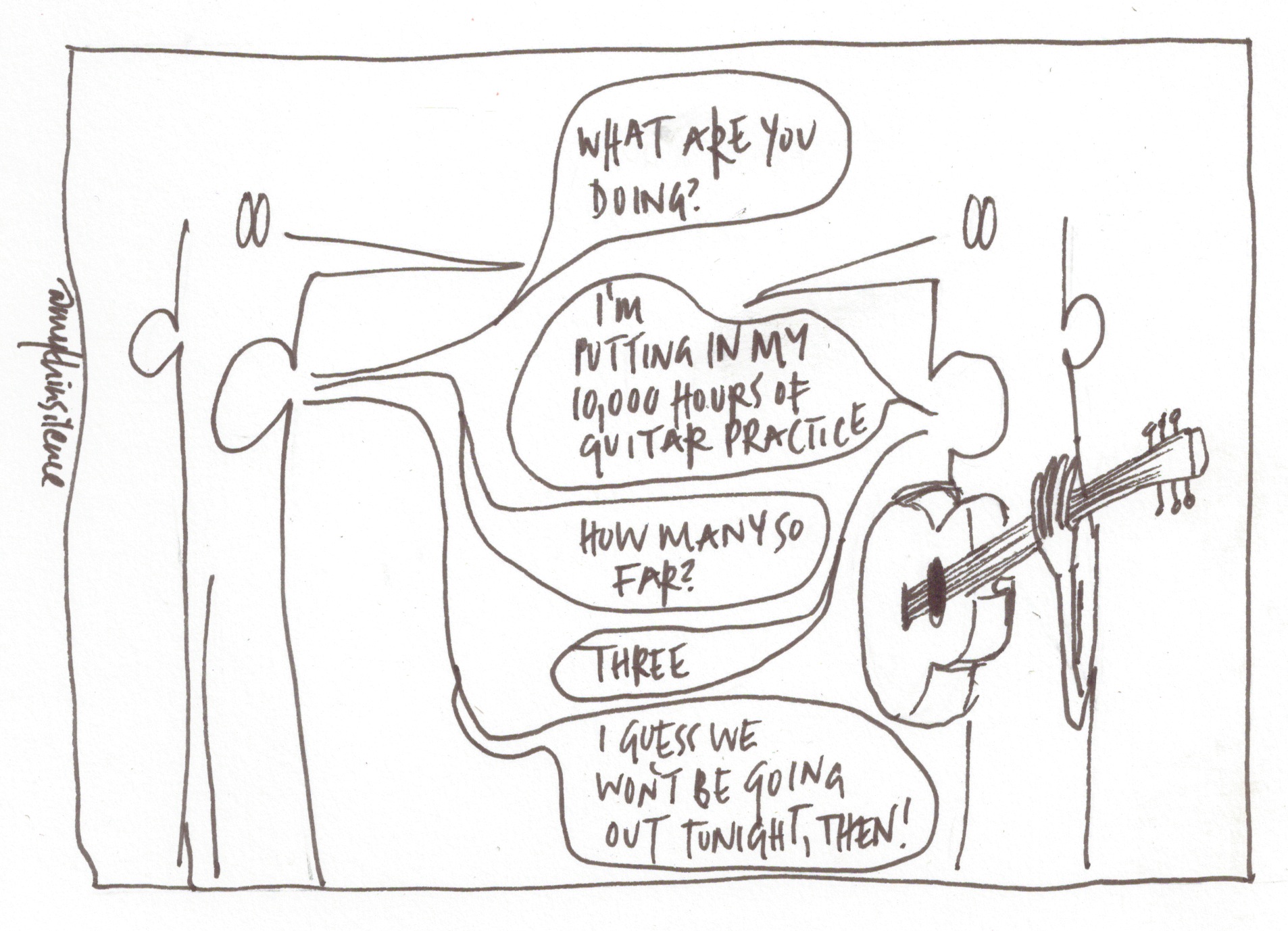
Listen to any sports programme for only a while and count how many times this or that sportsperson is said to be a natural born footballer or gymnast or tennis player.  It’s important to recognise, height, weight, and the type of muscles people are born with may exclude from certain sports and point us in the directions of others, but what we really find beneath the surface of star performances are thousands of hours of practice.*

I suggest the practice of outliers is to move beyond the safe and predictable and familiar, to see and understand and try and fail and feel more.

This demands we are also inliers: people who care for and maintain a strong interior life, including the intrinsic curiosity and desire to explore certain things, which pushes us out to wonder and wander more.**

Habits are both formed by, and lead to, thousands of hours of practise.  Paradoxically, whilst sounding dry and boring, habits are what allow us to journey to new places and have new experiences, build skills, and produce geniuses.

Everything then becomes a useful artefact to us: the work of other musicians, experiments in selling vinyl records, playing solidly for two years in Hamburg, endless hours on a computer terminal because you’ve figured out a way of bypassing access, beavering away in a home-brew computer club, or, whatever it is you discover and so on your journey.

Go wander, go roam: the bigger your world, the more you have to use to make astonishingly useful things.

‘Don’t wait for it.  Pick yourself.  Teach yourself.’^

(*The eponymous 10,000 hours, or ten years, of painful hard practice; Twyla Tharp reminds me how Mozart’s hands were deformed by the age of twenty eight because of all the hard work,and Amadeus himself wrote: “People err who think my art comes easily to me.  I assure you, dear friend, nobody has devoted so much time and thought to composition as me.  There is not a famous master whose music I have not industriously studied through many times.”  Just this morning I was listening to a sports programme discussing England footballer Wayne Rooney’s career ahead of his 100th cap for his country; those contributing to the conversation were telling of when he was only fourteen – he’s now twenty-eight –  being the first to the training ground: his graft would have got him noticed, meaning he trained with better players and spent more time training – a kind of never-ending circle of excellence.  )
(**This is also about our values, beliefs, and personal compass.  My own wandering and roaming through beliefs and activities has made me wonder why I feel this to be so safe, to ask what’s the anchored core.)
(^I’ve finished reading – or eating, as my friend Steve would say – Seth Godin’s Whatcha Gonna Do With That Duck, so I had to include one last quote.  Thanks for bearing with me as I’ve quoted from Seth’s book – it is 571 pages long!)

routines of goodness

14 goodness is

The good news about goodness is it’s scalable, sustainable, and doesn’t directly use natural resources.

Also, whatever the someone’s reason or motivation when they do some goodness, goodness wins.

Most people do goodness every day.

Goodness doesn’t come from nowhere, though.

Goodness flows most freely through practices, disciplines, and habits.  It’s always closer to the surface of our lives than we think.

Twyla Tharp is sharing here about creativity but this is also true of goodness (which is another form of imagining and creating):

‘The routine is as much a part of the creative process as the lightening bold of inspiration, maybe more.’*

Daily habits allow our intentions and imaginations to fire up, producing heat and mass and movement.

Yesterday, I mentioned being fascinated by the Rosetta Probe‘s journey to comet 67P/Churyumov-Gerasimenko, setting down its lander Philae on its surface.  When we imagine and live out our goodness against this bigger context, it promises to grow even more.

Rooted in humility, gratitude, and faithfulness, our routines of goodness involve connecting with others, our world and universe, and our future Self.**

Goodness for goodness sake is still misunderstood and undervalued; I am aware of how difficult it is to raise funding for projects wanting to help people live their dreams.

‘Among the things that distinguish our species from others is our combination of idealism and artistry – our desire to both improve the world and to provide that world with something it didn’t know it was missing.’^

(*From Twyla Tharp’s The Creative Habit.)
(**The future is very important for freeing us from our past, but oftentimes we undervalue the significance of this.)
(^Daniel Pink in To Sell is Human.  As much as I am able to, I will provide like to hive.co.uk which makes it possible to order books online, then pick them up from a local independent bookstore, who will also benefit financially.  Thank you, Charlotte, for this idea.)


experiments in goodness

13 wow, goodness

Yesterday, Rosetta Probe’s lander made it to the comet it had set out to intercept ten years ago, the result of a dream from thirty years ago!  In a violent world, it struck me this was a story of Human hopefulness, asking deep questions about the universe and our world.

I find myself wondering just how much goodness has yet to be released into the world, from lives unaware of just what they can bring to others.

There are as many ways to contribute as there are people, each life uniquely capable of crafting goodness.  And the kickback is a dopamine high which takes us by surprise, or, as Richard Rohr describes it: ‘the most egalitarian worldview of all, the broadest and biggest viewpoint possible, the harmony of goodness itself – and where goodness is its own inherent reward – which is always beautiful in people’.*

I am daily encouraged to try things: “Fail often to succeed sooner”** counsels IDEO’s David Kelley.  These are not character failures but failures in goodness.

Here are three steps towards this proffered by Joseph Jaworski:^

We must wake up with it: find some way of reflecting before anything else in the morning.^^

Create ways of staying connected with our deep intention throughout the day – habits and activities, even mantras.

Sense and seize opportunities when they offer themselves – the first two steps make the third more likely.⁺

Otto Scharmer names this, “Version 0.8.”

It doesn’t have to be complete or perfect.  We all get to go play with goodness.⁺⁺

(*From Richard Rohr’s Eager to Love.)
(**Quoted by Otto Scharmer in Theory U.)
(^From a conversation with Otto Scharmer in Theory U.)
(^^Julia Cameron suggests three morning pages in The Artist’s Way – connecting with what we each must do.)
(⁺Nassim Taleb would counsel taking those opportunities which have more “up” than “down” in terms of consequences – the wisdom of an antifragilista.)
(⁺⁺If you’re in Edinburgh on the 28th November 2014, why not come and play with us at VOXedinburgh’s KATHAA HAALNU?)
(Cartoon: I someone again tonight whose new charity was helped to set up by Good For Nothing: people coning together to help people just for the fun of it.)