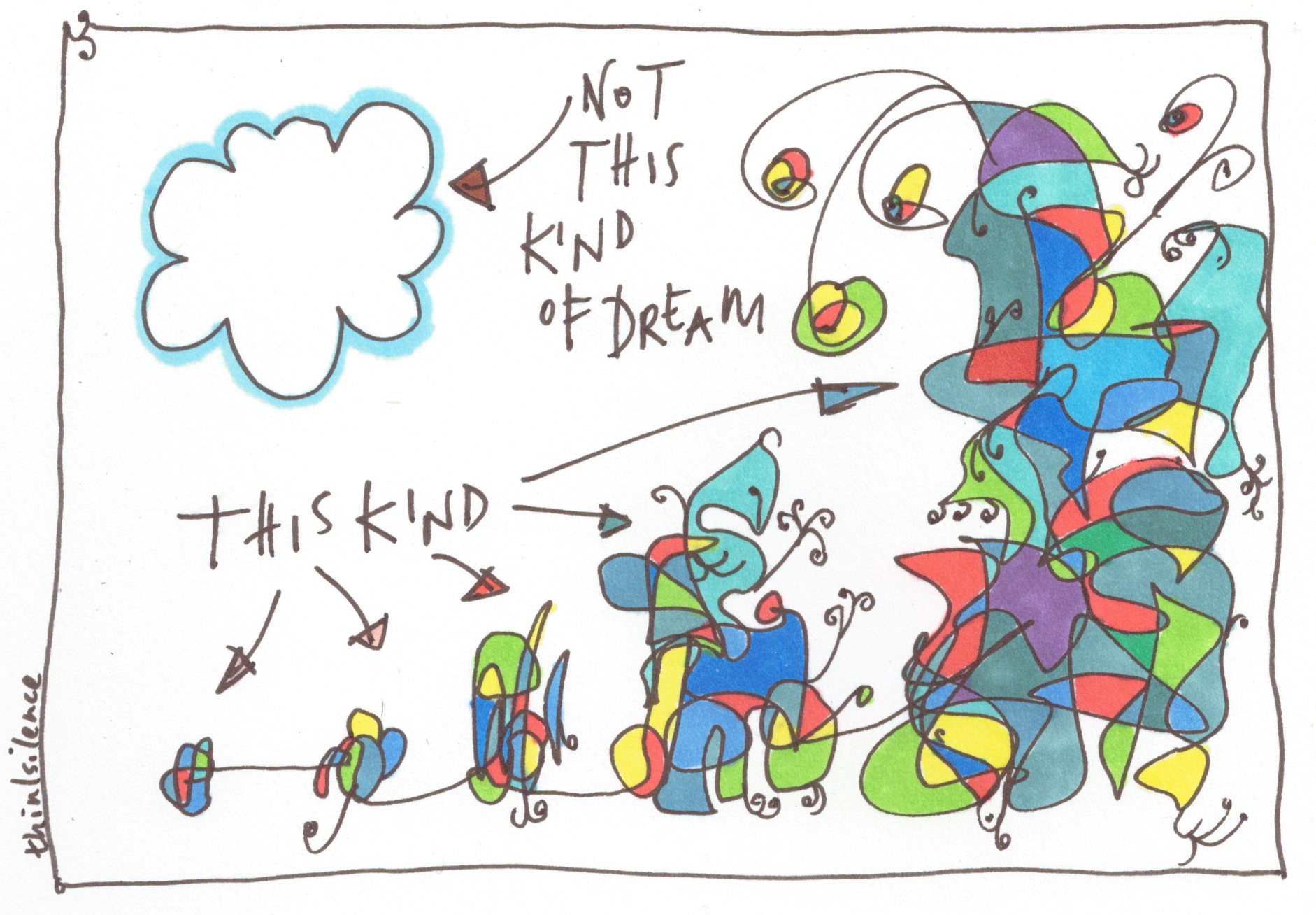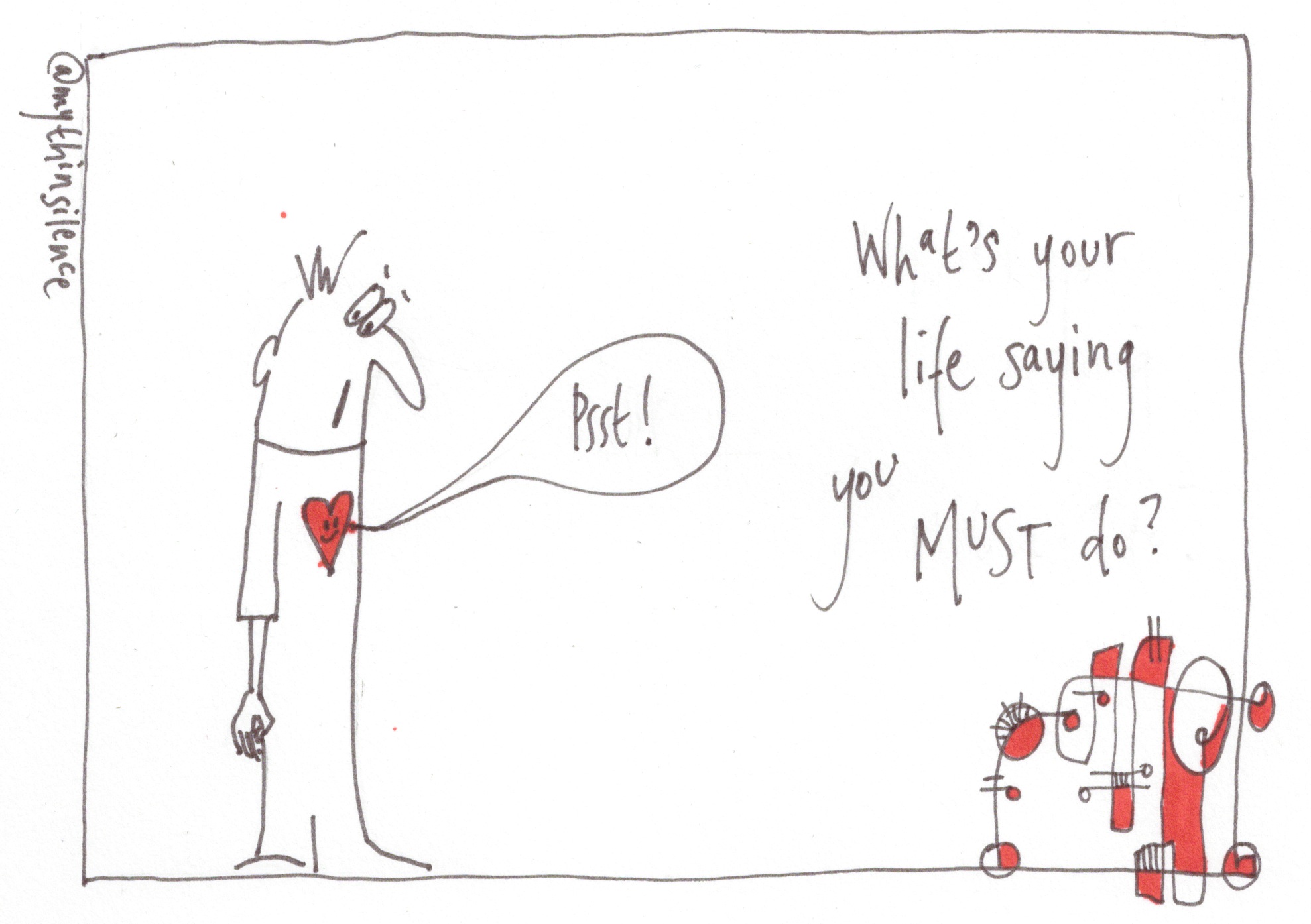
help from beyond

1surprises happen when hearts connect 1

I’ve just sent a thank you to some people who’ve become a significant part of my life – part of my help from beyond.

Some of us first met three years ago – the result of meetups set up by Seth Godin as part of his Tribes initiative – whilst others have joined our conversations with purpose that began on the 31st May 2011.

As part of our journey, we’ve all taken steps and leaps forward in making ideas and dreams reality.  The commemoration, though, is not backwards but forwards, into the more of an emerging future as we understand ourselves to be Human Becomings more than Human Beings.

James Carse writes about how we touch one another in a reciprocal way.  It is the surprise for both which comes from a generous act.  I cannot move myself – that would be inauthentic, and I cannot force you or move you to something I have in in mind for you – the surprise is the result of act towards one another with one’s whole heart, (then we ‘ll be surprised by belief or change or action).

Yesterday, I wrote how three exercises enable us to see the emerging future more clearly; here are some questions tying in with how our help comes from beyond:*

Exercise one: Towards knowing who we are and what we can do: What are your talents (try listing ten and ten double this, and then add another ten)?; what are you passionate about (everything)?; What gives you energy?; What do you want to do something about?; What are your top five values and beliefs?; Then, what has time proven you’re not talented at (begin with ten again)?; What leaves you could (the things already in your life)?; What drains you of energy?; What have you tried to do something about but found you’ve not been energised by?

Exercise two: Towards seeing your resources: Who are the most important people in your life and what do they bring to you (e.g., are they a companion, do they open your thinking, do they help you through situations, or work with you)?; Picture your home and how you can use it (who could you invite around, what kind of meals could you share, what could you do with your garden if you have one)?; What are the artefacts you have and how can they help you to produce your art for others (books, computer, equipment, tools)?; What about your finances and/or what can you barter to make a difference or get hold of things you need)?; What’s in your fridge and how could you make something to share (and how)?

Exercise three: Towards habits of activity: Begin mixing the things you’ve listed in exercise one with those in exercise two, coming up with as many possibilities as you are able, no matter how ridiculous you think these are; Begin trying these ideas out, making a space or time or connection (especially the connections as  our help comes from beyond); if you experience failure you’ve learnt something valuable making it possible to try again in a different way.

In each of these I know my help comes from beyond – the complementary passions and talents of others, the questions and contributions others make into my life, and, the conversations with purpose which enable me to action something.

(*Writing these things down will have real benefit for deepening our reflection and creation.)

seeing the future

31 seeing more of the future

If you could do some exercises to improve your physical sight you’d do them, yes?

Whilst there aren’t exercises to sort out my short-sightedness, stigmatism and opacities, there are exercises to improve my ability to see the future

(It would be more accurate to say, seeing a future rather than the future – the future doesn’t exist but it can be shaped.)

I’ve been reminded how it’s possible to relive the past into our future in unimaginative ways: repeating what we or others have done before, yet Life invites us into a game of original play, a story of spontaneity and originality – James Carse reminds us, ‘Whoever must play cannot play.

When past successes and behaviours and hurts shape our future it isn’t playing, it’s being trapped within a “script” that has to be acted out – maybe to prove a point to ourselves and others (though in proving a point we’re agreeing with the very thing or person we’re trying to make a point against).

The alternative is to be the author of a openended story.

The reason we can see the future is because our imagination is lighting up with hopes and dreams and want to turn these into reality – when we want something together we have a movement.

Lighting up our imaginations and inviting us to play are three exercises:

Firstly, to know ourselves: what we can and cannot do, what we are energised by, how we are comfortable in relation to others.

Secondly, to know what we have, to regard and count all our resources – relationships and things – as employable for and in creativity.

Thirdly, to create ways and means of taking our passions and our resources into daily practices and habits of making something – whether an artefact, a relationship, a journey, or a community.

When these three things are happening in our lives, we can be astonished by the number of possibilities for the future we see – even to the point of having to choose which we have to pursue and which we must put away.

You may recognise these as our purposeful companions: Humility, Gratitude, and Faithfulness, helping us to avoid the lose blindness which hubris, greed and foolishness can afflict us with.  Instead of enacting the past, we are able to live towards the future with creative originality.

I’ve no idea what this might exactly mean for you, but I’m sure you’ll wow me with what you come up with.


happy voxday

30 happy voxday 1

Your voice (Latin vox) is unique.

If you understand this to mean different then it’s possible for you to reach the end of your life and not done anything with it.

If you understand it to be about making a difference then you’ll produce your art of disequilibrium,* craft a story of giftedness and invitation and connection.

Brenè Brown says it right when she admits:

“It’s so scary to show up.  It feels dangerous to be seen,
it’s terrifying.  But it is not as scary, dangerous, or terrifying
as getting to the end of our lives and thinking – what if I
would have shown up?  What would have been different?”

Today is VOXday in Edinburgh.  A community of people will be turning up with their art and giving it away in amazing ways so they might make a difference in the lives of people they’ll never meet: “finding our voices so others may find theirs.”  Just one example of what’s happening in all kinds of places; people finding their voices and making a difference.

What’s your voice?

Happy VOXday!

(*When we produce our art because of our passion and love, it’s worth more than anyone can give us or pay us for it.)

seeing from the centre

29 i see you 1

Seeing is different to looking.

I was explaining this to someone earlier.  I looked at a pair of curtains in the room and suggested they could be used to draw across the window, offering warmth and privacy.  But to see the curtains meant I saw the material, the colour, the size, and what the curtains could become – clothing (Maria managed this in The Sound of Music*), art, blankets, dust-sheets, up-cycling into ?  To look at something is to see it within boundaries, to see something or someone is to see open-ended possibility.

Our lives can be more about looking than seeing.

I’ve been exploring how an inciting incident can tear us from a familiar reality into a new one, even from a life of looking to one of seeing.  And we can be surprised at what we find, how connected we find ourselves to be.

There’s more to you than old certainty suggested.  There’s something only you can bring into this world, emerging from your way of seeing, which I need to see too.  Deep observation allows you to be more deeply present to people and the world – it is as though you observe from within these.  Now the art you produce comes from the emerging future.

When you realise what it is you must do, you help me to understand what I must do.

To realise what you have to bring to into the world you must give it away, as James Carse suggests: ‘You can have what you have only by releasing it to others.’

(*You’ve got to love Hollywood.  I’ve been on The Sound of Music tour with a cynical Austrian guide telling us the true story.)

accidental heroes (or, life interrupted)

28 there's a superhero cape ...

It’s the classic story, told throughout Human history: the protagonist finds him or herself ousted from a familiar world and into a new reality by some inciting incident.  They must stop trying to return to what was (and has gone forever) in order to emerge.

This is about reality and grief and hope, and some Human genius.  Grief must not be avoided because it helps us let go and then to take hold.

Otto Scharmer tells of a personal and unexpected experience when he looked on the smouldering remains of the three hundred and fifty year old farmhouse his family’s generations had lived in for two hundred years:

‘I suddenly felt released and free to encounter the other
part of my self, the part that drew me into the future –
and into a world that I might bring into reality in my life.’

Moments like these are thin|silences within which our worlds change.  Joseph Jaworski describes this well: ‘In that special silence, you can hear or see, or get a strong sense of something that wants to happen that you wouldn’t be aware of otherwise.’*

We can find our future Self in unexpected places and occurrences.  What if I were to admit to not being very good at the role I’ve been in for some thirty years.  This would certainly be a hard reality I’d need to grieve over, but I also find myself free, as Scharmer puts it, to encounter the other part of my Self which calls me into the future .  And maybe if I try and deny this reality I might miss what James Carse identifies as the ‘genius of myself’ (with which we can originate something right and good and beautiful into this world).  This Self only exists with the acknowledgement of this genius in others.

Then, to face reality and grieve what cannot be, or never was, or cannot be again, is so important, turning ousting into opportunity, perhaps uncovering  the other part of who we are, our genius expressed in a courageous and generous life.**

Please feel free to use this post as an inciting incident.

(*Joseph Jaworski’s description isn’t the original source for the idea of  thin|silence, but he captures the very dynamic of an emerging future which we had not foreseen.)
(**Both courage and generosity are expressions of selflessness.)

dangerous people

27 all kinds of dangerous people

Are those who play with the rules rather than play by the rules.

Whilst many try and tell us this or that group of people are important, dangerous people tell us everyone is important.

And when some are telling us about how important this task is and how we need a decision yesterday, dangerous people are looking to see how it contributes a better future.

Whilst many are just serious, dangerous people seriously use fun, imagination, and disruption in order to live expansively.

The powers-that-be have to be control or employ by them, and if they can’t, they must marginalise them.

The infinite artist is a dangerous person because they have become generative beings, able to contribute far more than one person seriously should, and when they form a tribe … !

Vincent van Gogh believed artists living and working together would create a religion or spirituality for the future – ‘a miniature monastic community dedicated to producing the art of the future’; he was to produce some of his most amazing work in anticipation of Paul Gaugain’s arrival in Arles and the Yellow House.

I use artist in a wider sense to mean the creative contribution every Human is capable of, but perhaps we can extract something more from the life of Van Gogh: although he never sold a painting in his lifetime, his artistry continued in a prolific way which shocked others – it resided in the artist primarily and found expression in his paintings.  So an infinite artist isn’t her or his work – whilst a “work” is imbued with their passion and skill, the infinite artist is above all a generative being.

They know who they are and what they can do (an expression of their connectedness – to others and to the world); they also know what they have, they are not blind to their resources, which are substantial.  As a result, they are able to go further, and produce and contribute more.

Infinite artists or players know there is no limit or scarcity to the things which matter most: love, hope, and imagination.

And we are all invited to be infinite artists.


wanted: gameplayers without borders

26 wanted infinite players

We need to have some experimental games running.

To test out whether James Carse is right to suggest cultures are different to societies in that they are boundaryless.

Borders and boundaries exist because of opposition, they are the result of protecting the past from corruption – often an ideal which never existed but, then, ideologies don’t have to have any foundation in reality.

Carse defines a culture as something people do together rather than something a person does. Of the Renaissance he suggests: ‘the Renaissance is not a period but a people, moreover a people without a boundary, and therefore without an enemy.  The Renaissance is not against anyone.’

Cultures, then, play with borders and, if Carse is right, they don’t obtain freedom by taking it away from others.  In contrast to the finite game often found in societies, the infinite game* desires as many as possible to play and for the game to be as open-ended as possible into the future.

Our hope lies in infinite games; here are some final thoughts from Carse:

‘A people as a people, has nothing to defend.  In the same
way a people has nothing and no one to attack.  One cannot
be free by opposing another.  My freedom does not depend on
your loss of freedom.  On the contrary, since freedom is never
freedom from society, but freedom for it, my freedom inherently
affirms yours. A people has no enemies.’

(*Hospitality is an example of a cultural game rather than a societal one; although an ancient practice, it is open-ended towards the future because of its subversive nature, reversing roles between host and guest.)

leftovers of joy

25 after all the creativity ...

Who is my Self?

What is my Work?

Two questions posed by Stanford University’s Michael Ray of students on creativity courses.

In the place of thin silence where we are most aware of who we are and what we can do that hope is most powerful.  I was going to write fully aware, but who we are and what we do is more open-ended than we know.

The Self is not about me but who I can be in relation to others and this world.  My Work is not what I get paid for or even volunteer to do, but the art I produce from my skills and passions to make a difference.

When we live our lives in this way, we discover there are more than enough leftovers of joy for ourselves when we live our lives for the good of others (creativity plus generosity leads to enjoyment).

People want to make a difference; they only have to find a means for doing this.

Who is my Self?

What is my Work?

the problem

24 embracing our quest ...

It’s me.

I am the problem within the problem.

Oh, and you are too.

We want simple or fast solutions to problems, yet when we think we’re just coming to an answer, we’ve only begun to define the true question.

This from Daniel Kahneman: ‘ A general “law of least effort” applies to cognitive as well as physical exertion.  The law asserts that if there are several ways of achieving the same goal, people will eventually gravitate to the least demanding course of action.’  Furthermore, he suggests you ‘are likely to stop when you are no longer sure you should go further – at the near edge of the region of uncertainty.’

The reason for this can be unseen anchors from our past which determine our way of approaching an issue or problem.  Blind to exactly what this is,  we believe we have considered everything and WYSIATI (What You See Is All There Is) blocks attempts to find the better solution.

All Human systems are broken somewhere, some of the time, often in a different way or place to where we’re prepared to look.  We can live in denial of this and patch problems, or, we can do the hard and strenuous, and personally costly thing of going further.

So I am the problem in the problem, but when I am willing see and understand more deeply, what is hidden in the background comes to the fore.

None of us like to be wrong.  It’s thought of as weakness, but to the contrary, it’s the stronger way of hope.

remembering and permission

23 even those who anticipate the future ...

Because every day you and I have to remember we have a choice to be an infinite player.

Every day, we are confronted, and drawn in, by many finite games and their players.*  Whilst we need to play some finite games (the airline delivers you to the airport it promised to, the student turns in their dissertation by the agreed time, your employer allows you to leave at the end of the workday), we can forget there is always a greater game of open-mindedness, open-heartedness, and open-willed-ness, being played.

The infinite game anticipates an unknown and undefined future, aiming to include as many as possible for as long as possible (and when something threatens to exclude people or end the game, the rules are changed).

When we remember, we provide ourselves with permission to live with humility, gratitude, and faithfulness – practices which enable openness.  And because openness to seeing and understanding more, through the lives of others, towards changing our goals and behaviours can be frightening and threatening, infinite players need to create spaces for boundarylessness to be explored, replacing them with horizons.

Writing this has helped me remember again, giving myself permission to be an infinite player today.  By the way, feel free to join in.

(*Finite games can be both sophisticated and subtle and all-pervasive.)