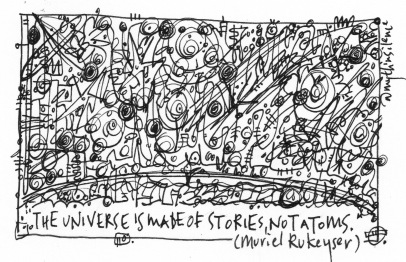
the future of the stories we tell ourselves

6 creating interesting

The passengers on the top reck of the number 26 bus didn’t know what to make of the group of pirates wielding cutlasses and “arr-ing” on the way to their seats.

SONY DSC

We’d begun on Portobello beach with a game of Battleship (or should that be Man O’War) on the sand, and we were now heading into Edinburgh to find a few pubs (taverns) to tell our stories of daring-do, handing out our treasure (chocolate) to those who would take it.

A story with lots of fun.

Jonathan Gottschall closes his book pondering the future of story, especially because it’ becoming increasingly possible to live within novels as they’re being written.  In MMORPGs (Mor-pegs, or massively multiplayer online role-playing games) players are the protagonists fighting against evil, escaping mundanity.  So will the story, which has been helpful to us as a species, become a liability, creating “a mental diabetes epidemic” as we prefer virtuality to realtime?*

I’m more hopeful.  Especially for stories which allow us to ask the most important questions.  In these stories, we can do some “thinking wrong” – the technique of ‘mixing and matching things that don’t normally go together.’**  When the expected things don’t work, why not combine things in stories which don’t go together and see what happens.

What if I don’t take offence at what someone says to me or does to me?  What if I don’t hold this person responsible for something their company or ancestor did?  What if someone could walk off the street into a shop in which they could purchase a different story to live.

The difference between the pirates in Edinburgh and a mmorpg is the pirates were trying out an idea to see how people can have fun and make a difference in the world.

‘Figure out what you are meant to contribute to the world and make sure you contribute it.’^

(*Brian Boyd, quoted in Jonathan Gottschall’s The Storytelling Animal.)
(**From Warren Berger’s A More Beautiful Question.)
(^From Susan Cain’s Quiet.)

escaping the bubble

 5 we all

I was brought up in the 60s when The Prisoner was running on TV, and Patrick McGoohan’s character was trying to escape the island where he was being held prisoner, but he kept getting captured by those crazy bubbles.

Reality is, we’re each living in some kind of Bubble-world – most bubbles are complete ecosystems in which we can exist. We complain about and love the Bubble at one and the same time. It may be our work or relationships or what we’re willing to think about or what we’re willing to attempt. We can think THIS is all there is, and we swallow the warning the Bubble feeds us, that we’ll perish beyond what we know and what we do, and our circle of friends or accomplices.

Rarely is this the case. As our knowing, our loving, and our doing increases, we will become creators of our best art, we’ll make our greatest contributions.

We probably have to have several turning points to move us beyond the Bubble. As I thought about this, some of my turning points have included realising the things I was becoming curious about and intrigued by needed me to leave behind the familiar and comfortable, and journey into a world of new people, new knowing, and new experiences.

‘To be willing to do new things you don’t think you’ll like requires you to prefer the unknown. Not just to tolerate it, but to prefer it.’*

(*From Seth Godin’s Graceful.)

gatekeepers

4 gatekeepers

There are basically two kinds of gatekeeper.

There are those who keep you out; they also  keep others in – end of story.

There are also those who invite everyone in – these are the ones who are endlessly fascinated by you and keep asking questions.

I’d been thinking about my friend Alex’s comment about not being misunderstood: what he fears is being understood.

What would it be like to be understood?  Where and by whom?  Do I want to be?  What would happen if I were understood?

I don’t want to be categorised or tested for accuracy or pass someone’s “understanding test.”  Id be halfway to becoming the kind of gatekeeper who keeps most people out and some people in.

I hope it’s okay to dream of a world which keeps opening upon opening, where people engage in inviting upon inviting, living the dreams coming from both within and beyond.

This is the kind of gatekeeper I want to be.

‘Wouldn’t it be great if you could change your belief system right now and make it more empowering; a belief system designed by you, that helps you engage your life at an altogether different level?’*

(From Michael Heppell’s How To Be Brilliant.)

a good friday in the universe?

3 good friday

The universe can appear a chaotic and dangerous place, yet some claim there’s a deeper grain which might even be called goodness.

When a person does good, then, they align themselves with this deeper grain.

“A tribe including many members who, from possessing in a high degree the spirit of patriotism, fidelity, obedience, courage, and sympathy, were always ready to aid one another, and to sacrifice themselves for the common good, would be victorious over most other tribes; and this would be natural selection.”*

These words from Charles Darwin help us to appreciate why, when we hear a story of selfishness or greed or uninvited suffering, we might find ourselves mouthing, ‘That’s just wrong.”  But when we hear a heart-warming story of giving, sacrifice and love, we know there to be something right about it.

Martin Seligman suggests, ‘altruism is an explosive puzzle for selfish-gene theorists … nothing makes us feel better than helping another person.’**  Psychology professor Dacher Keltner even claims it might be we are “Born to be good” – this deeper grain of the universe running through each of us.

Today is called Good Friday by Christians who tell just such a good story, of how Jesus of Nazareth lived out the words with which he’d encouraged his followers, how there’s no greater love than to lay down our lives for our friends.

I guess Friday can be good, then, and every other day.

(*Charles Darwin, quoted in Martin Seligman’s Flourish.)
(**From Seligman’s Flourish.)
(^Quoted in Seligman’s Flourish.)

scratching

2 creating the story

Twyla Tharp’s habitual routine for finding a good idea for her art: ‘I’m digging through everything to find something.’*

Scratching is also a way of understanding how we shape our stories about life.  And, have you noticed, we are the protagonists and never the antagonists in our stories.

Psychologist Cordelia Fine has called the idea of self-knowledge, a “farce” and an “agreeable fiction.”**

Philosopher William Hirstein proffers how our positive illusions keep us from despair because, “The truth is depressing.  We are going to die, … we are tiny insignificant dots on a tiny planet.  Perhaps with the advent of broad intelligence and foresight comes the need for … self-deception to keep depression and its consequent lethargy at bay.”*

We prefer to stay in the Matrix: “You take the blue pill – the story ends, you wake up in your bed and believe whatever you want to believe.”^

There’s another story here, one greater than we can handle.  We are also a vast universe’s expression of consciousness, imagination, and creativity.

Back in 1963, neo-futurist Buckminster Fuller asked, “How big can we think?”^^  The creator of the term “Spaceship Earth.” Fuller could see how our thinking threatened our very existence in a cold and dangerous universe, but also hoped we could think bigger still.

Thinking bigger involves increasing our awareness, which helps us to see ourselves in perspective.  Part of thinking bigger, then, involves thinking smaller, understanding our meaning and place:

‘If you are content with being nobody in particular, content not to stand out, you align yourself with the power of the universe.’*^

To look into the life of another, out into the universe, and into god – if you have one – is to see ourselves: ‘You … have become still enough inside to notice the vastness in which these countless worlds exist.’*^

The five elemental truths help us to begin life:
Life is hard …
You are not as special as you think …

Your life is not about you …
You are not in control …
You are going to die …

Your life is about completing each of these in a way which brings love and beauty and hope into the world in the way only you can.

(*From Twyla Tharp’s The Creative Habit.)
(**Quoted in Jonathan Gottschall’s The Storytelling Animal.)

(^The character Morpheus in the movie The Matrix.)
(^^Quoted in Peter Senge’s The Necessary Revolution.)
(*^From Eckhart Tolle’s A New Earth.)


a joy within

1 deep within

When we wait for our joy to come to us from outside – perhaps from something or someone – we open ourselves to disappointment or worse.

We find our joy within.

It is already there, waiting to be found, like a deep artesian well.  When we open up this joy, there is no need for some external or artificial pressure to make it flow.

Who you deeply are, what you deeply have, and how you want to act, are already there, deep within you.

When we discover or identify this, we’re able respond to both the good and the bad around us in a way which doesn’t threaten our core:

‘As you become happier and more satisfied with your life and the things in it, you will have more to give to others.’*

Peter Senge** writes of the ways we explain reality, which I think can be related to our personal lives.  At the surface level we react to things happening around us.  As we go deeper, we begin to see patterns and trends, and begin to see how we’re anticipating things to happen to us (usually more of what’s already happened).  Beneath this level of explanation, we see the systems we or others have designed (including habits and practices) which carry the patterns and trends.  Further down, if we keep drilling, we find our ways of thinking about things, and also how, if we change our way of thinking, we can be transformed, our world too.

Here we can identify a different story.  This new story alters our “systems for living”; our behaviours begin to change; and, we become shapers of events, perhaps small but some larger.

‘Issues of love and esteem and social connection are almost 100% about how we see the relationship taking place, not what is actually taking place.’^

(*From Martin Seligman’s Flourish.)
(**Peter Senge’s The Necessary Revolution.)
(^From Seth Godin’s Placebos.)

the present moment

31 deep first 3

There is no past.  There is no future.  There’s only now.

31 deep first 2

Now has contents, of course, and these contents changing provides us with the concept of time, making it possible for us to remember the past and imagine the future.  Everything is Now and because we experience Now as changing, we know we can engage in big projects because there’s enough time to do this.  So we get creative and move forward, building on what has gone before:

“The creative act is no loner about building something out of nothin but rather building something out of cultural products that already exist.”*

31 deep first 1

Now exists in this form: the vertical is the gift of deep presence in any moment.

31 vertical now

And Now exists in this form: the horizontal is the space in which we create.

31 field of now

Together, these create what might be called a field of Now: something we create with and for others.

The vertical makes it possible to deep mine time and we appreciate there’s enough for everyone.  Humility, gratitude, and faithfulness are my personal tools for going deep.

I also need to go wide, opening up possibilities for others, as others have done for me:

‘Creative work is not a selfish act or a bid for attention on the part of the actor.  It’s a gift to the world and every being in it.  Don’t cheat us of your contribution.  Give us what you’ve got.’**

When I’m into myself, being prideful, greedy and foolish, I skim the surface of Now.  I have to have more of it and I don’t open up possibilities for others.

31 horizontal only

So the deep moment not only identifies what I can do, but connects me to the deepest knowing of what I want to do, what I must do.

Over time (over Now), we create our story or our personal myth of what it means to live as “Me.”  Perhaps this is the ultimate Human creativity.  We can each create better or worse stories, with anything we put our mind and hand to, remixing ‘them to form something original, surprising, interesting, and useful.^

(*A quote from Wired magazine in Warren Berger’s A More Beautiful Question.)
(**From Steven Pressfield’s The War of Art.)
(^From Warren Berger’s A More Beautiful Question.  Berger is describing general creativity but his words seem to fit well here.  Jonathan Gottschall reminds us in The Storytelling Animal, we forget a lot from our past and retain what we need to shape our stories.)


there’s only now

30 who's time

“Live in the present, that’s all there is.”

I’m listening to the radio as Dr Robert of The Blow Monkeys is talking about the band’s latest album If Not Now, When?

I get what he means.

We can’t live in past time – it’s gone.  Neither can we live in future time it’s not here yet.  I also know, when I try and live in the past, it can often be about regrets, and when I try and live in the future it can be about what I have to get done: worry and angst whichever way I look.

To be present is critical to living life fully.

However …

We can miss how “Now” is heavily nuanced with deep time.*  When I realise this, I am able to visit both the past and the future to be more present now.  I find I remember the past more healthily – such as when I realise my failures are things to learn from and grow, and I can shape a better future through foresight, intention, and love.

We all can learn to live in deep time: in the nowness each day brings I am learning to be more present, now.

‘The Self wishes to create to evolve.  The Ego likes things just the way they are.’**

(*A phrase used by Richard Rohr in Falling Upward.)
(**From Steven Pressfield’s The War of Art.)

the question

29 no matter

Yesterday, I spent seven hours with a great group of people working on innovative learning.

We answered the following questions:

What does innovative learning mean to you?
What does learning and innovative learning look like to you now?
How do you see the world of learning or innovative learning around you in the future you imagine?
How will we as a community operate to make the themes we have chosen happen?

I really enjoyed joining them as they pursued their question and loved their imagination and creativeness, as well as their focus so that, by the end of the day, they had two ideas to develop.

It’s important we join others when they’re asking their questions, but each of us has a question we must pursue ourselves.

You may not have articulated this yet.  It’s likely to be a question no one else is asking, at least in the way you are.  It’s more than one question – one question leads to another, to another, to another, taking you the journey your life is asking you to make.  This may sound unnerving but, whilst it may not be easy, your life will never ask something of you it doesn’t believe you can do.

Whilst the question leads you into the future, it’s very much focused on now.  It will ask you something you keep noticing or wish to change or want to make and will require close observing, listening, and sensing (empathy) to be revealed.

‘The difference between just asking a question or pursuing it is the difference between flirting with an idea or living with it.’*

What is the question you cannot not pursue?

(*From Warren Berger’s A More Beautiful Question.)


the next obstacle

28 any ideas

There always is one.

It’s the way of a physical universe which doesn’t have to choose to do good or bad, but simply is being what it is.

‘The great law of nature is that it never stops. There is no end.  Just when yu think you’ve successfully navigated one obstacle, another emerges.’*

Good and bad is the understanding we place on “happenings.”  We know what makes life better or worse, and in our facing of obstacles we are also facing possibilities for becoming more Human, together.

The first elemental truth is: Life is hard.  The fourth is : You’re not in control.

We better get used to it.

I am so small in a vast universe, yet I can be big part of bettering the life of another.

We have to master our lives, which requires we describe the reality of who we are, discern meaning in what we find, and discover ways into the future.

We can do this together.  One movement of people discovered the way into the future began with awareness, then moved through love (life with others), ingenuity (identify uniqueness), and heroism (delivery).**

Erwin McManus captures well the possibilities in the obstacle we face:

‘The greatest art is an intersection of contrasts.  There is hope in the midst of pain, love in the midst of betrayal, courage in the midst of mystery.  To turn our lives into masterpieces is to know both pain and healing, despair and hope, darkness and light.’^

(*From Ryan Holiday’s The Obstacle is the Way.)
(**From Chris Lowney’s Heroic Leadership: Awareness, Ingenuity, Love, Heroism.  I have altered the order of these to compare and contrast with Theory U.)
(^From Erwin McManus’s The Artisan Soul.)