in this together?

14 sorry, can't talk

Over the next ten to fifteen years how Human life develops is going to be very interesting to see, even better as an experience.

‘Thinking about robots … is a way of thinking about the essence of personhood.  Thinking about connectivity is a way to think about what we mean to each other.’*

Human need and suffering will always be with us, and so will be the need to help one another through.  Technology promises to bring us together and to keep us apart.

Two stories:

Someone shares intimate details with their “friends” on Facebook.  Friends “like” their painful story, add a short “comment,” and forty six comments later has intimacy really been experienced?**

A Costco team travels from the United States to Guatemala so it can meet bean-growers and create a better system.  Not asking Guatemalan representatives to fly north is intentional, and, unexpectedly, finds the US team invited by the leader of a local cooperative leader to the mass for his son who has recently died.  Before anything else happens on the trip, the Americans sit in a church in rural Guatemala, mourning the loss of a child from the community they have come to experience.^

Which story speaks of intimacy?

(*From Sherry Turkle’s Alone Together.)
(**This story is a composite of a number I’ve spotted recently.)
(^From Peter Senge’s The Necessary Revolution.)

life is stranger than the gartner hype cycle

15 riding the

When I came upon the Gartner Hype Cycle in Peter Diamandis and Steven Kotler’s  Bold, I just had to take a closer look.  This graph for new technology looks to mirror how we develop our personal story or purpose.  Here’s my journaled copy tracking the journey of maturity and viability:

13 gartner hype cycle

Here’s how it can work out personally.

Something triggers a person’s need to take a long look at their lives and make some changes.

When they identify the way they want or must take, enthusiasm levels are high and there’s a hype of expectation and a flurry of activity.

Then reality hits and it’s clear this is going to be harder than first thought.   Disillusionment and de-energising now follow, leading to the hype of disillusionment.

If we can break through this, we begin to identify the things we need to do in order to grow our story: ‘the most important telltale factor is the development of a simple and elegant user interface – a gateway of effortless interaction’.*

We find a way which works for us: a personal interface of values, curiosities, skills, Sitz im Leben, and hopes, out from which the flow of our lives emerges.

(*From Peter Diamandis and Steven Kotler’s Bold.)


exclusively for everyone

12 imagination without prejudice

I love the possibility of everyone being special in some way.

This will sound like a joke or an absurdity to many.  If everyone could be special then no-one is special.  For others it’s a threat, because they are the ones who are special.

This has nothing to do with notoriety or the size of success – the kind of outward expressions we often think about.

It has everything to do with developing your inner world, the capacity to develop your skills and heart and make a unique contribution, becoming a generative being.

Scanning the Human story reinforces our understanding that more people are being provided with the chance to shine, and the future is going to see more of this reaching to more people around the world: Earth 4.0.*

Having no prejudice, imagination is available to all, making the possibility of exponential – or life in all its fullness – living available to all.

(*Using Theory U‘s concept of a society which makes it possible for everyone to participate and collaborate.)

incomparable

11 when we compare

Erich Fromm observed how all great teachers ‘have arrived at essentially the same norms of living, the essence of these norms being that the overcoming of greed, illusions, and hate, and the attainment of love and compassion, rare the conditions for obtaining optimal living.’*

When we compare ourselves to others, when we see ourselves as better or worse and act accordingly, we all lose.

When we compare ourselves with our future selves, when we see the potential we have to keep improving and developing until the day we die, and when we follow this path, everyone wins.

(*From Erich Fromm’s The Art of Being.)

spinefullness

10 he found himself  1

Choreographer Twyla Tharp caught my attention when she described how her work has a spin:’It keeps me on message, but is not the message itself.’*

This got me thinking about a couple of things “spinefulness” keeps us in touch with.

Specifically, we are able to stay connected to coordinating our skills and experiences and passions towards a preferred future which offers hope.

Also, as the spine is hidden from view, so is the courage of sacrifice, or selflessness, which is necessary for every endeavour worth doing.

When we identify this way of sacrifice, and also our purpose,we have something powerful.

(*From Twyla Tharps’s The Creative Habit.)

interface

9 he's been like that

‘Values are the nervous system of a brilliant life.  They connect everything to everything.  Put simply, values are right up there with oxygen’*

There are many interfaces before the one we share with others.

“The movement that started complexity looks in the other direction.  It’s asking: How do things assemble themselves?  How do patterns emerge from these interacting elements?”**

You and me, we’re  a tiny part of the universe, yet the universe exists in us – we’re made of the same stuff as everything else in the cosmos – just held together in different patterns which make us organic life forms rather than part of an asteroid belt around Saturn.

How do we participate in assembling our lives?

Peter Senge points to a trail of assembly – many interfaces.  Our actions are the result of our beliefs, which have emerged from conclusions we have drawn, from assumptions we have made to meaning extracted from selected data from observable information and experiences.^

Quite a journey.  At each interface, the possibility of something bigger or smaller, hopeful or hopeless, beautiful or ugly.

(*From Michael Heppell’s How To Be Brilliant.)
(**Brian Arthur, quoted in Joseph Jaworski’s Source.)
(^From Peter Senge’s The Necessary Revolution.)

is imagination imagined?

8 we are partners

There exists objectivity, subjectivity, and inter-subjectivity.

There is the objective nature of the universe.  Then there are stories and myths we tell ourselves and our place within it are subjective – imagined orders as Yuval Noah Harari* names them.  Inter-subjectivity covers our agreements towards shaping bigger myths and stories, like Spain, and Virgin.

I think of imagination as objective, though: a product of the universe, found in Humans, (and maybe other species on different planets).  It wasn’t our idea to be here, but now we are here, we’ve interesting choices to make, beyond meeting basic needs, and around the world Humans are exploring beauty and love and meaning.

Maybe this isn’t imagination as the universe intended, and, as some add, as god intended.  It seems to be up to us to use our curiosity, imagination, and make some things.  And maybe it will change Human life on earth again, in a dynamically different way.

‘Learning journeys are expeditions taken in search of new understanding of an issue or a set of issues.  Learning journeys mean leaving the familiar behind and going to see unfamiliar aspects of a system firsthand.’**

‘We are partners in the evolution of the universe.’

(*See Yuval Noah Harari’s Sapiens.)
(**From Peter Senge’s The Necessary Revolution.)
(^From Joseph Jawarski’s Source.)


i have seen the light

7 let your light shine again

Who are the people who have helped turn the light on for you?

Claudia Altucher suggests naming the people we’d like to meet be and be mentored by: ‘Who are your ten proposed mentors and what is the one question you would ask?’*

There’s so much I don’t know yet, and much more I will never know.  I keep this in mind every day.

Others know the things I don’t know.  If I am open to the light they bring me then my life changes for the better.

I know I can do better than this.

If I thought I was doing well enough, I wouldn’t try harder.  If we think our society is good enough, we won’t try for something better.

If we think we nailed that interaction with someone, we won’t try harder next time we meet.  If we’re content with how we look after employees, we won’t ask questions about how we can make a bigger investment in them.

Beware someone praising your performance: you may stick when you need to twist.

You don’t want dispraise, but someone’s presence is best.  I love being asked a question. I love asking questions.  Let the light in.

(*From Claudia Altucher’s Become an Idea Machine.)

the cat ate my yogurt

6 cats dreaming

Smudge was licking his lips but felt something was wrong because he skulked away guilty-like when I ordered him out of the kitchen.

But he couldn’t help himself: he was only doing what cats do.

On the other hand, Humans have a choice about whether to eat my breakfast or not.

Yuval Noah Harari picks over the American constitution from an evolutionary perspective, rewriting the following passage:

“We hold these truths to be self-evident, that all men are created equal, that they are endowed by their Creator with certain inalienable rights, that among these are life, liberty, and the pursuit of happiness.”

When rewritten in biological terms, Harari suggests these words:

‘We hold these truths to be self-evident, that all men evolved differently, that they are born with certain mutable characteristics, and that among these are life and the pursuit of pleasure.’*

For tens of thousands of years we’ve been living in contradiction to our biology and evolution because we are capable of choosing a story we prefer more.  Whether a person believes this is simply the best way for people to live, or whether they believe people are made in God’s image and likeness, they’re providing themselves with choices about how they think and act.

Everyone can be part of the better story.  Everyone ought to have the opportunity to choose a better story.  

I appreciate, this is how I choose to see life.  Have a go, though, and see what you come up with to this critical question: What does it mean to you to be Human?

We need more ways for helping people to live their answer.

‘Familiarity is one of the most subtle and pervasive forms of human alienation.’**

‘One of the keys to how to be brilliant is to find mentors who will push you, advise you, coach and encourage you.’^

(*From Yuval Noah Harari’s Sapiens.)
(**From John O’Donohue’s Anam Cara.)
(^From Michael Heppell’s How To Be Brilliant.)

smudge

(Smudge dreaming of having opposable thumbs
which would allow him to get his own yogurt)


cities of genius

5 everyone has

“What the numbers clearly show … is that when people come together they become much more productive per capita.  They exchange more ideas and generate more innovations.  What’s amazing is how predictable this is.  It happens automatically in city after city.”*

Geoffrey West has calculated just how the size of a city directly relates to its capacity to deliver innovation.

What intrigues me is how goodness and love and service might become creative with these automatic mechanisms found in a city, leading to more possibilities for people to flourish and thrive – especially those the powerbrokers deem to be worthless and unimportant.

That people can become is the most important thing of all.  So what would cities be like to live in which aimed to enable its residents to become.

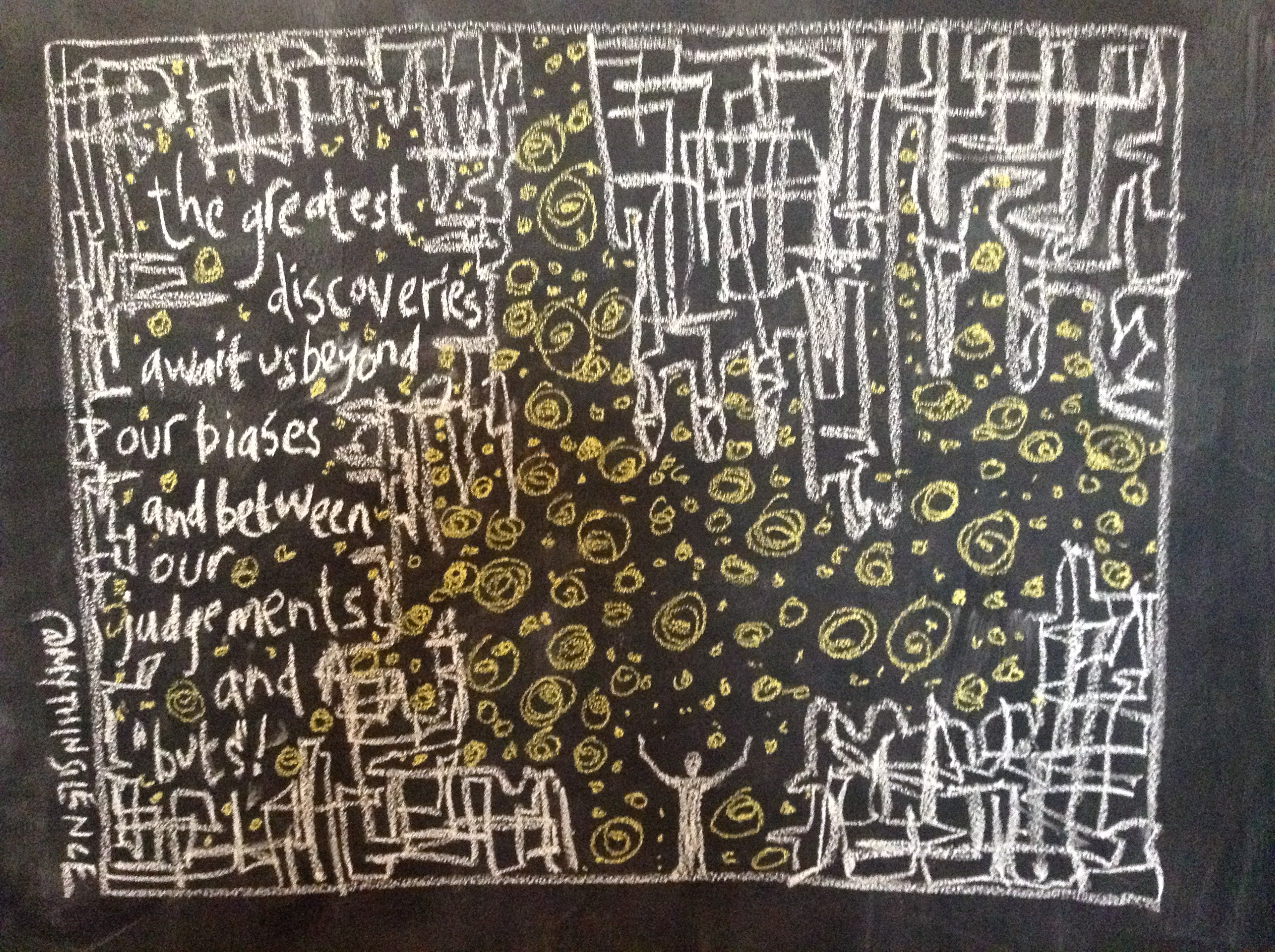
Though it may look as though people who connect more with others in their cities are being given something, a closer look shows that what is really happening is the opportunity for people to bring and develop their genius through combining theirs with the genius of others.**  It’s why I’m a member of transformative space shaping group called Cities That Listen.^

You may not live in a city, but knowing that more happens when people get together means you can create your own cities of genius.

(*Geoffrey West, quoted in Jonah Lehrer’s Imagine.)
(**There is homework to be done, though.  Once we know what we are capable of, we develop this on our own and connect with others – then something astonishing happens.)
(^Cities That Listen lives and breathes a way of listening and encouraging and activating innovative thinking, relating, and behaving.  We’d love to share and spread the stories and processes we’ve been employing, so they can be used in more places.  Get in touch to find out more.)