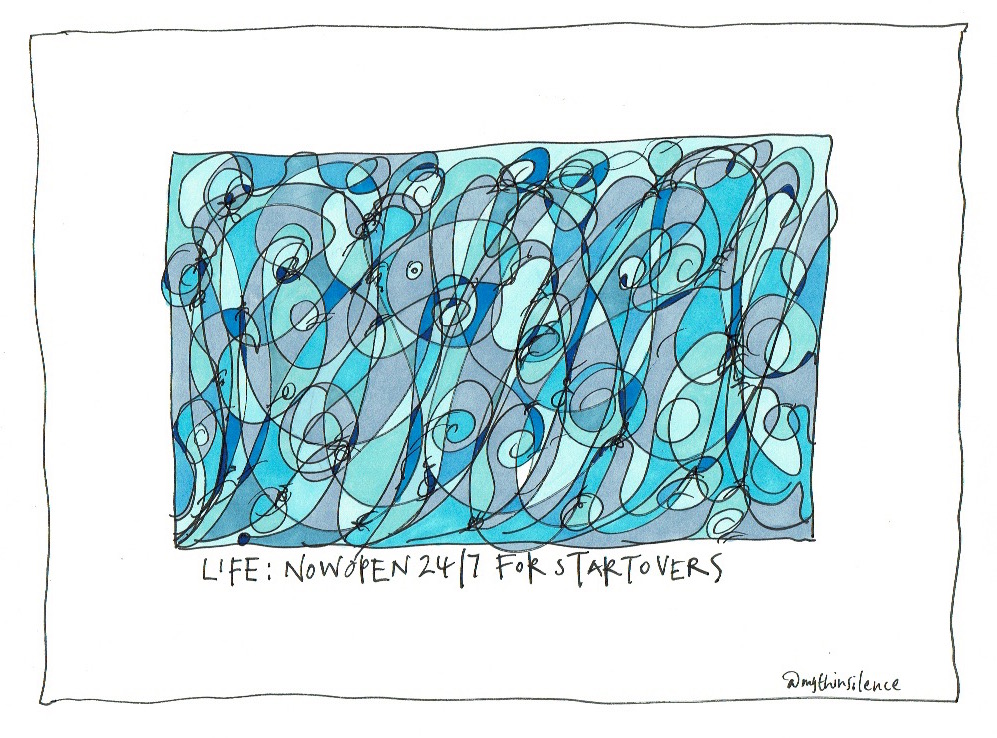
choose blue not red

13 life now open

There’s nothing quite like getting another chance.  Just when we thought we’d messed up so badly that we’d completely blown it.

We need to remember, though, that life is drama rather than theatre; it is unscripted, unfolding.  We can always write the next sweep of story.

The key is to go deep, kindly:

‘Focus on the real problem, not the first problem.’*

Chan Kim and Renée Mauborgne write about the difference between red ocean and blue ocean strategies.  The red gets nasty when we engage in a small, competitive ocean of scarcity; this is theatre-thinking – we think we know how things work and what will happen.  The blue is about opening ourselves to the new possibilities no one else is thinking about or imagining – this is a dramatic story of who knows what will happen next.**

When it comes to the things we’ve got wrong, we think it’s going to be red ocean – getting bloody and very messy, so we avoid facing our wrongs and mistakes like the plague.

The blue way, however, promises that if we go deep, kindly, then we’ll see things differently, we’ll grow wiser, and we’ll find new possibilities because the universe can be about abundance we can share with others.

Our choice.

(*From Michael Bungay Stanier’s The Coaching Habit.)
(**From Chan Kim and Renée Mauborgne’s Blue Ocean Strategy.)

fake questions

12 our questions change the story

What does it mean to you to be human?

There are as many answers to this question as there are humans.  It’s a real question, and our answers will show just how fond, or not, we are of facing searching questions.

If it were a fake question, it would be telling you how you ought to be human.  It’s only asking for your best imagination and hope – fake questions offer advice in the form of a question.

Another kind of of fake question is the switched kind, like, Who has most inspired you? or, to switch the switch, Who would you not want to be like? – they are  less-demanding than the answers to the real questions.

Fake questions allow us to absence ourselves from the deep work, covering up the real issues even more – closing down minds, hearts, and wills.

Real questions help us to get to the source, not to a symptom – being deeper than we imagine, they make it possible to journey closer to knowing what we are capable of – whatever that might be.

‘When people start talking to you about the challenge at hand, what’s essential to remember is what they’re laying out for you is rarely the actual problem.’*

‘People don’t need new facts – they need a new story.’**

(*From Michael Bungay Stanier’s The Coaching Habit.)
(**From Blake Mycoskie’s Start Something That Matters.)

when the question is the servant

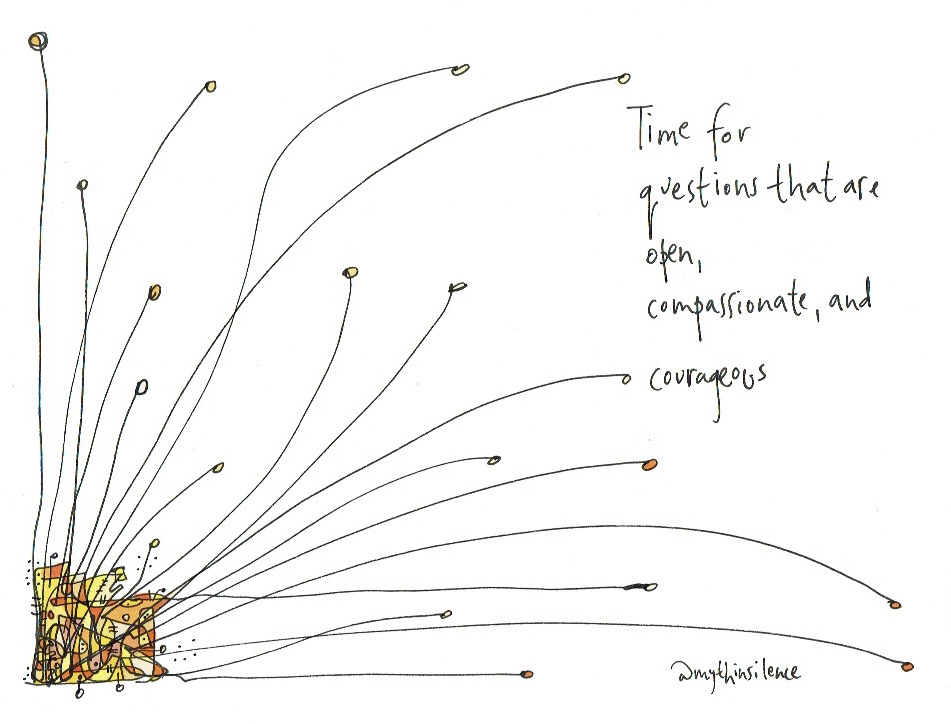
11 time for questions that

There are times when questions are not servants.

When they’re after the answers the questioner wants to hear.

When they want to prove you’re wrong, or stupid, or unfit.

“And the point is to live everything.  Live the questions now.”*

Quick answers, easy answers, predictable answers, steal from us the exploring of possibilities.

Great questions are beautiful in their form.  Michael Bungay Stanier offers “And what else?” as a question that can be asked several times to go deeper:

‘More recent studies have found that follow-up questions that promote higher-level thinking (like “And what else?”) help deepen understanding and promote participation.’**

Another example is, “Why is that important to you?”  A simple question that can be asked several times.  Krista Tippett holds that a beautiful question elicits a beautiful answer, and a generous question elicits a generous answer.

Servant-questions desire the best for others, trying to help people across the boundaries preventing them reaching their future Self.  We live, though, in a culture that goes for quick answers, running too quickly for structure.  Questions prolong the mess, yet the mess is where some of the most beautiful of future possibilities can appear.

“I’m a firm believer in the chaotic nature of the creative process needing to be chaotic.  If we put too much structure on it, we kill it.”^

(*Rainer Maria Rilke, quoted in the Northumbria Community‘s Morning Prayer.)
(**From Michael Bungay Stanier’s The Coaching Habit.)
(^Pixar producer Lindsey Collins, quoted in Creativity, Inc..)

relaxing, kindness, and what we do not know

10 relax, be kind

Humans move into the unknown one life at a time, each person being capable of uncovering something new, something we didn’t know before, somehow making the invisible visible.

No matter how far we’ve journeyed – and we’ve come a very long way, there remains more that is unknown than is known.

Some move forward as if they know what they are moving into, but in reality, the unknown requires we make endless course corrections.  Something then begins to happen.  It’s as though the future is telling us what wants to happen.

‘[T]here is a sweet spot between the known and the unknown where originality happens; the key is to be able to linger there without panicking.’*

“The most important thing about art is to work.  Nothing else matters except sitting down each day and trying.”**

We do not go blindly into the great unknown; we each carry a curiosity for something – call it our art – which we pursue in the form of questions – open questions, not closed ones, and not one but many.

When we relax and go with the flow, more opens up.

Which also brings failure and the need to start over, so we need to be kind to ourselves.

And we need to believe that what is unknown, will reveal itself when it wants to, to the people it wants to reveal itself to.  To those who humbly ask, knock, and seek; not to those who demand, not to the violent.

To people like you.

‘We are partners in the unfolding of the universe.’^

(*From Ed Catmull’s Creativity, Inc..)
(**Steven Pressfield, quoted in Chris Guillebeau’s The Happiness of Pursuit.)
(^From Joseph Jaworski’s Source.)

passion and time and questions

9 beyond simplicity

‘How can we reconcile these two facts – that we hate randomness, and yet need it to succeed?’*

‘An infinite player does no consume time but generates it.’**

‘Ask the question.  (And then shut up and listen to the answer.)’^

In this universe of randomness, passion is our guide, claims Frans Johansson.  If we’ve identified what most energises us, we know our passion will never lose its way.

Passion also does something strange with time.  It can feel like time is standing still.  We seem to move faster and get more done.  When passion is not involved, though, time can drag and we get less done than we wanted to.  We even say, we’ll make time for the things we love.

Questions are always better than advice, and one question is never enough.  Questions are the best way of drawing out from someone the advice that already exists within them.

When we begin to grasp the power of passion and time and questions, and turn these into daily practices, we find ourselves being reborn into complexity and perplexity and harmony – a universe that is complex and random in the extreme, yet beautifully and amazingly holds together to make life flourish.

‘By practice, we mean doable habits or rhythms that transform us, rewiring our brains, restoring our inner ecology, renovating our inner architecture, expanding our capacity. We mean actions without our power that help us become capable of things beyond our power.’^^

(*From Frans Johansson’s The Click Moment.)
(**From James Carse’s Finite and Infinite Games.)
(^From Michael Bungay Stanier’s The Coaching Habit.)
(^^From Brian McLaren’s Naked Spirituality.)

absolute beginners

8 we all have to begin somewhere

[I]n Japanese Zen, [the] idea of not being constrained by what we already know is called “beginner’s mind.”  And people practice for years to recapture and keep ahold of it.’*

Brian McLaren frames life in terms of four seasons: simplicity, complexity, perplexity, and harmony,** so I thought to use these as a way of exploring our universe of randomness.

Simplicity believes, once we have learned or experienced something, that’s it – but complexity challenges us to see that this way of seeing and understanding cannot help us navigate an ever-opening universe.  Our openness is critical.

In perplexity, we understand things to be far more complex than we’d thought; life is absolutely random.  But there are more skills we can learn, helping us to interact with randomness as in a dance.  Here we find some of the richest possibilities – for ourselves, one another, and our world.  Whilst complexity corresponds to Nassim Taleb’s Mediocristan, perplexity is Extremistan.^

Harmony lies beyond perplexity, where we identify something rich and significant for us, worth investing ourselves in for others.

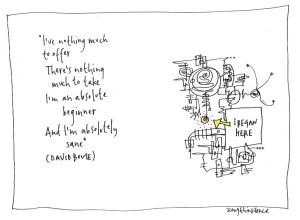
If, at the end of it all, we’re still absolute beginner, we’ll have made some of the greatest contribution we could possibly have made.

8 i've nothing much to offer

(*From Ed Catmull’s Creativity, Inc..)
(**From Brian McLaren’s Naked Spirituality.)
(^See Nassim Taleb’s The Black Swan.)

disguises, surprises, and triggers

7 seeking out

Disguises are what we wear to hide our true identity from others, for all manner of reasons.  But possibilities also come in disguise.

Surprises are the many possibilities the universe throws in our direction, what we miss if we’re only focused on certain things or the same things or the wrong things.  Surprises can also come in disguises.

‘[W]e are what we pay attention to.’*

‘If we are looking for something specific, we set aside anomalies and stay focused.’**

Triggers are the things which cause us to behave in certain ways – positively or negatively: “Why do we feel guarded or suspicious when we’re with this person?” or “Why do I feel elated when I’ve been doing this task?”  Triggers often surprise us, because they were disguises.  (We don’t usually notice what’s on our mind.)

The world needs us to turn up without disguise, bringing our beautiful art, whether this is thinking, relating, or doing.

Turning our attention to surprises can lead us into new dimensions of life and the contribution we can make.  We need to surprise ourselves by using different ways of asking questions or being curious, or watching and listening.

Recognising triggers can help us create more positive trigger-times, and replace or manage negative triggers with positive ones.

Throwing off our disguises, following surprises and being mindful of triggers, make it possible to enter into a beautiful place of possibility:

“Synchronicity is being open to what wants to happen.”^

“Possibilities can be disguised.  They can be blurred, and the most important thing – they flicker.”^^

(*From Michael Bungay Stanier’s The Coaching Habit.)
(**From Frans Johansson’s The Click Moment.)
(^David Morsing, quoted in Peter Senge, Joseph Jaworski, Otto Scharmer, and Betty Sue Flowers’s Presence.)
(^^Former Ecuadorian President Jamil Mahuad, quoted in Frans Johansson’s The Click Moment.)

what will you be doing as a result of the next five steps you’re going to take?

6 do something

Who knows where the next step will take us, never mind the following four.

Exactly.

‘In order to harness complex forces you must first create something for the force to latch on to.  You must actually do something, even if you are not sure where it will lead.’*

What do you do if you have a lot of snow?

Build an ice hotel!

But you’d be wrong.

You start with an idea of bringing in some people who can create some ice sculptures, get even more people involved, have a go at making an igloo, then a bigger building able to house an expo, and eventually get to build an ice hotel – which took several winters to achieve*

To begin a journey like this, we need to observe more, but not from the sidelines.  When we enter into the complexity and see what happens, then wen find ourselves on one of the most amazing journeys in the universe, and it involves exploring our humanity.

When we see more, we can try more.  This is what makes an infinite player: finite players  believe they have to be free to do what they want to do; infinite players know they are free to make time to do what they want to do.**

We’re already free to prototype,^ and when we do, we’re allowing ourselves to step into the complexity full of unknown possibilities.

“Once we had that idea we had to try it out immediately.  I like that way of working – you don’t just talk about it, you try it.  No matter if it doesn’t work.”^^

(*From Frans Johansson’s The Click Moment.)
(**See James Carse’s Finite and Infinite Games.)
(^ See Otto Scharmer’s Theory U.)
(^^Creator of the original ice hotel Yugre Bergqvist, quoted in Frans Johansson’s The Click Moment.)

performance or development?

5 presence

‘Call them forward to learn, improve and grow, rather than to just get something sorted out.’*

An ancient scripture speaks about focusing on inner beings and hidden hearts, which I take to mean development over performance.

Improving performance helps us to deal with a given situation better, but the situation may be a one-off in what is a random, and some would argue, chaotic universe.

Development helps someone to be more imaginative and adept in the same universe.

Pixar undertakes post-mortems on its films, learning from both the good and the bad (don’t we wish we could get away with just the good things?), with five things to look out for: consolidate what’s been learnt, become a teacher of others outside of the project, don’t let resentment fester (everything is people, i.e., relationships), force reflection, and pay it forward (there’s always a What next?)**

We may occasionally need to focus on performance, but it’s a short game; those who focus on development are playing the longer game.  And those who help others to cross borders, rather than simply identifying them.

(*From Michael Bungay Stanier’s The Coaching Habit.)
(**From Ed Catmull’s Creativity, Inc..)

gently does it

4 when we are gentle

None of us can take pride when others get it wrong; we all make mistakes.

We wished we didn’t.

We need is a way to recover; we require a gentle way back. Perhaps gentleness is the way.

Life is fragile; handle with care.

There’s no point in comparing ourselves to someone else.  It doesn’t help us become our future Self.

Gentleness isn’t about “anything goes.”  Gentleness has powerful substance in that it is humble, grateful, and faithful.  Or, in other words, gentleness arises out of deeply knowing who we are – warts and all; it carries a deep gladness for being able to begin again; and, displays a deep willingness to pass gentleness on to others.

The gentle person refuses to judge, instead remaining open for as long as possible – they are grateful for not being judged by others.

If a Tunisian municipal officer slapping a market vendor can ignite a series of actions and events that lead to the Arab Spring, what can gentleness instigate?*

The question is, how can gentleness become a force of nature in a random world when it comes from within: deep calling to deep?

Gently does it. The challenge to be gentle is one we face each day.

Be gentle to yourself, don’t judge too quickly that this is who you are; be open to who you can become.  Then share with others, gently freeing their hopes and dreams, as well as their talents and experiences.

(*The story of the opening movement of the Arab Spring are played out by Frans Johansson in The Click Moment.  Johansson identifies three different complex forces: unintended consequences, a cascade, and, the self-reinforcing loop, of which the Aran Spring is a cascade.)