hospitably yours

4 creating spaces of enlightenment

‘A tribe that communicates more quickly, with alacrity and emotion, is a tribe that thrives.’*

“Freedom is not the absence of structure … but rather a clear structure that enables people to work within established boundaries in an autonomous and creative way.”**

There are spaces for copying the performance of others – most spaces are like this.

And there are the spaces in which the host(s) make it possible for their guests to go beyond what they can teach.

One environment reacts to an immediate problem.

And the other initiates future solutions.

There’s great humility to be found in such spaces.  The host humbly encourages their guest(s) to surpass them.

The guest humbly acknowledges what they can become together with others is far more than they can become on their own.

Such places are enlightening in the true sense of the Enlightenment:  the shedding of light on our potential as Human Becomings: “in your light we see light.”^

(*From Seth Godin’s Tribes.)
(**Erich Fromm, quoted in Peter Senge’s The Necessary Revolution.)
(^A interesting phrase from Psalm 36.)

persistently opening

3 why we need each other

‘Answers cure you, answers help you.  Asking questions make you feel alive.’*

“If everybody is doing it one way, there’s a great chance you can find your niche by doing it in exactly the opposite direction.”**

For twenty three years, he’d been pointing out what was wrong in the system he and others were living in, but no one was listening.

His life had become persistence personified and there was a word that described this and meant so much to him.  It was a word had come to describe the labour of people who began their day before dawn so they would not be overcome by the heat of the day.  In his tongue the word was hashkem: to shoulder a burden or load.^

We need those who bring different perspectives to us, who ask the questions we hadn’t thought of asking.  We need these people to be persistent, to not give up when we charge them with not collaborating or being inaccessible because they’re not using the same words as everyone else, or doing the same thing.

When answers come too quickly, or they look a lot like what we want them to look like, or they satisfy us so that we don’t ask further questions, then we need to be wary.

If you are the one who sees things differently to everyone else, we need you.  You may want to try this word hashkem out for size; don’t give up.

Our imagining of a better future is our attempt to imagine a better now.

(*From Albert Espinosa’s The Yellow World.)
(**From Linda Rottenberg’s Crazy is a Compliment.)
(^Eugene Peterson unwraps this story of the Hebrew prophet Jeremiah’s persistence in his book Run with the Horses.)

welcome more than you ever imagined

2 when we dare

“Poor people deserve to feel beautiful too.”*

‘I first had to recognise my passion. … My next step was to make time for it, to find ways to integrate my passion into my ordinary days, and to stop measuring myself against some irrelevant standard of efficiency.’**

Dare to Dream is the name of the Scottish International Storytelling Festival’s campaign to encourage schools and communities up and down Scotland to dream of a better future through story, as well as gather the stories they want to carry with them from the past.^

When I heard about this, I needed to check it out because daring to dream with individuals is where I love to be, living between the truth of people’s lives and the possibilities.  This isn’t daring to dream in a vacuum, but through talents and passions, including some of the most difficult things life can be:

“[E]ven the saddest things can become, once we have made peace with them a source of wisdom and strength for the journey that still lies ahead.”^^

Taking what is already there, we move it further.  We are here because of following our curiosities, developing practices around these, then deepening them, and forming creative habits – some less visible than others.  The more we are open, recognising and welcoming these things, then we’re welcoming more than we ever imagined and we are daring to dream.

(*Slum entrepreneur Leila Velez, quoted in Linda Rottenberg’s Crazy is a Compliment.)
(**From Gretchen Ruben’s The Happiness Project.)
(^This is an example of why I love living in this country.)
(^^Frederick Blechner, quoted in John Ortberg’s All the Places to Go.)

without appointment

1 all we have is love and imagination

“If you let yourself be absorbed completely, if you surrender completely to the moments as they pass, you live more richly those moments.”*

‘[T]he first thing I should do is to take a moment, to consider what is actually being asked for, to adopt an attitude of humble inquiry, to be a process consultant.’**

From today, “without appointment” is how I’m recorded within my institution.

I am now officially on my own to pursue the work I have felt called by for some time.  It’s a new story, a new land to be journeyed into.  Whilst there are a number of things I know this new direction will include, there are many people and things I’ve no idea I will come upon.  These will emerge from the future, inviting me to be attentive, the become, to act.

This will mean, in order to keep journeying, there will be things I must let come, as well as things to let go – and maybe even some of the hopes I hold right now.

‘A world that works for everyone does not exist, except in our imagination.  So we must feed the imagination.’^

The future asks of me, “What can you imagine?”

Imagination isn’t solely a mental process, but one that combines heart and mind: ‘the heart may perceive future events before the brain does … at the very least it implies that the brain does not act alone in the perception of future events.’^^

We exist in an age when we’re discovering and developing our perceptual skills, being open to others, our world, and our future self.  It is the appointment I’m seeking to be busy in.

Ramez Naam imagines what this will mean – I echo his sentiment, though add the heart to this:

‘We stand poised on the brink of the largest ever explosion of human mental power, a second renaissance more transformative, more far-reaching, and more inclusive than the first.’*^

(*Anne Morrow Lindbergh, quoted in the Northumbria Community‘s Morning Prayer.)
(**From Edgar Schein’s Helping.)
(^From Alex McManus’s Makers of Fire – ebook version.)
(^^From Joseph Jaworski’s Source.)
(*^From Ramez Naam’s The Infinite Resource.)

running with rosie

31 i prepared for this moment

Rosie Ruiz won the 1980 Boston Marathon.

Except she didn’t:

“I saw a woman coming out of the crowd on the south side of Comm Ave and start running. I thought it was a hoax or someone running just for the fun of it. She did not run with an elite runner’s style or form.”*

Rosie had run about a mile.

She never admitted to the fraud and even said that she would run another marathon to prove her running ability, though it’s unlikely she ever did. One reporter concluded that Rosie really believed she’d run the marathon; it seems she was trapped inside her own lies.**  Rosie was not an elite runner, but if she’d trained, she may have become really very good.

Running with Rosie is about being tempted to take shortcuts in life; we try to be something on the outside without being that something on the inside.  It’s about how we can fool even ourselves into thinking this life is normal.

It’s also about everyone being able to build their unique kind of capacity, whatever their age.  The kind of capacity that’s able to take the things that life brings and make something beautiful out of them.

Learn to do for yourself.  It’s the only way to broaden your skills.’^^

(*John Faulkner, friend of reporter Alice Cook.)
(**Eugene Peterson tells Rosie’s story in Run with the Horses.)
(^From Twyla Tharp’s The Creative Habit.)


the inner life

30 why not begin

It sounds positively monastic, but it’s just life.  To live without veneer.

‘Why try to recover someone else’s originality? … Servitude through admiration or tradition must be cast off.’*

Richard Sennett tells of how luthiers have tried to uncover the secrets of Stradiveri and del Gèsu, but without success.  In truth, the way these men crafted their instruments was made up of millions of nuances comprising their uniqueness.

To try and disguise who we are with a more impressive persona is to live beneath a veneer, but so too is the copying of others, no matter how great such an aspiration in this may be.

Inspiration is more liberating.  Be inspired.  Develop your own uniqueness.  Inspire others.

The best workshop a craftsperson has is their own life.

(*From Richard Sennett’s The Craftsman.)

blue steel

29 purpose

[P]erhaps, the wild ones amongst us are our only hope in calling us back to our true nature.’*

‘The only way to fix a broken story is to embed it in a larger story, that begins and ends well.’**

Model Derek Zoolander‘s names his eponymous pose Blue Steel.

Your Blue Steel, though, is a heart thing, not a face thing.  it is the intensity you feel deep down inside to do something which may place you out of step with many others. When others seek safety, you know safety is a place to venture out from and return to, but not to live permanently.

It begins with how you connect to who or what we must be about at the beginning of each day – perhaps a ritual or habit that makes this possible and you would painfully miss if it were somehow not available.  It says, “I am armed and dangerous for something purposeful and wonderful.”

Often unnoticed, you make a difference in the fabric of someone’s universe.

(*Joel McKerrow, quoted in the Northumbria Community‘s Morning Prayer.)
(**From John Ortberg’s All the Places.)

helping in the other direction

28 don't be

‘Pure inquiry biases the interaction toward going with the flow, and that must be balanced by constructive opportunism.’*

‘A waker is someone who is very good at waking other people from their metaphorical slumber, temporary or otherwise.’**

We’ve all experienced it.  The person who tries to help us and they’re not helping at all.

Unless this is exactly the help we need.

When the last thing we need is help in the present direction of our lives.  When help in the opposite direction is exactly what we need because we’d never find our way to this place unless we were helped from beyond.

In a world where we can still aspire to get by without any help – “I did it my way” – the real divide isn’t between those who need help and those who get on by themselves, but between those who know being human is about giving and receiving help and those who refuse to give and receive.

We all need help from beyond ourselves.

(*From Edgar Schein’s Helping.)
(**From Hugh Macleod’s Evil Plans.)

and we are flawed

27 need a t shirt

A hopeful future requires that we find some way of opening to and being present to one another in our imperfections and incompleteness.

Yet, even with these things, we have more than we know, and bringing them together provides the future with an advantage.

It’s more dangerous when we make out that everything is okay with us, or with some situation, because our covering and protecting ourselves with okay makes us incapable of being fully present in the new possibilities which come along.

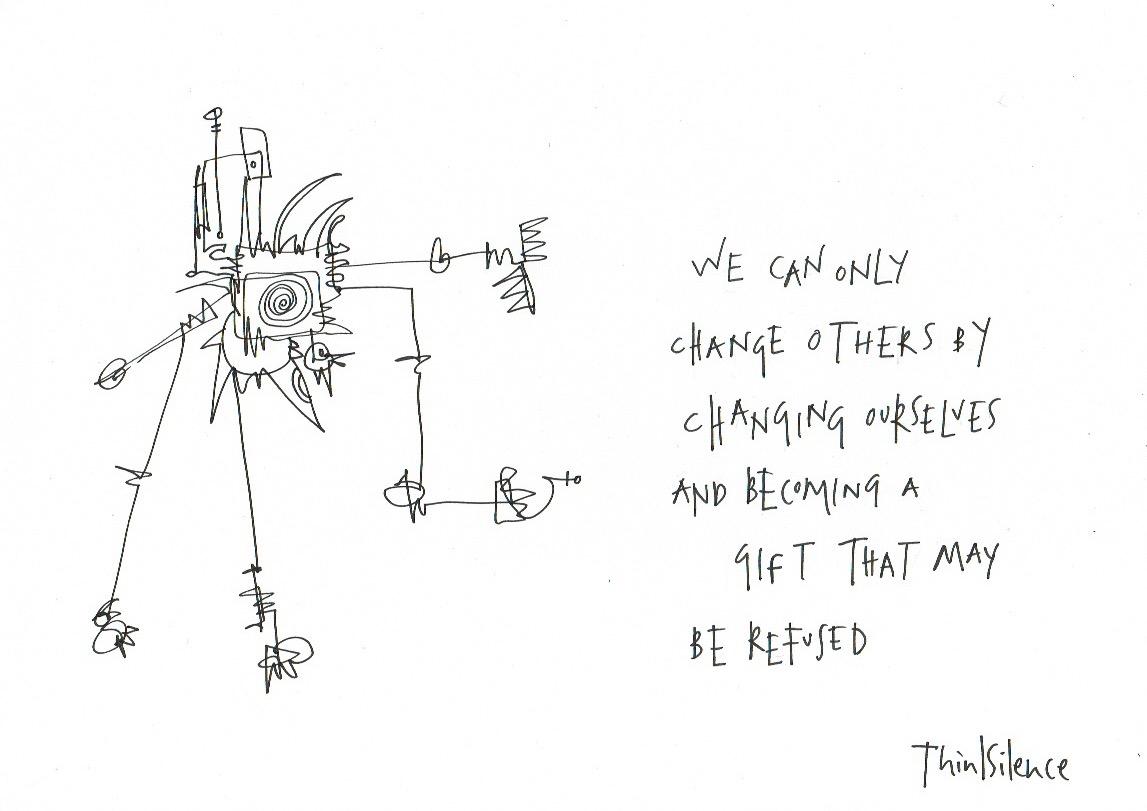
Something magical happens when we admit we make mistakes, we don’t know everything, we’re not the answer: we become new people.


seek, ask, knock

26 a friend is

‘Old age offers the opportunity to integrate and bring together the multiplicity of directions that you have travelled.  It is a time when you can bring the circle of your life together to where your longing can be awakened and new possibilities come alive for you.’*

‘[T]he confrontational question introduces new ideas, concepts, hypotheses, options, etc. that clients must now deal with.’**

Novo Nordisk decided there wasn’t a lot of room for improvement when it came to insulin quality.  Instead, the company turned its attention to improving the experience of the insulin user, including introducing the novopen, and so ‘transformed the company from an insulin producer to a diabetes care company.’^

Apparently, there was lots more improvement to seek out, different questions to be asked, and new doors to walk through.

It’s the same for all of us – we just sometimes need another person, or a group of people, to help us

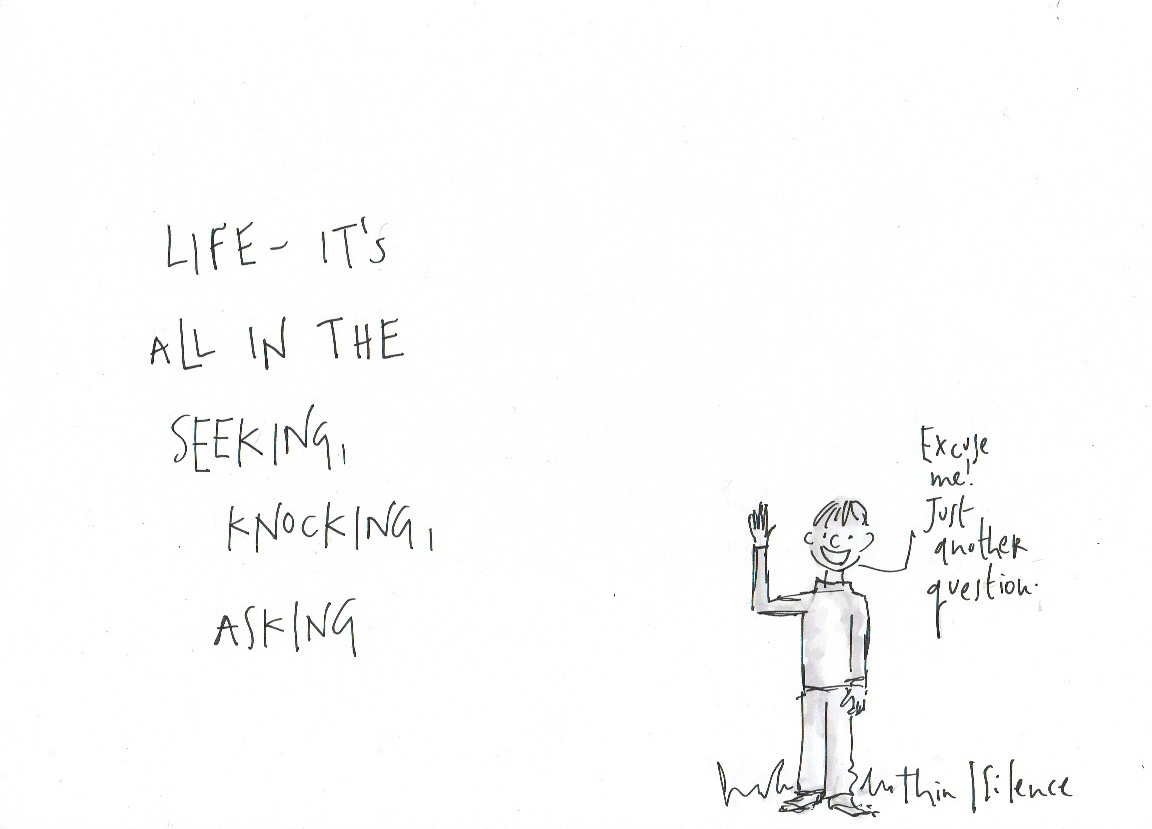
We are at our best, and life is bigger, when we’re seeking, asking, and knocking, towards creating the future rather than repeating the past.

Though, if it was this simple, everyone would be doing it, but they’re not – because it’s hard.  Daniel Kahneman highlights what goes wrong when we give up seeking, asking, or knocking towards what we do not know:

‘The familiar [thinking] processes of WYSIATI [what you see is all there is] and substitution [with an easier question] produce both competition neglect and the above average effect.’^^

In other words, “We don’t have to improve; we’re doing better than most.”

This is a choice, of course.  It doesn’t have to be this way.  We’re more capable than we know of becoming ‘creative nonconformists, … difference makers, aliveness activists, catalysts for change.’*^

(*From John O’Donohue’s Anam Cara.)
(**From Edgar Schein’s Helping.)
(^From Chan Kim and Renée Maugborne’s Blue Ocean Strategy.)
(^^From Daniel Kahneman’s Thinking, Fast and Slow.)
(*^From Brian McLaren’s We Make the Road by Walking.)