new containers

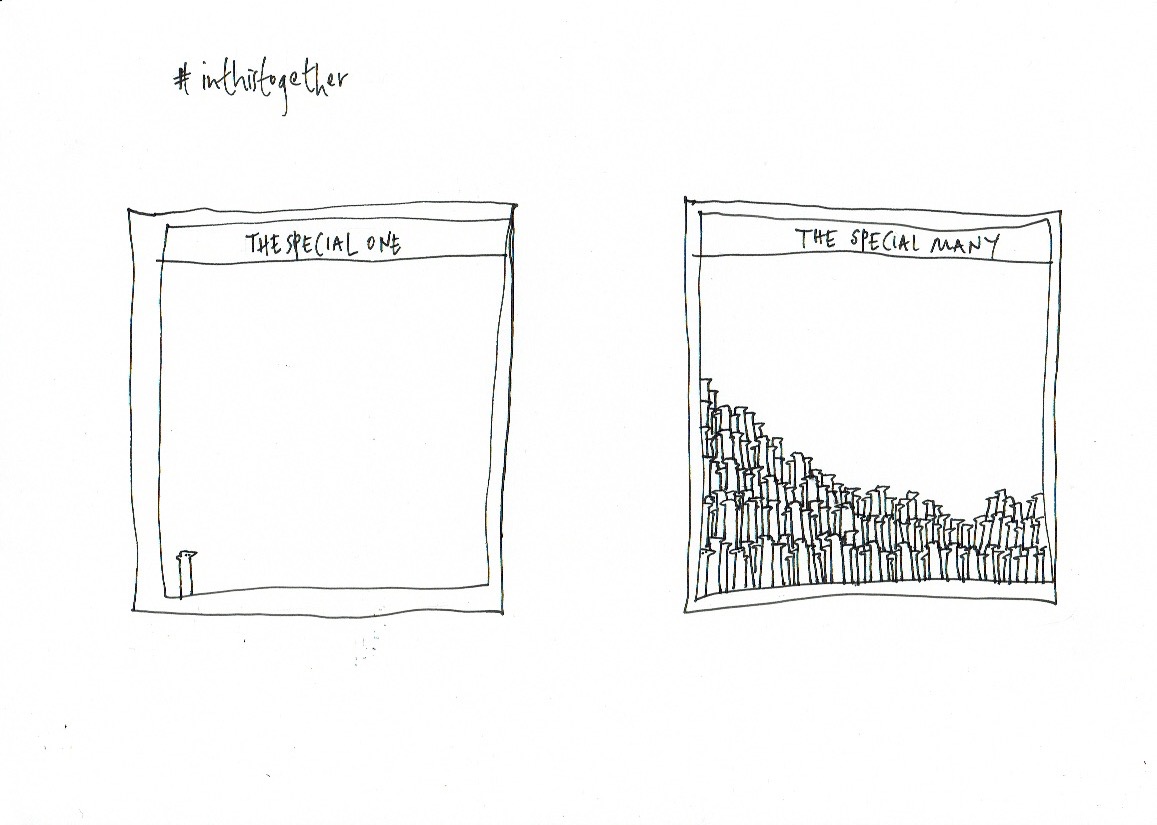
‘The creation of new life often requires a specialised “container” because established systems are basically hostile to the “other,” “the outsider,” “the alien.”*

‘Moral concepts do not move about within a hard world set up by science and logic.  They set up, for different purposes, a different world.’**

The most destructive forces can be those calling us back to a past idyll that never existed.

The most positive forces call us to a future we cannot see alone but only together, what can be and who we can become.

The best of our stories and myths and religions know this.

Do we make terrible mistakes?  Absolutely.  Do we stumble around lost?  More than we care to admit to our embarrassment.  There is, though, in almost everyone, this deep-down sense that there’s a better future being moved towards.

Perhaps the only helpful distinction for us to note is that there are people becoming more open to the flow of life and those becoming more closed.  With the caveat that we’re free to change direction whenever we choose.

(*From Peter Senge, Joseph Jaworski, Otto Scharmer, and Betty Sue Flowers’ Presence.)
(**From Iris Murdoch’s The Sovereignty of Good.)

the considerer


Origin: Late Middle English: from Old French considerer, from Latin considerare ‘examine’, perhaps based on sidus, sider- ‘star’.

‘You have to walk and breathe and give, and – voilà! – you’re in the flow.’*

There’s something really important about noticing what is already there.  Erich Fromm wrote about requiring that a patient ‘acquires or has some idea of what his life ought to be or could be’.**  I am a “patient” too.

To connect with the flow that life is – to one another, our world, ourselves, everything requires our deep consideration.

I found myself recently in an organisation’s conversation about its purpose.  It felt very much that people would have to figure out how to fit in if they were to become part of it.  I couldn’t help but reflect, rather than people having to do this why not help them to bring out and to bring what was already inside of them.^

I found myself continuing to consider this as I read some words from John O’Donohue, Alan Lightman, and Jacques Goldstyn’s young protagonist.  I offer them in the order I read them:

‘The soul is always wiser than the mind, even though we are dependent on the mind to read the soul for us.’^^

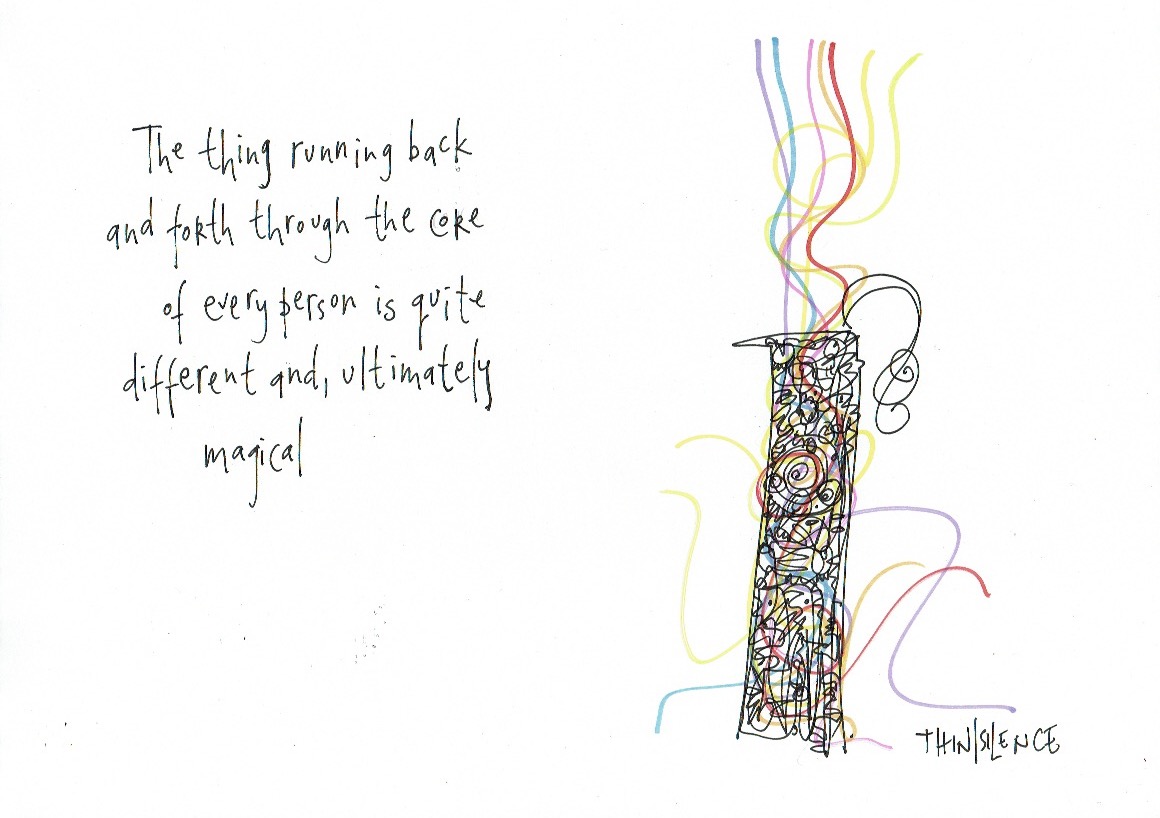
‘Roughly speaking, the scientist tries to name things and the artist tries to avoid naming things […] Every electron is identical, but every love is different.’*^

‘To tell the truth, I have a feeling I’m not like other people.  Not just because of the mittens.’^*

I found myself with more questions.

Is John O’Donohue’s “soul” a way of understanding how we understand ourselves and connect to the flow, for everyone, not just the religious?  Maybe it’s about our unique way of “examining the stars”?  A way of joining science and art?  Getting to live all manner of weird and wonderful things with our identical electrons?

Chris Guillebeau writes about what he’d noticed people doing when they identified their “weirdly different” (my phrase):

‘It was as if they had chosen a particular kind of life and then changed other circumstances to accommodate it.’⁺

We’re each l capable of being considerers: noticing slowly and deeply, examining, exploring, wondering, wandering.

(*From Richard Rohr and Mike Morrell’s The Divine Dance.)
(**From Erich Fromm’s The Art of Listening).
(^ I couldn’t help but see Michelangelo’s unfinished sculptures which now reside in Florence – images that have become deeply influential for my work.)
(^^From John O’Donohue’s Eternal Echoes.)
(*^From Alan Lightman’s A Sense of the Mysterious.)
(^*From Jacques Goldstyn’s Bertolt.)
(⁺From Chris Guillebeau’s The Happiness of Pursuit.)

with gentleness and imagination

Here are two words that emerged for me as I began the day.

There’s something about gentleness and imagination that can make people nervous, even fearful, though.

I wonder whether there’s a kind of gentleness that allows us to deal well with ourselves, freeing our imaginations, and whether this, in turn, fires our gentleness with all kinds of possibility.

Flow.

Flow is a dangerous place to be because it is open-ended, taking us from ourselves to others, to other places, to other thoughts – not in order to judge but to be a gift.

In his beautiful children’s book on identity, friendship, solitariness, and death, Jacques Goldstyn’s young protagonist reflects:

‘The only problem is that when you’re different, people can laugh at you, or even worse.  Sometimes people don’t like what’s different.’*

Earlier, I had read these words from Anne Lamott on mercy, which I think explains something of why gentleness is so powerful taking on big challenges to our lives:

‘Mercy is radical kindness.  Mercy means offering or being offered aid in desperate straits.  Mercy is not deserved.

[…]

Mercy, grace, forgiveness, and compassion are synonyms, and the approaches we might consider taking when facing a great big mess, especially the great mess of ourselves – our arrogance, greed, poverty, disease, prejudice.’**

In the disarming way Anne Lamott opens up her life to scrutiny, she continues:

‘Kindness towards others and radical kindness to ourselves buy us a shot at a warm and generous heart, which is the greatest prize of all.  Do you want this, or to be right?  Well, can I get back to you on that?’**

It’s a different way of living I don’t know enough about.

I’m learning to be more open to who others are and to what they think.  Perhaps this is beginning..  And I have an inkling that gentleness allows people not only to be who they but to be who they are even more beautifully, more creatively, and more generously.

Flow.

I smile at Nassim Taleb’s aphorism concerning how we think we know more than others, including what others know about themselves:

‘The problem of knowledge is that there are many more books on birds written by ornithologists than books on birds written by birds and books on ornithologists written by birds.’^

So I wonder what imaginative gentleness might look like.  Maybe it won’t answer every question or solve every problem but I get the sense that it’s a preemptive disposition for life.

(*From Jacques Goldstyn’s Bertolt.)
(**From Anne Lamott’s Hallelujah Anyway.)
(^From Nassim Taleb’s The Bed of Procrustes.)


i know, i know …


… you don’t have to tell me!

When information becomes knowledge, there’s always the danger of my wielding it as power: I know, you don’t know.

“Nor do I really know myself, and the fact that I think that I am following your will
does not mean that I am actually doing so.”*

‘Motivation is a forest full of twisting trees, unexplored rivers, threatening insects, weird plants, and colourful birds.’**

We surprise ourselves.  This isn’t where we expected to turn up, or, to turn out.

We think there must be something big wrong with us but I wonder whether it’s something really small.  I don’t know for certain but I wonder whether it’s about noticing the small things that have a “tipping point” affect upon our lives.

Karen Armstrong introduces her twelve steps to a compassionate life with a description of the invention (or discovery?) of yoga:

‘the new men of yoga were engaged in the conquest of inner space and in a raid of the unconscious drives that held human beings captive to their ‘me-first’ instincts.’^

We are divergent-emergent-convergent people.  If we only notice the big things, we are only dealing with convergence: this is it.  When we first of all are divergent – noticing the many things, then emergent – noticing the things that connect deeply with ourselves and also deeply with others, then we are capable of moving knowledge to wisdom – something to benefit all.

(*Thomas Merton, quoted in the Northumbria Community‘s Morning Prayer.)
(**From Dan Ariely’s Payoff.)
(^From Karen Armstrongs’s Twelve Steps to a Compassionate Life.)

one, two …

First of all, there were Ones.

Some found being One a disappointing place to be, less than they hoped for, and began imagining what it would be to reinvent themselves as a Two.

Twos are better, more successful … and then some – they spread the word, if we can make it work, anyone can so gain the edge over others, keep telling yourself, work hard.

Others didn’t believe Ones like them could ever become Twos, and began sorting themselves out as One.ones or One.twos.

Only when the Ones and Twos began hearing the whispers did they understand they were really meant to be Threes all along.

In his fable of creation, Alan Lightman has his crating character of Nephew, contemplating the new life spawned by the Big Bang:

‘These mere conglomerations of atoms and molecules discovered my laws.

[…]

I realised that these brains were participating in the beauty of the cosmos, as Uncle Deva had described.

[….]

They were aware of themselves, yes.  They were thinking, yes.  But they were more than thinking.  They were feeling  They were feeling the connection of themselves to the galaxies and stars.  They were grasping the beauty and depth of their existence and then expressing that experience in musical harmonies and rhythms.  And in painting.  In metaphors, and words.  In dance.  In symbiotic transference.  They imagined the cosmos beyond their own bodies.  They imagined.  But they could not imagine where all of it started.  For all their intelligence, there were limits to their imagination.  They could not know of things that were not of their essence.  They could not know of the Void.  But the mystery of such things they did seem to feel, and it tingled in them and opened them up.’*

(*From Alan Lightman’s Mr g.)

entering the dark places

The “adjacent possible” is theoretical biologist Stuart Kauffman’s wonderful term for all the myriad paths unlocked by every novel discovery, the multitude of universes hidden inside something as simple as an idea.’*

‘Listen to your life. See it for the fathomless mystery it is.’**

I came across Stuart Kauffman‘s adjacent possible a few years ago and loved it straightaway.  It spoke to me of the multitude of universes I found hidden inside the lives of the people I met.

These dark and secret places open to our humility, as Edgar Schein so well identifies:

‘Humble inquiry maximises my curiosity and interest in the other person and minimises bias and preconceptions about the other person.’^

(*From Peter Diamandis and Steven Kotler’s Bold.)
(**Frederick Buechner, quoted in the Northumbria Community‘s Morning Prayer.)
(^From Edgar Schein’s Humble Inquiry.)

mtp

A massively transformative purpose.

‘Today, almost anyone with a passion has the power to bring real change into this world’*

The game has changed.

It used to be that we needed opportunity but only a few people were provided this.

When more were provided with opportunity then we needed to come up with a possibility, and idea, something we can make happen.

But now we have opportunities and possibilities and we must now initiate: to move from thinking it and feeling it, to doing it.

This is the hardest part and it begins with the first bold step.  (More tomorrow.)

(*From Peter Diamandis and Steven Kotler’s Bold.)


the back story

‘Many faiths believe that some day a messiah would appear and end all wars, famines, and even death itself.  But the notion that humankind could do so by discovering new knowledge and new tools was worse than ludicrous – it was hubris.’*

‘We are conditioned to search for similarities not differences.’**

Once upon a time there was a back story …

A back story is our way of explaining backwards why things are as they are now.  They’re often told by the people with the power or influence or kudos for why their belief, their political argument, their right to be leader is the right one.  These stories aren’t necessarily true but every day we believe them because we want to, because it’s easier than the alternative.

If Frans Johansson is right (the second quote, above) and we are conditioned to look for similarities – please conform – then we can also be re-conditioned to look for differences.

A forward story is a way of imagining what might be when we understand and express the power and idea we find within, and within a group of people working together.  It’s a story that recognises everyone has something to imagine, to make and to ontribute.  This will sound like chaos to some, but as John O’Donohue helps us see, nobility as a characteristic of being human, is something to be found in all kinds of wild and weird people who do not want to conform:

‘The Irish word “Uaisleacht” means nobility; it also carries echoes of honour, dignity and poise.  A person can be wild, creative and completely passionate and yet maintain Uaisleacht.’^

Richard Rohr argues that every thing has something to offer, too:

‘In fact, you can trust after a while that almost everything is a kind of guidance – absolutely everything.’^^

This is an expansive understanding of the universe and of our place with in it, one with flow in which we find ourselves exploring wonder and meaning.  Richard Sennett writes about anthropomorphism of the brick, blocks of clay built together being described as  a “shining mane of hare,” “mottled skin,” “an old man’s weathered face.”  Furthermore:

‘The attribution of ethical human qualities – honesty, modesty, virtue – into materials doesn’t mot aim at explanation; its purpose is to heighten our consciousness of the materials themselves and this was to think about their value.’*^

There’s something in this that speaks of how it’s possible to be emotionally connected to all people and all things, a way of engaging with our personal gift, too, seeing all kinds of ways for turning it into a contribution because we value it.

Time to be a fabulist and tell a different story.

(*From Yuval Noah Harari’s Sapiens.)
(**From Frans Johansson’s The Click Moment.)
(^From John O’Donohue’s Eternal Echoes.)
(^^From Richard Rohr and Mike Morrell’s The Divine Dance.)
(*^From Richard Sennett’s The Craftsman.)

what more can i do?

‘loosen my heart
until it becomes a wing,
a torch, a promise”*

We don’t know the extent of the we can do, the more – or magis as one group named it – we can bring.**  All we know is that the path to discovery is not an easy one and we can turn away.

There are those who want to get more out of us: more effort, more time, more commitment, more loyalty, more attention, more focus, more output.  This is not about magis.  It misses a trick, the desire that many of us have for doing something we love better, with imagination, innovation, and creativity – whatever it is.  If this is how businesses and companies and relationships operate then there will never be more.

When we step back from the way life happens on a day to day basis, we see how we are part of a universe that makes it possible to find and pursue something that keeps us up at night dreaming and imagining.  In his novel about creation physicist Alan Lightman has his character Uncle Deva speaking about the beauty brought into being by anticipated lifeforms:

“The beauty you speak of – the stars and the oceans and so forth – is part of their beauty, those living things.  And so much enhanced by their participation, by their absorption of that beauty and then the responsive outflowing of their own beauty.  It is a spiritual thing, don’t you see?

[…]

Intelligence, awareness, mindfulness are going to connect the pieces of the universe in a way that inanimate matter never could.”^

When we step back into the way life happens on a day to day basis, we see how we are missing out on the opportunities: in our education system, in our workplaces, in our families, in our societies, in our politics, in our own lives.

The group I mentioned at the beginning was the early Jesuit movement.  450 years ago there were no easy ways to get around the expanding world but within ten years the original group of ten were on four continents, sharing their joy in the new sciences and technology and maths.  They had made those seemingly impossible journeys through a process of self-awareness (what is my dream), innovation (all the different ways this dream can live), love (how can I share this with others?), and heroic deeds (making it happen).

Who wouldn’t want people to show up with this kind of energy, whether its meeting with friends, going to work, taking on a challenge, or being willing to see how much more there is inside each one of us.

‘Ingenuity blossoms when the personal freedom to pursue opportunities is linked to a profound trust and optimism that the world presents plenty of them.^^

(*Dawna Markova, quote in the Northumbria Community‘s Morning Prayer.)
(**Magis was a saying of the early Jesuits; see Chris Lowney’s Heroic Leadership.)
(^From Alan Lightman’s Mr g.)
(^^From Chris Lowney’s Heroic Leadership.)

what next?

There’s always what next?

It’s about being able to see it.

“If people would but do what they have to do they would always find themselves ready for what came next.”*

I’ve just ordered Dan Ariely’s Payoff after reading the following quote in Hugh Macleod’s gapingvoid blog:

“We’re motivated by meaning and connection because their effects extend beyond ourselves, beyond our social circle, and maybe even beyond our existence.  We care deeply about meaning, we care about it more as we become aware of our own mortality – and if we have to go to hell and back in search for meaning and connection, we will: and we will get satisfaction along the way.”**

Motivation opens up our “what next.”  There’s “flow” to these words, the flowing of something into us and flowing out through us – we might name this the “great flow” of life we’re all caught up in.  We participate when we make our small contribution, our “little flow” with all its messiness and mistakes and sometimes beautiful moments.

‘The Great Flow makes use of everything, absolutely everything.  Even our mistakes will be used in your favour, if you allow them to be.’^

I place these words from Richard Rohr side by side with some from Alan Lightman’s Uncle Deva character in his novel about creation Mr g.  The two are looking over the first forms of life, forms that would become intelligent and self-determining eventually:

‘Wouldn’t the beauty have more meaning with other minds to admire it?  Wouldn’t it be transformed by other minds?  I’m not talking about a passive admiration of beauty, but a participation in that beauty, in which everyone us enlarged.’^^

This is a dream about you and me though we doubt it or even refuse it.

One of the most beautifully dangerous things we can do to release our motivation, so that it reaches out across the limitlessness of space, is to write it out.  Social psychologist James Pennebaker has identified how ‘writing about emotional upheavals for just fifteen to twenty minutes on four consecutive days can decrease anxiety, rumination, and depressing symptoms and boost our immune system’.*^

It’s also one of the most powerful ways of releasing motivation and flow from its stuckness.  Writing out our hopes and disappointments, our challenges and questions, our mistakes and failures – staring all of these full on and not being overwhelmed – will lead us to our what nexts.  We connect to the great flow even as we discover the flow of our lives.

Through history literacy has threatened the “powers-that-be.”  Finding our own literacy, writing our story as unfolding drama rather than predictable script, joins us to the possibility of life growing larger.  I am not a very good writer but writing every day for the past nineteen years has constantly moved me in new directions.

The following words come from Ursula Le Guin‘s poem The Mind is Still and connect me with Michelangelo’s unfinished statues situated in Florence’s Gallery Academie.  When I first read of them,  figures wrestling themselves free from the stone which held them, epitomising my story of helping people to awaken to their dreams.  I knew I had somehow to see them and it took me more than four years to make to Florence, and while others rushed past them toward Michelangelo’s David, I gazed on them for more than an hour:

‘Words are my matter.  I have chipped one stone
for thirty years and still it is not done,
that image of the thing I cannot see.
I cannot finish it and set it free, transformed to energy.’

(*George MacDonald, quoted in the Northumbria Community‘s Morning Prayer.)
(**Dan Ariely, quoted in gapingvoid‘s blog Instant motivation.)
(^From Richard Rohr’s The Divine Dance.)
(^^From Alan Lightman’s Mr g.)
(*^From Brene Brown’s Rising Strong.)
(^*From Ursula Le Guin’s Words are my Matter.)