a-mortality and too much life

A-mortality is the indefinite extension of human life, a holy grail some believe is not far away.  I don’t think I’ll be around to see it.

Life is made up of science and story.

Science is about the way things are, including those things we’re able to manipulate.

Story is about the tales we tell ourselves in order to make sense of the past, present and future science we find ourselves in.

Theoretical scientist and fabulist Alan Lightman brings the two together in his novel about creation Mr g.  Nephew, the Creator in Lightman’s fable, encounters the sinister Belhor, visitor one of the planets in one of the universes.   Belhor speaks first, then Nephew:

‘”All little lives, such little lives. […] I find it amusing to see how they live – their cities, their habitats and rooms, their squalid little alleyways filled with garbage.  Did you notice the dirty pools of water in the alley in front of the young woman’s house?”

“Yes,” I said.  A thin film of pollen floated down and covered their surfaces.  The puddle of water split the sunlight and glimmered in colours.  Like diamonds sprinkled about.’*

Here is story.  Like diamonds sprinkled about.  This is like that.

Lightman’s fable continues with Nephew reflecting:

‘One thing I have learned: the mind is its own place.   Regardless of natural conditions and circumstances, even of biological imperative, the mind can control its reality.  The mind can make hot out of cold and cold out of hot, beauty from ugliness and ugliness from beauty.  The mind makes it own rules.’*

Nephew goes on to examine a world in which the males demonstrate and maintain their dominance over the females by disabling their hands by severing critical nerves.  The females are as intelligent as the males but accept this as the way things are.  Lightman is, of course, saying this is only a story they tell ourselves and they could tell a better story.

Someone was telling me yesterday, about a business event they’d attended recently with contributions from business person and a folk singer.  The business guy was encouraging the audience to get into the latest technology, no questions.  The folk singer told a story of a woman whose life had been dismantled by technology:

The following words, from poet Wallace Stevens, call us to stop and reflect on what we think is reality – what he calls “the pressure of reality” – but is only a story we are telling ourselves when our imaginations can do better:

“By the pressure of reality, I mean the pressure of external event or events on the consciousness to the exclusion of any power of contemplation.”**

This is a point creative writing instructor Robert McKee makes in his excellent book Story: we appreciate and enjoy stories so much because they offer an experience but also an opportunity to reflect on that experience.  In life we only have the time to experience.

In his book Payoff, Dan Ariely tells the stories of two workplaces.

One involves a company that notices its employee cubicle’s were being decorated with all kinds of personal details so decided they had too much space and reduced the cubicles by 20% to get more “boxes” in.  The other tells the story of Zappos, a company that encourages its employees to be “weird” when it comes to decorating their workspaces.

We think only children like to play but that’s only a story we’re willing to believe.

With alternative realities or stories available right now there’s already too much life for some –  I’m not too worried about missing out on a-mortality; my question to self is, How will I live my life fully today?

(*From Alan Lightman’s Mr g.)
(**Wallace Stevens, quoted in Maria Popova’s Brain Pickings: Wallace Stevens on Reality, Creativity, and Our Greatest Self-Protection from the Pressure of the News.)

how much of you is here? (investing in motivation)

In Topography of Tears, photographer Rose-Lynn Fisher has captured duotone images of tears shed for many reasons.  Dried onto a glass slide and magnified a one hundred times, the images display tears of grief, change, possibility and hope, compassion, redemption, remorse, and even from peeling onions.

“Perhaps this flow [of tears] is the very proof that we cannot put our feelings in one place and out thoughts in another, the bleak result of a certain rationalism that threatens to overtake our civility – our capacity to forgive – and wants to make all ideas into abstractions, rigid and blunt, free of secretions.”*

When we speak of our motivation, we are speaking of our feelings.

A motivation isn’t simply a thought that we put into action.  The thought has to pass through our heart, through our feeling and determining.  It must carry meaning for us.  Erich Fromm is perhaps adding more to this when he speaks about freedom.  Emerging from opening our minds and hearts:

‘Freedom is not something we have; there is no such thing as freedom.  Freedom is a quality of our personality; we are more or less free to resist pressure, more or less to do what we want and to be ourselves.’**

Dan Ariely comes upon a boss who doesn’t value this intrinsic motivation.  The CEO has cancelled a project without recognising the hard work or explaining why it’s been necessary.  Maybe the CEO believes interesting and well-paid work is enough to be able demand anything necessary of the employees.  In speaking to the engineers who’ve worked so hard and been left high and dry, Ariely tells them:

‘[I]t seems like your CEO doesn’t see the value of investing in your motivation.’^

When asked by Ariely about their working day, these same employees admitted they were turning up for work later and leaving earlier.

My reason for mentioning this is it looks like a case of feelings don’t matter at work.

Erwin McManus identifies the human quest for honour as critical: from humility to integrity to courage – an everyday courage that opens the future:

‘Our courage directly affects the speed at which the future unfolds.’^^

I mention this because humility is really about seeing ourselves in a new and more accurate way – an opening of our mind.

Integrity is about embedding this, noticing how it resonates within us – an opening of the heart.

Courage is our willingness to act upon this, to do what we must do – and opening of the will.

Mihaly Csikszentmihalyi describes how we can experience moments of mastery and meaningfulness:

”On the rare occasions it happens, we feel a sense of exhilaration, a deep sense of enjoyment that is long cherished and that becomes a landmark in memory for what life should be like.’*^

Csikszentmihalyi is touching on the everyday courage people show when he identification this as being about flow; he’s already quoted Viktor Frankl’s emphasis on happiness being “the unintended side effect of one’s personal dedication to a course greater than oneself.”^*

‘I developed a theory of optimal experience based on the concept of flow – the state in which people are so involved in an activity that nothing else seems to matter; the experience itself is so enjoyable that people will do it even at great cost, for the sheer sake of doing it.’*^

This is not about how to get more out of people but about how to be more present, to be more human.

(*Ann Lauterbach, quoted in Maria Popova’s Brain Pickings: The Topography of Tears.)
(**From Erich Fromm’s The Art of Listening.)
(^From Dan Ariely’s Payoff.)
(^^From Erwin McManus’ Uprising.)
(^*Viktor Frankl, quoted in Mihaly Csikszentmihalyi’s Flow.)
(^*From Mihaly Csikszentmihalyi’s Flow.)

there’s always deeper


‘The will is the discipline of the heart and the soul.  The will is the one thing we control, completely, always.’*

‘Focus on the real problem, not the first problem.’**

You can try fixing the things on the surface.

Beyond the obvious there is an epic journey of discovery that will develop some beautiful things in you and will sort out many of the surface things on the way.

You are going deeper when you notice there’s more to who we are and what you have.  Notice how your energy is higher when it comes to doing some things over others.  Now there’s a sharpness appearing.  When you begin to experiment with these things – some way of thinking, or relating, or actioning, or a combination of two or three of these – you are created a diamond bit for going deeper.

It’s not easy but with what we now know about talents and passions, and the resources available to us which never were before, much more is possible.  It’s one of the more hidden human advancements.

(*From Ryan Holliday’s The Obstacle is the Way.)
(**From Michael Bungay Stanier’s The Coaching Habit.)

beyond anger

Richard Rohr suggests more difficult to forgive the small things people do to us:

‘The little things you know about another person; how they sort of did you wrong yesterday […] it’s much harder to let go of these micro-offences, precisely because they’re so tiny.  And so we unconsciously hoard then, and they clog us up.’*

Like those fine diesel particles burying themselves in the depths of our lungs, accumulating.

As Anne Lamott points out, it feels like real life shows us in our worst light:

‘Real life was often slow and disappointing, not one bit like TV.  Life seemed to be set up to shine light on our defects.’**

It’s Eckhart Tolle who warns us of the ego’s “painbody.”  This part of us wants to be hurt because it proves what kind of person the other is.  The ego wants to tell us that the present is only a repeat of the past … nothing changes, no surprises.

It’s Richard Rohr, in another of his books, who helps us to see how “deep-time living” makes forgiveness possible:

‘I would wonder if you would be a hero or heroine if you did not live in what many call deep time – that is, the past, present, and future all at once.’^

The present emerges from the past but also from the future – where no offence can be committed because it hasn’t happened yet – and so there is a new possibility.

It’s our choice.

We can move from ego to eco (my recent blog outlines this with a little more detail).  Deep time living allows to make different choices.  We can choose the future over the past.  It doesn’t mean that we act naively with those who have done us wrong.   Rohr recognises this:

‘To grow in the ways of love, I think this shows real genius.  Psychologically, humans actually need some conditional love to lead us towards the recognition and need for unconditional love.’*

We’re explorers of growing human efficacy, moving towards the horizons of human capacity over dependence on technology alone – think pharmaceutical, genetic, and surgical enhancements:

‘One basic way to expand our efficacy its through modern science and technology.  But another is through integrated (emotional, mental, physical, and spiritual) growth and enhanced wisdom.  This means growing in our sense of connection with nature and with one another and learning to live in ways that naturally cultivate our capacity to be human.’ ^^

(*From Richard Rohr’s The Divine Dance.)
(**Fropm Anne Lamott’s Hallelujah Anyway.)
(^From Richard Rohr’s Falling Upward.)
(^^From Peter Senge, Joseph Jaworski, Otto Scharmer, and Betty Sue Flowers’ Presence.)

the dissatisfaction survey

Satisfaction surveys come to me all the time, searching for the small improvements that can be made by the company.

Life comes with a dissatisfaction survey, searching for the improvements we can make ourselves

‘For the creator who seeks to make something new, something better, something important, everywhere you look is something unsatisfying.  The dissatisfaction is fuel.’*

“Have patience with everything unresolved in your heart […] Live the question now.”**

For all the improvements that have been made we still see the possibility for more.  There is still, we feel, undiscovered country to be explore.

Most of all, we’re noticing how the things we feel most deeply are often the things we can make some difference in.  We’re moving out of the industrial paradigm of thinking and doing and are reconnecting our hearts.  Instead of our dissatisfaction being about the way others are doing things, it’s more about what we must do:

‘Our thoughts, in one sense, are geological upheavals of feelings […]. Our interior lives unfold across landscapes that seem to belong to an alien world whose terrain is as difficult to map as it is to navigate […].”^

Even in the industrial age there was more than thinking and doing going on, more than simply a good idea:

“If human nature felt no temptation to take chance … no satisfaction (profit apart) in constructing a factory, a railway, a more or a farm, there might not be much investment as a result of cold calculation … Enterprise only pretends to itself to be mainly motivated by the statement in its own prospectus.”^^

As Mihaly Csikszentmihalyi says of noticing our feelings around what we do:

‘Yet we have all experienced times when, instead of being buffeted by anonymous forces, we do feel in control of our actions, , masters of our own fate.  On the rare occasions that it happens, we feel a sense of exhilaration, a deep sense of enjoyment that is long cherished and that becomes a landmark in memory for what life should be like.’*^

What we’re noticing is the feeling, the energy, and connecting this to our thinking and our doing.  The heart is a powerhouse of possibility.  Richard Rohr, in speaking of generation, is  looking at what we can come up with in response to our dissatisfactions:

‘The hero or heroine is by definition a “generative” person.’^*

(*From Seth Godin’s blog Living in dissatisfaction.)
(**Rainer Maria Rilke, quoted in the Northumbria Community‘s Morning Prayer.)
(^From Maria Popova’s Brain Pickings: The Topography of Tears.)
(^^Economist John Maynard Keynes, quoted in Dan Ariely’s Payoff.)
(*^From Mihaly Csikszentmihalyi’s Flow.)
(^From Richard Rohr’s Falling Upward.)

pathmakers

Paths are for walking but they are found in stillness.

Stillness is powerful.

In stillness we connect with our Source and our path reveals itself to  us, though it only exists when we begin to walk it.

From this place of deep connection – the integrity of your life – you will ‘pave the way where no path exists’.*

“Traveller, there is no path, the path must be forged as you walk.”**

In your stillness you find your passion, and your passion will lead you into the unknown.

You are a pathmaker

(*From Erwin McManus’ Uprising.)
(**Antonio Machado, quoted in Brené Brown’s Daring Greatly.)

there are always more tools

‘You have too have an ego structure to then let go of it and move beyond it.’*

What Richard Rohr is describing here is movement from dependence to independence.

It’s critical we know ourselves.  How we are different to each other in our thoughts, our feelings, and the things we do because of these.  What Rohr also sees is the human need to move from independence to interdependence, from ego to eco, how we live in relationship to others who are like us and others who are not, and how we live in relationship with the world.

In Tribal Leadership Dave Logan, John King, and Haylee Fischer-Wright describe this movement as five tribes.

The first tribe’s mantra is “Life sucks!” – arguably an expression of dependence.

The second tribe exclaims “My life sucks!” – seeing the movement from dependence to independence as possible for some, although not for them.

The third tribe voices the mantra “I’m great!” – here is someone discovering independence, although the corollary of this mantra is “But you’re not!”, independence also carries exclusiveness.

The fourth tribe declares “We’re great” – with the corollary, “But they’re not!”; there are stronger signs of interdependence but it remains limited.

Finally, the fifth exclamation is “Life is great!”, including everything and everybody.

This is a difficult journey to make, Erich Fromm reflecting on how people ‘want to live happily without knowing how to live happily’.**

“Happily” means something different to each of our five tribes.

Brené Brown tells of an encounter with someone quite unlike her, an inconsiderate room-mate who had already marked the sofa in her hotel room with her filthy boots before wiping icing of her cinnamon bun over the cushions, then going out onto the patio to smoke when the whole of the hotel was non-smoking.

As a rule-keeper, this incident left Brown seething and, turning it into some research, she asked this question of about forty people:

“Do you think, in general, that people are doing the best they can?”^

Most people responded with “yes,” with 80% of those participating sharing a personal story of how they knew they could try harder and do better:

‘Still, at any given time, they figured, people are normally doing the best they can with the tools they have.’^

I found myself wanting to ask a follow-on question:

How do you want to do better, and how will you achieve this?

There are always more tools we can use.

I know, though, my thinking becomes messy and even harsh when I generalise about people.  I can’t really answer Brown’s question with people in it.  I need it to be: Do you think “Anne” is doing the best she can?

As I was wrestling with all of this, I read these “against the grain” words from Frans Johansson, followed by some from Ursula Le Guin:

‘How do we reconcile these two facts – that we hate randomness, and yet need it to succeed?’^^

‘If you don’t know what kind of book you’re reading and it’s not a kind you’re used t, you probably need to learn how to read it.  You need to learn the genre.’*^

Johansson is writing about ideas and Le Guin about genres of writing, but now I’m seeing people as random genres.  There’s something here that allows me to move from ego to eco, from isolation to inclusion – where I’ve isolated myself and others include me.

Everyone is a different genre needing to be learned – that is, understood in their uniqueness.

Unless this happens, I don’t think people will ever be able to give their best, because our best can only be provided in interdependence with others.  Then Fromm’s hope for life begins to take focus:

‘In which the process of living itself, if you please, is a work of art, as a masterpiece, of anybody’s life, hold the optimal strength and growth, and which in his life if the most important thing.”**

And a tool?

Don’t give advice, ask a question.

(*From Richard Rohr’s Falling Upward.)
(**From Erich Fromm’s The Art of Listening.)
(^From Brené Brown’s Rising Strong.)
(^From Frans Johansson’s The Click Moment.)
(*^From Ursula Le Guin’s Words Are My Matter.)

i am not sisyphus

Sisyphus is the guy condemned by the gods to eternally roll a boulder up a hill, only for it to roll back down again.

None of us want to be Sisyphus, though sometimes we may wonder if we are:

What’s the point to my work?  Nobody tells me.

Sometimes I wonder if anyone notices what I’m doing.

I haven’t got thirty years experience, I only have one year’s experience repeated thirty times.

When the things we’re involved fail to go anywhere, it’s time to find meaning somewhere else.  You can only take so much of this, but it’s never too late.  Part of the decision to leave the work I’d been involved in for more than thirty years is the organisation’s adeptness when it comes to avoiding going anywhere.

Dan Ariely names this the “Sisyphic condition” – being well paid and having a degree of security don’t compensate for the meaningfulness.  Viktor Frankl knew quite a lot about these things, having survived labour and death camps, having to watch people give up; he concluded:

“Life is never made unbearable by circumstances, but only by lack of meaning and purpose.”*

I’d learnt a lot in my thirty-plus years.  When you don’t see an outworking of what you have been involved in for so many years no matter what you try then you know quite a lot of valuable things.  It’s what I’m employing in what I am helping people with now.

We have to find our own meaning and our own motivation.

No-one else can provide this for us.  Each of us has more than enough to be able to identify what is meaningful and purposeful for us.  Ariely points out that when we are clear about this, we’re capable of making incredible journeys:

‘human motivation is actually based on a timescale that is long, sometimes even longer than our lifetimes’.**

Ariely shares this in the context of being called on to encourage someone who’d suffered massive burns, just as he had once experienced.  This encounter takes him back in time and he shares with much honesty how difficult it was to get through the years of treatment when he’d helplessly submitted to excruciating procedures.  He realises, though:

‘[My] own suffering has not been pointless. […] I could do something to help other human beings – something that I’m uniquely qualified to do.’**

Revisiting his own experience had led to something changing in him.   And together with Frankl, Ariely provides us with some hope for turning our experiences into making a difference for others.  We can redeem our pointlessness if we choose to.

A good place to begin is to admit, or allow ourselves to see, we haven’t seen our experience entirely accurately, there is much that we don’t know about ourselves and our circumstances, especially in noticing the points of intensity and momentum:

‘Conscious ignorance, if you can practise it, expands your world; it can make things infinite.’^

These words, proffered by Nassim Taleb who’s noticed more than most others about what makes randomness random, sound like Zen’s “beginners mind,” a way of learning throughout our lives.

It’s how we avoid becoming Sisyphus:

“When a great moment knocks on the door of your life, it is often no ouder than the beating of your heart, and it’s very easy to miss it.”^^

(*Viktor Frankl, quoted in Dan Ariely’s Payoff.)
(**From Dan Ariely’s Payoff.)
(^From Nassim Taleb’s The Bed of Procrustes.)
(Boris Pasternak, quoted in the Northumbria Community‘s Morning Prayer.)


absolutely

When someone asks if something is possible, I love being free to say Absolutely!

No qualification, restriction, or limitation; totally.

Words are very important, not only as the means to grasp things, but also to open worlds.

Karen Armstrong offers an example of this when she writes about how Europeans didn’t have words to deny the existence of God until the end of the eighteenth century, but then things changed:

‘a vernacular language such as French lacked either the vocabulary or the syntax for scepticism.  Such words as ‘absolute,’ ‘relative,’ ‘causality,’ ‘concept,’ or ‘intuition’ were not yet in use.’*

Yesterday, I was with a group providing someone with new words and images to think about their work.  These words weren’t new and made-up but borrowed from other places.

Improving the vocabulary we use for ourselves and the contribution we make is critical.

“Take me down to the spring of my life, and tell me my nature and my name.”**

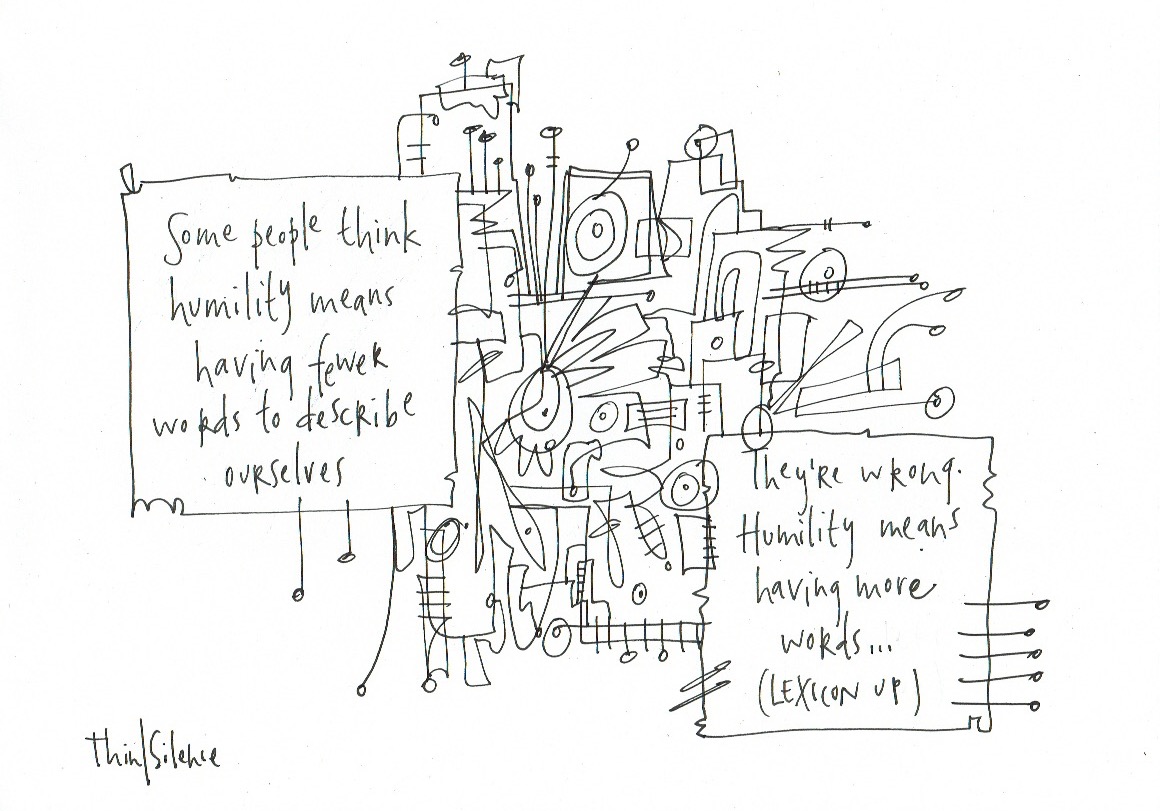
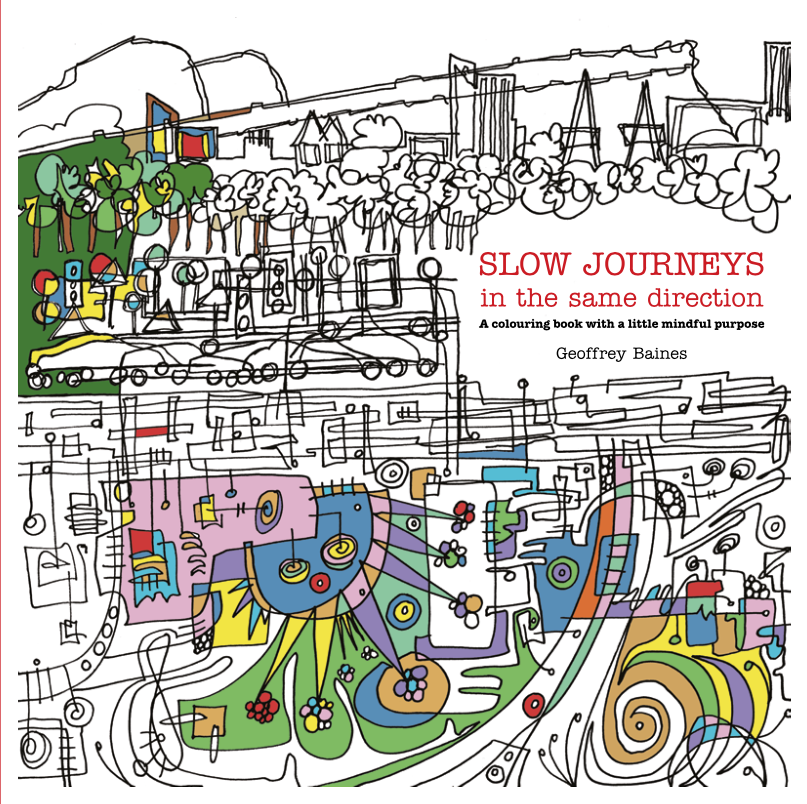
I’ve found new words to be critical for me when it comes to seeing and trying new things – things which have become very important to me, like the word doodle.  Just over three years ago I didn’t doodle.  I didn’t even notice the word until Hugh Macleod got my attention.  Doodling opened up a world of dawdling and wandering and mindfulness and slowness, towards the publishing of a book of doodles to take us on the slow journeys we need to find in life.^

As I continued to think about the importance of words, I turned to read Seth Godin’s recent blog identifing three ways in which we can hide:

‘The critic, the mimic and the clown all have one thing in common.  They’re not doing the work.  Pitching in requires a different kind of focus, and the generosity and humility to actually get something done.  If they stop hiding, they might even produce something significant.’^^

We can hide when we haven’t taken the time to increase the words that describe us and our work, when we haven’t realised this is what we are meant to be doing.  As Ursula Le Guin proffers, words open our futures:

‘Words are what matter.  The sharing of words.  The activation of imagination through the reading of words.’*^

Anne Lamott shares how she found an oasis from the difficult things of her childhood by reading, though warns there’s a risk of isolation – which is why the group I mentioned earlier met together:

‘Reading helped us get blissfully lost in resonant worlds where we could rest or gape or laugh with recognition but then we looked up again, at the dinner table, or the blacktop, or church, and we couldn’t close the covers of this spooky books.’^*

We need new words, new pictures, new worlds to help us be who we are and do what we love.  Words lie in the background to my doodling hero Hugh Macleod’s encouragement to pursue what we love to do:

‘What you love to do will grow with you, so long as you stay true to who you are and allow yourself to change and develop freely.⁺

Time to live life absolutely.

(*From Karen Armstrong’s A History of God.)
(**George Appleton, quoted in the Northumbria Community’s Morning Prayer.)
(^Slow Journeys in the Same Direction is coming out soon and can be pre-ordered.)
(^^From Seth Godin’s blog The critic, the mimic and the clown all have one thing in common.)
(*^From Ursula Le Guin’s Words Are My Matter.)
(^*From Anne Lamott’s Hallelujah Anyway.)
(⁺From gapingvoid’s blog Life Without Dissonance.)

no-flow

We know a good team happens when a group of differently talented individuals commit to and invest in producing together.

What we often don’t see is that the same law is at work in an individual’s life.

Here, it’s about different talents and passions and experiences needing to come together in some unique expression of creativity, generosity, and enjoyment.   But I do this, how can I do that?

Shaping our story is one of the best ways for making this so.