Time and tide wait for no one

You can’t save up time.  You can’t refuse to spend it.  You can’t set it aside.*
(Seth Godin)

The more you can manage yourself, the less other people need to manage you, the more intrinsically valuable you are to them.**
(Hugh Macleod)

We may talk about setting time aside and saving time but it won’t be there when we go back to it.  It’ll be gone forever.

We now know that not all time is the same, though, relatively speaking.  This is certainly true when we bring time and discipline together.

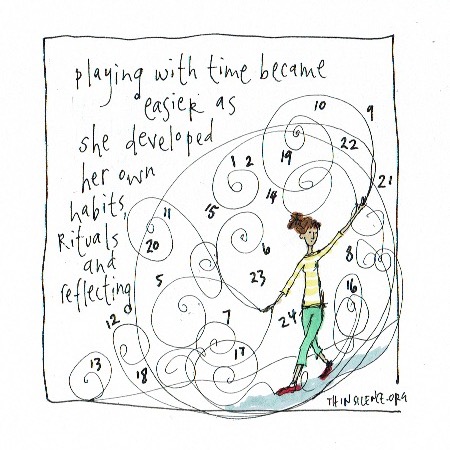
Those with imaginative and supportive habits and rituals, and who spend time reflecting through these, seem to be able to expand time and therefore the possibilities what can happen within it.

Everyone will come up with different habits and ways of reflection.  It doesn’t so much matter how but that we will.

Go make some time.

(*From Seth Godin’s blog: The difference between time and money.)
(**From gapingvoid’s blog: Eight behaviours for self management.)

Curativity and the art of generous obliqueness

There are many laws at work in the universe.  Beyond gravity and thermodynamics and relativity, one we’re discovering more about is the law of generosity.  When we understand and live within generosity, both how it flows to us and from us, more things happen.

First of all, generosity requires we are generous to ourselves:

‘I define wholehearted living as engaging in our lives from a place of worthiness.’*

This place of worthiness is where we discover we have more than enough – so not a selfish kind of generosity but one releasing us to give.  It’s as we notice the unnoticed in ourselves that we find there’s more to offer to others.  These words from mythologist Joseph Campbell contain the sense of this; we are able to move into the unfamiliar without:

“Wherever the hero may wander, whatever he may do, he is ever in the presence of his own essence – for he has the perfected eye to see.”**

Steve Jobs claimed of creativity:

“Creativity is just connecting things.”^

This helps us to understand and see ways of being creative with what we have – why knowing what we have is so important.  Michael Bhaskar, who is quoting Steve Jobs, above, continues:

‘creativity always contained elements of what we now call curation’.^^

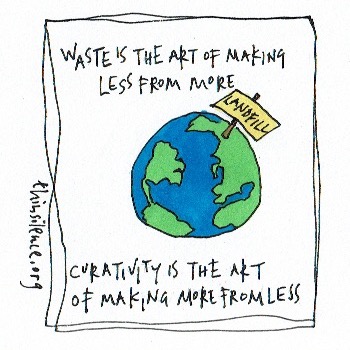
A more apt way of talking about what we do when bring different things we see together is curativity.

All the time generosity is flowing around us, if not toward us.  I am not only thinking about people but the generosity of others is definitely the kind of generosity we can capture and curate.  Richard Rohr is writing about love but could have been writing about this oblique generosity when he wrote:

‘if it’s not flowing out of you, it’s probably because you’re not allowing it to flow toward you […] And love can flow toward you in: through the image of a flower, in a grain of sand, in a wisp of cloud, in a person you allow to delight you’.*^

(*From Brené Brown’s Rising Strong.)
(**Joseph Campbell, quoted in Keri Smith’s The Wander Society.)
(^Steve Jobs, quote in Michael Bhaskar’s Curation.)
(^^From Michael Bhaskar’s Curation.)
(*^From Richard Rohr’s The Divine Dance.)


The hero with a thousand choices

Mythologist Joseph Campbell writes about the hero with a thousand faces, identifying the hero figure within the stories that cultures have told throughout the millennia.  These stories are explorations of what it means to be human, maximising our capacity to think, feel and do.

The hero with a thousand choices is an attempt to point out that within each of us there are so many ways we can choose to live, though some will be more important to us than others.

Here’s the first of a number of Campbell quotes to help us explore this concept – bliss is his word for the discovered and lived purpose for our lives:

‘if you do follow your bliss you put yourself on a kind of track that has been there all the while, waiting for you, and the life that you ought to be living is the one that you are living  When you see that you begin to meet people who are in your field of bliss and they open the doors to you’.*

This notion that the life we ought to be living is the one we are living is right where I find myself working with others, in what I am increasing seeing as hero’s journeys or adventures.  Not some “Look at me, I’m special” kind of hero.  Such a way of thinking just shows how far we have wandered from the stories of heroes.

Hugh Macleod writes about bringing an idea to life, how we can be misunderstood by those around us when the possibility we imagine is very young; it’s just that:

‘win or lose, you really don’t have a better reason for being alive’.**

Macleod is one of those I have “met” in my own field of bliss.  He has opened doors to me:

‘Furthermore, we have not event to risk the adventure alone, for the heroes of all time have gone before us.  The labyrinth is thoroughly known.  We have only to follow the thread of the hero path, and where we had thought to have found an abomination, we shall find a god.  And where we had thought to slay another, we shall slay ourselves.  Where we had thought to travel outward, we will come to the centre of our own existence.  And where we had thought to be alone, we will be with all the world.’*

These have misunderstood the need for adventure.  It is not to conquer the world (of money, of business, of sport, of social media, of ….) but to conquer ourselves, not to gain but to give:

‘A hero is someone who has given his or her life to something bigger than oneself.’*

Those we meet who’re struggling in their everyday existences – with busyness, with boredom, with people issues and all the other things we think we can do nothing about, Campbell has this to say:

‘The usual hero adventure begins with someone from whom something has been taken, or who feels something is lacking in the normal experiences available or permitted to the members of his society.  This person takes off on a series of adventures beyond the ordinary, either to recover what has been lost or to discover some life-giving elixir.  It’s usually a cycle, a going and a returning.’*

This hero’s journey or adventure is intended for everyone in the everyday, and it is so close to us; we mistakenly think it can only take place in some far off place when it’s within the life we are living.  I read these words from Keri Smith as a metaphor for this when I read them alongside Campbell:

‘It’s up to the wanderers to remake the city into something that ignites the imagination.’^

This adventure includes challenge; transformation comes through trials and revelations.  Perhaps aware of these and those who are met in Campbell’s field of bliss, Alex McManus writes of change:

‘Whatever the reasons change comes, there seems to be three Events that instigate change: Contact with outsiders, Significant events, and Epiphanies.’^^

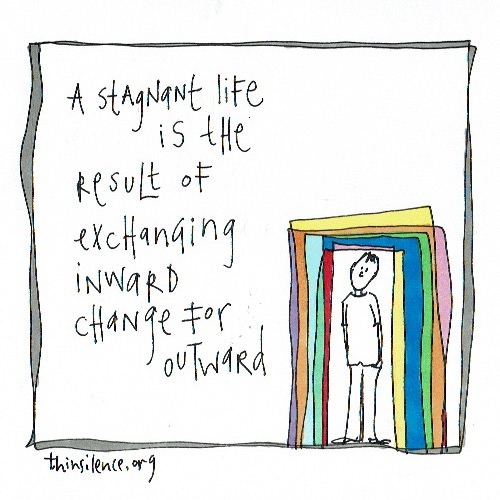
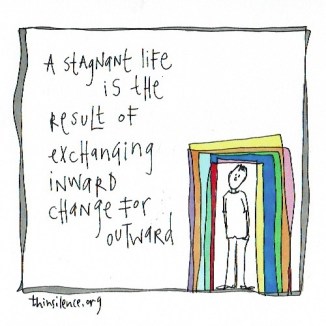
We prefer the attempt to change the things around us before we attempt to change the things within.  It’s why life slows down and eventually stagnates.  We can obtain many bigger and better things, from jobs to houses, from clothing to electronic devices, but only adventure can stir up the life within:

‘If you want to put it in terms of intentions, the trials are designed to see to it that the intending hero should be really a hero.  Is he really a match for his task?  Can he overcome the dangers?  Does he have the courage, the knowledge, the capacity, to enable him to serve?’*

(*Joseph Campbell, from Joseph Campbell and Bill Moyers’ The Power of Myth.)
(**From gapingvoid’s blog: Great ideas have lonely childhood.)
(^From Keri Smith’s The Wander Society.)
(^^From Alex McManus’ Makers of Fire.)

Rank and file

The biggest problem with a forced ranking is that it’s forced.*
(Seth Godin)

All rankings are forced.  But at least we can be top of the rankings for what it is we love to do most of all – at least, this is where we ought to be.

Joseph Campbell points to three stages in his concept of bliss, or finding our joyful purpose.  These three words from Sanskrit, point us in the direction of knowing our ranking and being at the top of it:

‘The word “Sat” means being.  “Chit” means consciousness.  “Ananda” means bliss or rapture.’**

Which I take to mean, identify who you are, lean into this which is your energy, and then create create create.

(*From Seth Godin’s blog: The problem with forced rankings.)
(**Joseph Campbell from Joseph Campbell and Bill Moyers’ The Power of Myth.)

Beyond opprobrium

I had to look the word up but opprobrium means harsh criticism or censure.*

The future invites us to move beyond opprobrium – both when it comes to us from, and when we are tempted to use it against, others.

‘I was at once impressed by the phrase “make place for the other.”‘**

Theodore Roosevelt declared in his arena speech:

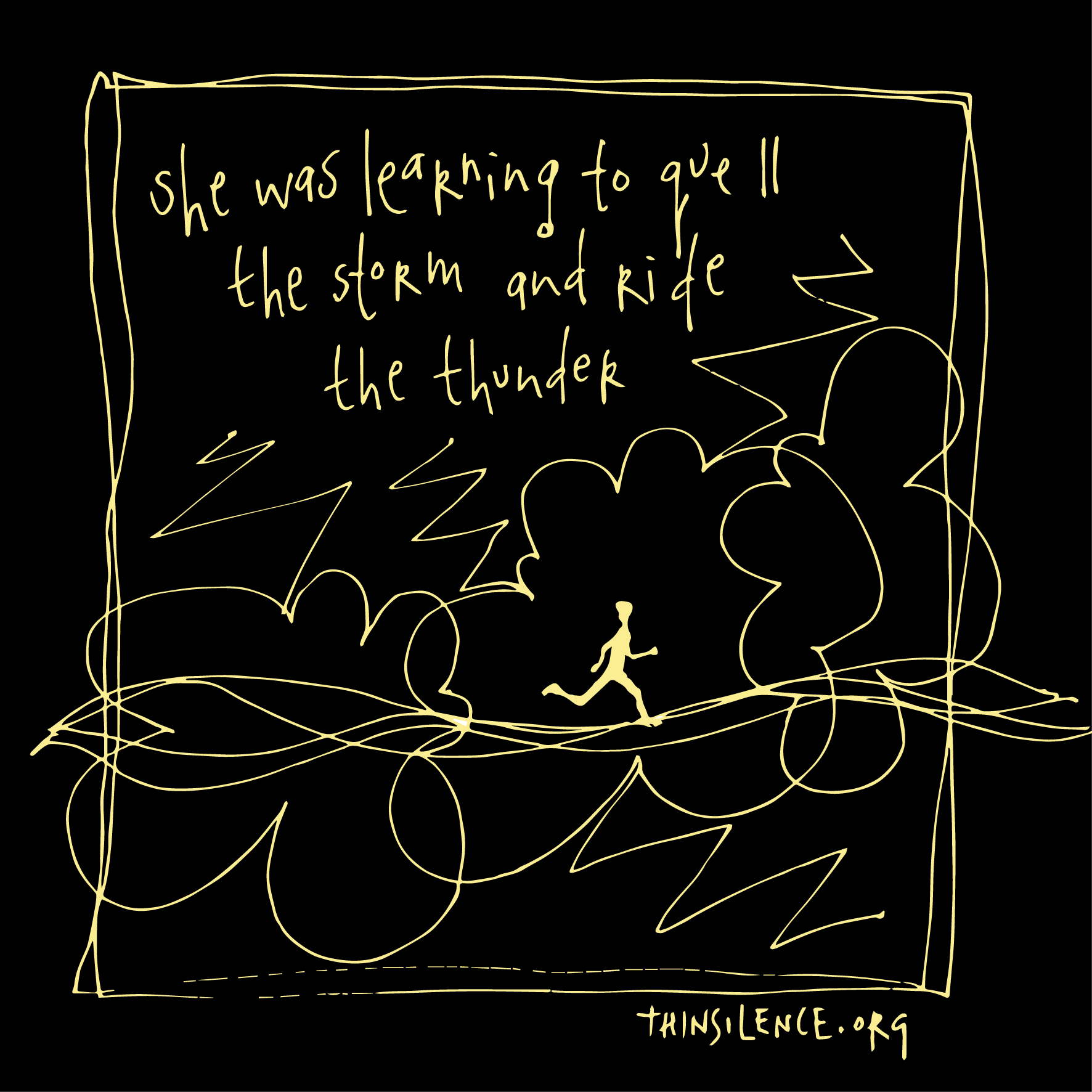
“There is little use for the being whose tepid soul knows nothing of great and generous emotion, of the high pride, the stern belief, the lofty enthusiasm, of the men who quell the storm and ride the thunder.”^

Quelling the storms and riding the thunder begins as a desire and becomes an art.  The kind of art that may save the world.

(*Maria Popova uses the word in her Brain Pickings: Theodore Roosevelt on the Cowardice of Cynicism.)
(**From Karen Armstrong’s Twelve Steps to a Compassionate Life.)
(^Theodore Roosevelt, quoted in Maria Popova’s Brain Pickings: Theodore Roosevelt on the Cowardice of Cynicism.)

Knowledge, stories and paradigms

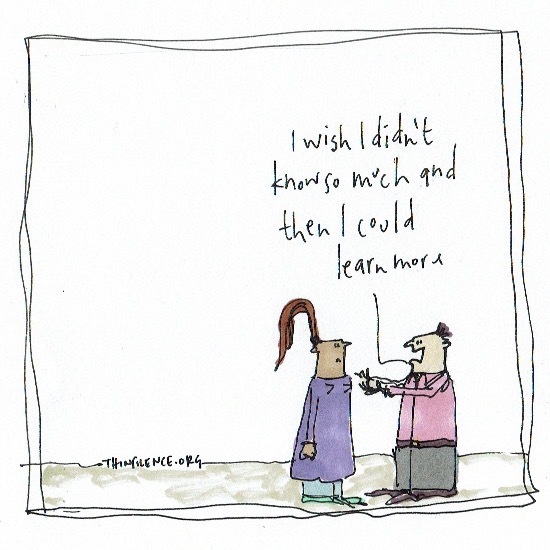
I have a problem.  What I know becomes a filter to what you know.  

I can end up thinking that what I know is more valuable than what you know because it’s wrapped in my stories but I do not see your stories.

Knowledge wrapped in stories produces my paradigm, my worldview – and a worldview is hard to displace.

What we need are new stories we can create and own together around what we know.  Our understanding is that we are living in a world – intra-, inter- and extra-personal – that is far more complex than it is complicated.  New ways of knowing are needed, new ways of finding answers being required of us.  (I also anticipate that the visual will be an important part of this, images helping different worlds to come together when words struggle.) 

If I think I have the answer, I don’t.  I am trying to live my way into the answer, though, and I think I need your help in this.

When we notice what we’re noticing we are noticing

We’re moving through the levels of noticing.

We’re noticing things all the time.

When we notice what we are noticing then we’re turning our attention towards some person, idea, thing.

When we do this, there’s the possibility of noticing just how we feel about this and a connection can be formed which may be short-term of longer-term.

When this kind of noticing happens then we open ourselves to the possibility of doing something – a noticing through activity.

The problem is, these levels of noticing demand so much of us.  Like muscles stretching, tearing and repairing they require great intention and discipline, but after all the effort, we find we have grown.

It’s certainly easier to limit our noticing of all there is to notice, reducing the possibility of having to notice what we are noticing we are noticing.  Of such a person, Theodore Roosevelt declared:

“The poorest way to face life is to face it with a sneer. There are many men who feel a kind of twister pride in cynicism; there are many who confine themselves to criticism of the way others do what they themselves dare not even attempt.”*

When we open both our mind and heart towards the other, we open fields of growth possibilities for ourselves and for others, so Keri Smith writes about the Wander Society:

‘I believe its members exist to aid us in our quest to discover our own deepest should life, to help us move to a higher plane of consciousness.’**

When describing communities of gifts, Lewis Hyde writes:

‘As in the case with any circulation of gifts, the commerce of art draws each of its participants into a wider self.  The creative spirit moves in a body or ego larger than that of any single person.’^

John O’Donohue adds in his usual helpful way:

‘It seems that in a soul sense, we cannot be fully ourselves without others.  In order to be, we need to be with.‘^^

It’s as if we’re creating a map of possibility that is able to teach, enchant and guide us.*^

Noticing in deeper ways is akin to laying down more detail on the map.

(I want to write here about how maps combine images, shapes and words, but I’ll resist the temptation and leave this for another day).

The more complex the journey we want to take, the more details we need on the map.  Maps are about getting somewhere but they are also about how we choose to get there, what we want to experience on the way.

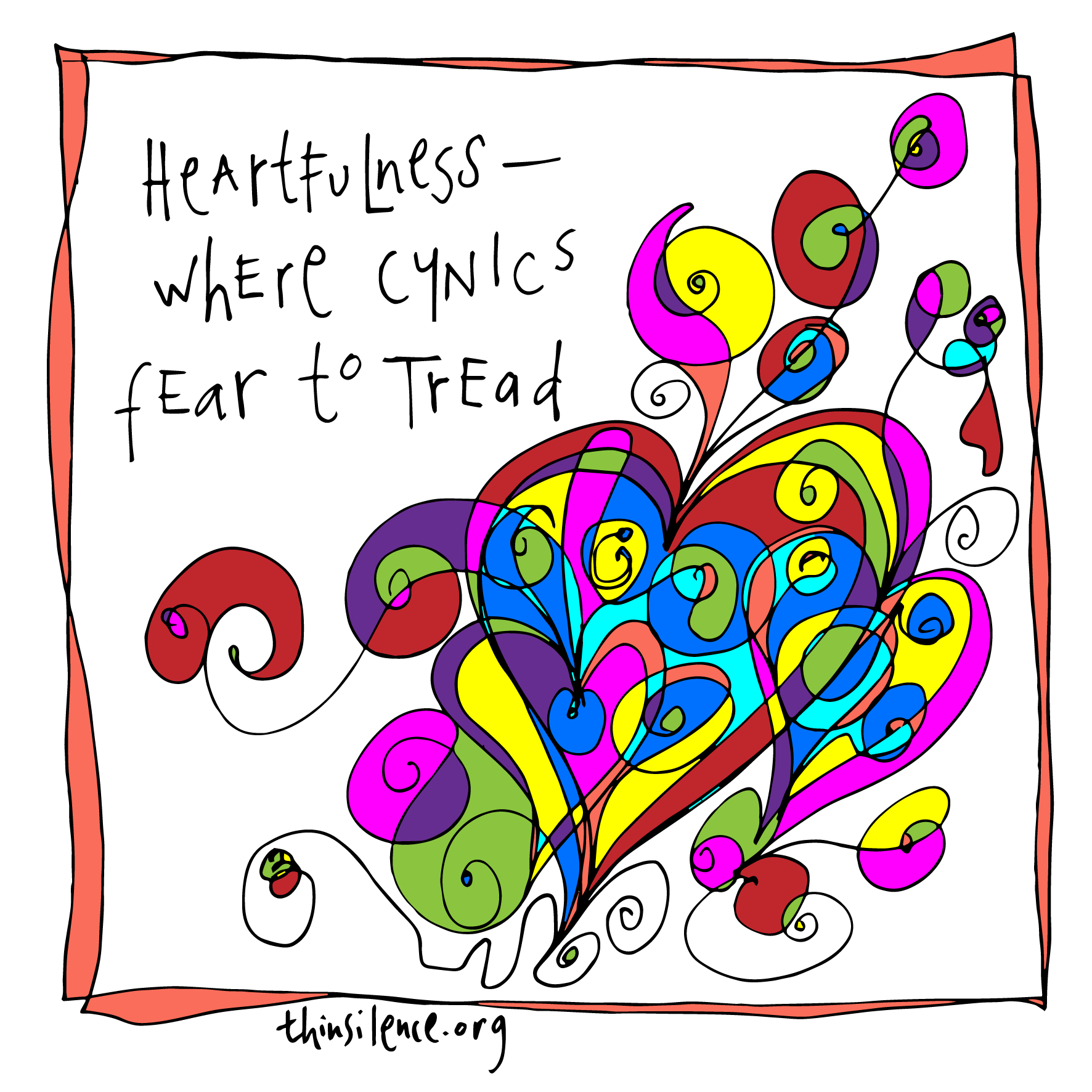
Most of us would not want to think of ourselves as a cynic or of being cynical, but oftentimes cynics don’t have a sneer on their faces but an unwillingness to notice, to connect, to cross borders in order to enter new lands.

(*Theodore Roosevelt, quoted in Maria Popova’s Brain Pickings: Theodore Roosevelt on the Cowardice of Cynicism and the Courage to Create rather Than to Criticise.)
(**From Keri Smith’s The Wander Society.)
(^From Lewis Hyde’s The Gift.)
(^^From John O’Donohue’s Eternal Echoes.)
(*^These three dimensions are borrowed from Otto Scharmer’s characteristics of a living field of possibility: Theory U.)


Attention, everyone

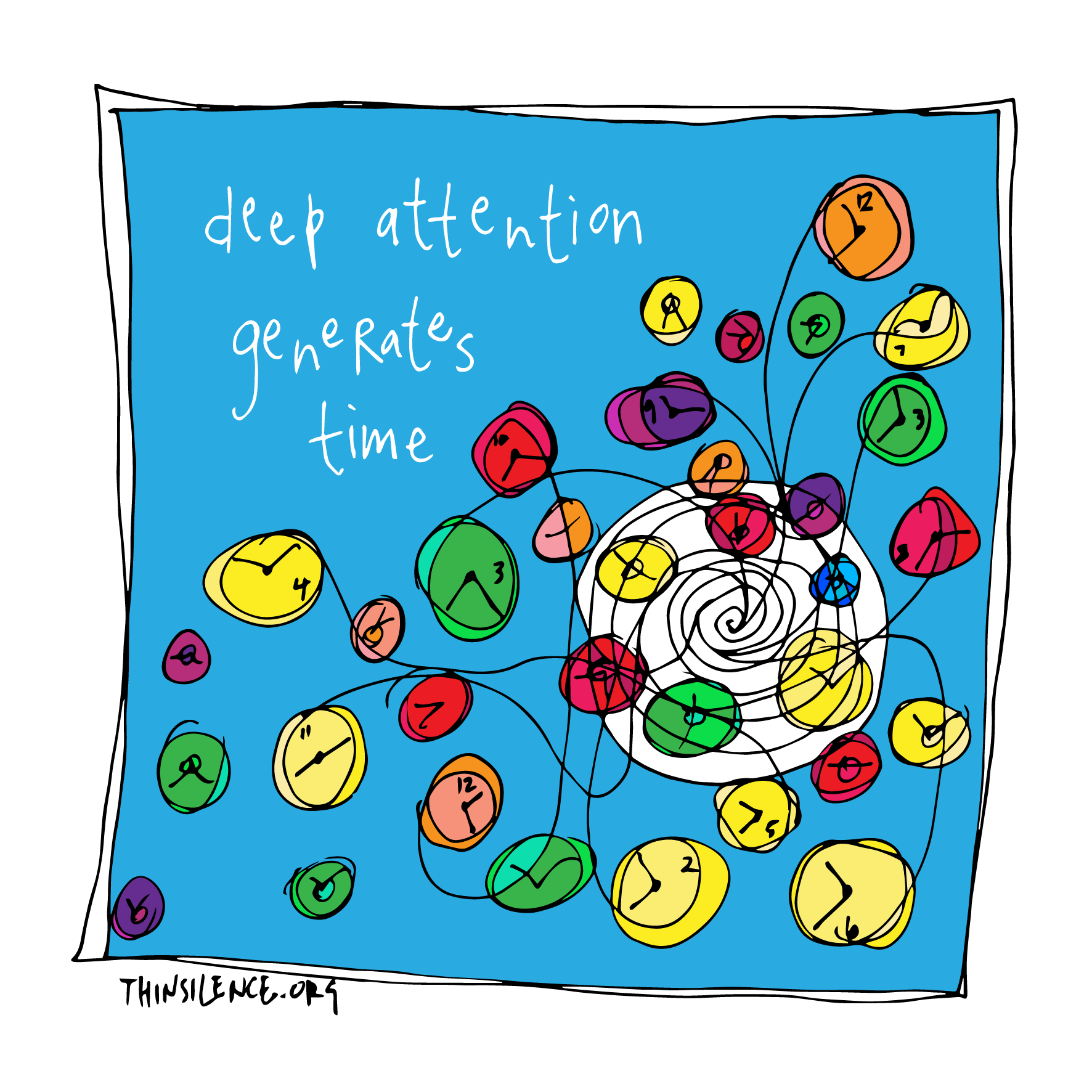
But with everybody so busy these days, who has time for thinking? […]  In a world where most people spend their days rushing around, to have the time and space to actually think properly, at a deep enough level to where you’re actually solving real problems; is for real people, one of the great privileges of the western world.*
(Hugh Macleod)

Most people have no idea how to generate Attention like this.  Most people think about listening as linear.  They think that listening is lined up waiting, waiting to speak. […] Most people miss the creator.  Most people miss the ignition that is inside the listening.’**

To slow down, to notice more, to listen deeply, to think deeply.  All of these are enhanced by the visual.

Forget the arguments about not being able to draw.  We are visual creatures living in an increasingly visual-information world, and everyone can include shapes and images alongside words – the building blocks for being a visual thinker, creating:

‘an incubation formula where art and science co-exist’.^

Time to visualise the future.

(*From gapingvoid’s blog: Where ideas are born.)
(**From Nancy Kline’s More Time to Think.)
(^Misha Mercer, from Drawn Together Through Visual Practice.)