Skin in the game keeps hubris in check.** (Nassim Taleb)
A myth is an attempt to express some of the more elusive aspects of life that cannot easily be expressed in logical, discursive speech.^ (Karen Armstrong)
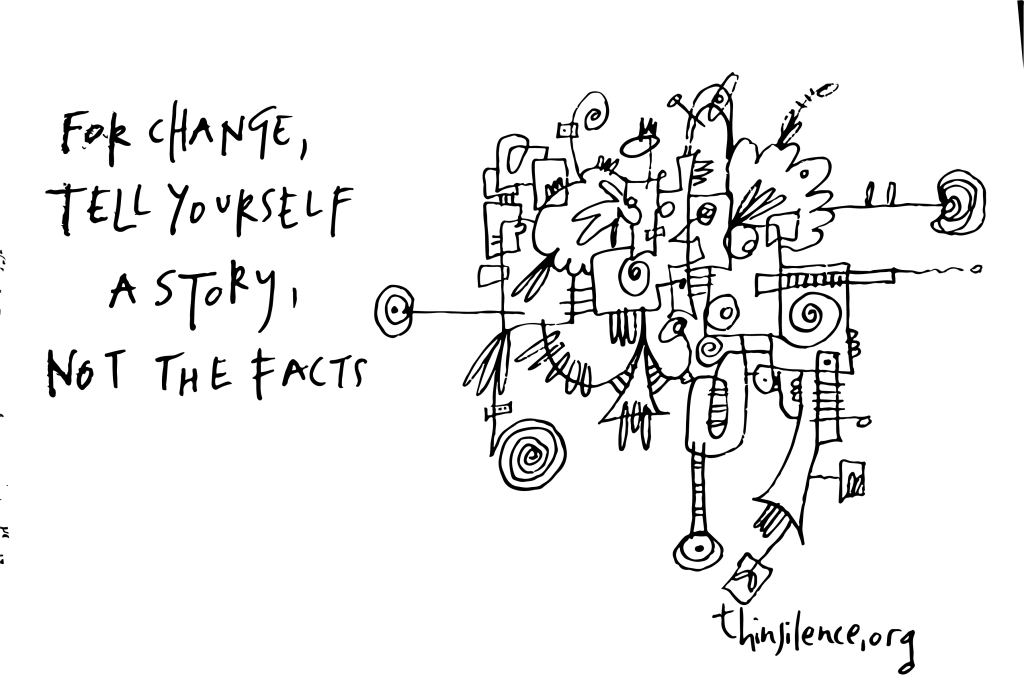
Alchemy takes place within living stories.
Let us be open to the possibilities today brings to us.
(*Dawna Markova, quoted in the Northumbria Community‘s Morning Prayer: Day 18: I will not die an unlived life, I will not live in fear of falling or catching fire. I choose to inhabit my days, to allow my living to open me, to make me less afraid, more accessible, to loosen my heart until it becomes a wing, a torch, a promise… (**From Nassim Taleb’s Skin in the Game.) (^From Karen Armstrong’s Twelve Steps to a Compassionate Life.)
it is much easier to be fired for being illogical than for being unimaginative* (Rory Sutherland)
Narratives that cause us to pay attention and also involve us emotionally are the stories that move us to action.** (Paul Zak)
Alchemy^ is more likely to occur within a story.
It’s why the two main questions I work upon with others – Who am I? and What is my contribution? – are about creating personal stories Stories that are worthy of them.
(*From Rory Sutherland’s Alchemy.) (Paul Zak, quoted in Bernadette Jiwa’s The Right Story.) (^Not the lead into gold alchemy, but the ordinary life into a remarkable life kind.)
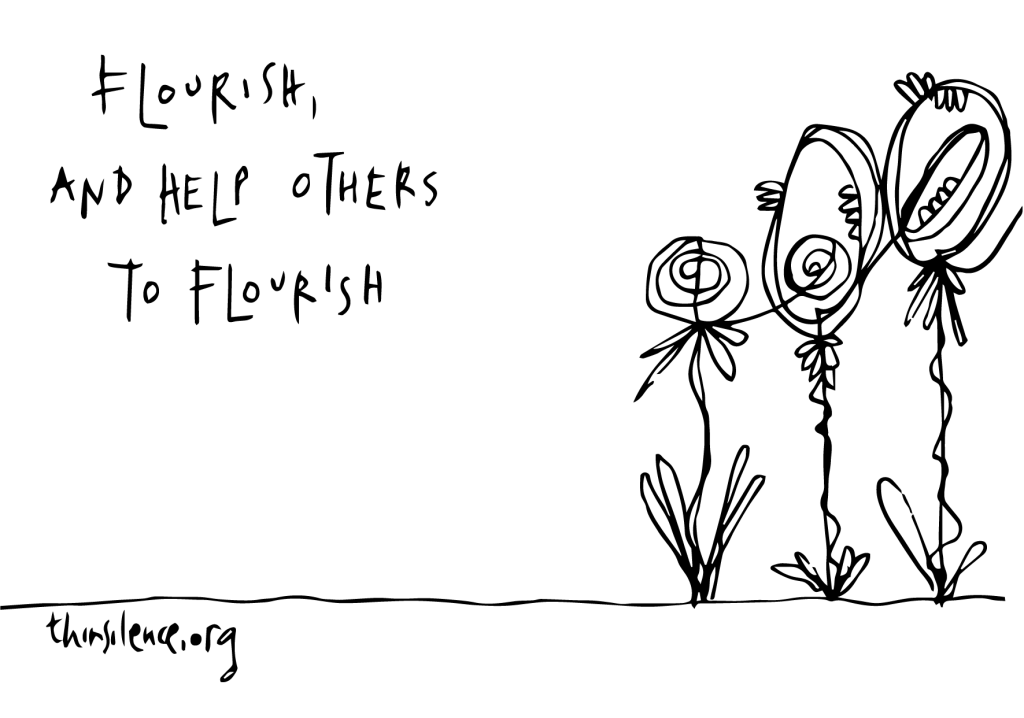
You do your best work by getting others to do theirs.* (Hugh Macleod)
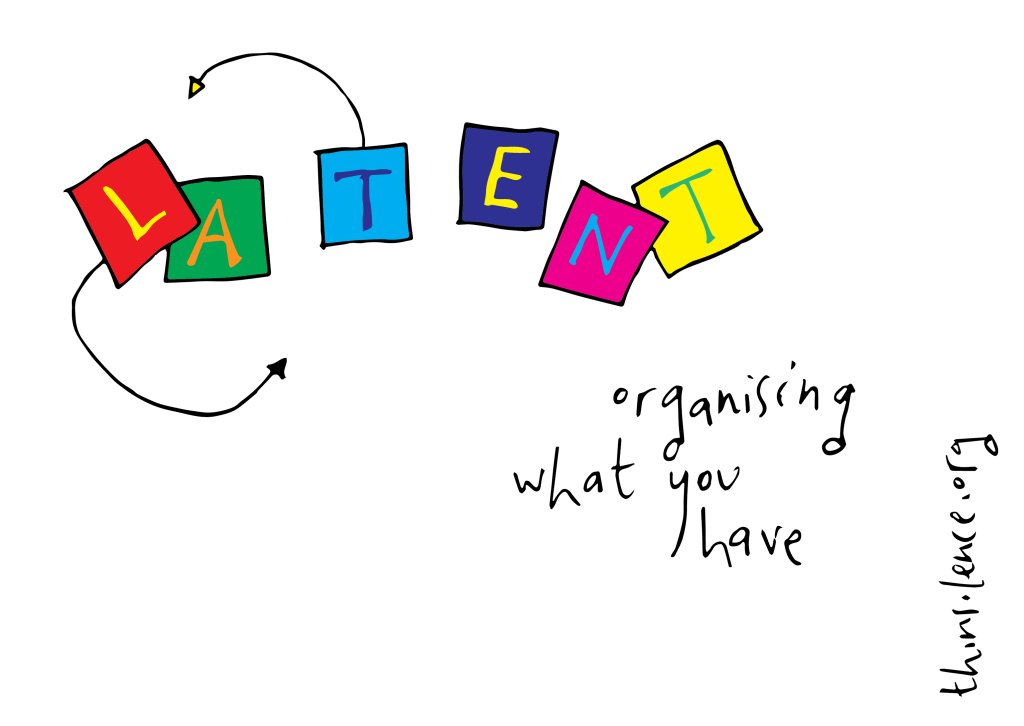
Even if someone is born with a particular talent, that talent will usually remain latent if it is not fostered, honed and exercised.** (Yuval Noah Harari)
Whatever a person’s life contains, there will be many abilities and talents included – whether recognised or not. Just taking the time to notice these and to organise them in particular and peculiar ways will open possibilities and opportunities – like the letters in the title.
There’ll be plenty of work ahead to develop these – we won’t know how far we can take them – but this is half our fun in life.
One thing for sure, if we don’t pay them any attention, we’ll know how far we can take them.
There’s a common meme doing the rounds – the idea that “People don’t want stuff, they want experiences.”* (Hugh Macleod)
Pain, discomfort, shock, boredom, imposter syndrome, awkwardness, fear, being wrong, failing, ignorance, looking stupid. Your avoidance of these feelings is stopping you from a life greater than your wildest imagination.** (Ben Hardy)
It’s become easier to buy an experience than make one. Which is to say, it easier than to become the kind of people who are able to reflect on our lives, all those experiences we’re already having, the same experiences through which we can become more healthy and fruitful (productive sounds too industrial but is a good word to use).
All of humanity’s problems stem from man’s inability to sit quietly in a room alone.^
Ryan Holiday quotes Pascal’s words in his book Stillness is the Key, but widens our perception of stillness so we might see where it is already present in our lives, those: moments of insight, giving our best, pride in completing something, training deliberately, watching snow fall. It’s something we all have the capacity for and can develop:
Stillness is the key to, well, just about everything. To being a better parent, a better artist, a better investor, a better athlete, a better scientist, a better human being. To unlocking all that we are capable of in life.^^
Stillness, then, is the ability to reflect upon what we are doing in life and also what is being done to us. We come to see how life is special, we may even say sacred:
By conscious self-awareness, we are connected to the mystery from which we emerge.*^
As I say, we all have stillness, reflection, awareness to some degree. Now it’s about how prepared we are to develop our stillness, noticing these moments in our lives and enlarging them. As with all things of substance and value, it takes time and effort.
And as with all the things that grow and develop us, journaling offers itself to us as a way of pondering in a more hopeful way.
Tell a story that is about the listener, not about you.* (Seth Godin)
What if there’s a different way of seeing things and, so, understanding and, so, living our life differently as a result?
Where we are in our thinking and feeling and doing right now offers us a particular perspective, but what if we move to a different viewpoint or perspective? How will things look then?
Different, I guess.
It turns out that actor and country singer and songwriter Kris Kristofferson loves William Blake, quoting the following words. I offer them here because they are about why it could be important to get a different perspective:
If he who is organised by the divine for spiritual communion, refuse and bury his talent in the earth, even though he should want natural bread, shame and confusion of face will pursue him throughout life to eternity.**
Kristofferson reflects on Blake’s words:
He’s telling you that you’ll be miserable if you don’t do what you’re supposed to do.^
Knowing what we are supposed to do is a different perspective for many people, making it possible to “reset,” to change our way of thinking, feeling and doing.
Or not, if we choose to bury it.
Knowing who we are and what we must do provides us with the best perspective of all, one that is highly adaptive, because we’re in the flow of something we know is never finished, always growing, always changing.
Michelangelo’s unfinished statues hold more beauty for me than his finished ones. Caught in a moment of time, they speak of how much can change before they are completed. Perhaps we only become the finished piece just before we die.
It’s a choice because of the law of human plasticity:
A new “Law” puts all other laws and criteria into an utterly new perspective.^^
Look around. All those people you know so little about – they know something about you that you don’t know about you: it’s a Johari thing:
When you have a growing awareness of how much you don’t know about someone else, you begin to understand how much you don’t know about yourself.*^
We often have to step into a new idea or another’s person’s perspective or a new behaviour to discover more about ourselves.
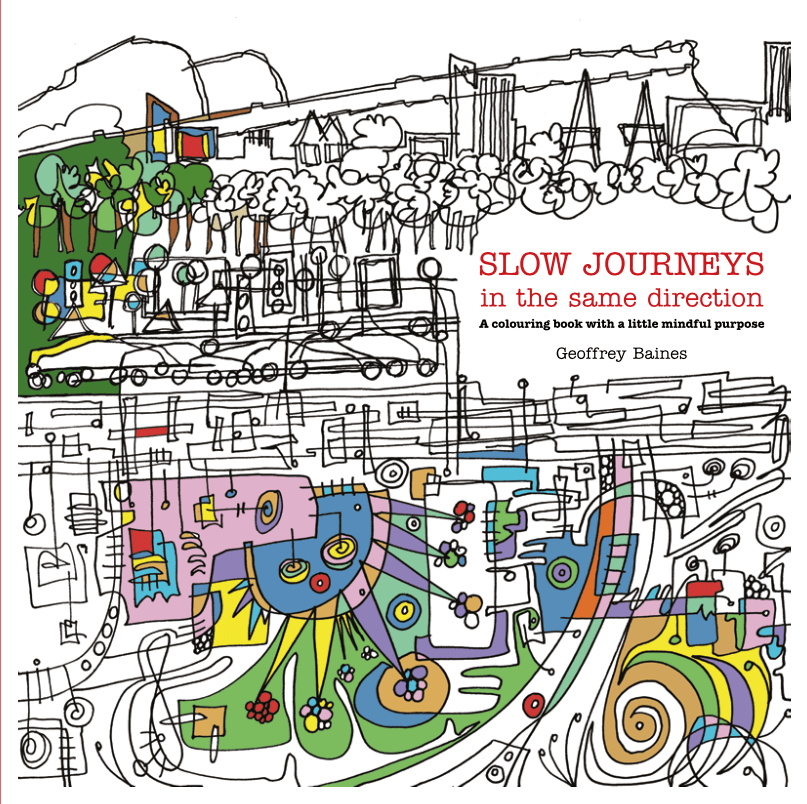
Here are some more expressions of Thin|Silence, beginning with my colouring book Slow Journeys in the Same Direction. As far as I am aware, this is the only colouring book with online content to guide you through each doodle’s texts, including things you can try out. It’s available from Methodist Publishing at £4.99 plus postage; it’s still a great price compared with other colouring books available in shops.
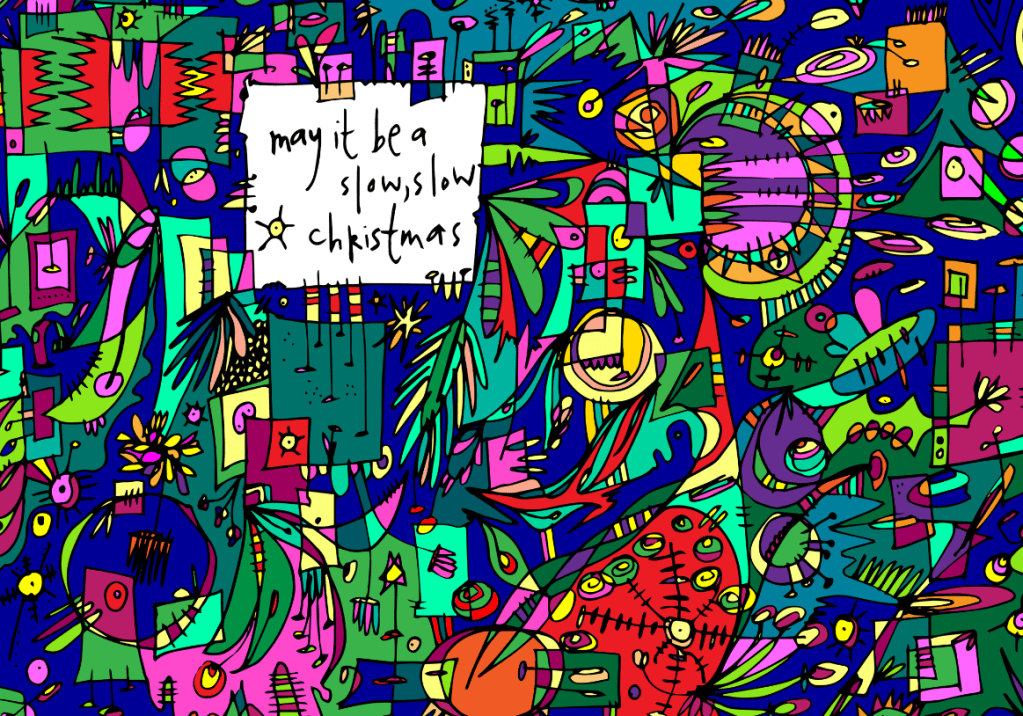
Thank you to those who have ordered my Christmas card design May it be a Slow, Slow Christmas; this is now with the printers.
I want to “test the waters” to see if there would be interest in the same design as a tea-towel. It would be a limited run of 36 and the price of each would be £10 plus postage. If you are interested, email me by Monday, 25th November at geoffreybaines@gmail.com.
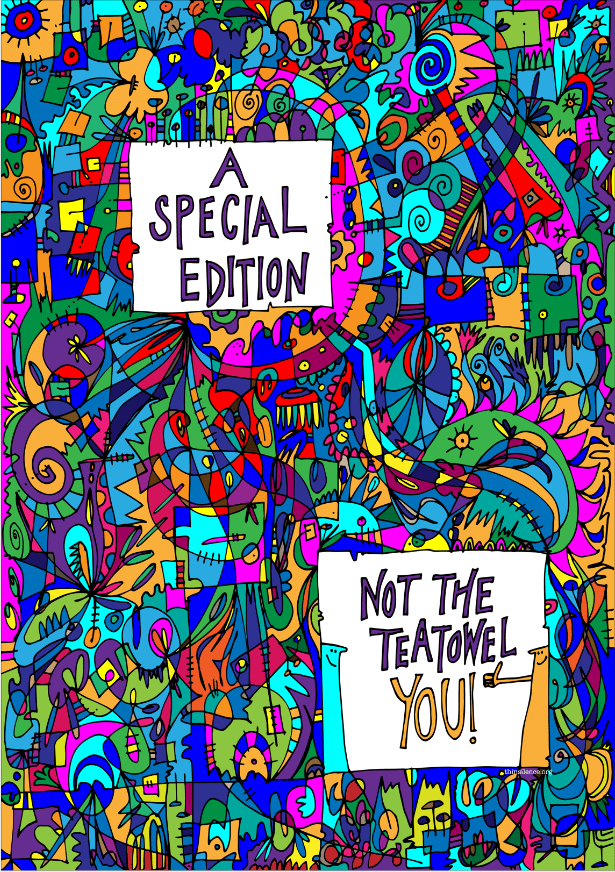
I also have a small number of my A Special Edition tea towels – though a smaller number from last week – from a limited run of only 37 which come with a gift card in the same design. These are £10 plus any postage and packing.
And why are we joyful? Because this is who we are? This is how the gods designed us to be. Producers. Makers. Artists. Effective.* (Hugh Macleod)
I found that what I had desired all my life was not to live—if what others are doing is called living—but to express myself.** (Henry Miller)
We can mistakenly focus on what we haven’t got rather than what we have.
The result is that we bury an awful lot of interesting things. I know because this is my work. In every person I meet there’re incredible things life had entrusted them with. These are uncovered in our conversations and I find myself wondering whether they will value and give expression to them.
This morning I read a short blog post from Steven Pressfield telling of how fame and wealth and all that go with them are of no interest to him:
The only thing that allows me to sit quietly in the evening is the completion of a worthy day’s work. What work? The labour of entering my imagination and trying to come back out with something that is worthy both of my own time and effort and of the time and effort of my brothers and sisters to read it or watch it or listen to it.^
Pressfield’s words resonate because of my work as it plays with two questions: Who am I? and What is my work (or contribution, not job)?, the latter carrying the understanding that our best work benefits others. He continues, describing the asymmetrical nature of this work, disrupting both ourselves and others:
I’m not saying this way of life is wholesome or balanced. It isn’t. It’s certainly not “normal.” By no means would I recommend it as a course to emulate.^
This kind of work is unreasonable, but it is, as Henry Miller has it in the opening to this post, the truest expression of our lives.
We know there’re easier ways to walk and work, but there still remains the thing we must give shape or form to most of all:
Nor did I choose this path for myself, either consciously or deliberately. I came to it at the end of a long dark tunnel and then only as the last recourse, the thing I’d been avoiding all my life.^
Listen to your life. Value it for the amazing thing it is, all it contains, and may you come to the moment when to move towards the fullest expression of your life is easier than avoiding it.
So learning isn’t quite what we teach inmates inside the high-security prisons called schools. In biology, learning is something that, through the filter of intergenerational selection, gets imprinted at the cellular level – skin in the game, I insist, is more filter that deterrence Evolution can only happen if risk of extinction is present.* (Nassim Taleb)
Around me the trees stir in their leaves and call out, “Stay awhile.” The light flows from their branches. And they call again, “It’s simple,” they say, “and you too have come into the world to do this, to go easy, to be filled with light, and to shine.”** (Mary Oliver)
Photosynthesis is how trees turn light and carbon dioxide and water into food. They do it because they’re hungry.
Learning is our photosynthetic process of taking information and knowledge and turning it into understanding, which, as Nassim Taleb reminds us in his inimitable way, involves living it.
The next time you’re feeling hungry, it may not be for food – or clothing, shelter or entertainment – but for understanding, to do something new, different, meaningful.
(*From Nassim Taleb’s Skin in the Game.) (**From Mary Oliver’s poem Among the Trees, quoted in Maria Popova’s Brain Pickings: Amanda Palmer Reads When I Am Among the Trees by Mary Oliver.)
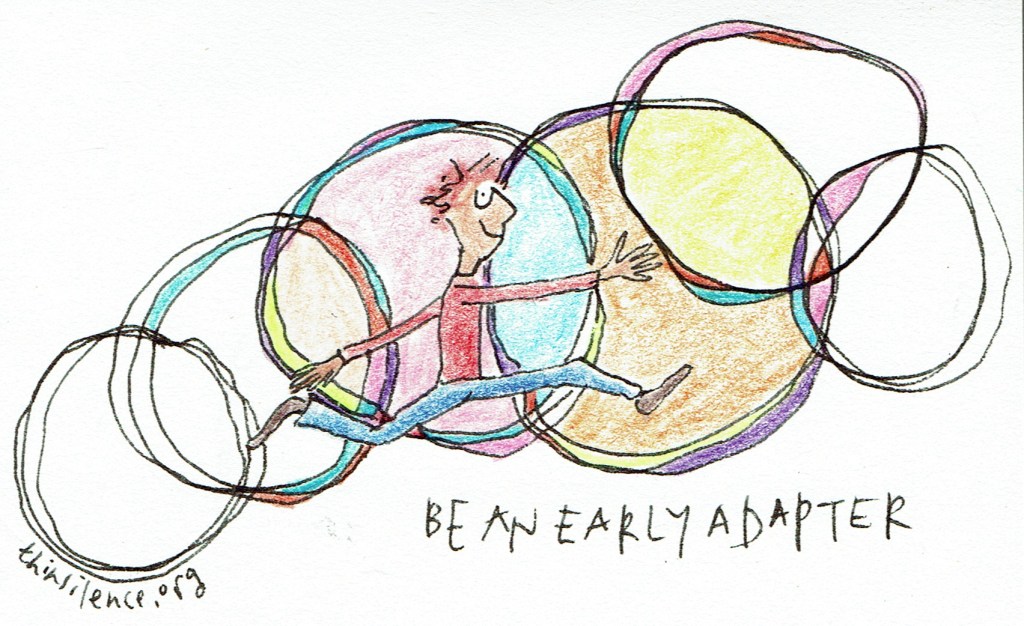
School trains people to work as maintainers. […] A few people somehow avoid these lessons and become instigators, impresarios and disruptors instead. They’re not only dancing with infinity but completely unsure what’s going to work, and yet they are hooked on leaping forward.* (Seth Godin)
May the Angel of Awakening stir your heart To come alive to the eternal within you, To all the invitations that quietly surround you […} May the Angel of Wildness disturb the places Where your life is domesticated and safe, Take you to the territories of true otherness.** (John O’Donohue)
It’s time to show up, to do what only you can do, to give your heart and should for something, to become a living brand of something you care passionately about and makes a difference for others.
When it comes to your purpose here, don’t be anonymous: bad work can’t be corrected and good work cannot be rewarded.
We may not realise yet that we want what you are bringing but that’s just the kind of asymmetry we need.
noblesse oblige [-] the very status of a lord has been traditionally derived from protecting others, trading personal risk for prominence* (Nassim Taleb)
It used to be that only the rich and powerful got to play the “noblesse oblige game,” but we’ve moved on a little since then and many more of us find ourselves with the possibility of playing.
In some words I often find myself reflecting on from Frederick Buechner, we find our purpose or calling where our deepest joy meets the world’s deepest needs.
More than having a great idea, more than feeling passionately about something, it is about having “skin in the game,” as Nassim Taleb puts it.
Ironically, it can be a promotion that takes us out of our “deepest joy” which loses our particular skin in the game.
The testing question is: Is this still not about me?





You must be logged in to post a comment.