Righteous

it is essential to put yourself into the unconditional service of the future possibility that is wanting to emerge. Viewed rom this angle, presenting is about a dialogue with the future possibility that wants to emerge*
(Otto Scharmer)

the religious task of man is to to think right, but to act right**
(Erich Fromm)

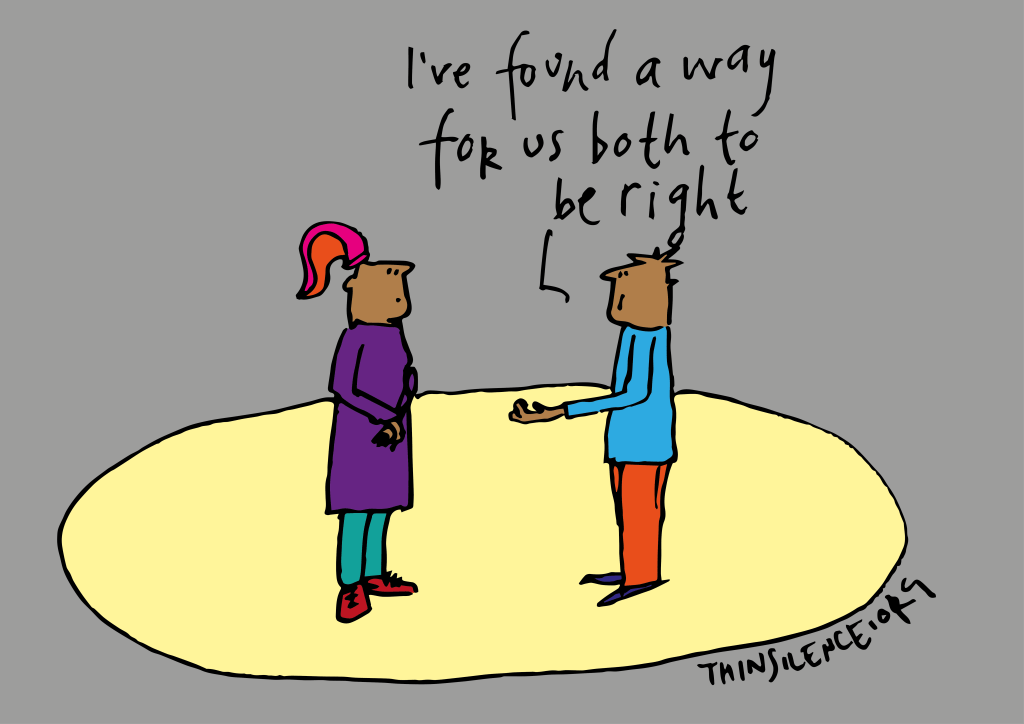
When it comes to the future, it is not only “this or that” but the possibility of many things yet to be imagined.

The scriptural term righteousness is simply a description of what happens when we do the right thing and the right thing often is seldom “this or that”. See this from Peter Carroll:

When you push a “fitting in” culture you miss the opportunity to help people find their personal drive – what comes from their hearts. leading for true belonging is about creating a culture that celebrates uniqueness. What serves leaders best is understanding your players’ best efforts. My job as a leader is to identify their unique gift or contribution. A strong leader pulls players towards a strong belief in themselves.^

When reading these words this morning, I found myself thinking about a recent conversation with someone who described their work environment as being marked by a lack of communication and staff not being valued for their work.

The odds are, we are more likely to stay with “this” when presented with a “this or that” choice. Even if “that” is chosen it covers up all the unimagined possibilities:

The Western habit of argument and dialectic is defective because it leaves out the generative and creative. Critical thinking is fine for reacting to what is put before you, but does nothing to produce proposals.^^

Between “this and that,” we find imaginative and creative righteousness: the right thing to do, often derived by people coming together to create something none had imagined when coming together.

How expensive would it be for an organisation or company to value and communicate with its workforce so they are all able to turn up to work with their alacrity flourishing?

Probably not a lot.

(*From Otto Scharmer’s Theory U.)
(*From Erich Fromm’s The Art of Loving
(^Pete Carroll, quote in Brené Brown’s Braving the Wilderness.)

(^^From Edward de Bono’s Six Thinking Hats.)

I have it all and I have it now

Blessed are the meek, for they will inherit the earth.*
(Jesus of Nazerath)

I must know that I am, at least in part, the very thing I am seeking.**
(Richard Rohr)

Meekness allows us to understand how just privileged we are.

As far as we know, no creature quite like us in our galaxy, in terms of consciousness, to be curious, to explore, to understand, to create:

The purpose of life is to see.^

If only we could see this for one another, if only we could see it for our planet on in which thirty species disappear every day, often because of our need to possess, but only those who know they can never possess this kind of richness are able to inherit it.

Here’s an adjacent blog out of reflecting the nature of meekness:

I recently received an email asking, if I wouldn’t be make a particular date for providing a dreamwhispering session for a group of law students, whether I knew of anyone else who could lead this. I’m trying to think of someone else but basically this is what I have shaped and offer.

Meekness is not an emptiness but the producer of great nuance and variation, and when we recognise this in ourselves (and in others) and turn our attention towards its development, we bring something original into being:

We become original through practise.^^

(*Matthew 5:5)
(**From Richard Rohr’s Eager to Love.)
(^Jack Turner, quoted in Terry Tempest Williams’ The Hour of Land.)
(^From Seth Godin’s blog: Two kinds of practice.)

Becoming is where I live

Protopia is hard to see because it is becoming. It is a process that is constantly changing how other things change, and, changing itself, is mutating and growing. It is difficult to cheer for a soft process that is shape-shifting. But it is important to see it.*
(Kevin Kelly)

Belonging so fully to yourself that you’re willing to stand alone is a wilderness – an untamed, unpredictable place of solitude and searching.**
(Brené Brown)

Protopia, as a state of becoming, is we are all born and reside. It is a state made up of character and personality. Character is who we are becoming over the long haul, personality our ways of connecting our characters with those of others and our world.

I was reflecting once again on this conversation between May Angelou and Bill Moyers:

MOYERS: Do you belong anywhere”
ANGELOU: I haven’t yet.
MOYERS: Do you belong to anyone?
ANGELOU: More and more. I mean, I belong to myself. I’m very proud of that. I am very concerned about how I look at Maya I like Maya very much. I like the humour and the courage very much. And when I find myself acting in a way that isn’t … that doesn’t please me – then I have to deal with that.**

Angelou is using character words rather than personality words. She is describing how she is both, in Brené Brown’s terms, braving the wilderness towards becoming the wilderness.

I love working with people on their talents and strengths, the elements of personality, but I know these must work with our characters. It’s not one or the other. It’s both.

For this reason, we can never say this is who I am, only this is who I am becoming.

(*From Kevin Kelly’s The Inevitable.)
(**From Brené Brown’s Braving the Wilderness.)

An unfair advantage?

WE HAVE AN UNFAIR ADVANTAGE: We care more.*
(Seth Godin)

Strong Back. Soft Front. Wild Heart.**
(Brené Brown)

I try to carry within me the five elemental truths:^ Life is hard; I am not as special as I think; My life is not about me; I am not in control, and, I am going to die.

They help me towards a true perspective of myself and others: a source, then for humility:

We see leaders who are driven by hubris and narcissism often forget about who came before.^^

We all benefit today from those who have gone before. None of us have started from scratch in that sense. And somewhere in each of our personal and systems histories there’ll be people of humility who’ve shaped our better future.

Anything other than humility – meaning, a true rather than a false sense of who we are and who others are – is a shortcut, and a dangerous one.

As Brené Brown’s opening words remind me, humility doesn’t have to be boring. Far from it. We get to shape a different future.

(*From Seth Godin’s blog: The unfair advantage.)
(**From Brené Brown’s Braving the Wilderness.)
(^From Richard Rohr’s Adam’ Return.)
(^^From gapingvoid’s blog: Memories are meaning.)

With modem

Connection is the energy that is created between people when they give and receive without judgement.*
(Brené Brown)

Listen to the silence.
It will teach you. It will build strength
Let others share it with you.
It is little to be found elsewhere.**
(Frances Roberts)

For hundreds of thousands of years, humans have been developing the most sophisticated of all modems, making possible connection with one another and our environments, with ourselves and perhaps a god, too.

We have always improved the modem’s receptivity by practising openness over judgement, compassion over cynicism, courage over fear.

(*From Brené Brown’s Daring Greatly.)
(**Frances Roberts, quoted in the Northumbria Community‘s Morning Prayer.)

Knowing and No-ing

A good conversation is a constant stream of unexpected responses.*
(Tim Harford)

Conversations like this can bring out what we know but haven’t had a chance to use as yet.

They are the conversations out of which amazing things emerge.

The problem is, we can be so worn out by what we need to know to just get through the complexity of the modern day that we say no to knowing more than what is necessary.

When the opportunity arrives for one of those amazing conversations, it never happens, it fizzles out, we have nothing much to share.

Saying know to no is about accumulating knowledge that we won’t use today but we will one day in the future.

(*From Tim Harford’s Messy.)

The uninquirer?

Living the same old same old (SOSO) and What You See Is All There Is (WYSIATI) is like trampling back and forth over soil until it becomes so hardened that it is hardly capable of growing anything.

But curiosity and inquiry can break open the most trampled down lives:

I was just barely holding onto the principle that the brain that generates the question usually generates the best answer.*

(*From Nancy Kline’s More Time to Think.)

A broken spirit and a contrite heart

It’s true that how we spend our days is how we end up spending our lives.*
(Bernadette Jiwa)

What if the life we are meant to live requires a broken spirt and contrite heart as we yield to who we are and to what must bring?

Just a thought.

“A dream,” he said, “as it goes whiffling through the night air, is making a tiny little buzzing noise. But this little buzzy-hum is silvery soft, it is impossible for a human bean to be hearing it”**

(*From The Story of Telling: Always, Sometimes, Never.)
(**From Roald Dahl’s The BFG.)

The person who jumped and became a hero

The hero is the person who finds their purpose in life and pursues it.

Some people are pushed and become a hero.

Others jump:

In all these tales, the hero begins by looking around his society and finding that something is missing […] decides to leave home, turn his back on everything safe and find a different answer.*

We don’t want to simply exist, we want to make a difference, for someone or something. There are as many possibilities as there are people. It’s how we move forward:

constant and longterm exchanges between many people may have no “economic” benefit, but through them society emerges where there was none before.**

What’s is it that you notice is missing and you must pursue?

(*From Karen Armstrong’s Twelve Steps To a Compassionate Life.)
(**From Lewis Hyde’s The Gift.)

Complexity to complexity

We use our imagination not to escape reality but to join it, and this exhilarates us because of the distance between our ordinary dulled consciousness and an apprehension of the real.*
(Iris Murdoch)

we transgress not because we build the new but because we don’t allow ourselves to consider what it disrupts or diminishes. We are not in trouble because of invention but because we think it will solve everything**
(Sherry Turkle)

I may have mentioned this before.

I was once involved in setting up a walk-through experience of communication through the ages. Based on Rex Miller’s book The Millennium Matrix, four spaces were created to mark the ages of communication: oral, print, pixels and bits and bytes. In between each of these were liminal spaces marking the transitional times of change.

Seven rooms in all.

I was part of the group of guides helping others to pass through each and pointing out to those who completed the journey that they now knew something others did not – tens of thousands of years of human tradition to call on when understanding and creating the new present.

The OECD (Organisation for Economic Cooperation and Development) defines competence in this way:

Competence is the ability to meet important challenges in life in a complex world.^

Increasingly complex times means change is happening more rapidly then ever, the liminal spaces appearing greater than those they connect. Yet we are complexity, too. Diverse individuals and communities bringing imagination to bear on reality.

As in all things, this complexity doesn’t express itself without practise, and this is perhaps one of the greatest challenges we face: to utilise our own complexity.

Some of the most important depth we can give to competency is to know something of our human past, how we have faced great challenges and overcome, finding ourselves possible of more than resilience. Rebecca Solnit caught my attention when describing her friend Marine, whose musical competency is deep, providing a metaphor for our imagination and how we hone it:

Marine was too interested in being a musician to be a real three-chord punk rocker, so she gravitated towards the more ornate and les ideological realms of rock and roll proper. She had a surprising knowledge of obscure cultural things, not only the classical music that had been part of her family’s life since a great-grandfather had hung out with great composers. She’d suddenly describe someone as having a beard like De Sade’s, empty an obscure term, wax lyrical about the baroque era or Saint Anthony’s temptations. I remember the delight she took in the profusely illustrated Audubon insect guide she acquired when she was living in Santa Monica, her fascination with the exotic species crawling around that subtropical global crossroads.^^

(*From Iris Murdoch’s The Sovereignty of Good.)
(**From Sherry Turkle’s Alone Together.)
(^The OECD, quoted in Maureen O’Hara and Graham Leicester’s Dancing at the Edge.)
(^^From Rebecca Solnit’s A Field Guide to Getting Lost.)