More than faith

It feels like faith in wider possibilities than I had imagined and living one’s life in the shadow of those possibilities.*
(David Brooks)

Faith, like fire, does not dispel the darkness. It creates a space within it. Faith creates a womb for hope and love within a universe that seems indifferent to both.**
(Alex McManus)

Faith is not a religious capacity but a human one; religion is, perhaps, one way for organising it.

Faith is what we all need in difficult or dark moments, creating a space in which it can harness and bring shape to everything we are and all that we have. When we thought there was no space, nothing that we could do, we are shown a way forward through our talents and values and energies.

What is faith. It is many things; here’s a definition for starters:

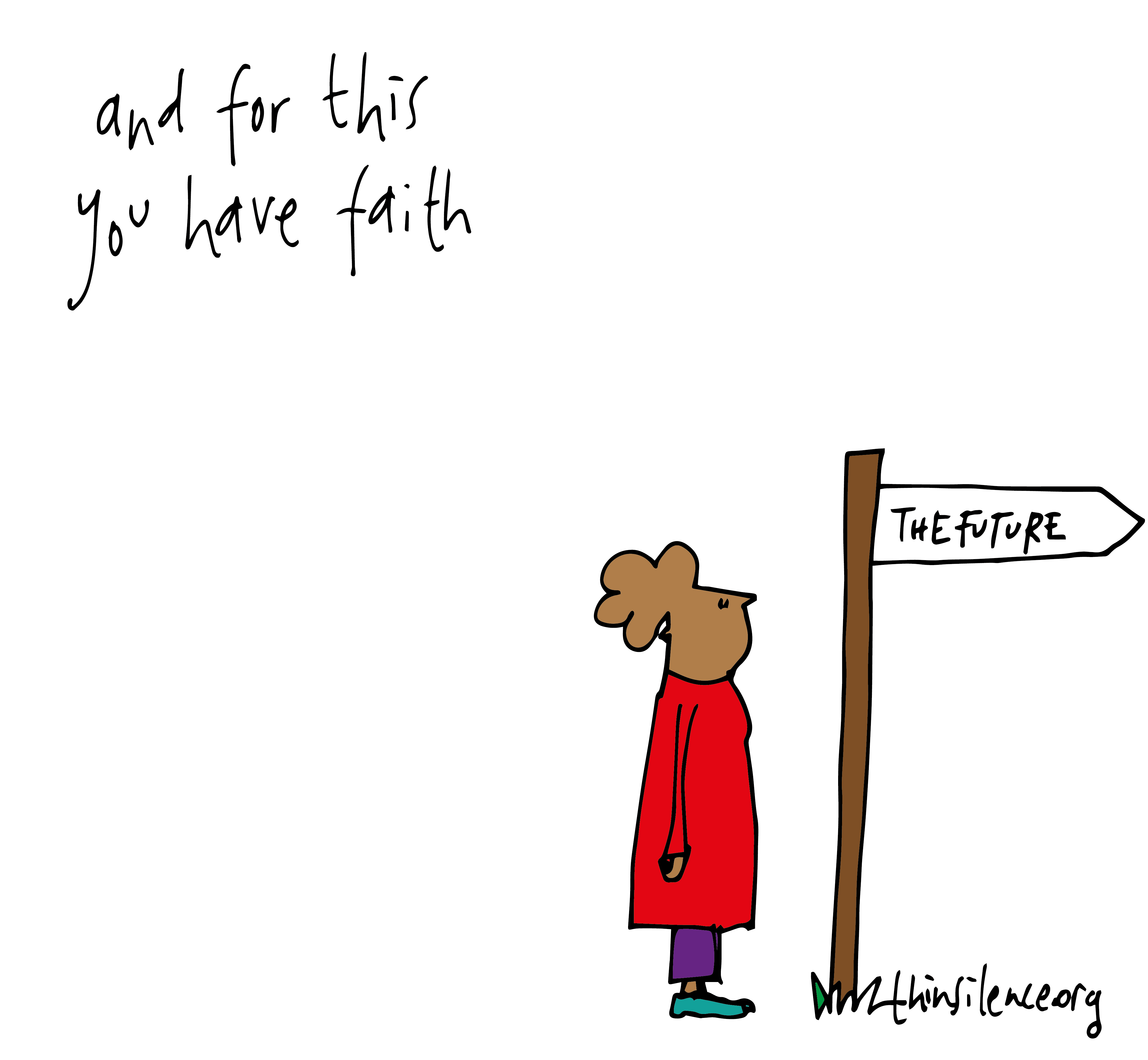
To imagine and hope in a future that does not exist and to live towards it with all our being.

(*From David Brooks’ The Second Mountain.)
(*From Alex McManus’ Makers of Fire.)

Life undercover

My own particular cover is that of a university professor. It’s a way of looking responsible while attending to more important things.*
(Belden Lane)

Where is your ifthen? We all have them. […] Too often an ifthen is nothing but a stall.**
(Seth Godin)

What’s your cover? The thing you have figured out to do that makes it possible to follow your higher calling, the thing you most want to do with your life?

If you have an ifthen, it could be that you haven’t found your cover. An ifthen is a way of putting own hold the thing you really want to do until something else happens: If this happens then I can pursue what I really want to do.

A cover makes it possible to pursue what you must sooner, it doesn’t wait for everything to be in place, but even while things are exactly where and how they are at this moment, finds one small possibility and then another, and another.

So it may well be about where you are right now, doing the things you’re doing, is just the cover you need for beginning to pursue your higher calling.

One small place to begin is by writing out what your higher calling or purpose is – it’s more difficult to ignore once you have put a little ink on the paper.

(*Belden Lane, quoted in David Brooks’ The Second Mountain.)
(**From Seth Godin’s blog: Where is your ifthen?)

Daemons and dreams

A daemon is a calling, an obsession, a source of lasting and sometimes manic energy.*
(David Brooks)

If he who is organised by the divine for spiritual communion, refuse and bury his talent in the earth, even though he should want natural bread, shame and confusion of face will pursue him throughout life to eternity.**
(William Blake)

Daemons and dreams are yoked.

Your daemon is the world’s greatest need as you are attuned to hear:

when you are looking for a vocation, you are looking for a daemon. […] You are trying to find that tension or problem that arouses great waves of moral, spiritual, and relational energy.*

This daemon calls to your deepest joy, the dream you have to live with creativity, generosity and enjoyment.

In Florence’s Galleria dell’Accademia stand four unfinished statues by Michelangelo – the figure in each strains to be free – a picture of your dream. But only the chisel can achieve this – a picture of your daemon. It will always be the grittier element of what it is you must do with your life.

(*From David Brooks’ The Second Mountain.)
(**William Blake, quoted in Austin Kleon’s blog: You’ll be Miserable if You Don’t Do What You’re Supposed to Do.)

Unscripted

He would go insane could he not liberate himself from this prison and reach out, unite himself in some form with men, with the world outside.*
(Erich Fromm)

Maybe the most important thing you can train an aspiring improviser to do, [Charlie Todd] says, is listen and observe and stay fully open to the possibilities in whatever his or her fellow actors might be saying or doing.**
(Rob Walker)

I may be an introvert, but I know I need others to become my True Self, to be fully alive.

We all prefer different ways to connect to people. For me, connections need to be deep, so I prefer one-to-ones and small group immersions.

David Brooks shares an experience of transcendence from a journey to work with thousands of others that feels like the sun rising on a grey day:

Suddenly it seemed like the most vivid part of reality was this: Souls waking up in the morning. Souls riding the train to work. Souls yearning for goodness. Souls wounded by earlier traumas. Souls in each and every person, illuminating them from inside, haunting them, and occasionally enraptured within them, souls alive or numb in them; and with that cam a feeling that I was connected by radio waves to all of them – some underlying soul of which we were all a piece.^

When we notice people, really notice them, then we find more of ourselves.

We also find find hope for what we can be about together, especially when we can leave our scripts behind and begin to improvise – the kind of scripts that tell us people like us don’t mix with people like them, whether because of beliefs, age, gender or ethnicity.

(*From Erich Fromm’s The Art of Loving.)
(**From Rob Walker’s The Art of Noticing.)
(^From David Brooks’ The Second Mountain.)

Who cares

The truth – that love is the ultimate and highest goal to which man can aspire.*
(Viktor Frankl)

I came to realise that the object of life is not prosperity as we are made to believe, but the maturity of the human soul.**
(Aleksandr Solzhenitsyn)

Have you noticed that when we care about someone or something, the world grows larger; more wonderful people, more detail, more colour, more possibilities.

And the larger the world grows through our caring, the more we grow.

May you grow very large indeed.

(*Viktor Frankl, quoted in David Brooks’ The Second Mountain.)
(**Aleksandr Solzhenitsyn, quoted in David Brooks’ The Second Mountain.)

The commitments

Most of us make four big commitments over our lives: to a vocation, to a spouse and family, to a philosophy or faith, and to a community.*
(David Brooks)

David Brooks argues our commitments provide us with identity, sense of purpose, move us to a higher level of freedom, and build our moral character.

Not bad for investing ourselves in the things that matter most to us in life.

When we lack commitment, we set ourselves adrift, prey to external forces and pressures, internal whims and vacillations.

Nothing worthwhile emerges from an uncommitted life; in considering the thing we must do, Seth Godin writes,

With only slight exaggeration I would say that we approach our process with commitment. It acknowledges that creativity is not an event, it’s simply what we do, whether or not we’re in the mood.**

We cannot be told to commit by others, we can only be invited. True commitment, though, comes from a deep-down-inside-of-us place in which we find humility – who we truly are, gratitude – what we truly have, and faithfulness – what we can truly do with these for others:

Art is something we get to do for other people.**

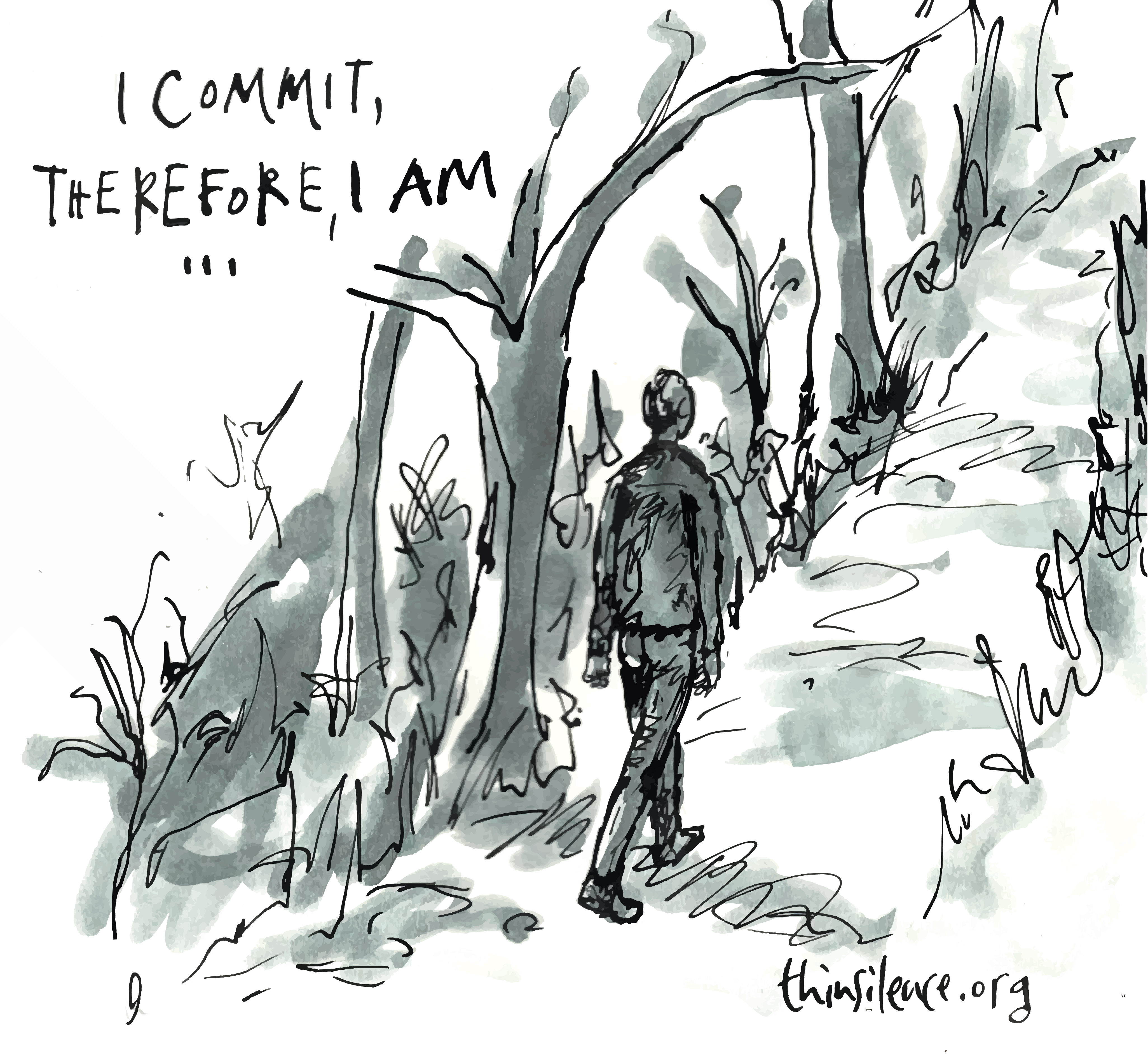
I commit therefore I am …

How would you like to complete this declaration of your true self and contribution?

Have fun.

(*From David Brooks’ The Second Mountain.)
(**From Seth Godin’s The Practice.)

Things can only get better*

Human beings at their best are givers of gifts.**
(David Brooks)

Only love and suffering are strong enough to break down down our usual ego defences, crush dual thinking, and open us up to mystery.^
(Richard Rohr)

I am only guessing, but you probably admire selflessness in others and struggle for it within yourself; I know I do. There is a hunger within us that can only be fed when we live for others:

the chasms within us cannot be filled by the food the ego hungers for**.

We can understand this to be our quest for nobility, outlined here by Nassim Taleb as he contemplates how we must have skin in the game of life:

noblesse oblige; the very status of a lord has been traditionally derived from protecting others, trading personal risk for prominence^^.

There comes a point in all our lives when we wonder whether we have lived meaningfully. David Brooks likens the soul – ‘the part of you that is of infinite value and dignity’** – to a leopard, perhaps glanced at different moments in our lives, but finally cannot be ignored:

And then there are the moments, maybe more toward middle or old age, when the leopard comes down out of the hills and just sits there in the middle of the doorframe. He stares at your inescapably. He demands your justification. What good have you served? For what did you come? What sort of person have you become? There are no excuses at that moment. Everybody has to throw off the mask.**

The third elemental truth is your life is not about you. We can lose the wonder and glory of this amidst the industrial landscape that separates us from one another, but there is another way, as Seth Godin reflects on here:

This is the path followed by those who seek change, who want to make things better. It’s a path defined by resilience and generosity, but not dependent on reassurance or applause.*^

When it comes to the path we are seeking, there are three tests we can use to see whether this path is worth following.

The psychological asks whether it reflects our personality, including our talents and abilities.

The emotional test asks whether the path resonates with our heart.

The moral test asks whether we will do good as we pursue it.

(*You’re welcome to read though while playing D:Ream’s Things Can Only Get Better, with the message that we have to see it through.)
(**From David Brooks’ The Second Mountain.)
(^From Richard Rohr’s The Naked Now.)
(^^From Nassim Taleb’s Skin in the Game.)
(*^From Seth Godin’s The Practice.)

How did we get here?

We are now absorbed in something, no longer self-aware, even of our bodily self. We have become the thing on which we are working.*
(Richard Sennett)

How did you get here, doing this thing you do?

Long ago, there was a glance, but something registered,

Your curiosity slowed you down to look more closely,

It was as if a conversation had begun, fascinating questions and answers,

Before you know it, you have gone deeper,

Bringing you to the beginning of the surrender,

You commit,

Things go wrong,

You try again and show you can learn

(You will fail and learn many times),

And finally it all comes together –

Boom!

(**From Richard Sennett’s The Craftsman.)

Apart to be a part

An artist is always conscious of standing apart from life, and one of the results of this can be that you begin to feel most intensely that you have failed to feel: a certain emotional reserve in one’s life becomes a source of great power in one’s work.*
(Christian Wiman)

Lost in all the noise around us is the proven truth about creativity: it’s the result of desire – the desire to find a new truth, solve an old problem, or serve someone else. Creativity is a choice, it’s not a bolt of lightning from somewhere else.**
(Seth Godin)

There is the very real possibility that deepening our observation and being reflective will take us into our art. Rory Sutherland wants us to understand:

Never forget this: the nature of our attention affects the nature of our experience.^

There are no guarantees, but one thing we know about humans is that we love the idea and perhaps dream about artful in some way. When this is turned into activity then art is found in many different places beyond what we traditionally think of as the arts.

Through attention and reflection, we are able to notice the intensity of our heart towards some things and not towards others, and yet we miss so much of what our lives are telling us because we’re being rushed along most of the time by what our head us telling us to do:

We begin to realise that the reasoning brain is actually the third most important part of our consciousness. The first and most important is the desiring heart.^^

One way to slow all of this down and help you notice more and reflect upon it is journalling – all you need do at first is just open a notebook and start writing:

Writing in your journal is more powerful than simple meditation for the same reason that writing your goals down is more powerful than leaving them in your head.*^

Make brilliant art, whatever it may be.

(*Christian Wiman, quoted in David Brooks’ The Second Mountain.)
(**From Seth Godin’s The Practice.)
(^From Rory Sutherland’s Alchemy.)
(^^From David Brooks’ The Second Mountain.)
(*^From Ben Hardy’s Willpower Doesn’t Work.)

The earworm

It began as a riff back in ’76, a short combination of notes that wouldn’t go.

Over the years more notes have been added, words too, form a song, richly from the past, present and future.

Still to reach its climax, it leads me to movements yet to be arranged and heard.

And within it, even now, that riff, as arresting today as it was so many years ago.

May your riff come to you again and lead you.