Enflourishing

Any work environment in which people feel like they need to lie, hide and fake their anxieties, mistakes or gaps in training for her of getting in trouble, humiliated or losing their job undermines the very things that allow people to build trust.*
(Simon Sinek)

Peace I leave with you; my peace I give to you. I do not give to you as the world gives. Do not let your hearts be troubled, and do not let them be afraid.**
(Jesus of Nazareth)

Peace is not only meant to be a lack of anxiety and trouble and conflict, but also the presence of prospering and growth.

A field of possibility.

Who wouldn’t want to prosper and grow?

But where does peace come from?

How do we develop it?

What are the qualities for a person of peace?

I’ve got a vested interest: my name Geoffrey means “peace of God.”

So I’m wondering how I can live into my name.

Concerned with long-term rather than short- or near-term possibilities, peace is an expression of an infinite game.

Here are a few things that came to mind when I considered the person of peace.

We can sit a while with the five elemental truths and consider how:

Life is hard
We are not as special as you think
Our lives are not about us
We are not in control
We are going to die.

We may also reflect on what these words mean to us and what we’d have to do to align ourselves with them:

Humility
Gratitude
Faithfulness.

How have we been developing our:

Physical flexibility
Emotional flexibility
Mental flexibility
Spiritual flexibility?

Are we becoming more:

Open-minded
Open-hearted
Open-willed?

Towards all of these, how are we developing our:

Solitude
Reflection
Input
Practise?

A person of peace opens a field of possibility in which they and others may flourish.

It doesn’t happen without intention expressed in time and effort and perseverance.

A person of peace is not unquestioning, rather the opposite, knowing which form of inquiry to use of themselves or of another, whether:

Humble inquiry: maximum curiosity and openness
Diagnostic inquiry: trying to understand something
Confrontational inquiry: trying out an opposing thought
Process-orientated inquiry: what is the best way to work with questions.

All the time, the person of peace is trying to figure out an be someone who provides a place for another to flourish or to be the kind of space to another to flourish, or to help create a larger space for more to thrive.

*From Simon Sinek’s The Infinite Game;
**John 14:27.

More than we know

Rather than looking at personality as a “type” you fit into, view it as a continuum of behaviours and attitudes that is flexible, malleable, and based on context.*
(Ben Hardy)

Those I dreamwhisper with explore their talents and energies and values, full of detail and nuance.

Noticing who they are and what they are able to do is not explored as some fixed ending.

It is about the future.

Not only a future to explore, but a future they want to shape.

*From Benjamin Hardy’s Personality isn’t Permanent.

Use your imagination

The imagination gives to everything it touches a peculiarity, and it seems to me that the peculiarity of the imagination is nobility, of which there are many degrees. […]   I mean that nobility which is our spiritual height and depth … But there it is.*
(Wallace Stevens)

Wallace Stevens’ contention is that imagination is as powerful a thing as reality.

Are you encouraged to use your imagination at work?

Imagination training?

Imagination problem-solving?

It’s crazy when you think about it, that one of the most amazing and powerful faculties we have is underused and under-developed.

We have to use it somewhere, though, or we’ll burst.

Stevens appears to intimate that if we are not being encouraged to use your imagination, we’re more likely being seen as a commodity than as a person.

*Wallace Stevens, quoted in Maria Popova’s Brain Pickings: Wallace Stevens on Reality, Creativity and the Greatest Self-Protection from the Pressure of the New.

I’ve come a long way to tell you some good news

An overnight success almost never is. Might as well plan for the journey.*
(Seth Godin)

The idea is simple: You have a purpose so big and inspiring it transforms your entire life.**
(Ben Hardy)

I have been journeying for more than sixty years to be able to tell you something:

It’s not about who you are but who you can become.

What would you go on a long journey to be able to tell someone?

*From Seth Godin’s blog: All at once and quite suddenly;
**From Benjamin Hardy’s Personality Isn’t Permanent.

No full stop …

Every aphorism here is about a Procrustean bed of sorts – we humans, facing limits of knowledge, and things we do not observe, the unseen and the unknown, resolve the tension by squeezing life and the world into crisp commoditised ideas, reductive categories, specific vocabularies, and pre-packaged narratives, which, on the occasion, have explosive consequences.*
(Nassim Taleb)

Source. Life force. Aliveness. Around us, in us, a wellspring of energy to tap into at any minute.**
(Kelvy Bird)

Finite worlds are able to exist within infinite worlds, but infinite worlds may not be contained within finite ones.

They must be quashed or they will spill out.

There are no fullstops to life.

It was here before we arrived and it will be here after we are gone.

And for a while, for a span, through our own openness, we will taste of its limitlessness.

The world outside and the world inside.

Life endlessly unfolding.

Remaining open is hard for us, though.

A willingness to constantly bring our attention and openness to the unfolding-more-and-more requires a lot of energy., means we are not able to completely

We want to arrive: to know, to understand to judge.

We want to declare, This is it!

We know all we need to know about things.

And we know all we need to know about people.

And then life breaks out again.

*From Nassim Taleb’s The Bed of Procrustes;
**From Kelvy Bird’s Generative Scribing.

Clearly

The ultimate aim of the quest must be neither release nor ecstasy for oneself, but the wisdom and power to serve others.*
(Joseph Campbell)

When we play in a finite game, we play to win. […] The motivation to play in an infinite game is completely different – the goal is not to win, but to keep playing. It is to advance something bigger than ourselves or our organisations.**
(Simon Sinek)

Simon Sinek offers five tests for clarity for our Just Cause.

(Other names are available for this, such as life-quest or Must.)

These are about more than sorting out a problem. They’re about bigger pictures taking us into places often unimagined by others.

They have to pass all five tests to qualify.

They must be for something, inclusive, service-orientated, resilient and idealistic.

I thought to test what lies behind dreamwhispering.

In a nutshell, this is about everyone having the opportunity to discover and explore how amazing they are and how they can make a difference for others.

For something (rather than against something):

I am for people discovering their True Self and what their contribution in life can be.

Inclusive:

It’s open to all, and I will figure out a way that works for each person.

I also aim to constantly improve in my abilities to do this.

Service orientated:

It’s all about helping someone journey to a place of greater self-realisation and service, joining up their past, present and future:

I would wonder if you would be a hero or heroine if you did not live in what many call deep time – that is, the past, the present, and future all at once.^

If they in turn can help someone else as a result, that would be wonderful.

Resilience:

Adapting to new knowledge and experiences it grows and develops in order to be more helpful to more people.

Idealistic:

I’ve been realising more recently that it’s about connecting with a personal story of mythological proportions.

More than a job, career and vocation.

These are not only five tests; they also provide five means of honing our purpose in life.

*From Joseph Campbell’s The Power of Myth;
**From Simon Sinek’s The Infinite Game;
^From Richard Rohr’s Falling Upward.

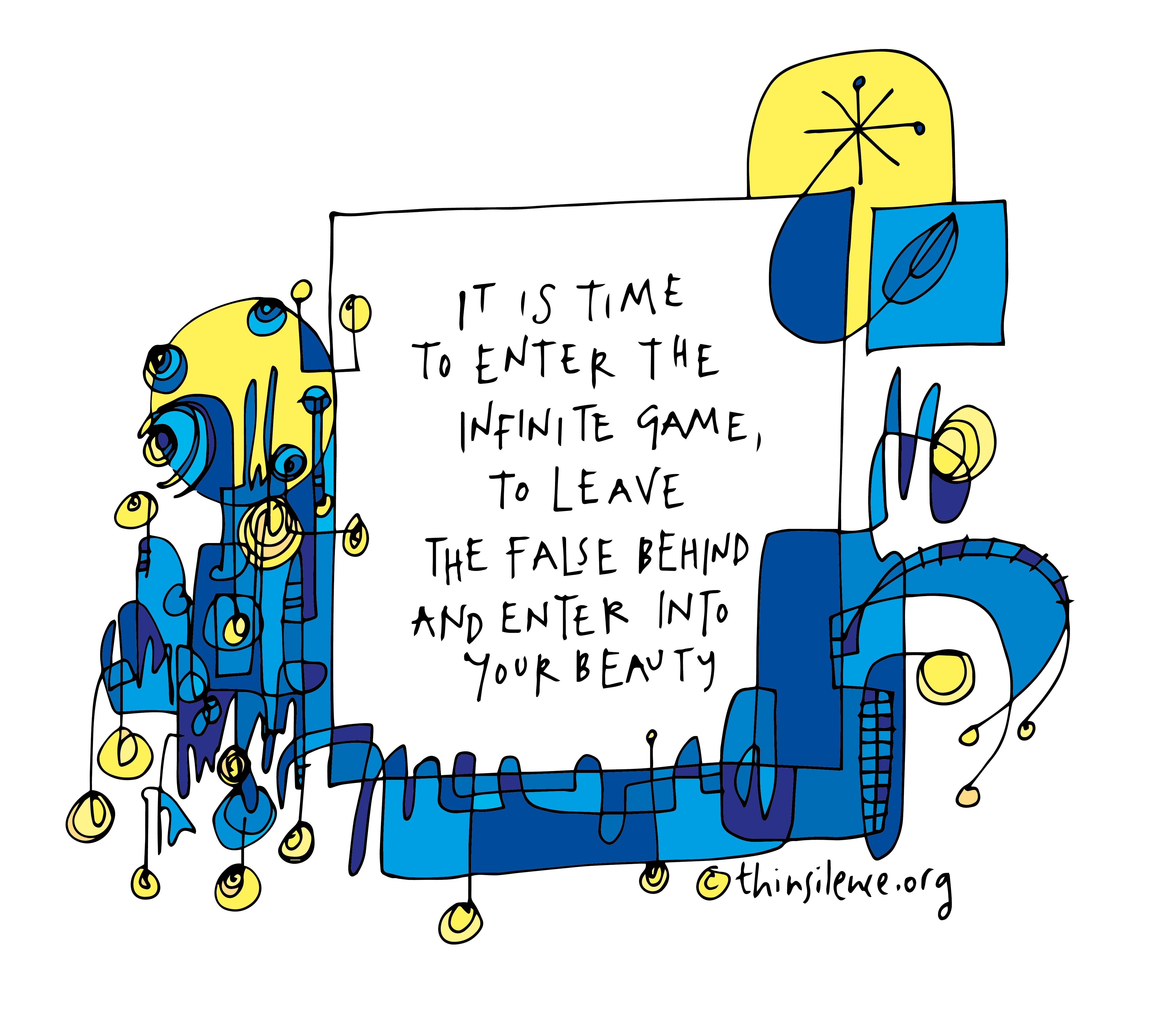
The labyrinth

The motivation to play in an infinite fame is completely different – the goal is not to win, but to keep playing – it is to advance something bigger than ourselves or our organisations.*
(Simon Sinek)

But a labyrinth is actually an arrangement of paths that lead you, in time, to their centre. You can’t get lost in them; they are comprised of only one winding corridor. It slows you down. That’s all.**
(Lauren Elkin)

The words of a song have just transported me back some twenty six years.

I’m videoing a reading to send to a community I served all that time ago and the song came to mind:

Fears that crowd around me
For the failure of my plans
For the dreams of all I hope to be
The truth of what I am^

I didn’t know where my failures would lead me, or how my dreams would grow and what they would become, but looking back I can see more.

There’s a point early in walking a labyrinth where you find yourself very close to the centre.

A short hop and you would be in the centre.

What is important, however, is to continue on the path now carrying you away from the middle for what seems an age before it finally bringing you to the centre.

The words in the song feel like that.

Twenty six years ago, they felt close and very important, but I now understand I wasn’t grasping them as fully as I am able to now.

Twenty six years later and I am able to appreciate that my contribution is all about failures and dreams, for me and for others, too.

Simon Sinek writes about the “just cause,” part of the infinite game, something bigger than ourselves, a cause that shapes the future.

A story that might be said to be of mythological proportions, spanning a lifetime and more.

Life is less like a linear path and more like a labyrinth, circling or twisting around the centre, sometimes closer, sometimes farther away, but, sooner or later, it will arrive, at the right time, rich with stories and experiences.

It’s not time to give up on your failures and dreams.

*From Simon Sinek’s The Infinite Game;
**From Lauren Elkin’s Flâneuse;
^From From Graham Kendrick’s For This, I Have Jesus.

Homo inventionibus

All stories take the form of a Quest. […] To understand the Quest form of your story, penetrate the psychology of your protagonist and find an honest answer to the question: “What does he or she want?”*
(Robert McKee)

What does it mean to be human?**
(Erich Fromm)

Erich Fromm answers his question with a number of possibilities: Homo faber (the toolmaker); Homo sapiens (one who knows); Homo lumens (one who plays); Homo nagens (one who says “No”); and, Homo esperans (one who hopes).

I add Homo inventionibus: one who quests.

Even as we need to make tools, to seek knowledge, to play, to say “no” – and “yes,” we also need to quest.

We need to journey away from ourselves and to others, and then we shall know ourselves:

You think your pain and your heartbreak are unprecedented in the history of the world, but then you read. It was books that taught me that the things that tormented me most were the very things that connected me with all the people who were alive, who had ever been alive.^

*From Robert McKee‘s newsletter: The Complex Simplicity of Story;
From Erich Fromm’s The Revolution of Hope;
^James Baldwin, quoted in Maria Popova’s Brain Pickings: The Gospel of James Baldwin.

The human human

The tendency to install technical progress as the highest value is linked up not only with our overemphasis on intellect, but, most importantly, with a deep emotional attraction to the mechanical, to all that is to alive, to all that is man-made. […] One cannot help being suspicious that often the attraction of the computer-man idea is the expression of a flight from life and from humane experience into the mechanical and the purely cerebral.*
(Erich Fromm)

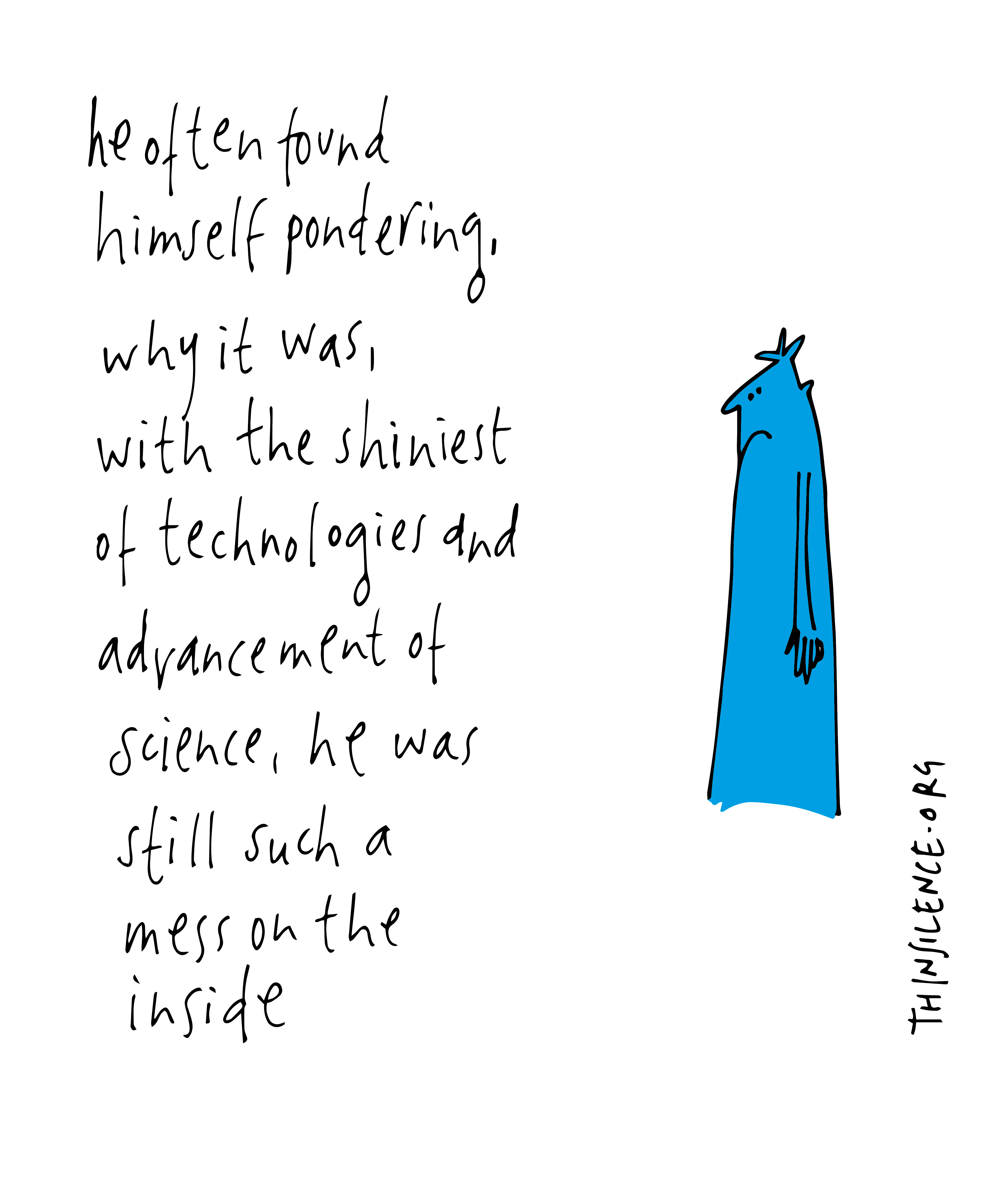
More than fifty years ago, Erich Fromm found himself wondering why it was that humans wanted to make machines more human – the computer-man – rather than growing humans more human.

Machines can provide the illusion that we have things under control, but it may be that they are a place to hide.

With all that peculiar stuff happening on the inside.

All that is needed to remedy this is some slowing down, solitude, giving attention, so that we can make a few changes in the direction of what we value most of all.

*From Erich Fromm’s The Revolution of Hope.