alchemy!

give and see what happens

There’s a kind of magic that happens when we add our willingness to give to our resources.  We discover we are generators – generative beings.

Through curiosity and ideas and mixing things up and playfulness and love, we’re able to make more.

But we face resistance …

When we don’t think we have enough or don’t think we’re ready enough to give.

When we think we see the other person, or environment or context, as not ready to receive, and we feat what we give will be rejected.  

But more magic happens when we do the thing we love to do – when we give, things happen – not always – but more often than we expect.

permissive?

go on, encourage someone

Permission and choice.  Two words which are both beautiful and practical.

What if life becomes richer when we make possibilities available to others through permission and choice?

Permission, because we all need help from outside.  Choice, because the best permission gives people the opportunity to choose the way they really want to go but didn’t think they could.

Some of the most important people in my life are those who have given me permission to move from old thinking new, old doings to new.

Each day provides us with opportunity to provide permission so others may have choose.

WYSIATI

watch see

What You See Is All There Is.

Really?

Some say. “I’ll believe it when I see it.”

Reality is more weighted towards you seeing something when you believe it.

Check out Carol Dweck’s Mindset and you’ll find four sets of portrait drawings.  You could be forgiven for thinking four had been drawn by children and the other four by adults.  In fact they’re by four people on a five day art course: four before-and-after sets of drawing.  The course was really about helping people to see, the art improvement simply followed.  How much more are we missing because we can’t see very well?

Our worldviews, paradigms, philosophies and prejudices filter what we see. And these are the things we’re most aware of.  Beneath these are the ways Humans prefer to make judgements quickly – we’re told this dates back to when our ancestors had to decide quickly whether to run or fight the eponymous sabre-tooth tiger.  But the world is bigger and decisions more complex today than back then.*

Seth Godin recommends a course on seeing as being one of the most important ones we’ll ever take, enabling to see what others cannot.

It begins with seeing yourself; there’s more to you than meets the eye.  When you see this, you also realise there’s more than meets the eye to every person you meet.  And there’s more to the world in which we live than meets the eye, opened to us by others.

But don’t take my word for it; go see for yourself.**

(* It takes a lot of energy to be what Nassim Taleb names a sceptical empiricist, suspending judgement of people, things, and phenomena for as long as possible.)

(**I had an eye-opening experience several years ago which I’ve referred to in earlier posts; that was just the beginning, each day bringing new things to see.  I’ve just got to keep my eyes open – which isn’t easy.)

resourceful?

thank you!

Or resource-full?

You already have what you need to move forward.

I’ve mentioned, I think gratitude leads to freedom, autonomy, you choose.

This appreciative awareness allows you to see all you have as resources for moving forward.  You are able to see what many others – who may have more but cannot see this.  Gratitude gives you the edge, makes you more resourceful, and able to act more quickly.

It’s like reverse seeing, like when I reversed the 10k route I ran earlier in the week.  I saw the town and the countryside in a very different way – same scenery but a totally different view.

The problems you and I face are firstly in our heads (in this case, an inability to appreciate what we have) rather than being out there (look at what others have and we don’t), affecting what we think may or may not be possible.  But gratitude connects us to our resources, fuel for movement.

why not shape the future

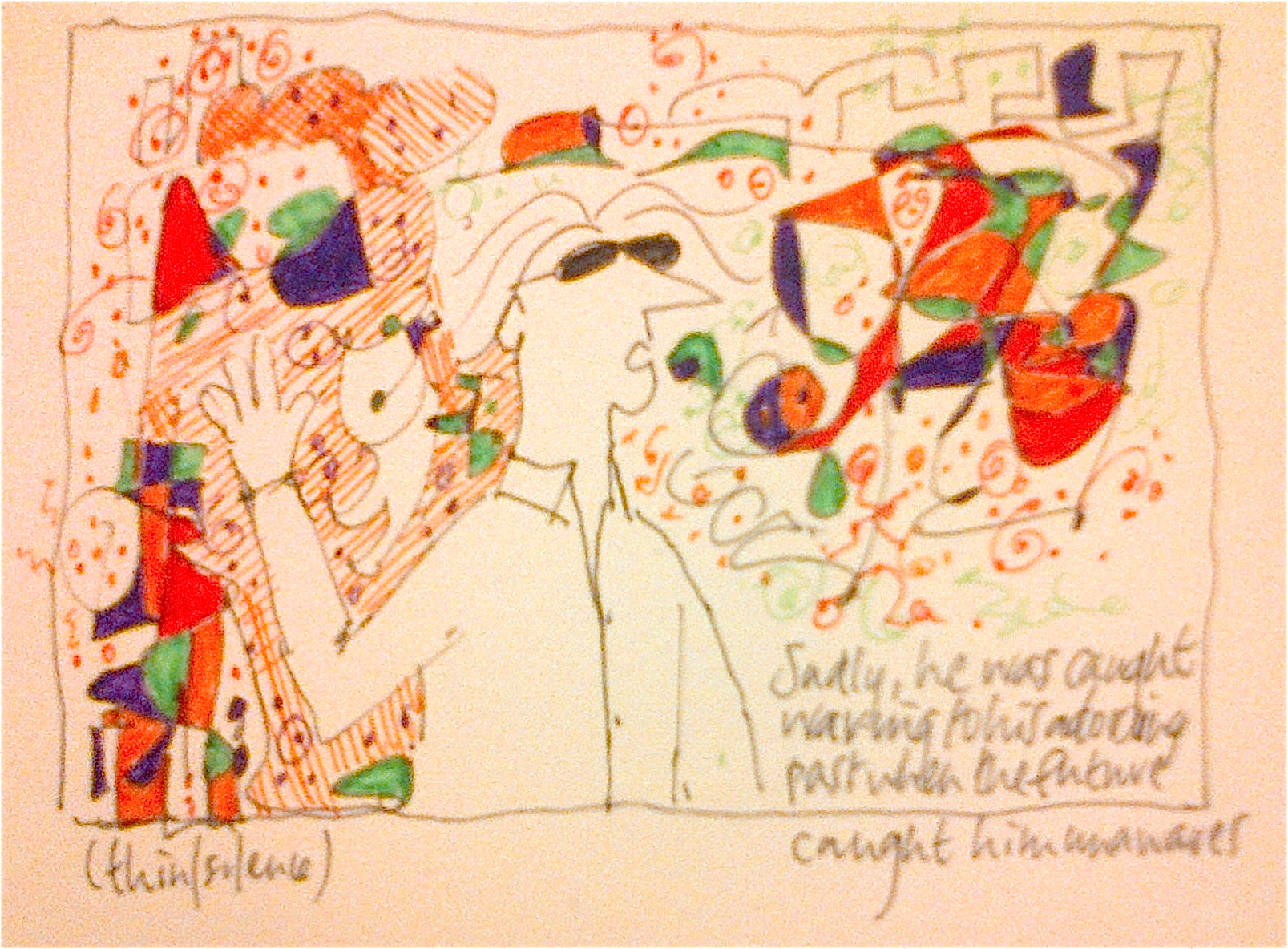
sadly, while he was waving to his adoring past ...

Have you noticed how the future is coming towards us ever faster?

My father was born in 1909, his father was born in 1872.  Back then, steam transport was just approaching the golden days of steam, altering people’s lives dramatically.  My father died the year before the world wide web became a reality.  It was also the year we got our first computer – an Amstrad with 256kb memory – no hard drive, black-and-white screen – £1,000 please.    1990: Smith Corona portable typewriter. 1991: welcome to the future.*

I didn’t foresee what this was going to change, but others were shaping the future.

Which gets me to thinking, we can all be shapers of the future.

It begins with noticing the thing our lives keep whispering to us about, and to allow our hearts to be shaped by this.  When we are changed by these whispers, then we have set our feet upon the path of shaping the future.  Carlos Castaneda was right to suggest we need to find a path with a heart.


(*Only twenty-three years later, 3D printers offer new foods (insects to order), jewellery-printing in gold (my daughter-in-law has access to this technology), and the first building to be printed.   Then check out Ramez Naam’s and other futurists imagining of what the future might be because of what is happening now with genetics, drugs, and technology.)

why future is spelt c o u r a g e

so many possibilities

Here’s a paradox.  If we’re to become more who we can be, and do more of what we can do, we must live with courage, and to live with courage is not living without fear and anxiousness, but living with an absence of self.

Part of what it means to be Human is our desire to conform – to look after our selves within the collective.  Another aspect of being Human is the desire to journey beyond our places of safety – for this we need courage.  Without courage we will conform more and more.  Not only do we lose sight of the technicolour life but so does the collective, becoming more and more inward looking.

Without courage there is no future, and without future there can be no better now.

Some see the future as being more days like today, some brighter, some not so bright.  Others believe the future is not set but is open to our shaping.

With all the experiences and skills and curiosity and energies in your life, there are many possible futures.  From these, you can identify which are more probable to follow with your heart.   Which of these do you prefer?  Which will you pour your energy into?

Step 1: see your many futures;
Step 2: focus in on those which excite and you need to look at more closely;
Step 3: choose a path with a heart and give your energy to it.

to the future with love

sent to the future with love

The things you do today do not have to be this way.  Instead, they can be that way.  Our choice.  And by our choices, we are changing the future, even as we are changing ourselves.

Imagine, five hundred years into the future.  An archaeological dig is taking place over the remnants of your last home.  The archaeologist unearths all kinds of objects, including those containing your thoughts and values.  What kind of world do they suggest you hoped and worked for in this “time capsule” left behind?  (Perhaps it’s more likely to be a collective picture of our lives, our hopes, our mistakes, our endeavours, which will be uncovered, but the reality is, in many ways, we shape the future.)

Humans have been stepping outside of genetic evolution for thousands of years.  We understand we are not our genes but also our choices.  And these choices change things for those who follow us.

When we talk about starting with a clean sheet of paper, what we’re actually doing is taking on board the many things we’ve inherited.  As we look into the future, the same is true of those who follow us – for good or ill.

Perhaps a late Valentine’s thought, but what is the best thing you can leave for the future with love.

resistance is (not) futile

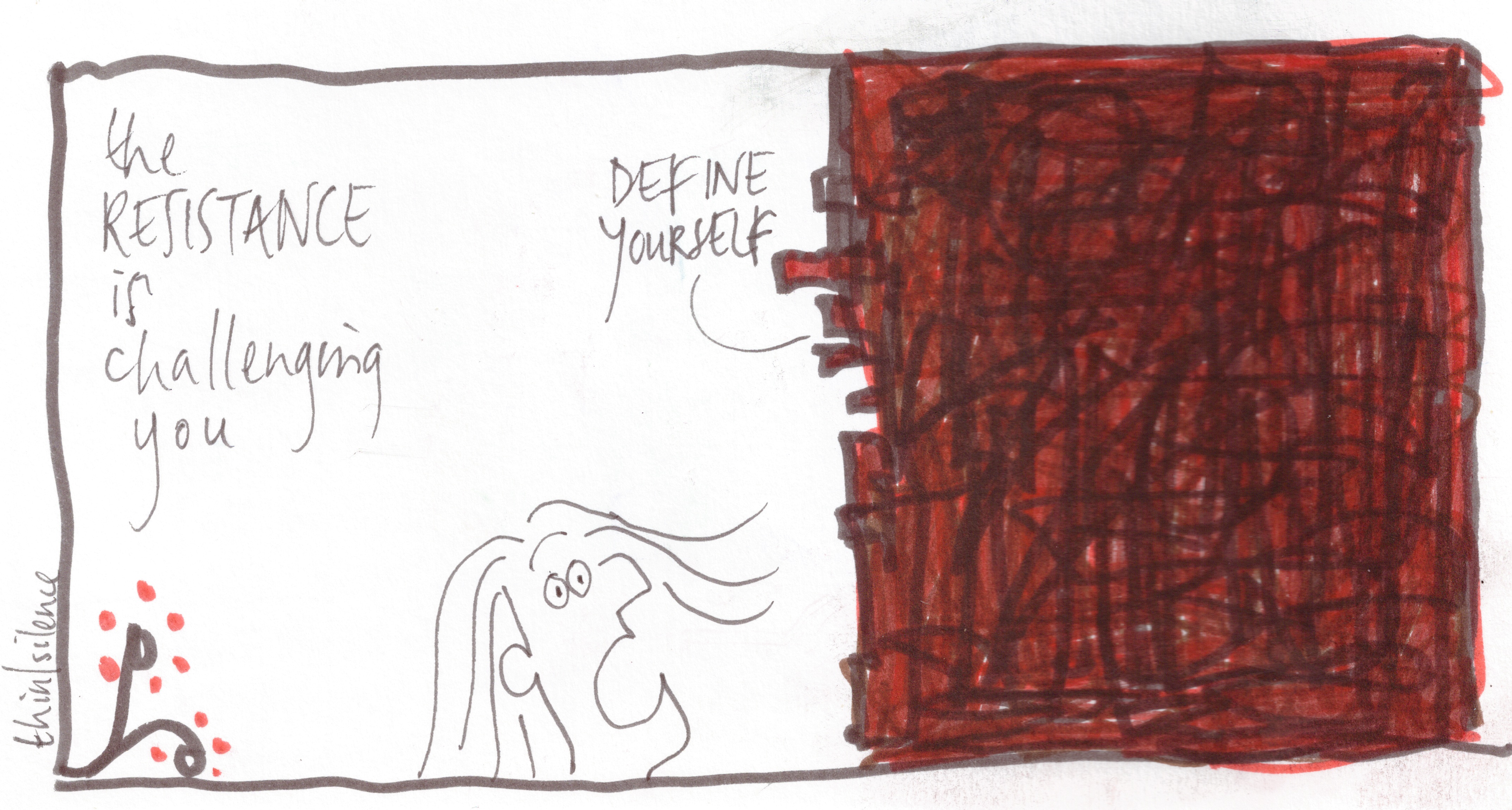
the resistance is challenging you

When we produce our art – the unique work of our lives – we experience resistance: both from without and within.  Some people won’t like your art at all – others will love it.  Yes, listen to those who don’t like it … so you can make something better for those who love it – (few of us have the energy needed to turn a critic into a fan).

Then there’s the resistance within: the doubts and fears and  tiredness and pain and …………………  (empty space: where are the ideas and possibilities?).  Producing your art never gets easy.

It’s said that it takes ten years or 10,000 hours of deep practice to master something, and each hour comes with resistance.  You produce something and it creates resistance, and the resistance defines what you will go on to produce.  The ice-skater works hard to master a particular manoeuvre – maybe a BiDs (backward inside death spiral) – and when accomplished the resistance is there again, to go further – now a BoDs (backward outside death spiral).

If you feel the resistance right now, it’s not there to stop you, but to help you go further.

The Borg might tell all species they meet that resistance is futile, but they hadn’t reckoned on Captain Jean-Luc Picard.

flourish!

it's not for them ...

The painter Jack Vettriano shares a saying he was brought up with as a child in Fife: “Everyone is equal and no one is special.”

Seth Godin comments, ‘The cynic says that if everyone is special, no one is.’

Neither the Scottish saying or the cynic want you to flourish.

What we’re beginning to see at the beginning of this 21st Century is how every person can flourish is some special and unique way, so one of the things we have to be about is making space available for this to happen, environments for people to flourish.

I’ve told the story before, when I was asked the question, “What does it mean to be Human?”  Someone in the group asked this, offered back, “I am not Human, we are Human.”

I told this story to another group just a few days ago.  I’d been sharing how our particular group forms around this same question, “What does it mean to be Human?”  I went on to say that only as we listen to each other, and see through the eyes of each other, can we answer this question, can we express how we are Human.  As the evening went on, I enjoyed listening to buzz of the conversations happening around the table.  Each person was providing at least one Other the opportunity to explore who they are.

We have grown up with sayings like the one above, or the opinions of those who want to flourish themselves but haven’t the imagination for you to flourish.  We are controlled by all of this more the we know and we need to free each other.

When we get together and create spaces and environments for people to identify and explore creativity, joy, and purpose, we are part of a conspiracy to overthrow the things seeking to prevent  everyone from flourishing.

the best way to navigate adventures?

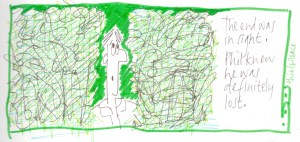
the end was in sight ...

Some pursue individuality as the way to express themselves, to be different to everyone else.

What if there is a better way?

I’ve been pondering the difference between individuality and autonomy (the freedom to control and direct one’s own life).

Individuality does not necessarily lead to autonomy, but autonomy leads to individuality.

What individuality can lack is self-awareness – knowing what we’re good at and what energises us, also how we can best live this in an integrated way with others, with our world, and with our future Self.  Individuality can fly in the face of each of these.

Self-awareness connects us with the elements and dynamics in our lives which are self-energising and self-rewarding – the things you’d do without being paid.  When we don’t have this, we can substitute external or extrinsic endorsements – the people we connect with, the things we wear (labels on the outside, please), the possessions we must have to achieve.

Think of self-awareness as a compass providing us with our true north no matter the geography we find ourselves in or the map we are trying to make sense of.  We know who we are and happily can depend on, or interdepend with, others.

Robert Greene offers a powerful picture of autonomous people when he describes how ‘they decide to forge their own route, one that others will see as unconventional, but that suits their own spirit and rhythms and leads them closer to discovering the hidden truths of their objects of study’.

He goes on to offer a wonderful story of how Micronesian sailors could make their   incredible journeys through knowing their world so well, a picture of how knowing ourselves offers the best opportunities for great adventures.

Master navigators knew the sky chart so well that
with the sight of one star in the sky they could
immediately sense where all of the others were
located.  They had learned how to read the other
navigational signs so well that it has all become
second nature.  They had a complete feel for this
environment, including all the variables that
seemed to make it chaotic and dangerous.

These variables also include being able to sense the temperature of the water, the reflections off clouds, the phosphorescence of the water, the flights of birds moving to and from land at different times of the day, and more.  All amazing.

The life of every person is as amazing.