wanted

27 you're not obliged ...

Those who’ll enable us to step into the future.

As change happens all around us at a bewildering pace, we’re realising the world we thought would be around for always, is passing away.*  We may well blame many things for this but there’s no reverse, there’s only forward into shaping the future.

There’ll always be people who chant, It didn’t used to be like this.

There’ll also be people who say, To be Human is to make all things thrive.

I know which I prefer to say.

Everyone with a passion, a skill, and an internet screen are more connected than they know to the world which is emerging:

‘this is a platform for a kind of art, a far
more level playing field in which owning
a factory isn’t a birthright for a tiny
minority but is something that hundreds
of millions of people have the chance to do.’**

The shift is greater than this simply using new technology to do the same things.  The shift is from obligation to options.  From, this is what I have to do, to which of these will I choose to do?

We’re just on the cusp of this right now but increasingly the world will provide us with more and more options.

I’ve mentioned elsewhere three ways of imagining the future.

There’s the expected future, predicted from the particular trends we’re focusing on.  This is the one least likely to occur because everything has to remain the same – the bigger the expectation, the greater the possibility of change to this: Fukushima, Kodak, Manchester United.

Then again, we may be hoping for some event or other to positively change our future (the boss is replaced, we win the lottery, Richard Branson head-hunts us).  Perhaps at best we imagine and plan and wait.

The third way to shape the future is through choice – individually and collectively – cognisant of trends and expectations, and possible events, but choosing and acting and moving forward.

There has never been a better time or a greater need for people who see potential in individuals, communities, and societies to step forward and create spaces and environments in everyone can thrive.

(*To all positive and hopeful movements there is resistance and reaction; we see this time and time again in ugly inhuman efforts to take the world backwards.)
(**From Seth Godin’s Whatcha Gonna Do With That Duck?  Organisations, like micro-finance charity Kiva, are helping people around the world have more choice to grow their businesses and their lives.)
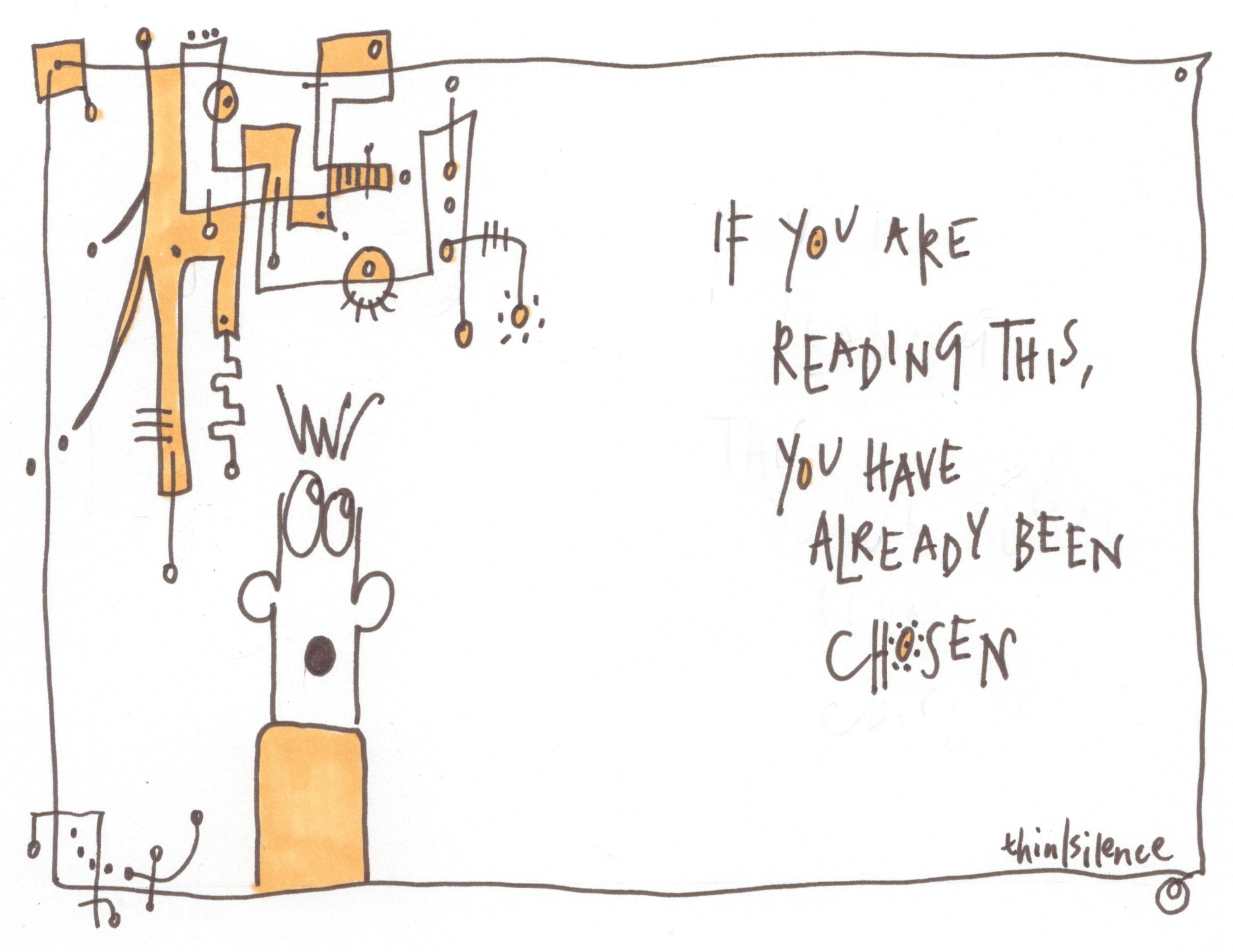
(Cartoon: The idea is, when there are options, everyone benefits.)


the legend of the identity thief

26 my life is a party ...

A story of mythical proportions.

Throughout history the identity thief has taken on many different guises to rob people of their identity: disease, slavery, doubt, control – whatever works the thief uses.

The person who begins the journey to take their identity back, to grow it and make a contribution, will cross several thresholds guarded by the thief’s minions.  The first is Judgement: “Who are you to think you can set out to know, own, and express yourself?”

Many do not make is past this guardian, settling instead for what they have so far known and fitting in.  For those who do overcome there is another guardian to encounter: Cynicism.  Cynicism defies us: “You struggle to be open and connect, you do not, can not, and will not care for others or your world, or even embrace the person you can be.”

This need to be open and to connect can be too high a price to pay; it feels more like losing the critical self than finding it.  Yet, some triumph and face the final guardian: Fear.  Fear knows it holds the greatest obstacle to the regaining of our identity: “It is time to let go of what was to take hold of the new, not only with your mind, not only with your heart, but with your will too; you have no idea what lays before you and yet you must let go.”

A few make it past all these guardians, into the Hall of the Identity Thief, to find there is only a mirror standing in the centre of the great space.  This single object draws you in and you look upon a face you hardly recognise.

It comes to you, the face and life reflected back is your own, changed by the overcoming of judgement, cynicism, and fear.*  You also come to the realisation, you are the identity thief, and, whilst other people and circumstances have aided and abetted, you have given them sway.

Identity is important because it is how we explore being Human.

(I wondered about writing a second blog at this point but if you can manage a few more lines, please read on.)

Identity is also important because it is a producer of ideas.**

We live in an information-saturated world, and information is what we work with to produce ideas.   Ideas will become increasingly important and valuable to control for those whose identities are more focused on themselves than others, who have not descended into the lair of the identity thief.

Those who have made the journey understand ideas are best shared allowing them to become better.^

Open ideas are important for Humans and our world because they provide us with options in a universe which is random and sometimes chaotic.

My friend Diallo said something which has remained with me: ‘We are to be, not to be like.’

I like this very much, the idea we are to be true to ourselves and not a copy of anyone else is a good final word.

‘We are to be, not to be like.’

(*Judgement, Cynicism, and Fear are three voices identified by Otto Scharmer for preventing us opening our minds, our hearts, and our wills.  I thought these three offered themselves as mythical guardians of thresholds to be overcome by the hero who must enter an unfamiliar and transformative space before she can return with the prize or boon to make a difference in their world – the classic mythological story.  What she comes to realise is, the world has changed forever.  Also, I began reading a retelling of the legend of Atlas in Weight by Jeanette Winterson, in the introduction of which Winterson describes herself as someone who ‘believes in the power of story telling for its mythic, and not explanatory qualities, and who believes that language is much more than information.’)
(**There are all kinds of ideas: good, bad, and ugly.)

(^A person’s response to your idea will give away whether they wish to control it or build on it; if they are willing to play the “Yes and” game, you have your answer.)
(Cartoon: This came out of a conversation with a friend in which we were exploring where validation for the things we do comes from.  First validation comes from within, from knowing what we are doing is good and valuable and we’re doing it well; second validation comes from without, from others,  providing us with another perspective – this is healthy.  When we make the validation from without first and our own, second, we are moving into ill-health.)

underdogs

25 underdogs know

They don’t play fair.

They can’t.

The giants they battle will always whip them if they play fair.  Of course, exactly what is fair is determined by the big guys; fair means playing by the rules they’ve established and interpret – the ones they can win by.*

Underdogs can win, though; more often than they know.

They don’t have all the paraphernalia and expertise of the larger players, and this means they have to work harder.  No coasting here, so it’s easier and simpler and less time-consuming and more acceptable to settle for playing with the favourites.

As Malcolm Gladwell points out, you have to be desperate to put in the great effort needed to turn being an underdog into an art.

I’ve worked with hundreds of people around their dreams and talents, and I’ve seen just how hard it is to put in the reflection and practice and creativity needed to hone their art and make an impact.**  When they make it, against the odds, it is one of the sweetest things in the universe to see.

It never gets easier.

I don’t want you to be under any illusion.  This is such an open-ended game, meaning, once we get into the way of hard graft and failures and trying again, and we see what can be produced, we don’t know how far we can take it, where the ceiling is.

You’re not there yet, for sure., so I want to encourage you to keep going, because you can.

It is very likely, underdogs understand the universe and know there is more to gain than lose if they make a move.

Ready?

(*I’m thinking of Richard Branson’s experience when he took on British Airways, or fair-trade versus free-trade.  I’m not questioning the rules apparently transgressed by Tesco’s recent “accounting error”.)
(**This is art in its widest sense: the amazing thing every Human life can create and contribute.)

imaginings

24 when a cloud of ...

Another name for Humans.

Have you ever noticed how much you use your imagination when you are reading a novel, listening to music, having a phone conversation, reading a map – you are “seeing” far more than what is in front of you.

We can’t get through a day without employing our imaginations.  Yet many deny they have any and it’s only the charismatic, the rich, the famous, and the glamourous who have it.  Hopefully, we’ve scotched this one.

Many use their imaginations to promote and serve themselves but others use their imaginations to serve others; they look at the world as it is and begin to imagine it differently, a better place for more people.

Every Human Imagining is different.  We each are interested in, and skilled at, different things.  Steven Covey wrote about seven essential habits for effective people but he hadn’t quite finished and identified one more – writing a whole book about this one really important habit: Find your voice and help others find theirs.

When our imaginations are freed, all manner of possibilities appear; we’ll need to see which most strongly identify and resonate with our voices, sweet spots, elements, knacks, purposes, callings, flow, Strengths* … and then you will have to lose some because you have too many. Who’d have thought it!

I want to link this powerful imagining to something Nassim Taleb shares about the journey we can make from being fragile (“I have no imagination”) to being robust (“I like your imagining”) to being antifragile (“Here’s something I’ve been thinking about and am going to begin – do you want to join me?);** Nassim imagines:

‘My idea of the modern Stoic sage is
someone who transforms fear into
prudence, pain into information,
mistakes into initiation, and desire
into understanding
.

Imaginings can be creative with prudence, information, and understanding.

(*Just some of the words used to describe what it is you do, your art.)
(**The phrases in brackets are mine.  Nassim Taleb would suggest fragile people are shaped and even crushed by the life-stressors they encounter, robust people recover their identity and shape after being stressed, but antifragile people grow as a result of being placed under stress.  The first group will react to life, the second respond, and the third initiate.)

free

23 when we free our art ...

We are made of earth and we return to earth, and, in between, we get to do some amazing things: “fearfully and wonderfully made” reflects one voice, a “mystery wrapped in a question,” another.

There has never been such a time as this, for a person’s individuality, value, and genius to be expressed and received.  Even difficult times do not appear to exclude a person, rather, making their contribution stronger, as they help others in similar situations.

We may or may not get paid for this, but it is clear, every day offers the opportunity to do what we love for free – no permission required, we can research, practise, prototype, and create.  What daily, free expression of what we love does – whether executing some action, influencing others, building relationships, or, coming up with new ideas – is hone it into something powerful.

There’s a lot of information in the the world these days, and it’s certain people know a lot of things, but it’s the putting of all of this together in some meaningful, alchemistic way which is the real magic.  Every day we get to practise amazing skills.

Who knows?  One day someone may want to pay us for our skills.  One thing for sure is we don’t have to wait, wasting the gift each day provides to do the things we love to do for free.

When you know what it is you do and what you have have to do it with, you can take it further and further – every day.

You don’t have to call it free; you can say, it’s gifted.

And one more thought: find others to join with.


gatekeepers and wild ideas

22 he's not noticed ...

These don’t usually go together.

Gatekeepers stand at the thresholds of communities and organisations and bodies of all kinds.

They’re the ones who usually decide who is in and who is out, by interpreting the rules of entrance and acceptance written by their executives – often interpreting in narrow ways because they have not been allowed any creative breadth.  They are powerful people, or maybe we should take a second look.

Here are a couple of thoughts.

The gate and world behind the gatekeeper is moving.
What if the gatekeeper of the future focuses on seeing many people in, rather than keeping many people out?

Malcolm Gladwell’s latest book David and Goliath takes another look at what lies behind the famous saying applied to business and sport and politics and much more.  He’s suggesting we’ve seen this all wrong.  While we might perceive Goliath in his armour as being powerful in this tale, he’s actually severely disadvantaged when he comes up against David, who is, in the ancient world’s military set-up, a projectile warrior.*  Gladwell further surmises, the size of Goliath possibly lay in his suffering acromegaly, an over-productive pituitary gland – which, as well as accounting for Goliath’s size, can cause poor sight (Goliath sees David too late, sees the game has changed – this isn’t another infantryman taking him on in “single combat” but a slinger).

Yes, the powerful ones appear extremely big and powerful but carry a great disadvantage; they struggle or cannot see the signals coming from the horizons – signals increasingly important to the world we live in today.

But what if gatekeepers are those who see as people into the game as possible?  McNair Wilson includes seven agreements towards hatching new ideas, and even by number six, he’s still encouraging wild ideas to be brought to the game: ‘outrageous, impossible, untamed notions that probably make no sense at first … The alternative to wild is “good” ideas, instantly acceptable-by-all ideas that fail to stimulate, inspire, or motivate.’  We can’t have too many people, too many ideas, too many possibilities.  The good ideas don’t seem to be working in our world of violence, injustice, poverty, and disease.

Yes, bring your wild ideas, but how about becoming a doorkeeper to others?

(*In the world of David and Goliath there is cavalry, infantry (which would be where Goliath fits in), and projectile warriors (the slingers on the battlefield).  Like a military paper-scissors-rock scenario, slingers take out infantrymen: apparently, the Romans even had a special set of tongs to remove projectiles from the bodies of unfortunate infantrymen.)


now

21 if not now ...

Today is a natural environment provided by life in which you can shape the future now.

Your life is just such an environment too, for others, now.

We might think this means some people and not others, but we’d be wrong.

On a personal level, we all can train and practise around our curiosities and skills and passions.  Together, we can shape these natural environments even more through intentional meetings exploring future possibilities.

‘We were all told too young, to colour
inside the creativity crushing lines.  The
child you once were – and might yet be
again – will not be careful, but sloppy and
more than a bit reckless, because it
genuinely doesn’t matter.’*

Today, I’ve been exploring future possibilities with a number of others for an hour or so; we didn’t know exactly what would happen, and still don’t – maybe something valuable we can give to others.  It was intentionally a now environment, not a wait environment.  (Whatever comes out of this will be helpful for making something else happen, as we learn what does not work as well as what does.)

library of awesomeness1

In his novel Invisible Cities, Italo Cavalo describes the city of Irene, about which there is only conjecture because no one has visited it, only observing it from a distance: ‘Irene is the name for a city in the distance, and if you approach, it changes.’  Now-environments change this.

Now we can step inside places of creativity.

library of awesomeness2

(*From McNair Wilson’s Hatch.)
(Cartoon: A take on Hugh MacLeod‘s blog Neither do I – here’s a little of this: “There’s a famous British story about two well-known authors who meet at a cocktail party (I tried to find the exact reference on Google, sorry, I failed).  
Having been asked by the first author what he does for the living, the second author says, “I write!”  “Really?” says the first author, “Neither do I!”  The story is a little quip about how little writing authors actually write every day, the rest of the time they’re just staring out of windows.”)


keep moving

20 while we have breath ...

One day we won’t be able to.

One day, there’ll be a final “moving on” to make space for someone else here – maybe death is an ultimate act of humility, gratitude, and faithfulness offered to others.

Until then, though, we must keep moving.

Implicit to moving is letting go: sometimes this will mean moving from what we know to what we do not know, and from who we know to who we do not know, and from what we are doing to what we are not doing.

Our personal world views are made up of what we hold on to and what let go of, as Seth Godin puts it, ‘the set of expectations and biases you bring to a situation before any new data appear.’

Alex McManus suggests four things to let go of and four things to take hold of, when it comes to shaping the future; these appear relevant for people, institutions, organisations, regimes, religions, and more: Letting go of truth to take hold of trust,
Letting go of doctrine to take hold of direction,
Letting go of certainty to take hold of faith,
Letting go of cultural power to take hold of spirit.

Truth, doctrine, certainty, and cultural power imply arrival.

Trust, direction, faith, and spirit are future-orientated and imply movement, journey.*

I know I have to keep moving.

Can this be a trap?  This need to keep moving?  Sometimes, but I prefer this risk to keep moving from the smaller to the larger.

Every day, we’re moving into the noise** and clutter of modern-day life, but trust, direction, faith, and spirit help us to distinguish the weak signals of what might be.  They are perhaps what Daniel Coyle calls soft skills – different to the hard skills built by repeating the same actions.  Soft skills are the abilities needed to innovate and adapt again and again in response to the diversity and complexity of our environments, developed by ‘playing and exploring inside challenging, and ever-changing environments’.

While we can, we keep moving.

(*Here’s a little more thinking around this: as hard skills, truth, doctrine, cultural power, and certainty at their best they can take us so far, at their worst, they imprison us.   They only make any sense if they lead to trust, direction, spirit, and faith.  These will always bring us back to the “best” of truth, doctrine, cultural power, and certainty – but we may be surprised by how much has vanished whilst we’ve let go.)
(**When I google noise I get almost 55 million results.)

together

19 to get her

I’m sitting in The Bridge Restaurant in South Queensferry, looking across a foggy Forth and can just see the Kingdom of Fife.  Over there, the Fife artist Jack Vettriano remembers being told as a child, “Everyone is equal and no-one is special.”

fife

I don’t use together in this way, the kind which cannot handle everyone having something to bring to the party – many different things from many different people, the hope I have for any society.

Dave Logan, John King, and Halee Fischer-Wright share some mindsets from the world of work in their useful Tribal Leadership.  They identify five different tribes, each summed up in a different mantra: Life sucks!, My life sucks!, I’m great!, We’re great!, and, Life is great!.  What they’re tracking is a development in people’s understanding of who they are, towards seeing how each has something to contribute to the good of all.  I’m great! is a significant step forward but carries the corollary, But you’re not great.  Even the tribe declaring, We’re great! adds, But your tribe isn’t.  It’s those in the fifth tribe who get how we’re all together against some of the greatest threats and evils facing our world: disease, poverty, injustice, violence, illiteracy.

Allowing for these categories being sharp-edged, they do line up with what Otto Scharmer describes as the society which is emerging from the future, one shaped through opening our minds, our hearts, and our wills, in which, ‘others of us who thought ourselves nothing special will be surprised in a positive way,’ as Brian McLaren has it.

To take hold of this hopeful future, we will need to let other things go.  Logan, King, and Fischer-Wright believe people can only proceed by passing through each tribe; we cannot skip the hard work of opening our understanding, our hearts, and our wills – for some, slowly, for others, faster, but never easily.*

When it comes to a world together in this way, McNair Wilson‘s assertion, ‘More is more’ fits critically – as many as possible to participate in the shaping of the future, which is a future for as many as possible.

I love this from Seth Godin and had wanted to include it yesterday; he’s offering his A-Z new words (often new ways for using words – beginning with artist):

A is for Artist: an artist is someone who
brings humanity to a problem, who changes
someone else for the better, who does work
that can’t be written down in a manual. …
it’s about bringing creativity an insight to
work, instead of deciding to be  a compliant cog.’

We are artists together.

(*Humility is not about having a low opinion of ourselves, rather, it is about having an accurate opinion; a low opinion is just as harmful as too great an opinion.  In this accuracy of who we are lived out, we find our equality together.)

openhandedness

18 openhandedness

Hands are so important to how we express ourselves.

When a hand is closed, clenched, fisted, it not only cannot give, it also cannot receive.

I guess most of us don’t choose to live this way, it creeps up on us.

A clenched life may be protecting itself, angry, or ready to fight back.

Openhandedness describes a way of living which consciously, and with much effort, prises ourselves open to know more, to connect more, and to do more.

There are always plenty of things which try to force our hands closed again, but the very nature and content of being openhanded makes us stronger.

I came upon three small examples about how openhanded living leads to more.

The language we use changes things:

‘New times demand new words,
because the old words don’t help
us see the world differently.’*

As a new word, humbleness used in a powerful way:

‘Simple, humble spaces, help focus
attention on the deep practice task at
hand: reaching and repeating and struggling.’**

Everyone brings something:

‘Never once have I heard one big, fully
formed, complete idea arrive full-blown
in a single comment.  Not at Disney, Apple,
Chick-fil-A, or John Hopkins Applied Physics Lab.’^

(*From Seth Godin’s Whatcha Gonna Do With That Duck.)
(**From Daniel Coyle’s The Little Book of Talent.)
(^From McNair Wilson’s Hatch.)
(Cartoon: I used a Sharpie to “tattoo” “Openhandedness” on my palm today; the only way I could see it was by opening my hand.)