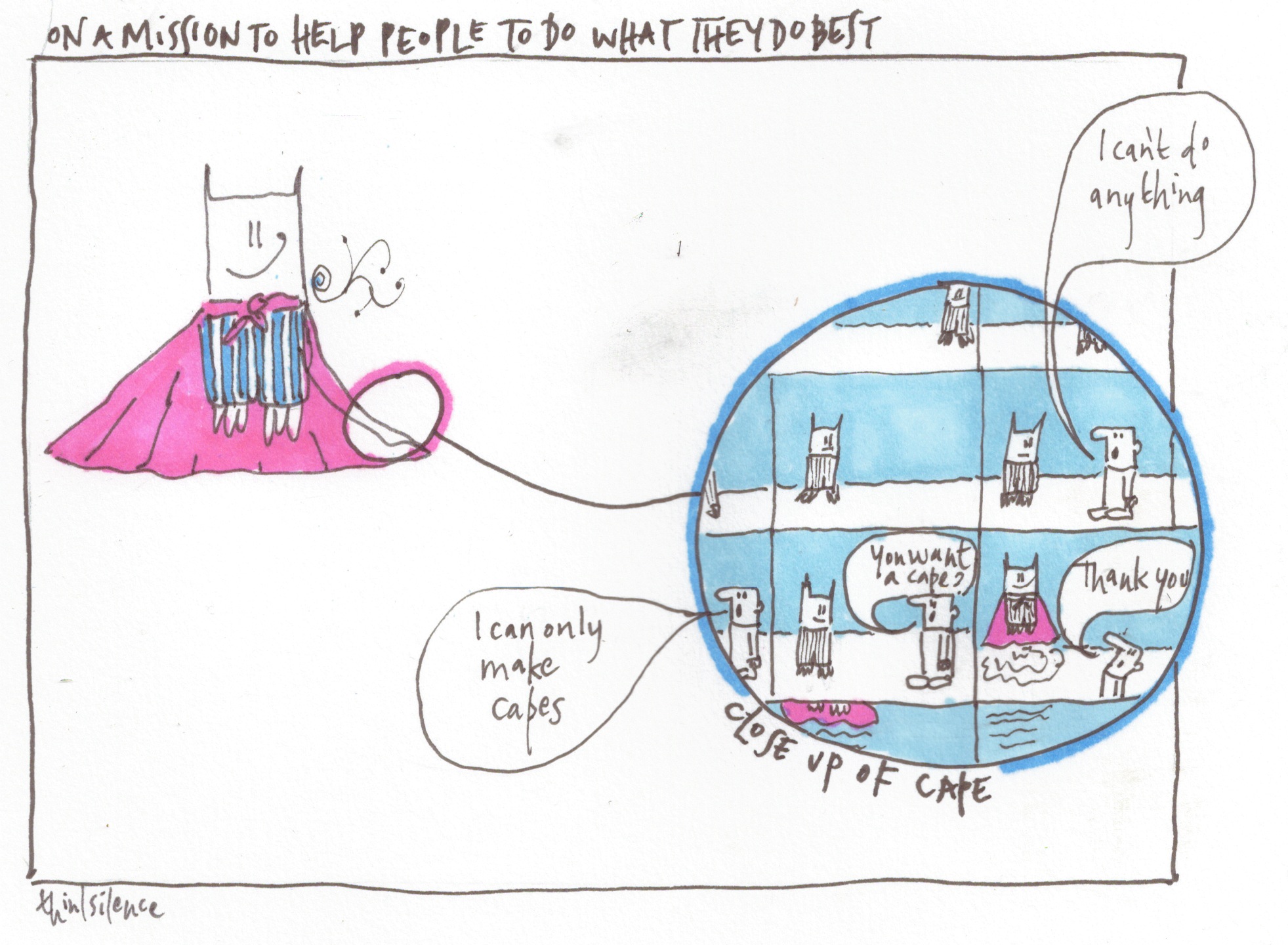
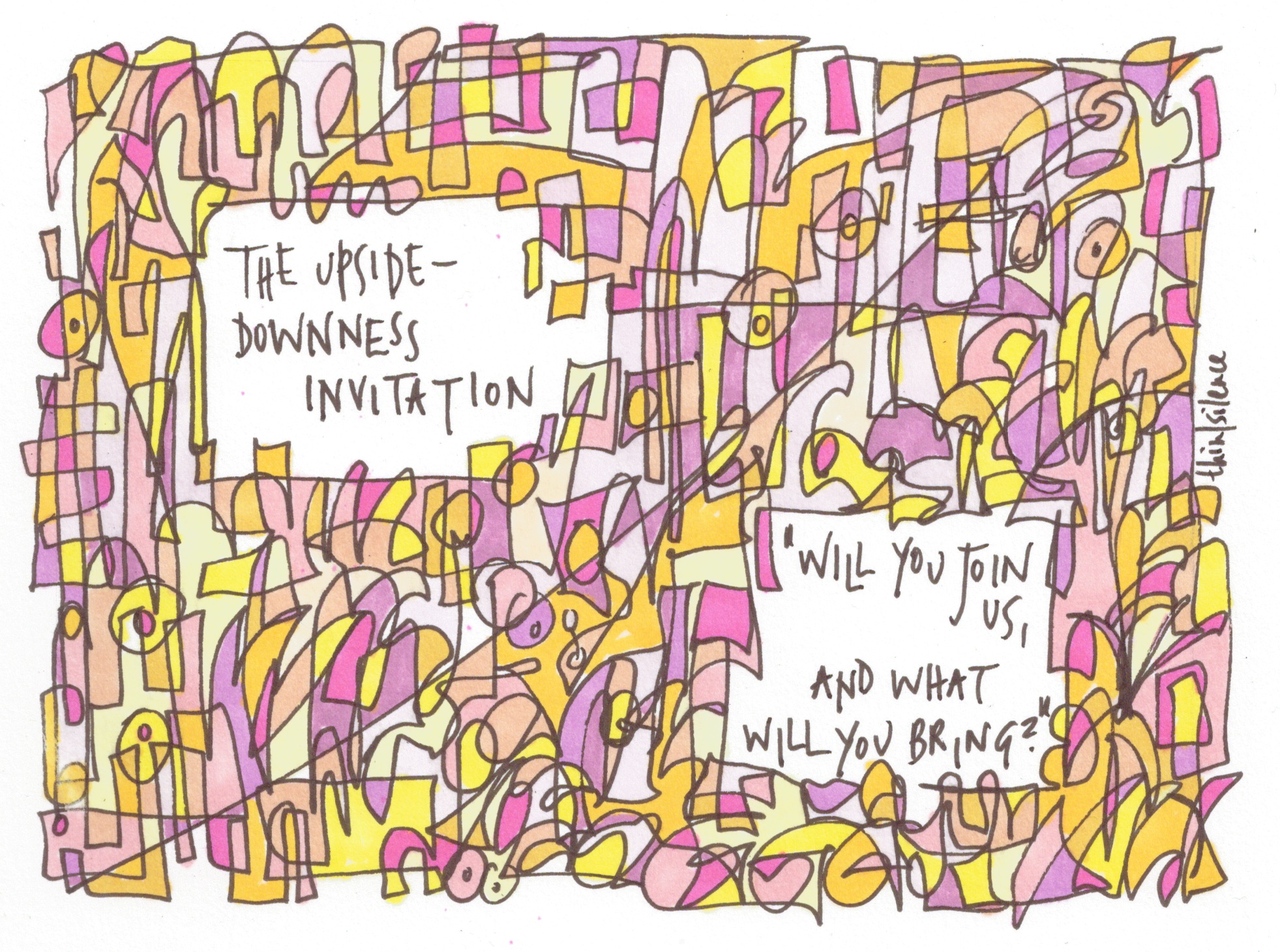
conformity and nonconformity

7 the thing is

We knew we are what we are, but also knew, we can be more.

There we were, two middle-aged, white males talking about things which really mattered to us, were outside our ken and experience, but which we were trying to fathom.

We can open our minds to know and understand and see more, open our hearts to the worlds of others and what they love, and open our wills to live what emerges from these transforming experiences.

Out of this journey towards more, towards the other, comes gratitude, and gratitude is connected with grace and gracefulness.

Then, the more we become a person of grace, the more we can create things of hope and beauty and goodness.

In his delightful Graceful, Seth Godin sees the person who makes themselves indispensable – the linchpin – in this way (I have simply replaced the word linchpin with grace):

‘Grace resists the pressure to conform and
comply.  Instead she works without a map,
solve interesting problems.leads, connects
and creates an impact.  Grace is the one we
can build a project around, the one we will
miss if she leaves.’

Whoever we are, we can be this person too.

(Written and cartoon drawn on the East Coast Line.)

it’s elemental

6 darn it

Richard Rohr offers five elemental truths, as gleaned from the initiation rites of different peoples.

I’ve shared a couple of these previously but here are all five:

Life is hard
You are not as special as you think
Your life is not about you
You are not in control
You are going to die

They’re intended to help a child become a contributing adult member of their society: to die first, and then live.

These elementals say, “You are Human,” and are found at the centre of who we are … waiting to be completed.

If we are to see the emerging future, we must recognise the pain in others, in our world, in our self, and, if we believe in God, even in God.

Italo Calvino‘s character Marco Polo describe the unhappy city of Raissa, where people ‘wake from one bad dream and another begins,’ yet there is another Raissa, if only people are willing to see it:

‘Also in Raissa, city of sadness, there runs an
invisible thread that binds one living being to
another for a moment, then unravels, then is
stretched again between moving points as it
draws new and rapid patterns so that at every
second the unhappy city contains a happy city
unaware of its own existence.’

The elemental truths are incomplete and we have the opportunity to be imaginative in how we can complete them:

Life is hard but …
You are not as special as you think, and yet …
Your life is not about you, so …
You are not in control, but …
You are going to die, so …

To do this is not easy, as Daniel Kahneman concedes when he writes:

Reframing is effortful and System 2* is
normally lazy.  Unless there is an obvious
reason to do otherwise, most of us passively
accept decision problems as they are framed
and therefore rarely have an opportunity to
discover the extent to which are preferences
are frame-bound rather than reality-bound.’

When we allow ourselves to see this reality – the pain and the possibility – then we have a story worth sharing.

(*System 2 thinking is a slower, more deliberate way of thinking, in contrast to System 1 thinking which fast, instinctive, and emotional.  It requires a lot of effort and therefore we tend to find it’s lazy.  Nassim Taleb picks up on how energy-sapping open thinking is when he introduces the sceptical empiricist: whilst we may wish to come to a conclusion about something and move on, we can remain sceptical about whether we know all there is to know or have covered all the angles.)

comparisons

5 oh, it's just my knack ...

The best person to compare yourself to is your self.

A few nights ago I’d the opportunity of meeting some brilliant young people helping each other to identify their knacks – their talents – with a view to sharing these with one another in help and support.

Not everyone was sure of their knack, but I wanted every one of them on my team because of the amazing things I think they could offer.

The really important thing is to have done the hard work within your domain,* constantly pursuing your curiosities and honing your skills … with a passion.

When it comes to those times when it’s necessary to compare yourself with others – to get a different healthy bearing on exactly where you, then it won’t get out of hand with you ending up thinking you have nothing to offer.

Here’s how you can compare yourself with your self.

Mihaly Csikszentmihalyi points to the following as indications of whether you are in the flow of your creative work, including:

1) you see clear steps; 2) you are able to recognise feedback immediately; 3) there is a balance between your skills and the challenge; 4) you are fully focused; 5) you cannot be distracted; 6) you are not concerned with failure; 7) there is no self-consciousness; 8) your sense of time is distorted; 9) you are so in the flow that the activity becomes autotelic – an end in itself.

Turn these things around and you have a list which looks like this:

1) you cannot see clear steps; 2) it’s difficult to tell how you are doing, because you can’t recognise feedback; 3) you feel there to be an imbalance between your skills and the challenge; 4) your mind doesn’t settle; 5) you find yourself easily distracted; 6) you worry about failing; 7) you are constantly self-conscious; 8) time drags and you find yourself time-watching; 9) the activity is exotelic – a means to an end which in and of itself you do not enjoy.

This tells you you’re not living your knack, or recognising and valuing it, and this can lead to unhealthily comparing of yourself to others.

To compare yourself with your self is about seeing whole picture within and without, upgrading rather than degrading what you know about yourself.  Otto Scharmer would encourage us to see this as presencing: being present to others, to our world and to our future Self in a healthy way.

‘Life is not about removing every obstacle;
it is about finding creative solutions for
taking advantage of those obstacles, or
learning from them … or living with them.’**

Flow, sweet spot, element, knack, purpose, calling, vocation, art, genius, strength – whatever you call it, it’s got to be you.

Our knack moves us from being reactive to initiating.

(*Your areas of knowledge and expertise.)
(**From McNair Wilson’s Hatch.)

u people

4 we travel to the future

U people come to live in the present from both their past and their future:

‘My journey began with the recognition
that I am not just one self but two selves.
One self is connected to the past, and the
second self connects to who I would
become in the future.’*

What if I don’t have to be the person I am in this moment because of who I have been, what I have done, or what has happened to me in the past alone?  What if I can live in this moment but because of who I choose to be and what I choose to do in the future?

U people understand this, giving themselves permission, and others encouragement, to connect with their futures.  They go as far as to posit, we cannot be whole and integrated people unless we also connect to our future.  This understanding opens boundaryless** possibilities.

There will always be people who call us back to, or reminds us of, our pasts; some because want to control, others want to compete, others don’t want anyone else to have what they don’t believe they can have, and, still others because they do not believe in the future, saying, “This is all you are and all you can be.”

They’re wrong.

In this very moment, you can be both your past self and your future self, so you can be more^ creative and generous.^^

(*This come’s from Otto Scharmer’s excellent Theory U; U people isn’t a term Scharmer uses but I hope it works as we think about being people formed by our past and our future.)
(**Boundaryless is a word I borrow from Jack Welch’s book Winning where its used to describe open thinking, though here I use it in relation to a remark David Shenk makes in The Genius in All of Us about how we don’t what we’re capable of.)
(^A group of people used the word more – magis – to describe how they would give everything they could for others, and then they would give more.
(^^Otto Scharmer offers three important actions to help us be U people: suspension of our seeing and understanding – in this case, how we only see ourselves as the product of our past, redirection – we reorientate towards the new we see our future can be. and, to let go – of the old ways of seeing and understanding which are no longer helpful or useful to our pursuing of the new.  Some might be cynical about all of this; I suggest what they are really reacting to is how difficult this is, and how the easier thing is to stay where they are.)

changed?

triple negatives

Interesting question.

Can we change who we basically are?

Do we need to?

Who are we, anyway, really?

We know the world needs to change.  Mohandas Gandhi encouraged us to be the change we want to see.  Personal change and world change are inextricably linked.

Can the baseline “me” be changed by the experiences I engage in and the choices I make?

Am I always slowly becoming a different person to the one I can be or want to be because I don’t choose?*

To be able to say what our life isn’t, or who we don’t want to be, can help us move forward.  By elimination we discount what we don’t want to be until we’re left with who and what we do want to be.

Change for change’s sake can be helpful too.   It gets us moving, and sometimes moving anywhere can be better than staying where we are.**

You could say I’m in the moving and changing business – helping people to identify points of purchase which are already within them and around them.  It’s about seeing differently, to see what there is rather than what there isn’t: who they are, what they have, what they can do.

(I am realising more and more this is about being  future-orientated.)

Voices which were meant to have urged us onward, to change, to become, have become voices which stand in our way.  We have to get past the voices of judgement, cynicism, and fear which hold us where we are.  I wonder whether these were once good voices: to have good self-judgement, to be curious about the other, and, to move forward whilst avoiding the destructive chaos are good things, allowing me to be more present to life.

Repent is a word which is thrown around as condemnation when it’s really invitation, it’s a future-orientated word, asking us to explore our future self.  Not what we have been but what we can be, to be open to this, to see how it comes through others, and to live out what we see.

(*In The Self Illusion Bruce Hood argues any such thing as the person: we are an ongoing adaptation to the world around us.)
(**Change for change’s sake can also be bad, when it covers up what we really ought to do, when it’s avoidance.)


the future is connected

2 please select one

But we all exclude people.

Sometimes we have to – we just cannot connect to everyone – even Facebook knows this.*

Sometimes we could connect and choose not to.

We tend to connect with people like us, excluding others, although the future will be increasingly about connecting with people who are not like us,** and seeing just what kind of world we can shape together.  There will be rules which will need to be followed – developed from those of the infinite game – but all kinds of people will come together around the things which matters to them, or around a person who matters to them.

When others exclude, we can create our own places for including.

Yesterday I mentioned the story of the Impressionists; marginalised by the Ecole national superieure des Beaux-Arts, they created their own community of artists – Societe Anonyme Cooperative des Artistes Peintres, Sculpteurs, et Graveurs – making it possible for all those who wished to pursue their art without compromise to do so, as equals.

Seth Godin’s We Are All Weird is an important reminder for us of how we now live in a world without normal people – even those who count themselves as normal are weird, and this is okay.

I find myself pondering why might happen with the founding of many groups devoted to including people, identifying with, and developing them in, their weirdness – and their weird art.  These places would be filled with mind-openers and people-builders and connectors and energisers and collaborators and champions and navigators and companions.^

There’s nothing to stop us from beginning such a place for ourselves and others, exploring and developing our weird art.

(*Facebook limits the number of feeds we see from our “friends.”  It also recognises how most of us connect to only four or five people regularly; we connect to the same numbers of groups.  Check out Grouped by Paul Adams for how Facebook sees small groups of friends as critical to social networking.)
(**Many are looking into the developing second renaissance with different people and different domains coming together in exciting new ways.)
(^These eight types of people are described in Vital Friends from Tom Rath.  Rath suggests we need different kinds of friend to accompany us through life – no one is all of this kinds of friend to us and we cannot be all of these things to others.  We could call the book Weird Friends because we’re all different and that’s healthy and fine.)

noise and signals

1 i call it ...

Malcolm Gladwell recounts the story of Paris’s Ecole nationale superieure de Beaux-Arts which annually exhibited what it believed to be the best art.

Impressionist art was not to be found on its walls.

Eventually, the Impressionist artists would exhibit their own work, bypassing this gatekeeper of fine art which found itself unable to hear the signals from these new artists, continuing to be curators of noise.

Those who played by the School’s rules ‘risked being lost in the clutter of other artists’ work’*

Surprisingly, sophistication and expertise can prove fragile at worst, adding more noise – reacting to the new art (whatever the new art might be) – and resilient at best – responding to the art, when what we need to see more of is antifragility – initiating because of the signals we’re hearing.**

Today, everyone can be their own gatekeeper – which is really about creating gatekeeping communities – as the Impressionists did when they exhibited their own work: explorations in antifragility.

Of course, we have to try and ensure our art is signal rather than noise: contributing, not spamming or cold-calling, in turn demanding we listen to what is signal (whispers) in our lives and not to the noise.

‘Until you remove the noise, you’re
going to miss a lot of signal.’^

(*From Malcolm Gladwell’s David and Goliath.)
(**This is the triad of fragile-robust-antifragile from Nassim Taleb, helpful for exploring the effects of stressors upon people and institutions in a universe with way more randomness and accident then we allow.  Taleb suggests we’re not great at innovating, unless we take the impact of the accidental into our thinking and behaving; he suggests it took us 6,000 years to realise the wheel could be attached to suitcases!  He does have a point.)
(^From Seth Godin’s Whatcha Gonna Do With That Duck?)

beyond par

30 he was lost ...

There are often more options than we recognise.

Options are a different kind of intelligence, the kind which says the more options I have the less fragile I am.

Nassim Taleb even suggests: ‘optionality is a substitute for intelligence.’

Options can appear risky to us, though.

Humans are loss averse and perceive par as being the thing to aim for: the one sure thing which will not fail.

Par offers us neatness and tidiness every day: symmetry.

Options are way more untidy, asymmetrical but stronger.  Options are the equivalent of using a compass, more useful than reading a map, especially when we reach the edge of the map, or when the road disappears.

Recently, I began on online course with edX – a sign of future learning.  For £35 I’m learning about The Science of Happiness with 100,000 others.  Something caught my futurist eye.  When it comes to the things which determine our happiness, it appears fifty per cent is in our genes – what you might call our baseline happiness.  It’s thought, circumstances and events determine about ten per cent of our happiness.  This leaves personal choice with forty percent of the determining pie.

I don’t know about you, but forty percent sounds like a lot and I began to wonder how these things might play upon the shaping of our personal futures.*

What if fifty per cent of our future is predictable because of the trends already present in our lives? To this, perhaps ten per cent of our future will be shaped by circumstances and events we cannot predict? What this leaves us with is a whopping forty per cent of our future open to the choices we make?**

Options: a lot of spice to add to the basic recipe.

It’s as scary as it’s exciting because we understand the par we live with every day doesn’t have to be the way it is: there’s more on the other side of par, there’s more off-map than on-map, and there’s more compass about us than we know – caught up in all the things which make it possible for us to produce our art: skills, passions, curiosities, experiences).

More and more, individually and collectively, are exploring what lies beyond par.

(*There are three basic ways of conceiving the future: the expected future through continuing trends, the possible future as a result of events we do or do not know about, and, the preferred future shaped by our choices.)
(**Researchers continue to explore whether the choices and actions we take change us at a genetic level, too.)

stuck

29 in this life ...

We all get stuck.

It’s best to keep turning up in those habits we’ve made work.

Don’t force it.  Trust.

It’s not easy, though.

We can worry nothing’s going to happen today: no ideas, no possibilities.

Then something from McNair Wilson caught my eye today:*

‘Inside Pixar they refer to their story
board sketches as “postcards from the future.”‘

Boom: a trail begins.

I love the future and I love the idea of postcards from the future.

Postcards are very analogue for me.

I’ve mentioned how these blogs begin with a journal and a fountain pen – someone once described this as the ideal writing instrument for the flow of ideas from the brain to the hand (I wish I could remember who so I could tell you).  We need to make things visible to the eye

Postcards and analogue remind me of something Austin Kleon encourages.  He has two desks: one for digital and one for analogue: we can’t do everything creative on a computer, yet thinking about things is a digital activity too, so we need to speak it out loud, or write or draw it, or sculpt something:

‘It wasn’t until I started bringing analogue
tools back into my process that making
things became fun again and my work
started to improve.’**

Go with the flow.

So, this thought from Burt Rutan followed:

“Revolutionary ideas come from nonsense.  
If an idea is truly a breakthrough, then the
day before it was discovered, it must have
been considered crazy or nonsense or both
– otherwise it wouldn’t be a breakthrough.”^

Before I put the book Rutin is quoted in back onto the bookshelf, I allow the page to turn and these words from Arianna Huffington (founder of the Huffington Post) catch my eye:^^

“Bottom line, taking risks is an indispensable
part of an creative act.”

Why?

Because we cannot always make the breakthrough we need to linearly.  (As I mentioned at the beginning, don’t force it.)

Then I read these words from Stephen Johnson:

“The strange and beautiful truth about the
adjacent possible is that its boundaries grow
as you explore them.  Each new combination
opens up the possibility of new combinations.”*^

The adjacent possible is the long list of possibilities which open up when a new discovery is made.

I like to use the term for a person’s life once they discover some new possibility for their lives they’d never seen before but has always been there.

Before you know it, there’s this long list of ideas or possibilities, and it’s time to do something with them.

Sometimes, though, we’re stuck simply stuck because we messed up somewhere and we simply can’t focus.  Good news: forgiveness is available – apply liberally and get going again.

(*My day begins with scanning many sources for ideas and possibilities to explore and maybe develop.)
(**From Austin Kleon’s Steal Like An Artist.)
(^Quote in Peter Diamandis’s Abundance.)
(^^I love my Kindle for many things, but this wouldn’t have happened with a Kindle – analogue over digital.)
(*^Also from Abundance.  I love the upbeat-ness of Diamandis.)

listening from a different place

28 in a world crowded with noise ...

What do I hear and what do I miss?

In his novel Invisible Cities,* Italo Carvino has Kublai Khan asking Marco Polo, “When you return to the West, will you repeat to your people the same tales you tell me?”

‘”I speak and speak,” Marco replies, “but the listener retains only the words he is expecting. … It is not the voice that commands the story, it is the ear.”‘

The Khan speaks again, “At times I feel your voice is reaching me from far away, while I am prisoner of a gaudy and unlovable present, where all forms of human society have reached an extreme of their cycle and there is no imagining what new forms they may assume.”

Your life is whispering you a story.

Your life – your skills and dreams and energies and experiences – is quite something.  Perhaps, though, what all your life means can be too tiny a whisper amongst the great big noises which make up your world.

The thought, the dream, the feeling will not go away, though.

You hold the possibility, what lies within you is greater, more signifiant than what lies without.   Your heart, your spirit, your strength, your self is so much more than the names and roles and objects and possessions which some believe signify you.

Perhaps, to hear the whispers better, you need to move – now.

Read something recommended by a friend: listen for the whispers.

What are your most important values?  Write them down.  If you could give expression to each of these, what would you be doing?  Who would you bedding this for.

Find a space to go to and be quiet and listen – every day, if possible.

Share with someone how you’re feeling.

Find an community exploring the things which interest you.

Identify someone to serve or encourage or just get to know, in the new week.

Have you got a word you can’t get out of your head?  (Or a picture?)  What kind of word is it?  Noun, adjective, verb?  Where might this word lead you?

Go to a place you’ve never been before and without a map, follow your nose,** or the sounds of the city, to experience the city and hear what it may be whispering.

These are just a few things you can do to move.  One small step will change things.  Many small steps will change our lives.

But you cannot hear the whispers very well where you are.

You need to move.  Use anything you can to move.

(*In this novel, Italo Carvino has Marco Polo describing many cities he’s visited to Kublai Khan – the cities are one: Venice.)
(**I read about someone who does explore cities by following his nose.)