no louder than the beating of your heart*

8-we-are

“Hope is a projection of the imagination; so is despair.  Despair all too readily embraces the ills it foresees; hope is an energy and arouses the mind to explore every possibility to combat them.”**

We are explorers of living for something greater than ourselves.

We have to become more skilled in hope, though; despair, or hopelessness, can be a more powerful energy than hope.

‘To be human is to be in trouble.’^

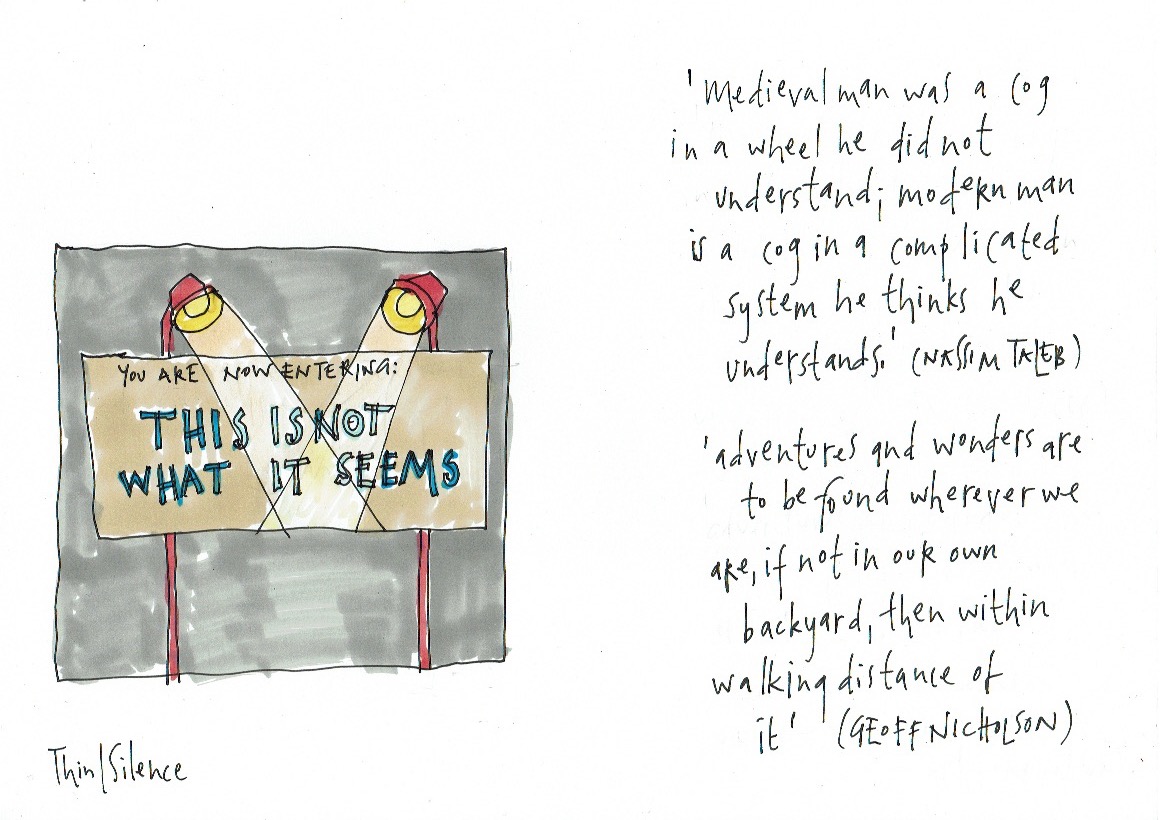
Nassim Taleb would probably describe this journey from despair to hope as one of fragility to antifragility.^^  Sherry Turkle’s observation of a scientists interaction with a robot adds further nuance.  The scientist in here experiments tries to feel what the robot is “feeling” – the robot’s programming that makes it possible to act and interact as it does.*^  This brings the realisation that humans are programmed too: something that’s taken place over many years years in thousands upon thousands of interactions in which we have been acted upon and reacted or responded to the different stimuli.

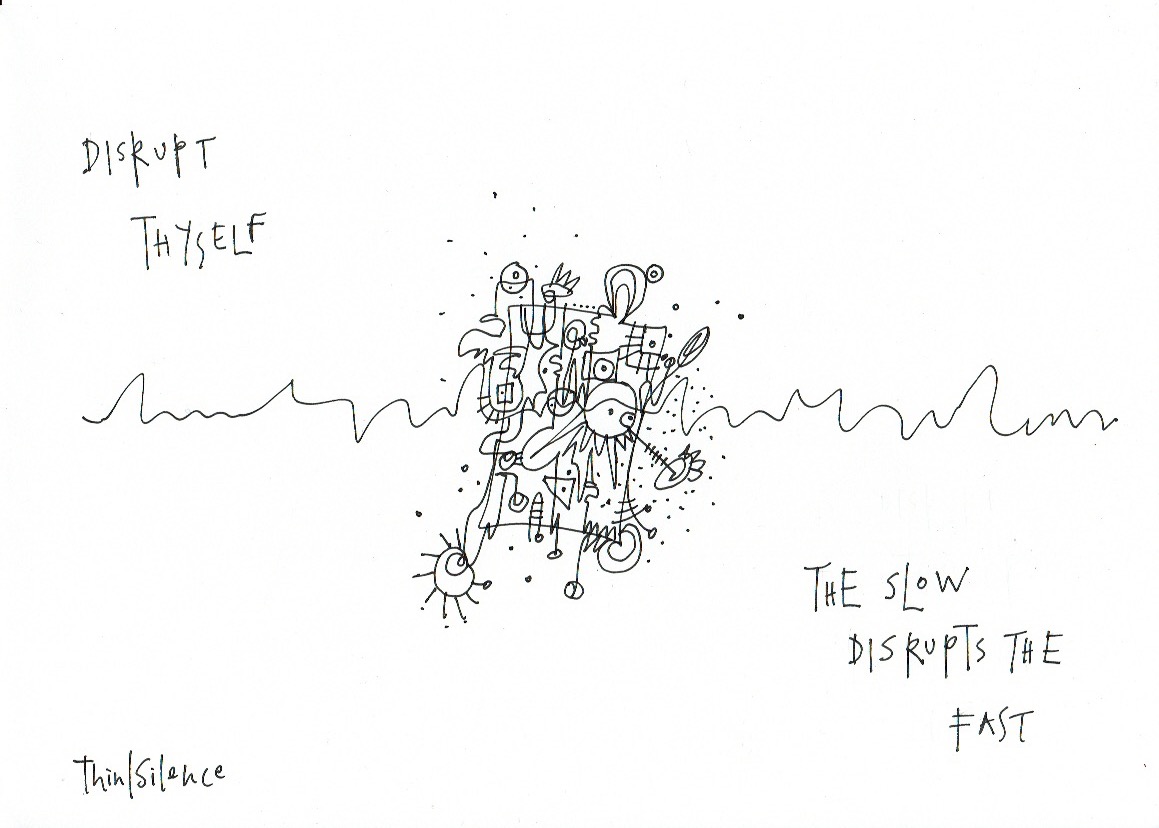
This programming has been a slow journey and so will be our reprogramming, which is a problem because slowness is something we’re averse to.  We want to become a better version of ourselves quickly.

“Reducing one’s attention to time may … be an important yet previously overlooked means of promoting flow.”^*

Speed is such a key component of our globalised and world-wide-webbed world that we can miss how it detracts from the focus required for flow and how it “flattens” distinction and nuance.

A person’s reprogramming or reinventing of who they are needs to be “local, specific, and particular.”⁺  In a culture that becomes bored with repetition we have also thrown out routine but they are different: ‘Routine.  Routine has nothing to do with repitition.’⁺⁺  Routine, or elegant interface with our story, is what brings us to the place of reinvention and development.

To become a person of greater hope honouring slowness and valuing routine, I need to better understand how everything is connected and interdependent; that we all have something, a gift, that is valuable for others to become more fruitful in their own lives; we can use all energy – positive and negative – for the good of self and others; nothing in life or in our lives is wasted; amazing things happen when people with complementary outlooks and skills work together for mutual benefit; and, we are all meant to be generative, fruitful beings in some way or other.

Everyone.

(*From Boris Pasternak’s description of a great moment coming to our lives, quote in the Northumbria Community‘s Morning Prayer.)
(**Thornton Wilder, quoted in Eugene Peterson’s A Long Obedience in the Same Direction.)
(^From Eugene Peterson’s A Long Obedience in the Same Direction.)
(^^See Nassim Taleb’s Antifragile.)
(*^See Sherry Turkle’s Alone Together.)
(^*Regina Conti, quoted in Maggie Berg and Barbara Seeber’s The Slow Professor.)
(⁺Borrowed from Tara Brabazon, quoted in Maggie Berg and Barbara Seeber’s The Slow Professor.)
(⁺⁺From Paulo Coelho’s Aleph.)

the pleasures of touch

7-only-connect

“Show me the hidden things, the creatures of my dreams, the storehouses of forgotten memories and hurts.  Take me down to the spring of my life, and tell me my nature and my name.”*

‘The rebirth of curiosity doesn’t last long, unless we enjoy being curious.”**

We get to mix our curiosities and skills and experiences of life into a dream of possibilities.

A dream once mixed doesn’t last long, though – sometimes minutes or hours, often no longer than three days.  It must touch the earth and feel the air in at least some small way in order to live.

What happens then can be nothing less than breathtaking.  Dreams not only open the future but transform the past – for the past is where we have been shaped into who we are, even with our longings for more it is where we have defined our focus, where we have honed our strength and produced our gift.

‘Awareness is the greatest agent of change.’^

To see and know things is to be able to dream.  It doesn’t have to be dramatic – it often isn’t:

I do not bring fire or earthquake or wind – I bring silence.

The silence is always speaking to us.  I mean the things and people and ideas that surround us, that we’re immersed in, everyday but often take for granted – the tings which lie before amazing things being imagined and brought into being.

Humans build things big but the larger we build things – like the products of the industrial and technological revolutions but also systems of business and care and such – the more disconnected we become, the less the majority are able to connect to their curiosities and skills and creativity: think Sports Direct or MacDonalds.  What Richard Sennett observed in the 19th Century steel industry looks like it still holds true today:

‘In the nineteenth-century steel industry, skilled artisans faced two potential futures because of technological change: deskilling or dismissal … Mechanical change came to the labour force rather than from within the labour movement.’^^

But you are a dreamer.

(*George Appleton, quoted in the Northumbria Community‘s Morning Prayer.)
(**From Mihaly Csikszenmihalyi’s Creativity.)
(^From Eckhart Tolle’s A New Earth.)
(^^From Richard Sennett’s The Craftsman.)

after yesterday and before tomorrow

6-everybody-should

‘The desire to change was meaningless if I couldn’t find a way to make change happen.’*

‘Yesterday shows another day is here.’**

Sometimes we need to be quiet and ask where something is flowing from and where it’s flowing to.

A gift has a yesterday, today, and tomorrow.  It comes from outside of my life, from somewhere else, from someone else.  For a time it remains with me and I must make it mine somehow shape it, personalising it, making more of it – this before I can give it on.

All the time, the gift is becoming more.  It’s a “yes and” game.  What have I received?  How will I shape it?  Who will I give it to?

Sometimes we need to be quiet and ask where something is flowing from and where it is flowing to.

(*From Gretchen Rubin’s The Happiness Project.)
(**From Ruth Krauss’s Open House for Butterflies.)

cause and effect

5-whatever-happens

‘Must is scary, hard, like jumping off a terrifyingly high cliff, where you can’t see anything down below.’*

‘I know that life without a cause is life without effect.’**

This could go very wrong.

That’s the point. We want to learning improve. This thing we must do, this thing is going to make a difference for someone, somewhere.

If there’s no failure involved then it’s not the innovative thing we hoped it would be. It’s only as good as everything else, and everything else isn’t working.

Because you’re learning from failure – reimagining, innovating, reshaping, and trying again – even if you just keep going in the direction of your cause, you will have an effect.  This alone could be what others need.

(*From Elle Luna’s The Crossroads of Should and Must.)
(**From Paulo Coelho’s Aleph.)

untapped happiness

4-our-dreams

‘Too much of the world’s happiness depends on taking from one to satisfy another.  To create my standard of living, people in another part of the world must lower theirs.’*

“Follow you bliss and doors will open where there were no doors before.”**

We don’t have to take happiness from others.  We are capable of creating goodness and happiness.

It’s the most astonishing thing.  With the grain of the universe, we’ve stumbled upon the close thing there’ll eve be to alchemy through our curiosity and imagination.

As we come to the end of 2016, I remember how a year ago I caught sight of someone’s frustration.  Recognising their uniqueness, I offered some help offered help.  The journey didn’t begin and I wonder how 2o16 turned out, whether this person was able to “follow their bliss” – their purpose, story, dream, find their flow?  I hope so.

Here are some questions for the beginning of an alchemy quest:

What would be a meaningful place for you to reach by the end of the new year?
What are you most curious about and fascinated by in life? How and when do you naturally reflect and read?

(*From Eugene Peterson’s A Long Obedience in the Same Direction.)
(**Joseph Campbell, quoted in Elle Luna’s essay The Crossroads of Should and Must.)

what lurks within?

3-to-know-is-more

“We have to be candles burning between hope and despair, faith and doubt, life and death, all the opposites.”*

“So maybe you aren’t any happier, you just think you are.”**

Not everything is measurable.  Happiness for example.  Well, at least not by the means we try to employ.

As Gretchen Ruben came to the end of her happiness project a scientist friend asked if you had used some systematic measurement.  She replies that she hasn’t and goes on to say it’s not that she thinks she is but feels she is and to know is more than thinking.

We can think all we like and we can miss how we feel.  I don’t mean the simple feeling of happiness and sadness but the more subtle feelings of connecting with some thing deep within us, or those of disconnection.  Noticing these more nuanced feelings and knowing how to interpret them helps us move forward with a more hopeful and imaginative worldview and life-path and away from destructive one.

Elle Luna writes for ‘Anyone looking to follow the energy deep within their chest but aren’t quite sure how to.’^  This joyful excitement within reconciles me with a universe of possibility over and against a world of measurement.^^

All things working together rather than measuring this against that.

(*William Brodrick, quoted in the Northumbria Community‘s Morning Prayer.)
(**A scientist friend of Gretchen Ruben’s, quoted in The Happiness Project.)
(^From Elle Luna’s essay The Crossroads of Should and Must.)
(^^Terms used by Rosamund and Benjamin Zander in The Art of 
Possibility.)

the boundary of the self

2-the-best-gifts

“Listen to the silence.”*

‘When all property is privatised, faith is privatised and all men feel fear at the boundary of the self.’**

Before the hustle and bustle of emails, meetings, events, errands … all the “to dos” of the day, before the day begins, I come to the silence.

I connect with a larger story, so hoping the smaller stories don’t take over: I read how ‘even the most technical of ideas needs to be framed inside a greater narrative.’^  It’s what we’re doing, consciously or unconsciously, whatever we do, all the time.  I just feel the best stories appear when we turn our attention towards them and ask some questions.

I find myself wondering whether the greater story for me means I must explore what life in all its fullnesss can be, and this with others.

This is pulling and pushing me acrosss the boundaries I’ve established in my life, whether because of the things I’ve pursued, or in protecting against the “other.”  I am pulled from the egoic to the ecoic, from bad dreams to good dreams, which will always include the other, the world and the true self.  ‘Bless and you will be blessed,’ counsels Paulo Coelho.^^

‘It is grace before, during, and after.’*^

Grace – ultimately the gift another shares with us out of the essence of their being – only exists when crossing thresholds.  It has journeyed from others to us, it works in us in possibilities and transformations, and then itss shared by us to others.

And now I wonder what an open-border day will look like.

(*Frances Roberts, quoted in the Northumbria Community‘s Morning Prayer.)
(**From Lewis Hyde’s The Gift.)
(^From Peter Diamandis and Steven Kotler’s Bold.)
(^^From Paulo Coelho’s Aleph.)
(*^From Richard Rohr’s Eager to Love.)

jackanory*

1-the-poet-places

I’ll tell you a story
About Jack a Nory;
And now my story’s begun;
I’ll tell you another
Of Jack and his brother,
And now my story is done.*

Today is a gift.

I can miss the truth of this because of all that needs to be done but today isn’t so much about time as it is a chapter or sequence within a story.

‘Perhaps we could temper the course as commodity with the course as story.’**

Psychology professor Joshua Searle-White and and associate professor of theatre Dan Crozier suggest thinking “of [the lesson] as a story that you will help unfold for the students,”* but this notion of  “embodied narrative” is important for anyone, whatever their walk of life and work.  We can turn any commodity into goods into services into experiences into transformative experiences.

So this is more than a day; this is our story.

The day doesn’t happen to us, a clock running down.  We play within it – with our imagination and purpose.  Even just to say this makes us more aware of the possibilities we can bring to a day, to the people encounters and meetings and demands within it.

‘A machine, like any model, ought to propose rather than command … Against the claim of perfection we can assert our own individuality, which gives distinctive character to the work we do.’^

The joy or blessedness of a day is not something that comes from outside us but from the very centre of our being.

(*Jackanory is the  name of a British children’s TV show that had celebrities reading a story.  The English nursery rhyme was first published in 1760 and jackanory became Cockney rhyming slang for story.  Today’s story isn’t told by a celebrity but by you.)
(**From Maggie Berg and Barbara Seeber’s The Slow Professor.)
(^From Richard Sennett’s The Craftsman – reflecting upon Denis Diderot‘s thinking with the appearance of the machine that produces something more perfectly than a human can.)

meaningful work

30-meaning-is-what-we-make

Or, following our golden phizzwizards rather than trogglehumpers.

Meaningful work resonates with who we are and what we can do; it also resonates with others, making a difference.  Doing work for as much pay as we can get, acquiring and possessing things is often an exchange of Plan A for Plan B.  It’s not that we do not believe in meaningful work but we don’t think it’s possible for people like us to find it.

I have sat with enough grieving families to know the measure of a loved one is not in how much they acquired but the quality of their relationships:

“We have forgotten our collective ends, and we possess great means: we set huge machines in motion in order to arrive nowhere.”*

‘The character of our work is shaped not by accomplishments or possessions but in the birth of relationships’.**

When it comes to developing their businesses as places for more =meaningful work, it costs virtually nothing for this quality to be increased in our workplaces: for companies to engage the heads and hearts as well as the hands of employees, and as we as the wallets of customers.

“From now on, we is keeping as still as windy little micies.”^

The best way is not to wait for someone to invite us to do some meaningful work but to begin exploring and employing ourselves in what is meaningful for us.

Find your dreamwhisperer: someone who will listen very carefully for the whispers of your life – golden phizzwizards – and also for the things you need to avoid or let go of – trogglehumpers.^  Create your story or plan for including these meaningful things in every day – whether this is in your workplace or when you’re at home or both.  Experiment or prototype every day.

Of dreams, the BFG says, ‘They is always invisible until they is captured.’^

(*Jacques Ellul, quoted in Eugene Peterson’s A Long Obedience in the Same Direction.)
(**From Eugene Peterson’s A Long Obedience in the Same Direction.)
(^From Roald Dahl’s The BFG.)

we is in dream country

29-this-is-where-all-dreams

‘What initiative, if taken on jointly, could help shift the field of your system to 4.0?’*

‘So transformations cannot be extracted, made, delivered, or even staged; they can only be guided.’**

4.0 means everyone is involved, contributing, leadership shifting like the exchanging lead in the V-formation of geese.  4.0 is a connection to others, to the future, to the world, and to the Self.

And transformation comes from within, beginning with a dream.

“This is where all dreams is beginning.”^

Dreaming allows us to move beyond our present competence and makes a fool of rote obedience, imagining who we can be and what we can do that is more than we can do today.

Whilst dreams come from within, we often need a place for those dreams to be heard and to grow.   And there’s no better place then a group comprised of those who have followed their own curiosities and interests, developed skills and turned these into daily practices. Such “Dream Collectives” are beginning to form and make space for others to explore their aspirations and begin their own journeys.

Above all, they know ‘we shall lose that life which remains unarticulated.’^^

(*This is the last of sixteen questions from U. Lab Portobello explored since the 10th November.)
(**From Joseph Pine and James Gilmore’s The Experience Economy.)
(^The BFG in The BFG.)
(^^From Lewis Hyde’s The Gift.)