All properties and events in the physical universe are governed by laws, and those laws hold true at every time and place in the universe.** (Alan Lightman)
I have just googled “the speed of light” and was returned over 2.6 billion results in 0.79 seconds. I am guessing, because I won’t be checking through all the results, that each will state the speed of light to be 299,792,458 metres per second.
At the same time when the laws of the universe come into contact with consciousness, interesting things happen, new energies being generated that we find difficult to articulate and measure, though not impossible. Jesus of Nazerath described himself as the light of the world on at least one occasion and perhaps we can see our lives as being small lights for the world, each bringing something different and, if we were to deny it, but break the fundamental truth about ourselves.
In the end, only we can articulate just what this “light” might be; only we can measure whether it’s offering some light into another person’s darkness. It’s why we’re here.
The portionless, who struggle with no such inherited encumbrances, find it about enough to subdue and cultivate a few cubic feet of flesh.* (Henry David Thoreau)
Each morning, I step outside the house to stand or sit for a few moments in my garden, to greet the new day before I do anything else.
The garden isn’t large and it’s taken a couple of years to sort out but I enjoy being with these growing things for a little while.
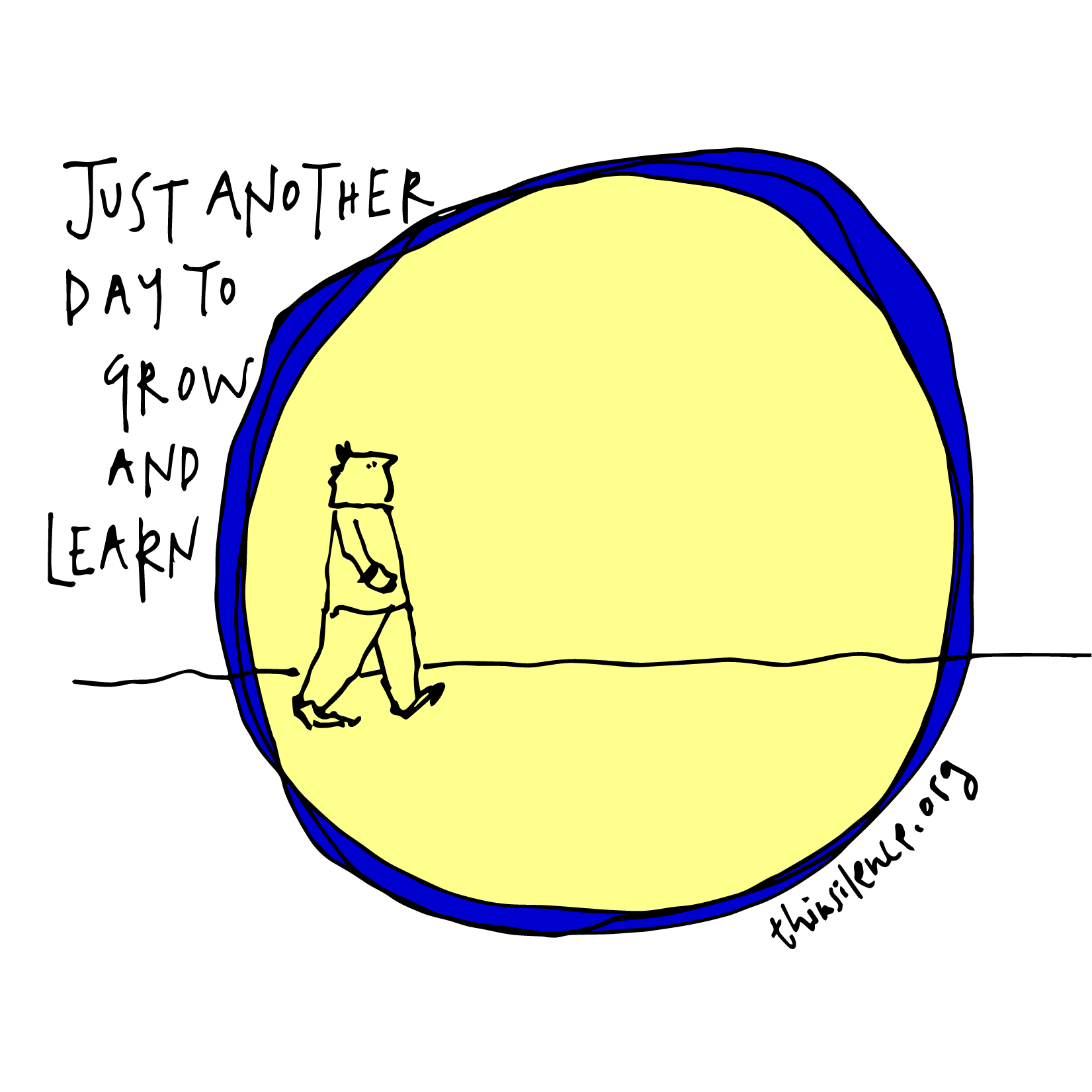
I feel the garden of my life has taken even longer to grow. My slow journey is about who I am becoming over a lifetime – this slowness is me, but I now see I can become, I can choose.
“Terroir” is about the influence of the total environment – soil, topography, climate – on the growing of grapes. No less, the places, the influences, the focus of the gardens of our lives develops a unique terroir that others can benefit from. I know this only too well from what others have made available to me. Though, as the elements of terroir suggest, there is nothing fast about this, it’s something that happens over a lifetime.
We want to build systems and patterns and memories that connect moment to moment to eternity. We long to be part of the Infinite.* (Alan Lightman)
Again, the kingdom of heaven is like a merchant in search of fine pearls; on finding one pearl of great value, he went and sold all that he had and bought it.** (Jesus of Nazerath)
Something appears to happen when we look beyond ourselves – into others, into the world and into space – and when we look into ourselves – into our curiosities and into our peculiar energies.
We find meaning. Or meaning finds us, or both, what Martin Buber is exploring when he writes:
Free is the man that wills without caprice. He believes in the actual which is to say, he believes in the real association of the dual reality, I and You. He believes in destiny and also it needs him. It does not lead him, it waits for him. He must proceed towards it without knowing where it waits for him. He must go forth with his whole being: that he knows. It will not turn out the way his resolve determines, but what wants to come will only if he resolves to do that which he can will, which is unfree and ruled by things and drives, to his great will that moves away from being determined to find destiny. Now he longer interferes nor does he merely allow things to happen.^
Today is a remarkable day. It allows just such venturing outwards and inwards on our part. And the best way? Stay small, young, stay curious, stay open, in these ways moving from our unfree will to our great will:
Crucially starting small is the hall mark of youthful days. When you are young, you cannot start things in a big way. Whatever you do, it does not matter much to the world. You need to start small. And what you have in abundance is open-mindedness and curiosity, the great kickstarters to one’s cause.^^
Creativity is the product of wasted time.** (Albert Einstein)
to stay hungry and unsettled is not the conventional wisdom. It clearly psychological demands on the individual. The attraction of the opposite state – satisfaction, expertise and security is almost irresistible^ (Maureen O’Hara and Graham Leicester.)
Perfect days tend not to be free from worry and concern – these are the kind of days that tend to get a little mergy, one looking just like another. A perfect day tends to set us up for something that matters, one that stretches and grows who we are as well as what we are doing. We don’t have to always e dong things either, often this can get in the way. It’s more about a direction.
there is an element of scarcity in what you do and how and why you do it, a combination your story and your superpower** (Bernadette Jiwa)
Some people seem to be capable of amazing things. It’s almost magical to us mere mortals looking on. We probably walk away thinking we could never do something like that, or, if we did, we’d have to figure out a way to fake it.
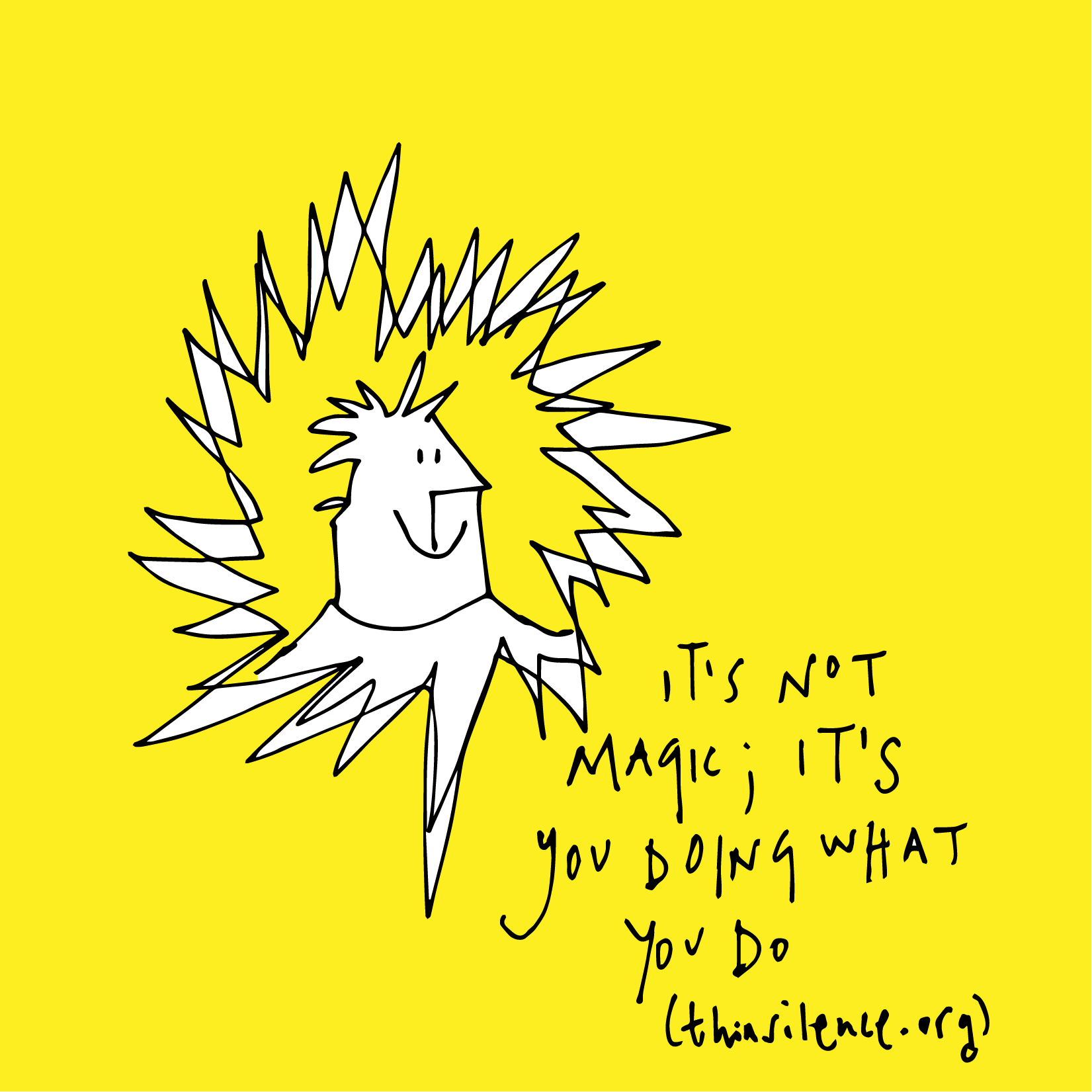
It isn’t magic, though.
It’s simply someone taking what they love and are good at as far as they possibly can. And this is a truth for everyone. There could be someone looking at you, right now, wondering how on earth you do this thing.
From your perspective, everyone can do this. But they can’t.
In art the self becomes self forgetful.* (Flannery O’Connor)
Desire leads to conception and conception leads to birth. This is the efficacy of desire.** (Philip Newell)
It’s important to know what it is you most want to do, to begin to give form to this, to help it develop and to finally bring it into being. This is our art. Art isn’t what some do, it’s what everyone does.
When our heart and should and mind and strength are invested in this, the last thing we’re thinking about is ourselves. We are living within the art of our humility and, contrary to popular belief, it is a very big place indeed:
But what happens when those cultural patterns are in flux? When the old rules no longer function well because they are not up to the new levels of complexity, uncertainty and rapid change in society.* (Maureen O’Hara and Graham Leicester)
In an odd way, my growing understanding of the vast forces that shape modern life has only increased my resolve to counter those forces, to build a parallel universe for my inner life and spirit. I am convinced that such an interior life is both possible and necessary.** (Alan Lightman)
We can do this.
We can face the “vast forces,” but it will require that we restore and maintain the vast forces of our inner universes, especially, as I keep mentioning, opening our minds, our hearts and our wills.
These inner places do not become places to hide. In another of his books, Alan Lightman writes of his openness to more:
And I hope there will always be an edge between the known and the unknown, beyond which lies strangeness and unpredictability.^
“Progress” is some kind of ordained imperative of our species, an abstract conception of evolution, an inevitable development like the increase in entropy, the future.* (Alan Lightman)
I say, follow your bliss and don’t be afraid, and doors will open to you where you didn’t know they were going to be.** (Joseph Campbell)
Alan Lightman confesses that we can lose ourselves as we progress but get caught in our smaller world of speed, information overload, consumption, accommodation of the virtual, loss of silence and loss of privacy. Before penning the words, above, he wrote:
I believe I have lost something of my inner self. […] I mean that part of me that dreams, that explores, that is constantly questioning who I am and what is important to me.*
The hopeful thing, I find, is that Lightman is naming the things he wants to recover, though there is no going back, only going forward, start-overs that are like being born again. This is the progress of a different kind:
Stop worrying about technology. Start worrying about people.^
When mythologist Joseph Campbell writes about following our bliss he understands this is not only about what we do but who we are.
Human activity has increased complexity. Dancing at the Edge is Maureen O’Hara and Graham Leicester’s description of what developing our competency with complexity looks like, part of what it means to start-over forwards. Here is the need:
When too much is in motion at the same time, it is harder for the brain to separate what is important from what is just noise. Certainty becomes more fleeting, mistakes are made more frequently, anxiety increases.^^
Yet just before these words, O’Hara and Leicester write about the amazing human brain and what it is capable of, being more than able to deal with everything if we help it – I would say through our practices (especially open minds, hearts and wills), disciplines, dreams and actioning:
Human consciousness is astoundingly complex. A healthy human brain contains over 200 million nerve cells or neurons, linked to one another via hundreds of trillions of synapses. Through this system flows information that drives both our actions and how we think and feel about them. But this arrangement is not fixed like wiring in a house with robust and resilient circuits that can be depended on to deliver the same results over time. It is more ephemeral, acting more like waves passing through crowds of individuals locking and unlocking their arms. One instant a connection is made and a signal travels, the next moment the connection is dropped and a new one made to another cell carrying another kind of input. In a vast, dynamic orchestration, sense is made and actions taken. Because memories of past actions persist, learning occurs.^^
Here is what we each have to pursue our bliss, even when we become thwarted, we can start-over.
And there’s a beauty that is harder to define or understand, because it occurs not just in the body but where the body and the spirit meet and define each other.* (Ursula Le Guin)
Hence the fundamental importance of the so-called “double task”: to be able to act and reflect on one’s actions at the same time.** (Maureen O’Hara and Graham Leicester)
We all get things wrong, we all fail. Facing up to these and yet not dwelling on them is what real forgiveness makes possible.
In a real way, forgiveness makes it possible for us to both act and to be reflective, to deal with our mess ups in a way that learns and integrates, keeping moving towards greater beauty.
This kind of forgiveness is like the lacquer resin mixed with gold or silver dust in the Japanese art of kintsugi (kin tsugi = golden joinery), making what was broken not only whole again but also beautiful in a way that defines us and the gift we bring into the world.




You must be logged in to post a comment.