
We live in digital time. Our rhythms are rushed, rapid fire and relentless, our days carved up into bits and bytes. We celebrate breadth rather than depth, quick reaction rather than considered reflection. We skim across the surface, alighting for brief moments at dozens of destinations but rarely remaining for long at any one. We race through our lives without pausing to consider who we really want to be or where we really want to go.
(Jim Loehr and Tony Schwartz: The Power of Full Engagement.)
I’d found myself awake in the middle of the night wondering whether these unusual days might offer an opportunity for solitude and reflection.
Whether we face fourteen days of isolation during the Covid-19 pandemic or are looking for something to explore through the weeks of lockdown, I offer fourteen practices to play with out of my dreamwhispering work.
Dreamwhispering entails listening to what our lives are trying to say to us. Suddenly, slowness has been thrust upon us, the kind of time that allows us to explore the kind of things that may positively and dramatically alter our lives beyond the pandemic.
Take a look through all fourteen practices as there may be some things you need to get hold of at the outset. If you need to have a chat about anything, just drop me a line at geoffrey@thinsilence.org.
Something to practice throughout to help welcome the slowness is slow-breathing: to simply focus on our breathing so that it may become slower and deeper. An upright seated position with both feet flat on the floor, hands just resting in front of you, eyes closed or open, is a helpful place to begin.
Stay well.
ONE: WELCOME TO ASKESIS
You must play a little hide and seek in order to produce something worth being found.
(Austin Kleon: Keep Going)
The dancer Twyla Tharp points out that “solitude without purpose” is a killer of creativity.
(Ryan Holiday: Stillness is the Key)
Another word for a place of solitude is askesis, a word I first came across in Eugene Peterson’s Under the Unpredictable Plant, defined as a place of confinement, sometimes chosen, though sometimes forced upon us.
Traditionally askesis refers simply to a discipline but Peterson’s description of this as confinement in which we rediscover purpose and energy was just what I needed. It is a gift for discovering where our deep gladness and the world great need meets.
Jim Loehr and Tony Schwartz, whose words introduce this post, dismiss the notion that we need to become better at time management:
Energy, not time, is the fundamental currency of high performance. […] Performance, health and happiness are grounded in the skilful management of energy.
(Jim Loehr and Tony Schwartz: The Power of Full Engagement.)
Today’s practice is simply to prepare the place of confinement. Take a look through the following practices to see what will be involved and then identify and shape your preferred space – a table or desk, a seat by a window, in the garden – so whenever you come to this place you know you are crossing an invisible line into solitude and reflection. Then take five minutes to quietly be there.
TWO: QUIETLY DOES IT
We live in noisy worlds as individuals and as societies. These days will offer the opportunity to step out of the noise and into the quietness. To be alone (or silent with others), turning off the technology and allowing ourselves to slip into the quietness.
As I write, the nib scuffs across the paper, the wind blows through the trees, a gate rattles, a bird occasionally chatters – there is no such thing as compete silence.
Composer John Cage spent some time in a silent room but he could still hear two noises. Reporting this to the technicians afterwards they told him these were the sound of blood moving around his body and his nervous system firing. Cage loved the sounds encountered on a walk, allowing them to become music to him, so the wind and the gate and the bird are part of the day’s natural music I am listening to at the moment. Cage composed the piece “Silence” (4 minutes 31 seconds) to show to audiences how silence is always changing, which, for the first listeners, included disgruntled people’s footsteps as they left.
I call my work dreamwhispering because our lives are whispering to us all the time, but so often the busyness and noise drown them out, so we’re taking the opportunity to step out of these and into slowness and quietness:
It is in this stillness that we can hear the voice inside us.
(Ryan Holiday: Stillness is the Key)
The second activity is to allow yourself to step into the silence. Turn the electrical gadgets off and just spend some time listening to the silence, discovering how full it is, changing from moment to moment in the music of it all.
THREE: ENTER THE JOURNAL
This is what the best journals look like. They aren’t for the reader. They are for the writer. To slow the mind down. To wage peace with oneself.
(Ryan Holiday: Stillness is the Key)
After one or two years of dedicated journaling, where I wrote words alongside sketches, I realised that my style – my true voice – was going to have to be something new, to me and to others.
(Kelvy Bird: Generative Scribing)
Journaling saved me. It’s how I’ve begun the day for the past 22 years no matter where I am. Before this, I used to wander into the day half-prepared, but now I am able to reconnect with my story, and get my thinking and feeling and doing together.
Journaling’s the easiest thing in the world to do: you simply open a notebook and start writing without judgement. Thoughts begin to un-jumble as they wait to be released through the ink onto the paper, allowing us to reflect on them and shape them into what you need them to be. (I re-read my entries a year later and then destroy the journal as I have nowhere to keep them all).
Many people join me in my journal – the writers of the books and blogs I’m reading each day: I always have several books open and practice slow reading as it’s not about me getting through the books but the books getting through me. These people are my guides and companions and mind-openers, their thoughts appearing at just the right time for me to have alongside my own. All of the quotes in this post will first of all been included in my daily ponderings. (I choose books with the acronym TEASE in mind: technology, entrepreneurship, arts, society, environment).
I address my journal to God but you can write to anyone or anything you want to: the universe, a muse, one of the writer’s you’re reading or yourself – perhaps a past self or a future self. The deepest journaling includes the past and the future in the present.
The activity for today is simply to open a journal and write for a few moments, and if you want a starting place you may want to write about shaping your askesis and what it felt like to slip into silence.
I’ve written about this practice or personally and you certainly don’t have to do what I do, but it may be a place to begin and then develop your own style of journaling out from it.
FOUR: THE WANDERING WAY
Solvitur ambulando: it is solved by walking
Wandering is not about a specific place or destination, getting from one place to another, or movement as a means to an end. Instead it’s about letting the soul and mind roam. The wanderer becomes one with himself or herself and the universe. We connect with the energy of all living things. We live according to our inner nature.
(Keri Smith: The Wander Society)
In a Turkish cafe in Georgetown, Washington DC, I got to talking with the owners about what I was doing in the city – just wandering around following a conference. They told me that gezmek is the Turkish word for wandering. It turns out there’s a word in just about every language for wandering.
As we’re encouraged to get some daily fresh air and exercise wherever possible, wandering really helps with noticing more in these otherwise sensory deprived days, the opportunity to give our attention to what we may normally rush past.
The aim is to slow things down, to walk at half our normal pace and observe the things you enjoy being, hearing, smelling, touching, perhaps something that’s always been there, or perhaps is present for just this moment. We are so very rich, all of this is ours, and we don’t own any of it.
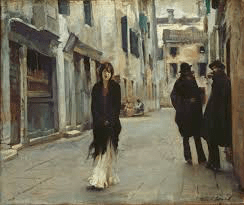
Wandering connects with the practice of flanering (or flaneuring), the practice of wandering town and cities simply to observe. More than simply seeing more, I see it as a means of feeling more so that we do more.
A very special thing had happened while I was wandering around Washington. A friend had sent me an article of flaneuring, which included this painting by John Singer Sargent, and I had thought it the perfect things to read before settling out wandering. One day I happened into the National Gallery of Art. Lo and behold, towards the end of the visit, there was the very painting by Sargent.
Take time to wander today. Be open to the possibility of surprise, either without or within you, or both.
FIVE: WANDER, DAWDLE, DOODLE
Doodling can provide students the opportunity to focus their listening and learning. I take my definition of doodling from Sunni Brown’s book The Doodle Revolution: ‘making spontaneous marks (with your mind and body) to help yourself think.’
(Laurence Musgrove: Drawn Together Through Visual Practice)
Who was it?
The person who told you that you can’t draw. Maybe it was even you?
Comic maker and lecturer Lynda Barry asks:
how old do you have to be to make a bad drawing?
(Lynda Barry: Making Comics).
Probably not very old. It was most likely becoming more of a struggle through primary school and had fallen away by secondary. But long before we could write, we were drawing. Pictures before words and then we learnt our alphabet letters by first drawing them.
Doodle is another word for dawdle which is another word for wander. So when we doodle we’re taking a slow journey with some lines, and we’re listening as we go: How do I represent this?, How do these things come together to form a picture rather than a sentence? Art is not about drawing – we can all draw, but it about seeing and listening – which are much more difficult skills. They are also what these fourteen days or practices are about.
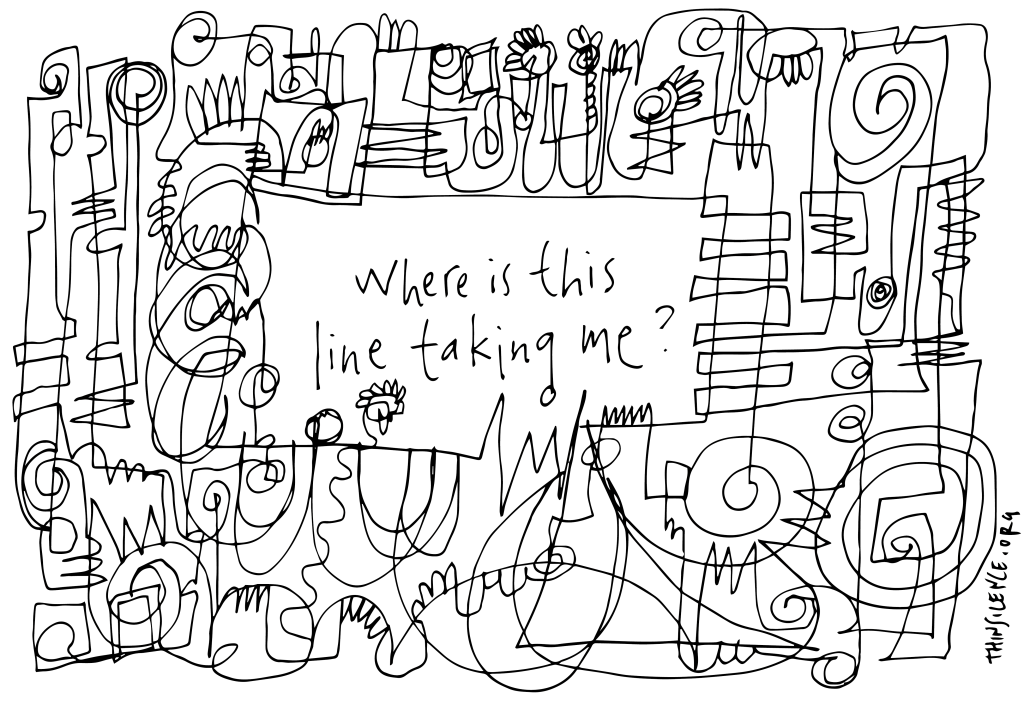
Here’s what to do today, with some white paper and a fine black pen, take a line for a walk, covering the paper without taking your pen from the paper (afterwards, you can colour this in – colouring is about relaxing). I also include a text so you may want to write boldly onto your paper – wherever you feel the words want to be – “Walking a wandering line.” Afterwards, did you take the line for a walk or did it take you for a walk.
SIX: RE-VISUALISING
[Betty] Edwards agrees that most people view drawing as a magical ability that only a select few possess. But this is because people don’t understand the components – the learnable components – of drawing. Actually, she informs us, they are not drawing skills at all but seeing skills. They are the ability to see edges, spaces, relationships, lights and shadows, and the whole.
(Carol Dweck: Mindset)
Please excuse another day on drawing. I’m on something of a mission to re-visualise our world in small doable ways: books, signs, blogs, presentations, rooms (I’m looking for an internal white wall to doodle on – let me know if you know of any).
Following on from doodling with a single line, today we’re going to play with some simple characters in the style of the artist Liniers: draw yourself standing to attention and another picture of yourself throwing paint in the air.

SEVEN: ME AND MY VALUES
Values are the nervous system of a brilliant life. They connect everything to everything. Put simply, values are right up there with oxygen.
(Michael Heppell: How to be Brilliant)
Values are now the first conversation with everyone I work with. I’ve become convinced that one of the most valuable things we can do is to articulate the things we value most. These will generally be about the kind of people we want to be and the world we want to help create. I think of values as being the eco-systems that make a world we want to live in and to invite others into.
You may come up with one word values first of all: trust, loyalty, learning, but don’t stop there. Tease more out of these; for example, what does trust look like?, how long does it take to create?, how does it relate to truth?, what do you dream of trust and truth bringing into being? You get the idea and I’m sure you can come up with far better questions.
Come up with at least three values you really like and feel as though you can live with each day.
Why not illustrate yours with some doodles or pictures?
EIGHT: PUT IT ON THE LIST
Your strengths aren’t what you’re good at, and your weaknesses aren’t what you’re bad at So you’d better find out what your real strengths are.
(Marcus Buckingham: The Truth About You.)
A strength is something that makes you feel strong and a weakness is something that makes you feel weak.
It’s about energy, as we identified at the outset.
Yet we can be so focused on competency – or not wanting to be found incompetent – that we fail to notice how we’re feeling about what we’re doing – that is, what our lives beyond our brains are telling us.
A lot of what we’re doing with these fourteen practices is about noticing more, and there’s a simple way of noticing energy. By keeping two lists over the following days – a “loved it” list and a “loathed it” list – you’ll be able to track the things that most energise and most de-energise you. Many things won’t qualify for these extreme lists and that’s okay because we’re not interested in them. What we need to see more clearly are the things that really animate us and those we feel drain us severely.
The best way to do this is by slowly building up the lists as you actually experience these, though the lockdown may make this difficult, but trust the process – you may be surprised what emerges from what you are able to do in these days of opportunity. These don’t have to be grand things, it’s the energy that counts and the energy can’t lie
Record in a sentence or two, what you are doing, why you are doing it, who you are doing it with or for, and when are you doing it (as in, the time of day or are you starting or finishing something).
When you have compiled your lists, identify the three significant things on each list for you and describe them as fully as you can – give yourself an hour for this and, wherever possible, doodle. These are you enriching and enervating environments and will allow you to identify different ways in which you can make more of the energising things happen and less of the de-energising.
NINE: TALENT-SPOTTING
Our goal was to start a global conversation about what’s right with people. We were tired of living in a world that revolved around fixing our weaknesses.
(Tom Rath: StrengthsFinder 2.0)
If I had to name one thing that had changed the way I viewed my life and others,’ discovering my talents would have to be it. I had known what my role of twenty years required of me and could certainly do these things, but I wanted to be clearer about what I should focus on and have a stronger idea of why – then I could develop these.
Our talents are our naturally recurring behaviours – whether we are conscious or unconscious of these – our preferred ways of interacting with our environments. They have been shaped in us by our preferences over many years and they’re why we’re so different to one another. Some are far more aware of their talents than others but there’s always a surprise to be uncovered.
One of the developers of the StrengthsFinder analysis that identifies talents is Marcus Buckingham; he names three myths we need to get by:
MYTH: As you grow, your personality changes
TRUTH: As you grow, you become more who you already are
MYTH: You will grow the most in your areas of greatest weakness
TRUTH: You will grow the most in your areas of greatest strength
MYTH: Good team member does whatever it takes to help the team
TRUTH: A good team member deliberately volunteers [their] strengths most of the time
(Marcus Buckingham: Go Put Your Strengths To Work)
We identify our talents in order to develop them into strengths. A definition of a strength can be: competency x passion (energy) x positive experiences. A definition of weakness might be competency x negative experiences.
You can choose one of two ways to proceed.
- Take this particular analysis and identify your top five talents (there’s nothing magical about five – the analysis used to show all thirty four strengths measured but people were going to the bottom of the list, thinking the best thing they could do was improve their weaknesses). Here’s a link to Strengthsfinder, which, at the time of writing costs of modest £12.58). When taking the analysis, be true to who you are.
Read through the descriptions of the talents, highlighting the words and phrases that resonate with you, and then write in the things that are missing. From this, create your own description for that talent: include at least five positive expressions, one negative and the genius of this talent – i.e., how it impacts the world. The more you include, the more you provide yourself with things to develop. - The other way is to go to a list of talents with brief descriptions at the end of this post and reflect slowly through each, identifying the ones that resonate most with you. Slowly refine your list until you are left with the strongest five.
If you are going to buy the book with the code, don’t read this list.
TEN: A IS FOR ALPHABET
I’m trying to get under your skin. I’m trying to stop being a spectator and a pawn in the industrial system that raised its, and maybe, just maybe, to stand up and do something that scares you. I want you to do what you’re meant to do, what we’re all meant to do, which is the hard work of creating art.
(Seth Godin: V is for Vulnerable)
These words introduce Seth Godin’s alphabet book for adults. I realised how, over the years, I’d found many words to be really important to me and I began writing them down with the intention of putting them together into my own ABC, including an explanation for why each is important. These are the words that spark my imagination, touch my heart and provoke me to action. It’s a big ongoing reflective exercise; you’ll have already come across many of mind in this blog.
Start putting together your own ABC of special words to spur your thinking, feeling and actioning, adding a one-sentence explanation to each for reflecting on.
ELEVEN: GLADNESS, GRATITUDE, GIFTS AND GENEROSITY
Secret #2 is more important: Generosity. It’s much easier and more effective to come up with good ideas for someone else. Much easier to bring a posture of insight and care on behalf of someone else.
(Seth Godin’s blog: The two simple secrets to good ideas)
When we lack gratitude, we move towards pessimism and even cynicism.
(Erwin McManus: Uprising)
It has been said that we do not measure our wealth by what we have but by what we give. And we all have far more than we know and we don’t even own most of it. It’s all around us to be discovered through these days.
Gladness is our first response to something that delights use, whether it be the sky, the birds, a song, a person’s action.
Gratitude is formalising that gladness, taking a moment to be grateful. This captures more.
Gift is about being able to turn this into something we can give to someone else.
Generosity is what we are developing in ourselves, th possibility of being a generative person.
Perhaps on your next walk, though you can do this in your askesis and home, as well as outside, gather a list of all the things you are enjoying. The slower you go, the more there’ll be.
TWELVE: TELL A FRIEND
Connecting with the ninth practice of spotting talents, I not only became aware of my own but also the talents of others. Everyone has amazing talents.
Is there someone you can have a conversation with, to tell them about what you’ve been discovering, so that you can have a conversation about the things they love doing, what they’ve been discovering. Just a big open chat to help both of you see more.
THIRTEEN: BRINGING IT ALL TOGETHER
You’ll have identified many things through these practices, and now they need to be brought together: values, talents, enriching environments and the enervating ones.
Here’s a simple template: draw twenty squares (4×5 storyboard style) on the largest piece of paper you have. Inside each square include a summary of the following: three values, five talents, five talent-genii (this is the impact you imagine each of your talents to have), three enriching environments and three enervating environments. Leave the twentieth square empty.
FOURTEEN: STORIFYING
A life story is a “personal myth” about who we are deep down – where we come from, how we got this way, and what it all means. Our life stories are who we are. They are our identity. A life story is not, however, an objective account. A life story is a carefully shaped narrative that is replete with strategic forgetting and skillfully spun meanings.
(Jonathan Gottschall: The Storytelling Animal)
The mythologist Joseph Campbell speaks of how we need two basic myths for our lives:
There is the mythology that relates you to your nature and to the natural world, of which you are a part. And there is the mythology that is strictly sociological, linking you to a particular story. You are not simply a natural man, your are a member of a particular group.
(Joseph Campbell: The Power of Myth)
These personal and social myths help us to know that we are alive, wrapping around the two questions we are exploring: Who am I? and What is my contribution?
Our aim is not to have a list of values, attributes, and enriching and enervating environments, though these are helpful. The aim is to bring all of our discoveries into a story we want to wake up to and live within each day in an unfolding way. We’re not creating these stories from scratch. They are already a part of us.
We’ve been telling ourselves stories throughout our lives; all we’re doing is editing them, and that in itself is a great adventure.
I’m suggesting you write your story, as you’ve been experiencing it through the practices of this post, using Pixar’s six step template. Here’re Mark Levy’s six secrets to free-writing to help with this (Accidental Genius):
Try Easy: write relaxed: we’re not after perfect
Write fast and continuously: it’s just about getting your thoughts down
Work against a limit: set a timer for 10 minutes
Write the way you think: you’re writing for yourself, no-on else
Go with the thoughts: the improv technique of “yes and”
Redirect your attention: ask yourself questions about why you wrote this.
Here’s Pixar’s template:
Once upon a time: What was life like before Covid-19?
Every day: What would every day bring that you wanted to change?
One day: Something has changed: yes, the virus but perhaps some new thought or hope that has come to you and you want to pursue
Because of that: What have you done because of this?
Because of that: What has changed or occurred because of what you have done?
Until finally: Not happy ever after, but what are you deciding to do differently from now on?
Every day is an opportunity to explore and develop our stories, overarching narratives for the other stories we find ourselves living, such as work, family and friends.
Enjoy.
TALENT THEMES
Achiever
People who are especially talented in the Achiever theme have a great deal of stamina and work hard. They take great satisfaction from being busy and productive.
Activator
People who are especially talented in the Activator theme can make things happen by turning thoughts into action. They are often impatient.
Adaptability
People who are especially talented in the Adaptability theme prefer to “go with the flow.” They tend to be “now” people who take things as they come and discover the future one day at a time.
Analytical
People who are especially talented in the Analytical theme search for reasons and causes. They have the ability to think about all the factors that might affect a situation.
Arranger
People who are especially talented in the Arranger theme can organise, but they also have a flexibility that complements this ability. They like to figure out how all of the pieces and resources can be arranged for maximum productivity.
Belief
People who are especially talented in the Belief theme have certain core values that are unchanging. Out of these values emerges a defined purpose for their life.
Command
People who are especially talented in the Command theme have presence. They can take control of a situation and make decisions.
Communication
People who are especially talented in the Communication theme generally find it easy to put their thoughts into words. They are good conversationalists and presenters.
Competition
People who are especially talented in the Competition theme measure their progress against the performance of others. They strive to win first place and revel in contests.
Connectedness
People who are especially talented in the Connectedness theme have faith in the links between all things. They believe there are few coincidences and that almost every event has a reason.
Consistency
People who are especially talented in the Consistency theme are keenly aware of the need to treat people the same. They try to treat everyone in the world with consistency by setting up clear rules and adhering to them.
Context
People who are especially talented in the Context theme enjoy thinking about the past. They understand the present by researching its history.
Deliberative
People who are especially talented in the Deliberative theme are best described by the serious care they take in making decisions or choices. They anticipate the obstacles.
Developer
People who are especially talented in the Developer theme recognise and cultivate the potential in others. They spot the signs of each small improvement and derive satisfaction from these improvements.
Discipline
People who are especially talented in the Discipline theme enjoy routine and structure. Their world is best de- scribed by the order they create.
Empathy
People who are especially talented in the Empathy theme can sense the feelings of other people by imagining themselves in others’ lives or others’ situations.
Focus
People who are especially talented in the Focus theme can take a direction, follow through, and make the corrections necessary to stay on track. They prioritise, then act.
Futuristic
People who are especially talented in the Futuristic theme are inspired by the future and what could be. They inspire others with their visions of the future.
Harmony
People who are especially talented in the Harmony theme look for consensus. They don’t enjoy conflict; rather, they seek areas of agreement.
Ideation
People who are especially talented in the Ideation theme are fascinated by ideas. They are able to find connections between seemingly disparate phenomena.
Includer
People who are especially talented in the Includer theme are accepting of others. They show awareness of those who feel left out, and make an effort to include them.
Individualisation
People who are especially talented in the Individualisation theme are intrigued with the unique qualities of each person. They have a gift for figuring out how people who are different can work together productively.
Input
People who are especially talented in the Input theme have a craving to know more. Often they like to collect and archive all kinds of information.
Intellection
People who are especially talented in the Intellection theme are characterised by their intellectual activity. They are introspective and appreciate intellectual discussions.
Learner
People who are especially talented in the Learner theme have a great desire to learn and want to continuously improve. In particular, the process of learning, rather than the outcome, excites them.
Maximiser
People who are especially talented in the Maximiser theme focus on strengths as a way to stimulate personal and group excellence. They seek to transform something strong into something superb.
Positivity
People who are especially talented in the Positivity theme have an enthusiasm that is contagious. They are upbeat and can get others excited about what they are going to do.
Relator
People who are especially talented in the Relator theme enjoy close relationships with others. They find deep satisfaction in working hard with friends to achieve a goal.
Responsibility
People who are especially talented in the Responsibility theme take psychological ownership of what they say they will do. They are committed to stable values such as honesty and loyalty.
Restorative
People who are especially talented in the Restorative theme are adept at dealing with problems. They are good at figuring out what is wrong and resolving it.
Self-Assurance
People who are especially talented in the Self-Assurance theme feel confident in their ability to manage their own lives. They possess an inner compass that gives them confidence that their decisions are right.
Significance
People who are especially talented in the Significance theme want to be very important in the eyes of others. They are independent and want to be recognised.
Strategic
People who are especially talented in the Strategic theme create alternative ways to proceed. Faced with any given scenario, they can quickly spot the relevant patterns and issues.
Woo
People who are especially talented in the Woo theme love the challenge of meeting new people and winning them over. They derive satisfaction from breaking the ice and making a connection with another person.





You must be logged in to post a comment.