Post-industrial thinking

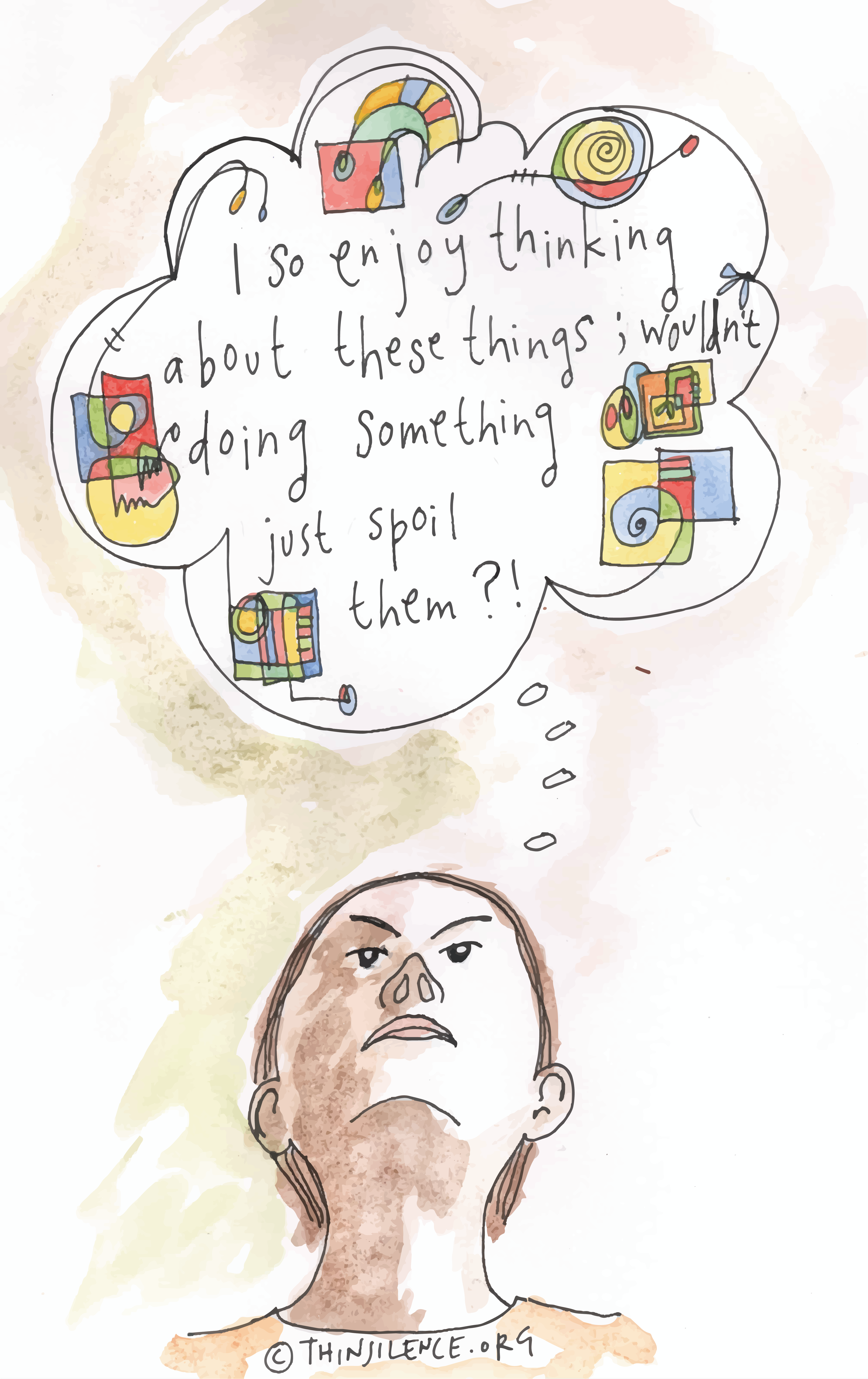
If we stick to the letter of the law, we don’t have to think. Because there’s risk involved in thinking. There’s nowhere to hide if it goes wrong. But real creativity often comes with risk. So don’t just blindly follow the words themselves. Take a risk. Think.*
(Dave Trott)

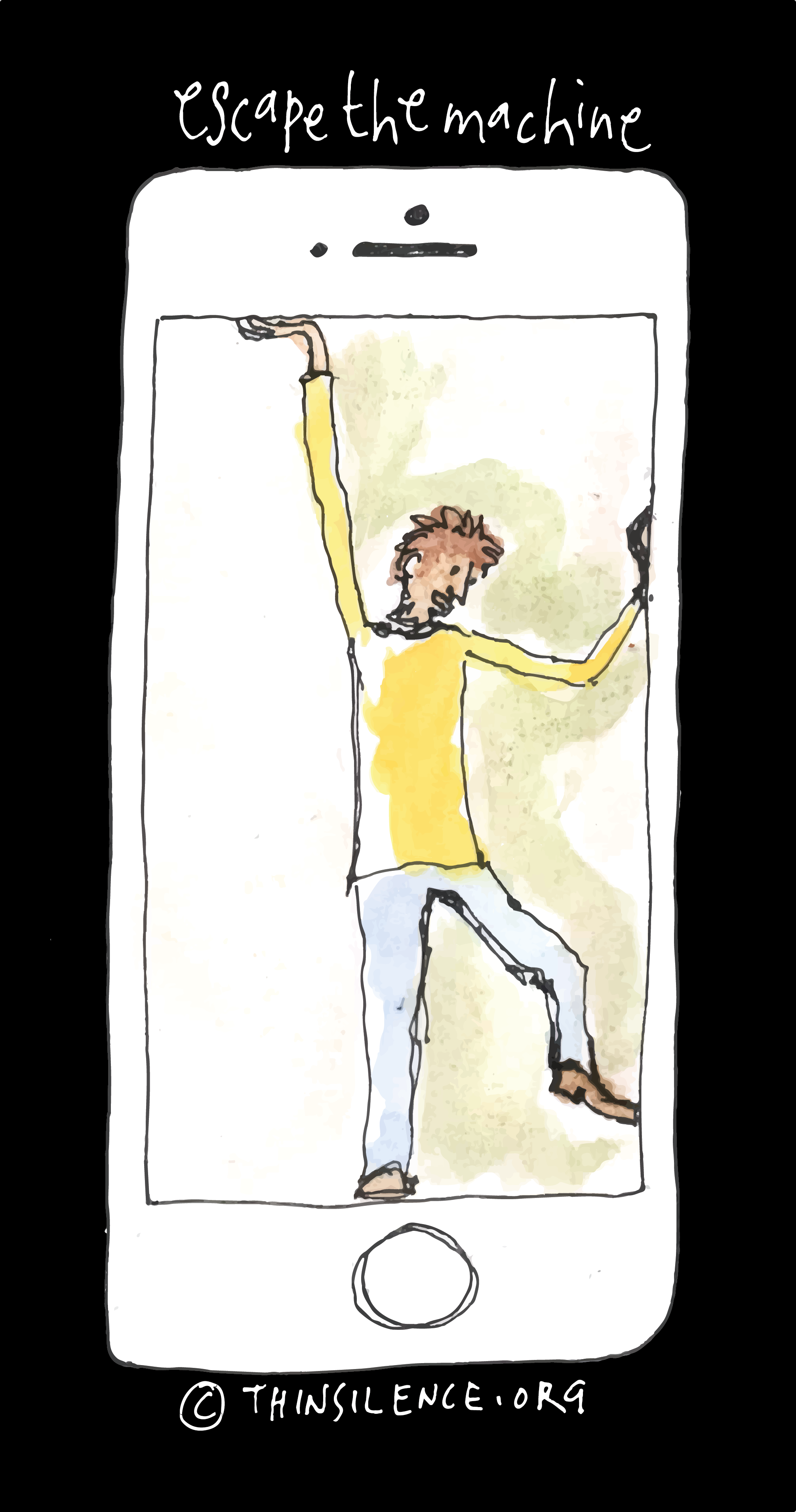
[The second industrial revolution] is characterised by the fact not only that living energy has been replaced by mechanical energy, but that human thought is replaced by the thinking of machines.**
(Erich Fromm)

All of us live within systems: multiple systems – systems within systems – and each comes with a script to follow … or not.

The systems become more complex, the scripts more confining.

You don’t have to follow a script, though, you can always interpret it.

Scripts are often finite whilst interpretations are infinite.

Interpretation requires that we think differently, beyond the boundaries of systems, into the adjacent possibilities.

This comes with risk.

There’ll be misunderstandings and criticisms, there’ll be failures and pain, but if we value and trust the small steps rather than the mighty leap we’ll make progress:

We all want big changes, but the best way to achieve this is to start small.  Give love, Take Pride. ^

*From Dave Trott’s One + One = Three;
**From Erich Fromm’s The Revolution of Hope;
^From gapingvoid’s blog: Celebrate small wins.
Messy wisdom

The more people have to attend to, the harder it is to get their attention. Attention is a precious resource. […] What if instead of showing up to get attention, we showed up to give it, without expectation? Imagine the resources we could build if we spent the majority of our time attending to how we could help instead of trying to be seen.*
(Bernadette Jiwa)

Now I think that what makes you alert is to be faced by a situation that is beyond your control so you have to be watching it very carefully to see how it unfolds, to be able to stay on top of it. That kind of alertness is exciting.**
(Tim Harford)

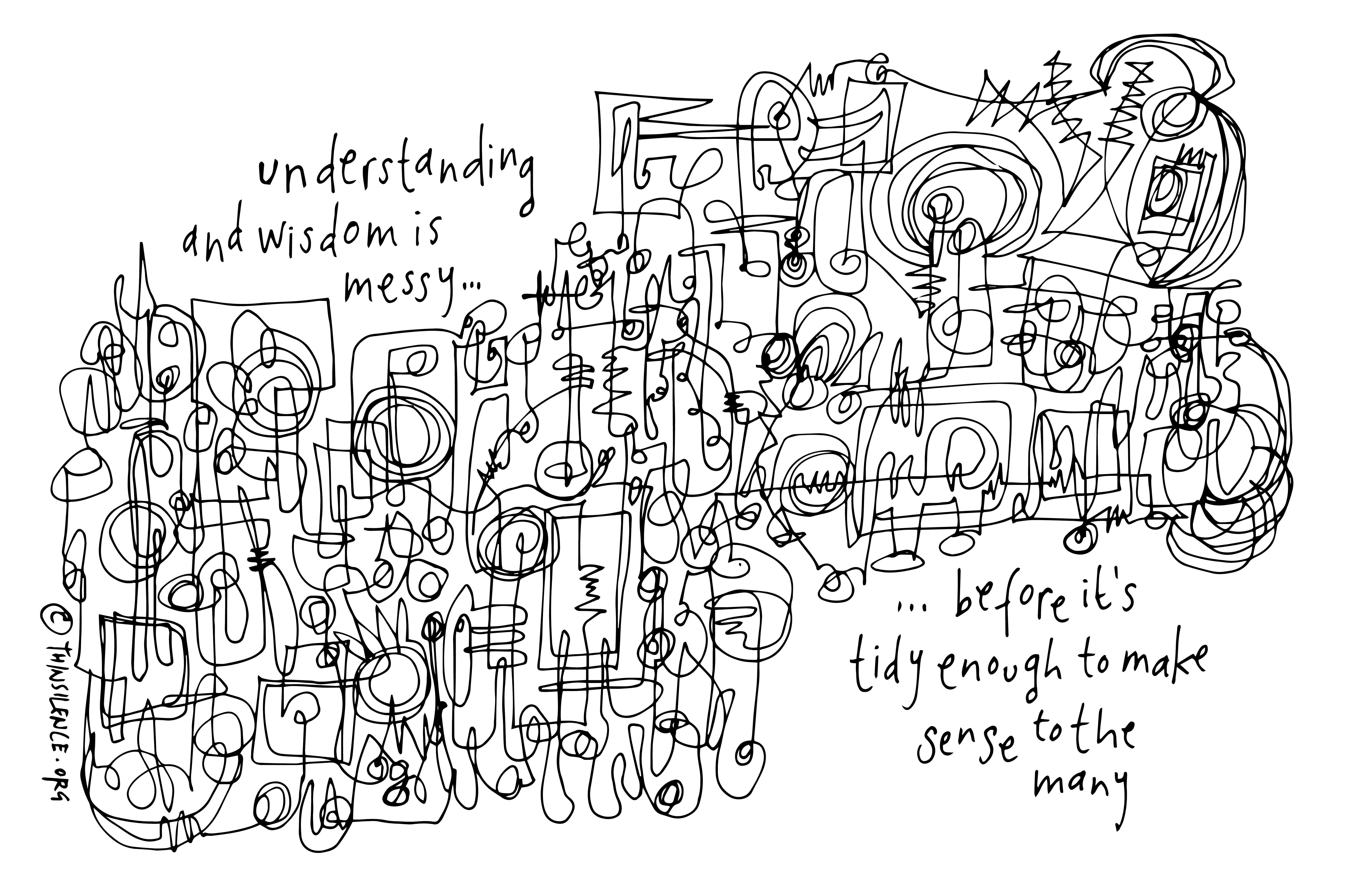
The thing about giving attention is that it opens us up to more understanding and wisdom.

And we are changed in the process.

Whereas getting attention leaves us with what we have, or not much more. And we remain unchanged.

Giving attention is a risky business, though. We are unable to control our new discovery, appearing clumsy and incompetent in the eyes of others.

We are trying to know something in order to understand it, in order to wisely move it up and to the right.

Pioneers and explorers know there’s always something out there that they don’t know and cannot understand … yet.

They are prepared for things being very messy before they make sense for the majority.

You may have spotted what the real risk, however.

Which is to stay where we are.

*From Bernadette Jiwa’s The Story of Telling blog: Giving Attention vs. Getting Attention;
**From Tim Harford’s Messy.

The right choice

See, you don’t have to threaten, or restrict or dictate anyone’s choices. If you’re clever, you can just rearrange the architecture.*
(Dave Trott)

That’s the truth of personality. It’s not innate but trained. It can and does change. It can and should be chosen and designed. Choosing one’s way is a primary purpose of our lives.**
(Benjamin Hardy)

How do you stop your child hanging from the school bannister three floors up above concrete?

Dave Trott decided his son wouldn’t stop if he simply told him not to do it.

Instead, he decided to show him how to safely fall downstairs at home, something his son was very much up for – Mum was out.

Wrap your arms around your head and roll into a ball:

And he fell down the stairs.*

“Ouch, that hurt.”*

Trott told his son that was because he hadn’t done it right, so he should try again.

He fell down the stairs a couple of more times.

It never became less painful, but the school reported that his son was no longer hanging from the bannister.

Trott calls this choice architecture.

Design that leads to the choice you want people to make, or not.

Here’s where my mind went when I read Trott and Benjamin Hardy:

Our lives don’t want to leave it to chance.

Or for us to miss the chances and opportunities everyone’s life includes.

Our lives constantly sends us information –

I call these whispers –

So we are enabled to make the right choice.

Not in some fixed, narrowing way, mind.

The right choice opens up more possibilities, so, more opportunities to choose.

The best part is when this happens, we’re designing ourselves.

We’re the origin of the whispers.

And on it goes.

(By the way, I’ve left the doodle for you to colour in with your choice of colours.)

*From Dave Trott’s One + One = Three;
**From Benjamin Hardy’s Personality Isn’t Permanent.

Doing a thought

The toll of making change is that you will be changed.*
(Seth Godin)

I may have ideas.
I may feel very strongly about these as they resonate with me
But until I do something with them, they remain invisible and can fade away.

(I have two at the moment that I need to move on.)

The thing about doing a thought is, not only are we are making an idea visible, providing it with an opportunity to breathe rather than expire, we’re also opening it to failure and ourselves to pain.
So we’re able to see how it can be developed and improved.
And also how we can be changed and grow.

What’s not to like?

*From Seth Godin’s Graceful.

Walk this way

When I’m walking, the subconsciousness is able to come to the surface more and it allows me to make magical connections that in my conscious mind I could never make.*
(Pico Iyer)

It is not possible to experience a feeling of control unless one is willing to give up the safety of protective routines […] what people enjoy is not the sense of control but the sense of exercising control in difficult situations.**
(Mihaly Csikszentmihalyi)

Taking a walk instead of being tied to your desk may just feel wrong to you. The reality is that your brain may need to take a walk in order to work:

I can only meditate when I am walking.  When I stop, I cease to think; my mind only works with my legs. ^

There is a letting go of convention when we leave the workplace for a walk, not knowing just what we’ll encounter and find ourselves thinking. Yet there is an artfulness and skill to this as expressed by Iain Sinclair’s revealing:

I have different walks for different questions or problems or ideas that I’m dealing with, a whole chain of maybe fifty different walks that I do for different things.^^

If you have something to do your way, as Frank Sinatra famously sings, then perhaps seeing this way as a path and introducing some walking into may bring just the benefit you need – and, if nothing else, you’ll find yourself smiling at all the sounds and sights.

*Pico Iyer, in his interview with Simon Schreyer: A Friend Afar;
**From Mihaly Csikszentmihalyi’s Flow;
^Jean-Jacques Rousseau, quoted in Shane O’Mara’s In Praise of Walking;
^^Iain Sinclair, quoted in Geoff Nicholson’s The Lost Art of Walking.

Provocation

Myths, told for their own sake, are not stories that have meanings but stories that give meanings.*
(James Carse)

All of us have to learn how to invent our lives, make them up, imagine them. We need to be taught these skills, we need guides to show us how. Without them, our lives get made up for us by other people.**
(Ursula Le Guin)

To provoke is to call forth.

Myths are provocative.

Myths call forth a story from our lives. Not some repeat of the myth, but something that may only find expression through our lives:

We resonate with myth when it resounds in us. A myth resounds in me when its voice is heard in mine but not heard as mine.*

If we want a teacher or guide so we might find our lives and live them large, there are few better than the great stories and myths passed to us.

*From James Carse’s Finite and Infinite Games;
**From Ursula Le Guin’s Words Are My Matter.

School is back

BASICS are the beginning.
REPEAT yourself often.
AVOID creating desperation.
INSPIRE with examples.
NEVER forget to repeat yourself.*

(John Maeda)

Many give up on learning and go into I’m-not-interested-in-what-you-have-to-say-but-I-want-to-tell-you-what-I-think mode.

Teaching is learning, of course, and teachers are learners first of all.

John Maeda outlines the things he remembers in order to draw people into learning: always be a learner in order to do justice to the basics, embrace the need to repeat so everyone gets it, don’t show off and make what you know unlearnable, trigger the the learner’s internal motivation, and if it’s worth saying it’s worth saying again.

Here’s to lifelong learning. School is back.

*From John Maeda’s The Laws of Simplicity.

Embodiment

I’ve been trying all my life to find what my limits are and I have never reached them yet.  But then the universe doesn’t really help, it keeps expanding and won’t allow me to know it entirely.*
(J)

You can’t just be you. You have to double yourself. You have to read books on subjects you know nothing about. You have to travel to places you never thought of traveling. You have to meet every kind of person and endlessly stretch what you know.**
(Mary Wells)

*J in Paulo Coelho’s Aleph;
**Mary Wells, quoted in gapingvoid’s blog: Always open self.

The story of where I live and what I live for

Our lives are a process of constant discovery and invention. Each of us lives a unique human life.*
(Bill Sharpe)

Stories that have the enduring strength of myths reach through experience to touch the genius in each of us.**
(James Carse)

Myths pierce the explanations we give to our experiences, reaching to connect with the truth and wonder of who we are and what we can do lying deep within each of us. They have been told throughout the centuries in all shapes and forms around the globe in countless cultures and societies exploring what it is to be human. In other words, they help us to see there is more to us than meets the eye.

Too quickly, we compare ourselves with others, focusing on our limitations, but these are exactly what matter most, how we bring our particular thoughts and talents to play on the world as it is:

This is the pleasure of limits, the fun of play. Not doing what we want, but doing what we can with what is given.^

This kind of play respects the other, allows it to be what it is through openness rather than judgement. We are not in control but caught up in interactive, generative play:

If we write this down, as in journaling, we find ourselves creating a narrative that we can reflect upon and develop. Play is how we make more from less – with who we are and what we have, and between ourselves and the other.

Time to play reflect, play …

*From Bill Sharpe’s Three Horizons;
**From James Carse’s Finite and Infinite Games;
^From Ian Bogost’s Play Anything.

A successful human being

It’s good to want to be successful, and do whatever it takes. But even better, is to be a complete human being. And that’s much harder than being a workaholic.*
(Hugh Macleod)

When we create something with practical elegance, we are investing time and energy in a user experience that satisfies the user more than it helps the bottom line of the company that made it. […] When a designer combines functionality with delight, we’re drawn to whatever she’s produced. That’s the elegance we’re searching for in our built world. […] As soon as a product or system creator starts acting like the user has no choice, elegance begins to disappear.**
(Seth Godin)

My hope is to live both a practical and an elegant life.

The other day I shared these words from Eugene Peterson:

As the scholastics used to say: ‘Homo non proprie humanus sed superhumanus est‘ –which means that to be properly human, you must go beyond being merely human.^

I like Peterson’s gentle and kind way of reflecting on how we can be human.

There is no one way to be properly human – this is the adventure that is open to all of us to explore in our own ways.

We may begin with the question, What does it mean to you to be human?

My response to this question is: to live with creativity, generosity and enjoyment.

This question is a starting point only, hopefully leading us into our values, talents and life experiences, sports that we might explore these as gateways into more: options, possibilities and choices – life that is not only practical, but elegant, too.

*From gapingvoid’s blog: This kind of hard work;
**From Seth Godin’s blog: Practical elegance
^From Eugene Peterson’s Run with the Horses.