Holes in the reasonable

If you truly want to get unstuck, if you want to move to higher ground or do something more worthwhile, the first question to ask is, “Am I willing to be unreasonable, at least for a while?”*
(Seth Godin)

A kairós is a penetrable opening in the weaving of cloth, the weaving of time, the weaving of fate.**
(Lewis Hyde)

There can be moments when our world opens to something else, something different, a possibility for becoming unstuck.

“Dibsy” McLintock was 28 years old, weighing 40 stones, and looking at an early death, but his story was heard by personal trainer Mike Hind who offered to help him shed 19 stones and run the Great North Run. I was listening to Dibsy speak on the radio, telling of how he couldn’t turn down the best trainer in the UK when he called. It would mean a total change of lifestyle but it would literally save his life.

What was breaking into Dibsy’s life was another reality when he was so stuck – something unreasonable, something accidental (what if Mike Hind hadn’t heard his story?).

This is only one picture of being stuck. There are boring jobs, bad relationships, meaningless days, too many choices – these are the reasonable things that make up our days. When the accidental comes along, and it will, we must be ready to move through the tear that appears in our world and into a different reality.

It is possible to make these things happen, too, or at least prepare ourselves for the holes-in-the-reasonable when they appear. It’s what I hope my dreamwhispering work is all about.

The important thing is not to turn down the new, unfamiliar, unreasonable kairós moment when it opens to us.

(*From Seth Godin’s blog: Being stuck is reasonable.)
(**From Lewis Hyde’s Trickster Makes This World.)
Playing with lines

As in the case of lines, you are likely to stop when you are no longer sure you should go further – at the rear edge of the region of uncertainty.*
(Daniel Kahneman)

Even within cultures strong on destiny, and social order and laws, there are trickster characters who help the people to playfully question the lines and to cross them.

We all need to find these tricksters and to learn how to be tricksters to others.

(*From Daniel Kahneman’s Thinking, Fast and Slow.)

The accidental artist – part three

More conservative minds deprive coincidence of meaning by treating it as background noise or garbage, but the shape-shifting mind pesters the distinction between accident and essence and remakes this world out of whatever happens.*
(Lewis Hyde)

we’re not seeing all the things we’re not learning, not engaging with, not creating, because we’re so busy learning like it’s 1904**
(Seth Godin)

In the first and second parts of my accidental artist posts, I was thinking about how important it is to be a participant rather than an audience member, and being open to and paying attention to the “noise” of distraction.

The thing is, the more we participate the more we become artists because we are being open to all that is, not some limited essence of is-ness, and we are learning how to be playful.

In his lovely children’s story and (adult fable) The Dot, Peter Reynolds has his protagonist Vashti exclaiming to her teacher:

I just CAN’T draw!^

Here’s how the story unfolds:

Her teacher smiled.

Just make a mark and see where it leads you.

Vashti grabbed a felt-tipped pen and gave the paper a good, strong jab.

There!

Her teacher picked up the paper and studied it carefully.

Hmmmmm.

She pushed the paper towards Vashti and quietly said, Now sign it.^

As the story continues to unfold, Vashti finds that her teacher has framed her dot and hung it on the wall. Vashti finds herself thinking she can do better than that and begins to draw and paint all manner of dots, even one without a dot.

The story tells me of how a distraction can become our art.

Someone has commented on my posts that they can never understand them and now they just skip over them.

That’s okay, you can’t distract everyone, but for those willing to explore the noise, the accidental and the distractive, there’s a whole new way of looking at things open to us.

(*From Lewis Hyde’s Trickster Makes This World.)
(**From Seth Godin’s blog: Computer education is an oxymoron.)
(^From Peter Reynolds’ The Dot.)

The accidental artist – part two

One kind of creative perception is always willing to take coincidence seriously and weave it into the design of things.*
(Lewis Hyde)

Opening yourself up to the world, to new experiences and themes and inputs, will push you to a new place. And that push? That’s growing.**
(Hugh Macleod)

The thing that’s distracting you may be just the thing you need to notice.

It could be something physical, a thought, a feeling … .

Why not pay it some more attention and see where it wants to take you?

(*From Lewis Hyde’s Trickster Makes This World.)
(**From gapingvoid’s blog: The magic of give and take.)

The accidental artist – part one (or making day while we can)

By sitting somewhere and sketching something, I was forced to really look at it […] a means of experiencing a place or a moment more deeply.*
(Robert Ebert)

Trickster is the great shape-shifter, which I take to mean not so much that he shifts the shape of his own body but that, given the materials of this world, he demonstrates the degree to which the way we have shaped them may be altered. He makes the world and then he plays with its materials.**
(Lewis Hyde)

A psalmist imagines God to be the rising sun, making the day, calling a new day into being:

The mighty one, God the Lord, speaks and summons the earth from the rising of the sun to its setting.^

We receive the day with a number of things largely outside of our control – the weather, number of hours, our relational and work schedules, but there’s an awful lot of empty space in-between these for us to play as makers of our days:

The sanctification of the local landscape is a fundamental function of mythology.^^

I snatch Joseph Campbell’s words for sanctifying our days with personal and social myths – the things we get to add to all that weather, time and scheduling.

Or how about this from Joseph Bueys:

Everyone an artist.*^

Reflecting on these words, Rebecca Solnit shares:

I used to think he meant that he though everyone an artist, but now I wonder if he wasn’t speaking to a more basic possibility; that everyone could become a participant rather than a member of the audience.^*

You’re already invited to be a maker of this day.

(*Robert Ebert, quoted in Austin Kleon’s Keep Going.)
(**From Lewis Hyde’s Trickster makes This World.)
(^Psalm 50:1-2.
(^^From Joseph Campbell and Bill Moyers’ The Power of Myth.)
(*^Joseph Buys from Rebecca Solnit’s Wanderlust.)
(^*From Rebecca Solnit’s Wanderlust.)

The death of inveteracy

Your inaction, inertia, and cynicism removes from the world that part of you that could learn to quell suffering and make peace. That’s not good. […] I have learned through painful experience that nothing is going so badly that it can’t be made worse. This is why Hell is a bottomless pit.*
(Jordan Peterson)

We can certainly make things worse, even when trying to make things better. Perhaps we shouldn’t be in so much of a rush.

Of course, if we can make things worse, we can also make things better.

Edgar Schein encourages us to see that not-knowing and curiosity are huge resources when it comes to what is best to do:

Allowing your ignorance, or allowing your curiosity to lead you, is often the best guide to what to ask about.**

Curiosity provides us with an antidote to cynicism, and also it siblings of inertia and inactivity.

Something more happens when we are curious, as suggested here by Martin Seligman:

Curious people do not simply tolerate ambiguity; they like it and are intrigued by it. Curiosity can either be specific […] or global, a wide-eyed approach to everything.^

We are prepared to stay longer with ambiguity and, more, to feel alive in its presence:

Curiosity leads us forward on an unknown path […].^^

My specific read for this month is Lewis Hyde’s Trickster Makes This World, an exploration of the characters who play around the edges of societies and cultures, finding ways of making change. Towards the close of his first movement of thought, in which he explores Native American tales of trickster, Hyde summarises:

Trickster is the great shape-shifter, which I take to mean not so much that he shifts the shape of his own body but that, given the materials of this world, he demonstrates the degree to which the way we have shaped them may be altered. He makes the world and then he plays with its materials.*^

Which I take as encouragement that we are more enabled to make things better.

(*From Jordan Peterson’s 12 Rules for Life.)
(**From Edgar Schein’s Humble Inquiry.)
(^From Martin Seligman’s Flourish.)
(^^From Terry Tempest Williams’ The Hour of Land.)
(*^From Lewis Hyde’s Trickster Makes This World.)
Where can I change my mind?

To be a thinking, feeling, creative individual in a mass society too often unthinking and unfeeling in its conformity is to find oneself again and again at odds with the system yet impelled to make out of those odds alternative ends – to envision other landscapes of possibility, other answers, other questions yet unasked.*
(Maria Popova)

It’s as if nothing is significant until it’s portable; we must move it, in fact or in mind, from one context to another.**
(Lewis Hyde)

It is often the small daily choices that get us stuck in life.

One day stuck isn’t the end of the world but, when it leads into a second and a third, it can be hard to get moving again.

We might be tempted to think stuck isn’t all bad – if we happen to be stuck in a pleasant place, yet we lose something when we’re not moving. As Maria Popova suggests, our thinking and feeling and creativity are affected.

Lewis Hyde’s opening words concern Odysseus’ oar also being a winnowing fan that can be taken from one place to another. This can also be that, here can also be there. Popova’s “against the odds” can also be the means to alternative ends.

Kosuke Koyama imagines “promised-land-life,” describing it thusly:

It is not an isolated life. It is a life busily engaged in encounters.^

Best to have some way each day to help make the choices that keep us moving in our thinking, our feeling and our creating. I know the first thing I must do each day – after feeding our cat Smudge – is to open my journal and enter the possibilities that silence and reading and writing allows:

No, if you’re going to change your mind, you might have to go off-brand, and offline is the place to be off-brand. Your bliss station, your studio, a paper journal, a private chat room a living room full of trustd loved one: These are the place to really think.^^

(*From Maria Popova’s Brain Pickings: W. E. Auden on the Political Power of Art.)
(**From Lewis Hyde’s Trickster Makes This World.)
(^From Kosuke Koyama’s Three Mile an Hour God.)
(^^From Austin Kleon’s Keep Going.)

I see I do not see I see I do not see

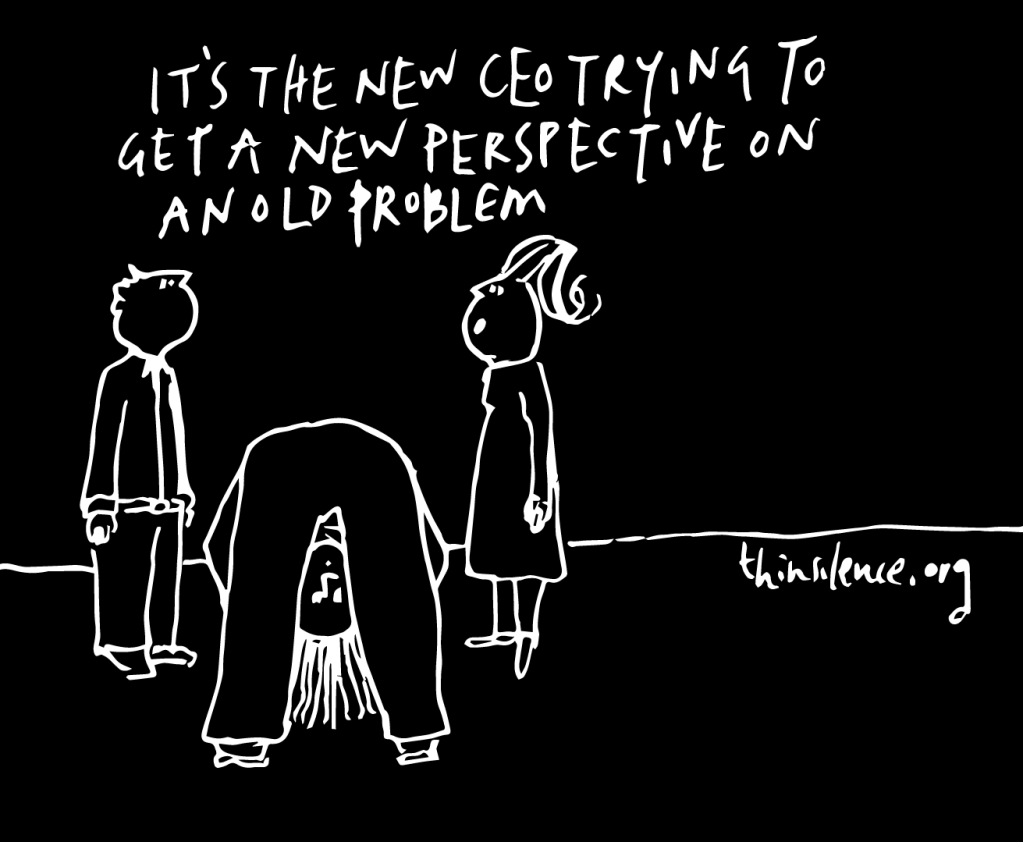
The changing of focus in the eye, moving the eye itself when looking at things that do not move, deepens one’s sense of outer reality. Then static things might be caught in the very act of becoming. By so simple a matter, too, as altering the position of one’s head, a different kind of world may be made to appear. Lay the head down, or better still, face away from what you look at, and bend with straddled legs till you see your world upside down. How new it has become.*
(Nan Shepherd)

It’s always been my philosophy to try to make art out of the everyday and ordinary … it never occurred to me to leave home to make art.**
Sally Mann)

Maybe you just haven’t found the best way to look at the thing you’re needing to focus on. Perhaps, then, there’ll be more to see.

(*From Nan Shepherd’s The Living Mountain.)
(**Sally Mann, quoted in Austin Kleon’s Keep Going.)

Do you really want to see that?

It’s as true today as it ever was: He who seeks beauty will find it.*
(Bill Cunningham)

Imagining possible futures is also where we must face both our deepest fears and greatest hopes.**
(Alex McManus)

Some refuse to see any more than they presently able to; they experience their sight narrowing over time

Others want to see but realise that in seeing comes the responsibility for doing and so they seriously reduce their looking to safer proportions.

There are some who want to see but realise that they have to give up looking at some other things if they are to see what they really desire; they try and hold on to everything and, struggling to focus, something dies in them.

Then there are those willing to pay the price of seeing more and give expression to what their imaginations give birth to.

They change the lives of others and in some small way, make the world more beautiful:

Great artists help people look at their lives with fresh eyes and a sense of possibility.^

They are dreamwhisperers who awaken hope. They connect meaning to action. They craft narratives that release human energy. They make new maps that guide us into places where there are no paths.**

(*Bill Cunningham, quoted in Austin Kleon’s Keep Going.)
(**From Alex McManus’ Makers of Fire – eBook version. I am grateful to my friend Alex who describes dreamwhispering better than I do.)
(^From Austin Kleon’s Keep Going.)

Writing that is noticing

A good pen or pencil and a well-made notebook are a genuine climax technology: simple, sustainable, fixable, lasting, and extraordinarily adaptable. It seems a pity to throw it entirely away by omitting to teach people how to use it, simply because a new, wonderful, and infinitely less sustainable technology has come along. I hate to think of a writerly great-grandchild silenced in the midst of a story by the failure of her power-source, dumb as an unplugged machine. Well, she’ll swear, and find a pencil, and start laboriously printing, and presently reinvent cursive. Nothing, not even our incalculable wrong-headedness, can keep human beings from telling stories.*
(Ursula Le Guin)

There is that in me … I do not know what it is … but I know it is in me.**
(Walt Whitman)

If we are going to write good stories we must be noticers, working with what is there rather than against it, especially the difficulties and problems we face in life. Joseph Campbell claims:

Privation and suffering alone open the mind to what is hidden from others.^

Whether the bad things of life or the good, there is no better way of noticing them than to write about them. In noticing, we will be surprised at what becomes possible:

A very original man must shape his life, make a schedule that allows him to reflect, and study, and create.^^

Writing without a purpose other than to notice more moves us beyond the impasse that thinking alone can come across, or even create:

Something supersedes thinking, despite its truly awesome power When existence reveals itself as existentially intolerable, thinking collapses in on itself. In such situations – in the depths – its noticing, not thinking, that does the trick.*^

Austin Kleon moves this thought along further, pointing out the connection between our lives and what we notice and, so, what we are able to change:

If you want to change your life, change what you pay attention to.^*

I have have been encouraged to write more than my morning journal pages, to write with noticing rather than thinking as the purpose.

So far, my experience has been, writing what I notice – the things I’m reading, the things around me, how I am feeling – produces more than enough, so much, I’ll need to lose some. But that’s okay, there’s plenty to keep.

(*From Ursula Le Guin’s Words Are My Matter.)
(**From Walt Whitman’s Leaves of Grass.)
(^From Joseph Campbell and Billy Moyers’ The Power of Myth.)
(Gary Wills, quoted in Eugene Peterson’s Run with the Horses.)
(*^From Jordan Peterson’s 12 Rules for Life.)
(^*From Austin Kleon’s Keep Going.)