worth and value

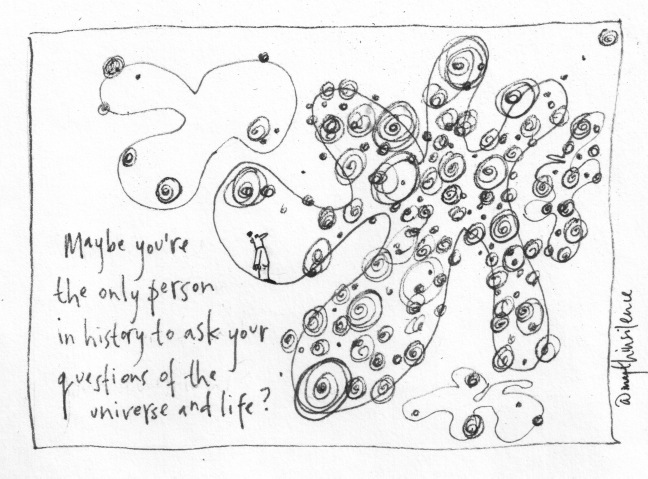
21 maybe you're

Worth here is not the same as value – it comes from the sense of being worthy.  We tend to use it to mean value – “What’s this worth?” – but, really, it expresses pricelessness – literally, this can’t be priced.

I’m writing this on a four year old macbook.  How much would I ask for it? I’m not sure, but not the same as for a new one.  That’s the thing about value, it allows me to compare this with that.

But a gift is incomparable.

To become comparable it crosses a threshold, usually from within a group to without:

worthy
ˈwəːði/
as a noun 
1. a person notable or important in a particular sphere.

Lewis Hyde suggests something else happens when a gift becomes a commodity: I have to detach myself from it if is to become a commodity with a price tag: “It’s nothing personal.”

Pride commoditises people: I see myself in comparison with others and I’m establishing boundaries.  Humility allows me to see my worth without comparison, refusing boundaries.  Greed then follows pride because I need to gather and store more on my side of the boundary, but gratitude sees abundance as something we share.

‘What happens when you’re afraid to stand out is that you unconsciously make sure you blend in.’*

This last thought may appear contradictory but the one who stands out is the one who doesn’t posture and position, who brings their gift or superpower to the game or party for the good of all and not for the good of the few.

This is really about you.  A person, not a commodity.  Worthy and without a price tag.  With a unique boon, necessary and transformative for our time.

(*From Bernadette Jiwa’s Make Your Idea Matter.)


vital gifts

20 perhaps we're the only

We’re submerged in a world of gifts and giveaways.  Maybe we need to distinguish: a vital gift is a transformative gift.

An unusual place to go, but 14th century Christian mystic Meister Eckhart spoke about how “the fruitfulness of a gift is the only gratitude for the gift.”*  this sounds like a description of a vital gift.

I’ve had many tell me that to gift my work to someone, rather than charging them for it, will mean they won’t value it.  I totally get this concern, and I think their obversation may be right in many cases.  I’m still left, though, with a question: where do gifts fit into our world if payment always takes precedence?

Whilst I value the gift, I’ve no way of determining whether it will be fruitful in the person I give it to.  To gift is to take a risk.  At least payment appears to assuage the risk.

As I’m reflecting on this, I find myself coming back to humility, gratitude, and faithfulness as means of preparing the soil for the gift to grow and be fruitful in.

A vital gift is a preemptive strike towards more giftedness in the world.

Not to provoke a gift in return, but the hope of a new gift – something which can only be grown inside a unique life, and the. gifted on to others.

Like the vital signs of life, a vital gift has its own telling marks: courage, generosity, and wisdom lived out towards others.

I still have to figure out how I pay for my bread and milk, but I can’t get away from this question about vital gifts.

Gifts ask questions.

(*Meister Eckhart – 1260-1328, quoted in Lewis Hyde’s The Gift.)

being present to the liminal

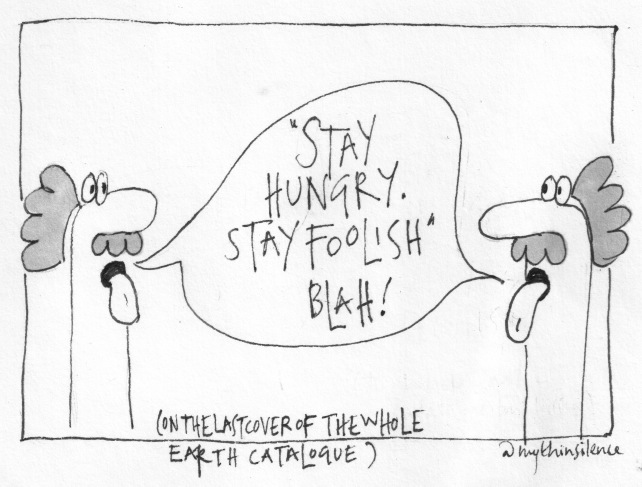
19 stay hungry

More than the sum of all our parts – our values, passions, skills, and experiences – each of us has received a gift to pass on.  I’m still groping for where this comes from and the language to explain, but I see in so many people the possibility of bringing a gift into the world only they can bring.

Our lives appear to have the capacity to form these gifts, even while we are pursuing our curiosities, learnings, and practising into forming skills.  As linguist Susan Smith ‘explains that voice is the “ultimate site of intersection and negotiation between the body and language,”* so our gift, like a voice, forms where these curiosities, learnings and doings meet, between character and personality, but is different to them.

To be aware that such a gift exists in everyone is only a beginning.  We must grow up to it if we’re to give it to others: ‘the person labours to become sufficiently empowered to hold and to give the gift’.**

Mindfulness is about being present.   To be aware of what we normally miss.  We must become present to the gift.

Growing up to the gift will take us into unfamiliar or liminal spaces, beyond and between the familiar ones.  We’ll not only hone skills, bringing these together into talents and developing them into strengths, but we’ll also grow our characters, facing our failures and learning to embrace our past and our future.

If this sounds more like a mythical journey than your life, this is exactly it.  Myths are explorations of what it is to be be fully Human.

Daniel Kahneman^ warns, though, that in our way lie substitution and WYSIATI (What You See Is All There Is).  We quickly find an answer, not realising that we have substituted an easier question for the more difficult original one, whilst our past experiences determine our anticipations of the future.

I hear it many times, the whisper of a hope for something more in life.  But it must come easy-ish and fit into an already overfull life: How can I be less rushed? is an easier question to face than, How can I become a person worthy of my gift?

(*Linguist Susan Smith, quoted in Charlotte Bosseaux’s Dubbing, Film and Performance.)
(**From Lewis Hyde’s The Gift.)
(^See Danile Kahneman’s Thinking Fast and Slow.)

non-obvious beyond

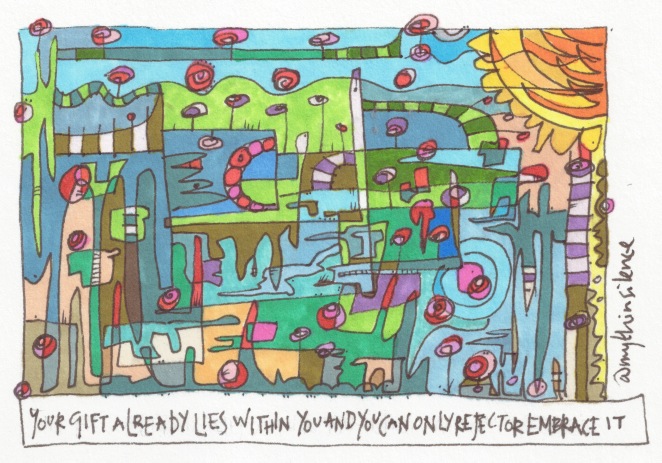
18 your gift (colour)*

“Labour and rest, work and ease,
the busy hand, and then the skilled thought:
this blending of opposites
is the secret
of the joy of living.”**

I cannot design the gift.  Somehow it comes to me from beyond.  It’s nature is non-obvious.

I may have been curious about this, learned about that, developed this skill, brought them all together as talents – these are things which are obvious to me, in that I’m conscious of choosing and pursuing them.  But they are not the gift.

The gift comes to me – I can only be open to embrace what has found me.  Any pride or greed on my part blocks the gift;  I am only able to embrace it through humility and gratitude.

‘I would like to speak of gratitude as a labour undertaken by the soul to effect the transformation after a gift has been received.  Between the time a gift comes to us and the time we pass it along, we suffer gratitude.’^

Now it changes me, and I must change because only a bigger me will be able to actualise the gift, to pass the gift on.

Your gift is non-obvious.  This is because it is unique, more than the sum of your parts.  My call, as a dreamwhisperer is the joy of listening for your gift.

18 your gift

(*You can get a high resolution copy of today’s cartoon to colour in yourself.  Just send a request to gb@geoffreybaines.com.)
(**From Alistair Maclean’s Hebridean Altars.)

(^From Lewis Hyde’s The Gift.) 

rescued rescuer

17 harriet tubman

Yesterday, I watched a launch of a lifeboat for my first time ever.

People were running towards the Queensferry boathouse within moments of one another.  Just a few moments later they all appeared on the other side of the building with their uniforms on and the boat being launched, and then they were gone.

I don’t know whether this was an exercise or for real but, as I reflected on what I witnessed, a number of elements had just come together:

Acute need experienced by those in trouble on the sea demands a highly skilled crew to respond – not just anyone who likes boats can do this.

The crew possesses a combination of personal values, skills, and experience which makes them the rescuers they are – matched on land by a team in support.

They have the kind of equipment which makes it more possible to deliver their skills and succeed for the people in need: boat, clothing, etc.

I call this acute need because it’s obvious to someone in trouble on the sea when they need help.

There’s also chronic need, though.

I’m thinking of the work people find themselves in, but it could also be their worldview or relationships or a health issue of some kind.  Many put up with their needs and try to get by – it’s not as if it’s life-threatening, they reason.

Rescue is at hand – people with values and skills and experience and means and practices who help us to turn towards the need rather than hide from it.

And people who are rescued tend to become rescuers of others – which is why today’s cartoon is a tribute to Harriet Tubman, who escaped from slavery but then decided to become a rescuer of others, being a founder of the Underground Railroad.

‘I’m very inspired myself, as a teacher, to communicate ways to help people not run away.  To help people take the view that they can allow whatever comes up, uncomfortable feelings, for example.  And then, secondly, to teach methods of different kinds to help others stay present.’*

I can name all those who helped to rescue me and those who still do.

(*From Pema Chödrön’s Fail Fail Again Fail Better.)

honestly seeing

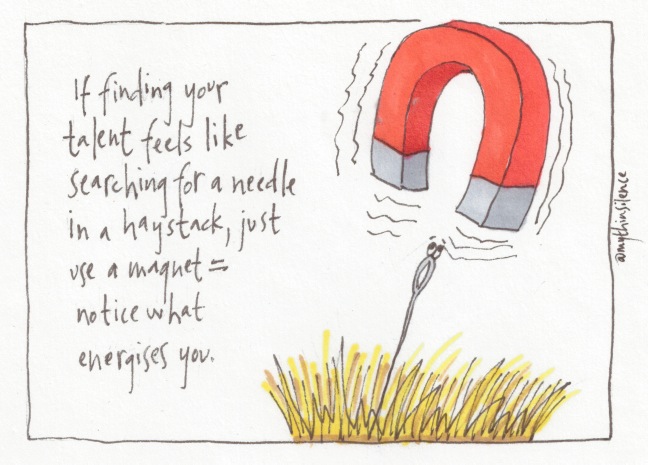
16 if finding

When Lewis Hyde writes about how the increase of a gift ‘is to speak of something simultaneously material, social, and spiritual,’* he catches my attention because these are Theory U’s three disconnects – and they’re really big ones.   U theory is about anticipating the emerging future together, and the place we begin is observation.**

We have to be willing to see, even when what we see is unpleasant and unpalatable.  To avoid the truth about ourselves, others, and our world is to impair our ability not only to see now but also to see the future.

“The most reliable way to anticipate the future is to understand the present.”*

This may not be good news to you.  Your present (or the present of others or the world) may not fill you with pleasant thoughts.  In my experience, though, there’re way more good things to see than bad or indifferent.  There are so many values and abilities and energies and dreams.

Yes, we make mistakes and we fail – often, but life loves grace and providing another opportunity transforming mistakes and failures into things to learn from.

Honestly seeing the truth of who we are is not an end, then, but a beginning.  Facing failure in this way makes us change-agents towards: ‘the beginning of something fresh and new in your life, turning you in a whole different direction … making you braver and stronger and more there for other people, and it will bring out your best human abilities’.^^

(*From Lewis Hyde’s The Gift.)
(^Theory U by Otto Scharmer.)
(^Futurist John Naisbitt, quoted in Rohit Bhargava’s Non-Obvious.)

(^^From Pema Chodron’s Fail Fail Again Fail Better.)

elegance

15 turn up

Elegance is flow.

The motion of a generative life, elegance works to remove barriers and obstacles to the possibility of an idea, a gift, a life.

When moving us into generative dialogue with others, elegance does not want to exclude people or win the argument, it doesn’t simply want to help another, but would rather create something with others, finding beautiful words or actions or ideas on the far side of complexity.

‘[E]legant proofs or theories have most or all of the following features: they are simple, ingenious, concise, and pervasive; they often have an unexpected quality, and they are very satisfying.’*

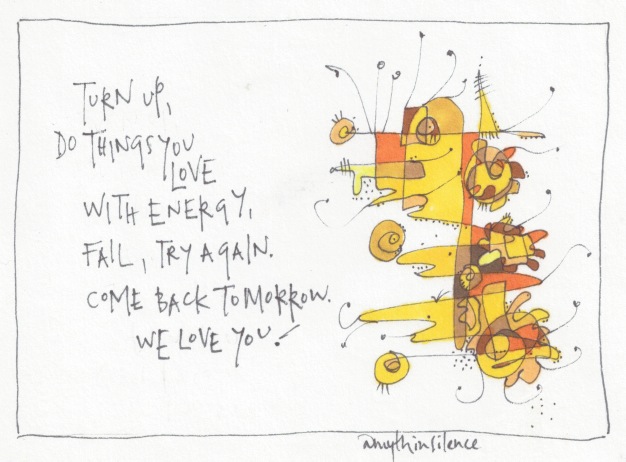
Elegance is not easy.  At its core lies vulnerability: a willingness to try and fail and try again until something works, with all the misunderstanding and pointing this involves.

‘It’s in that space – when we aren’t masking ourselves or trying to make circumstances go away – that our best qualities begin to shine.’**

(*From Rohit Bhargava’s Non-Obvious.)
(**From Pema Chödrön’s Fail Fail Again Fail Better.)

sea diamonds

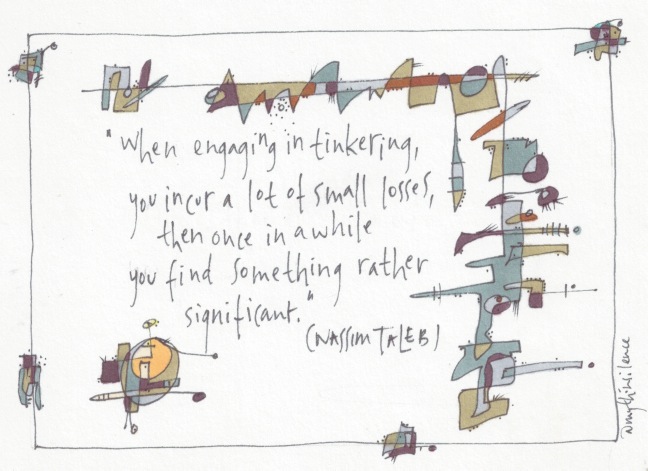
14 when tinkering

‘We can infer from the speed with which people respond to questions about their life, and from the effects of current mood on their responses, that they do not engage in a careful examination when they evaluate their life.  They must be using heuristics, which are examples of substitution and WYSIATI.’*

There we were, on a beach below St. Andrew’s castle: four middle-aged people picking out “sea diamonds” from among the stones, and dodging the waves of an incoming tide.

Sea diamonds are just my name for the pieces of broken glass ground smooth by the action of the waves.  A little later, in the window of a jewellers in the town, we spotted these pieces of glass made up into earrings, necklaces and bracelets.

Three things caught my attention this morning:

Lewis Hyde tells of how a gift’s value would increase amongst Native American tribes as it was broken.**
Pema Chödrön tells a story of how, when it comes to failure, we tend notice what is happening to us rather than our feelings about what is happening – which means we are more acted upon than acting upon.^
Rohit Bhargava encourages us to be thoughtful about a thought or idea before passing it on.^^

We are the sea diamonds in this tale, more than broken glass.  Something beautiful is happening in the gifts are lives are becoming to others through the difficult experiences of life.

Whilst we don’t invite these, we choose our response as we go through them, before we share our gift.

(*From Daniel Kahneman’s Thinking Fast and Slow.  Substitution is the swapping of a difficult question for an easy one, and WYSIATI is to be closed to a new way of seeing: What You See Is All There Is.)
(**Lewis Hyde’s The Gift.)
(^Pema Chödrön’s Fail Fail Again Fail Better.)
(^^Rohit Bhargava’s Non-Obvious.)

the art of fickleness

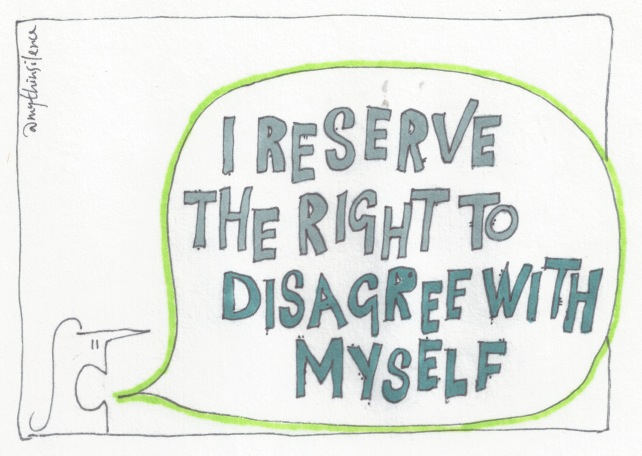
13 i reserve

fickle

ˈfɪk(ə)l/

adjective: changing frequently, especially as regards one’s loyalties or affections, or:

‘Being fickle means capturing ideas without needing to fully understand or analyse them in that same moment.’*

Individuals or organisations may want us to make our minds up quickly about something or someone.  But there may be more to know.  I might think what others consider to be the most important thing in the world not to be worth much at all.  I don’t want to come to a conclusion or judgement fast.

One organisation embraced indifference as a means of freeing people from the things which would prevent their ingenuity: ‘the ability to innovate, to absorb new perspectives, to respond quickly to opportunities or threats, and to let go of strategies that no longer work in order to embrace new ones.’**

(*From Rohit Bhargava’s Non-Obvious.)
(**From Chris Lowney’s Heroic Leadership.  The organisation Lowney writes about is the Jesuit order, which, in its early days, encouraged individuals to pursue what interested them most, meaning they had to be indifferent to many other things.)

makers of gifts

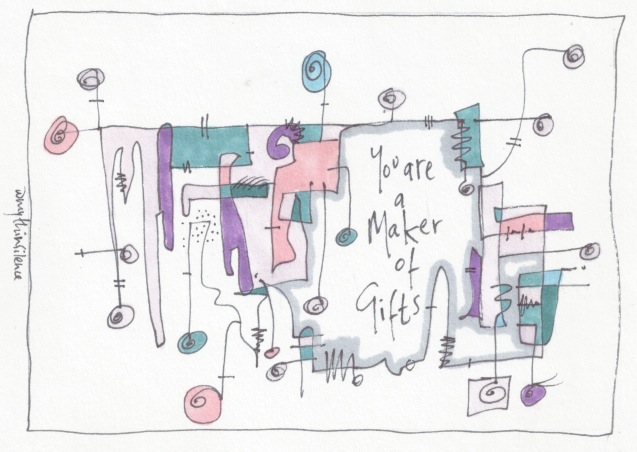
12 you are a maker

‘The gifted artist contains the vitality of his gift within the work, and thereby makes it available to others.’*

Although life is about passing on the gifts others have made, in this universe, everyone is capable of making gifts to fill the emptiness.

These are as unique and diverse as those making them.

‘Honestly, that is the best advice for life: no note cards.’**

Here’s a clue.  What can you talk about or do which you don’t need any notecards for? This is probably your art, your voice in this universe:

‘When air travels to our lungs we are given a voice that defines who we are.’^

What matters to us so much, we would let go in order to let come something more?

(*From Lewis Hyde’s The Gift.)
(**From Pema Chödrön’s Fail Fail Again Fail Better.)
(^From Charlotte Bosseaux’s Dubbing, Film and Performance.)