prophets and imagination and leading

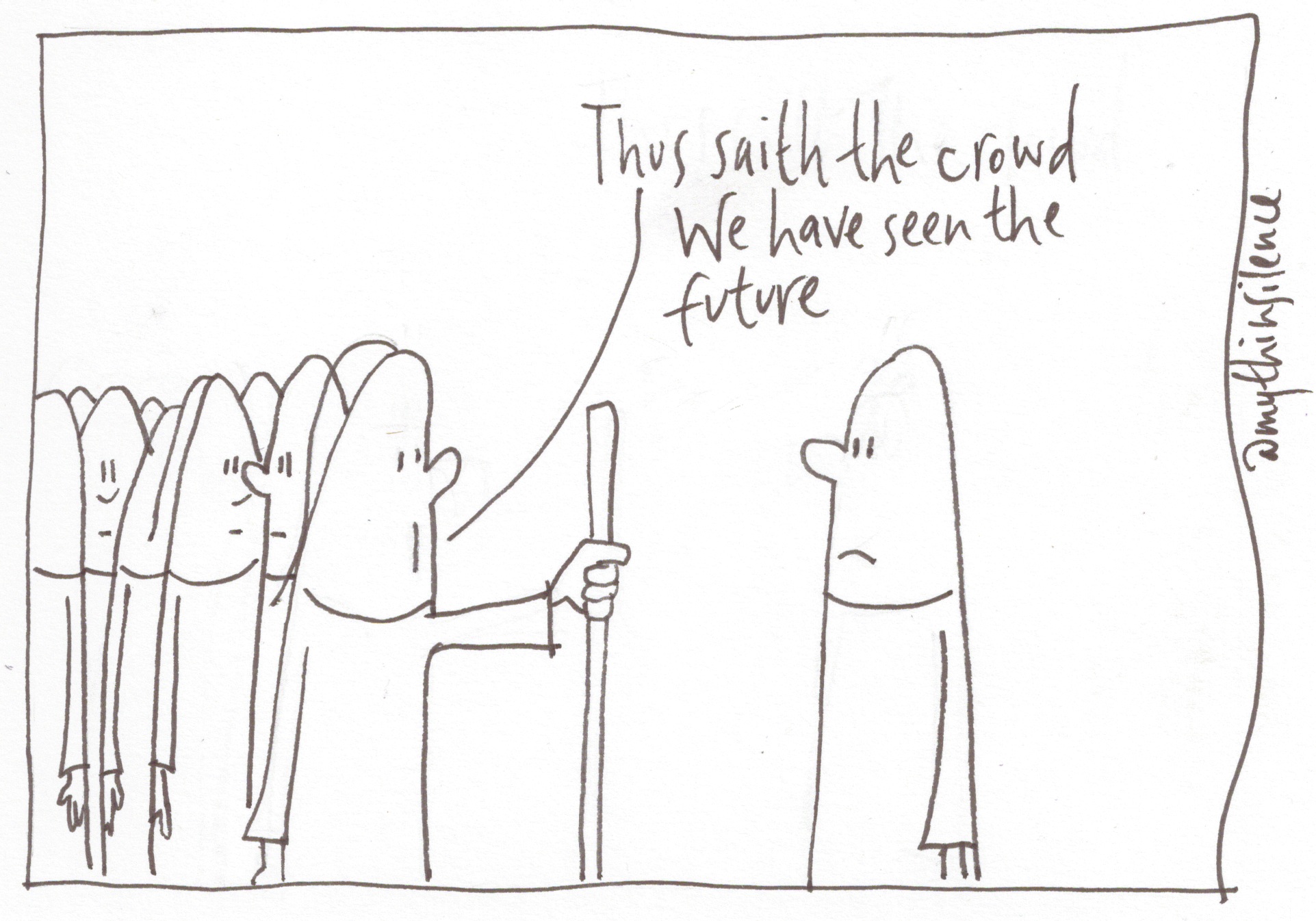
21 thus saith the crowd

It was thought prophets were lone voices, standing against everyone who didn’t “get it” – usually everyone.

The new thinking** has the voice of the prophet as representative of people who hope for something different.  Their imagining and words and enactments express alternative worlds.

“The part is a place for the presencing of the whole.”*

If this is so then a group I’m part of are imagining prophetically at the moment.  Our concern to provide a space for nurture and empowerment for people who are disenchanted with their work-spaces, in which others don’t appear to care as much as they do.

‘Your purpose is not what you do but why you do it.’^

You are being prophetic when you hope on behalf of others for something which does not exist, and when you imagine it into being you are leading.

(*Henri Bartoft, quoted in Peter Senge, Otto Scharmer, Joseph Jaworski, and Betty Sue Flowers’s Presence.)
(**From Walter Brueggemann’s The Prophetic Imagination.)
(^From Bernadette Jiwa’s Difference.)


eye test

20 london underground

I’ve just had my annual eye test.

My mum left her children and grandchildren with the blessing of cataracts.  Two of my children have already had cataracts removed from both eyes.

I got away with something different: opacities: “firework displays” in each eye, as one optician told me one time.

So, I know I don’t see the world as you do!  Different conditions of light and tiredness are issues to deal with; fortunately, the eye test tells me nothing has changed since last year.

Here are a couple more eye tests which can lead to better vision.

When I think someone else can’t see things clearly, maybe it’s me.

Am I prejudiced about something but unaware?
Do I think I know better than someone else?
Is this really what the “customer” wants, or is it what I want?

Bernadette Jiwa writes about, ‘the ability to see an experience through another person’s eyes’.*  This helps my vision no end.

‘Humble inquiry maximises curiosity and interest in the other person and minimises bias and preconceptions about the other person.  I want to access my ignorance in the least biased and threatening way.’**

As someone pointed out, my problem with seeing may not be the speck in the other person’s eye, it may be the log in mine.^

Here’s an eye test (being more present) for when you’re with others and things aren’t going your way – it only takes a minute or two; no-one needs to be aware of what you’re doing:

Sit comfortably in the room, feet flat on the floor.  
Acknowledge: where you are, what you carry (aches, issues at home, etc.) how you feel (frustrated, wary, annoyed, etc.). 
Become aware of your breathing (it’s a gift): not only gathering the air you need, but also your humility and talents, gratitude and curiosity, hopes and caring.
Expand your awareness: into the space, the conversation, the people, bringing what you have reconnected with in yourself.^^

(*From Bernadette Jiwa’s Difference, as she reflects on the practice of IDEO.)
(**From Edgar Schein’s Humble Inquiry.)
(^It was Jesus of Nazerath who told his disciples this.)
(^^Adapted from Mindfullness from Mindfullybeing.)

flow

19 don't assume

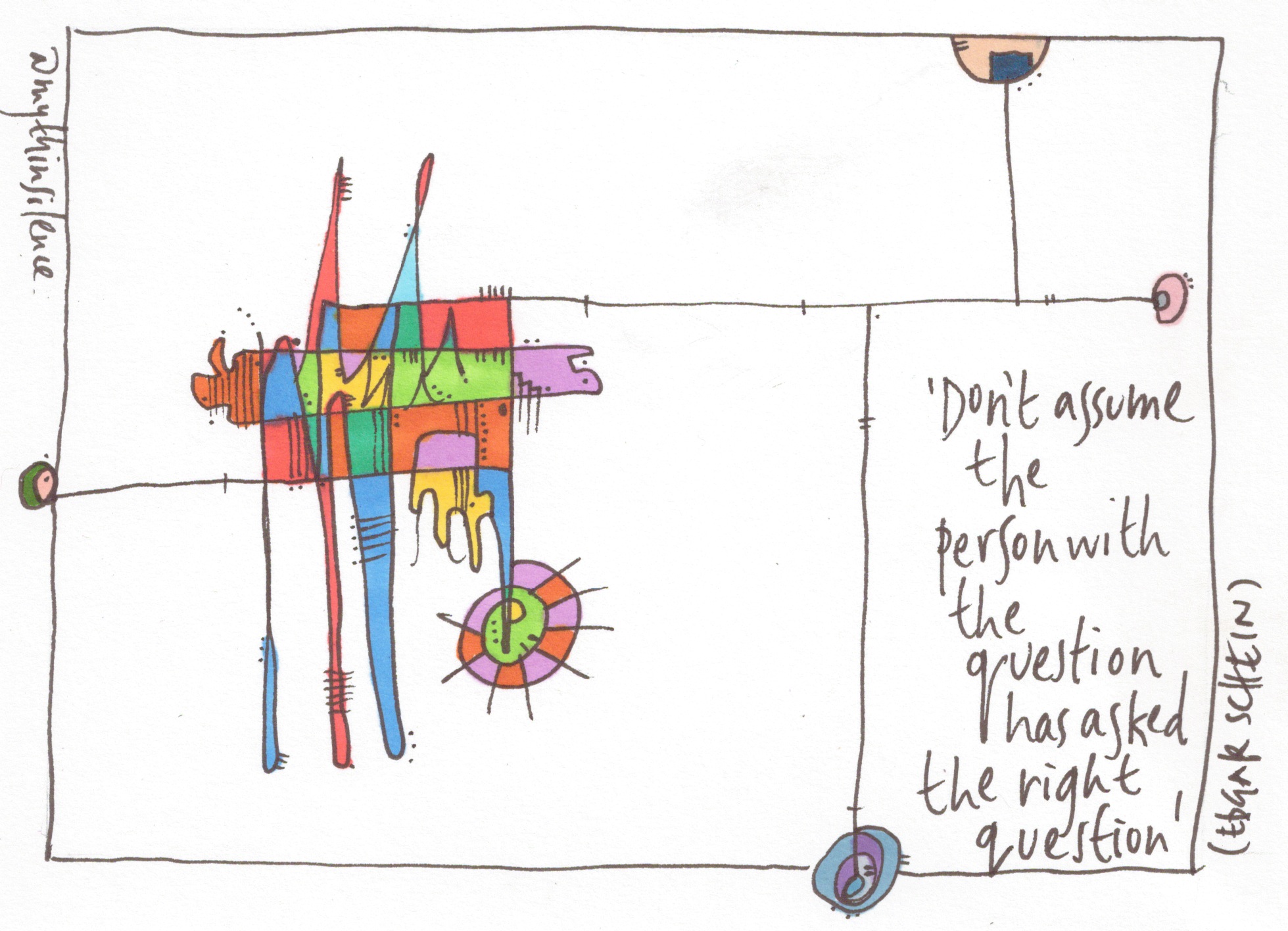
‘Many people have not found their Element because they don’t understand their constant potential for renewal.’*

Should we expect or anticipate a flow to our lives?

In concluding his book Flourish, Martin Seligman offers his Signature Strengths Test.  I was reading through the group of six knowledge and wisdom strengths (in all, there are twenty four signature strengths).  These include (in rising complexity): being curious, love learning, critical thinking,** practical ingenuity, social (emotional) awareness, and perspective (wisdom).^

When I take a new path with curiosity – whether curiosity in particular things or in all things – I discover a desire to learn more.  When I learn my thinking become better, stronger – my questions improve.  When my thinking gets stronger, creativity has a chance to flourish.

My own curiosity was piqued when I saw how Edgar Schein uses curiosity to describe his preferred way of listening:

‘Accessing your ignorance, or allowing curiosity to lead you, is often the best guide to what to ask about.’^^

This encourages me to see how human curiosity, learning, critical thinking, and ingenuity should be poured into relationships (with one another, with our planet and its many species, and with ourselves).  We stand a better chance at arriving at a different way of seeing what life can mean.

‘There’s a famous old quip: “A lot of people in business say they have twenty years experience, when in fact all they have is one year’s experience, repeated twenty times.”‘*^

Perhaps, when we develop these strengths and step out on the new path, we might find ourselves in the flow of what our life can be.

I’d love to hear what you are curious about.

(*From Ken Robinson’s The Element.)
(**Critical thinking is marked by the kind of dimensions which make Nassim Taleb’s sceptical empiricist – able to arrive at judgements whilst remaining open-minded: see The Black Swan.)

(^From Martin Seligman’s Flourish.)
(^^From Edgar Schein’s Humble Inquiry.)
(*^From Hugh Macleod’s Ignore Everybody.)

the yes campaign

18 flourish

2051.

In 2051 I will be 92 years old.

It’s also the year Martin Seligman hopes 51% of the world’s population will be flourishing – more people will be flourishing than won’t be.

1451: Florence has taken to heart the counsel of Cosimo the Elder, ignoring the militarios, who wanted to use the state’s new-found wealth to conquer, Florence ‘invested its surplus in beauty.’*

The Renaissance began.

Here’s one definition of flourishing: having high positive emotion, engagement, and meaning, plus any three from the following list:

Self-esteem
Optimism
Resilience
Vitality
Self-determination
Positive relationships.

You don’t have to have them all to flourish, you do have to have some.

I seriously question whether I’ll get to be 92 years of age, but I can determine to use every day I get to invest my surplus in beauty.

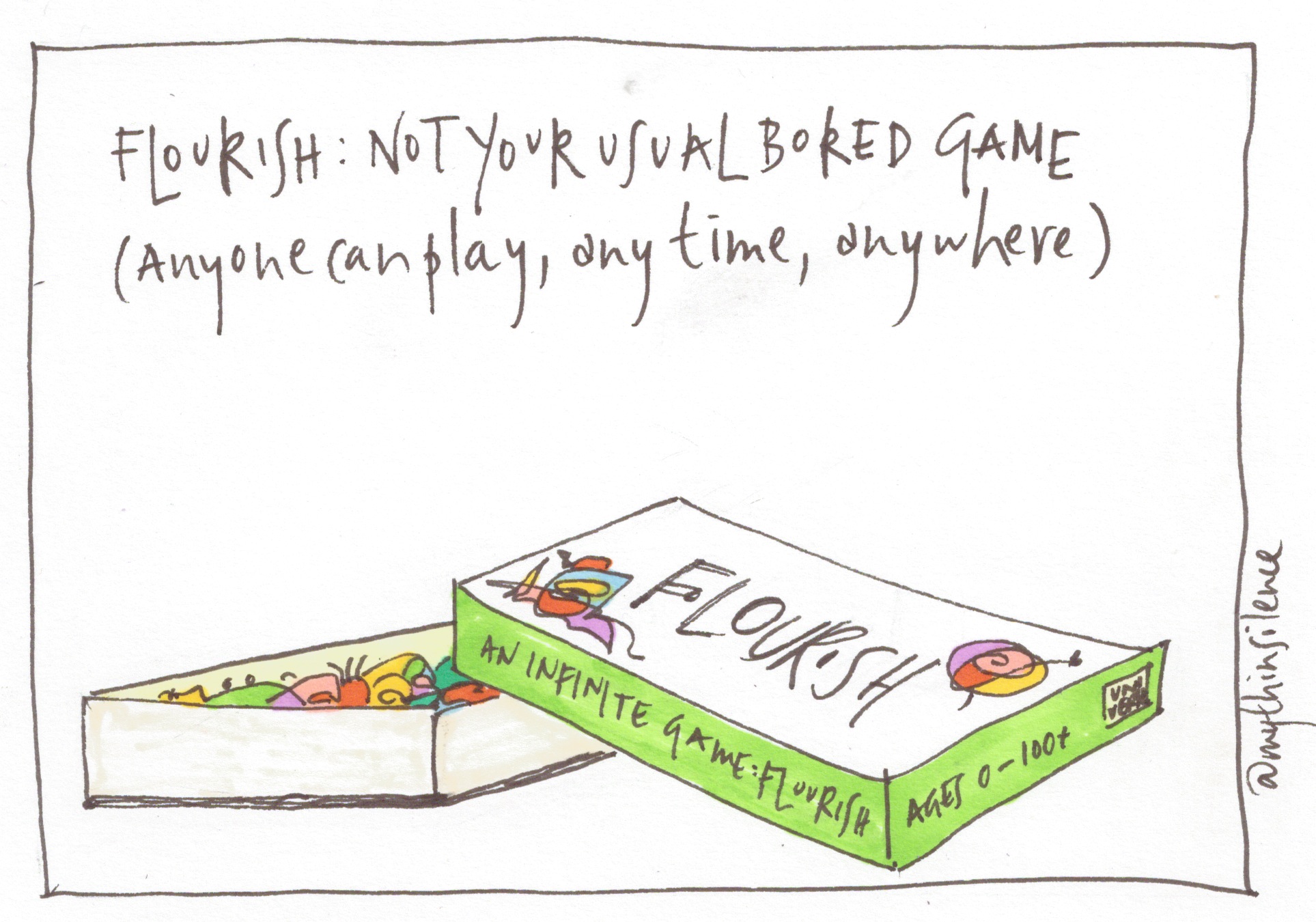
Our ultimate infinite game, measured by how many people we have participating, taking part for a lifetime, bringing their unique creativity and boldness.**

‘We can all say “yes” to more positive emotion.
We can all say “yes” to more engagement.
We can all say “yes” to better relationships.
We can all say “yes” to more meaning in life.
We can all say “yes” to more positive accomplishment.
We can all say “yes” to more well-being.’*

(*From Martin Seligman’s Flourish.)
(**I add creativity and boldness from something Mailchimp’s Lain Shakespeare offers – quoted in Bernadette Jiwa’s Difference: “When return on investment is measured by delight instead of sales or conversions, there is a lot more freedom to be creative, to be bold, or maybe even to be creative and bold.”)

tipping points

17 tipping point

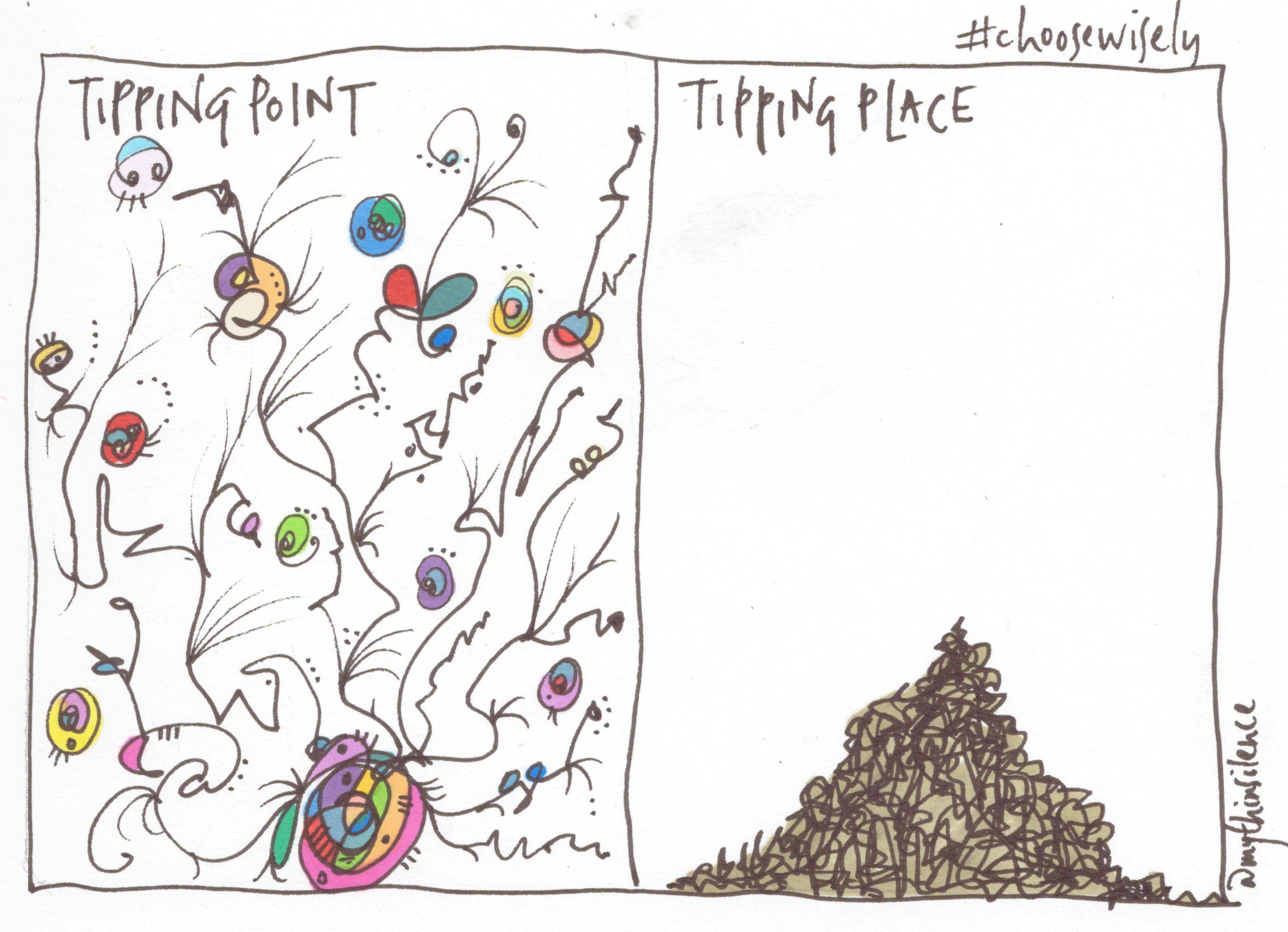
This is the phenomenon brought to light by Malcolm Gladwell in his book The Tipping Point, about how people and ideas and movements become contagious when they reach a certain mass and momentum which not be as big as we think, but is significant:

‘the very idea of a tipping point centres on the long term impact of relatively small groups adopting new ideas and behaviours’.*

These tipping points are “out there” in the macro-world of groups and organisations, but can they also be found “in here” in the micro-world of an individual, when we intentionally live each day so we may reach a tipping point in our own belongings, believings and behaviours?

I’ve mentioned before how we overestimate what can be achieved in a day and underestimate what can be achieved in a lifetime.  When we embrace the longer journey, things begin to happen.

Often, how we think about and describe our lives disguises their reality, maintaining the status quo: if we can somehow ignore or be oblivious to reality then we can get on with life as usual.

To see if this is so, here’s a reality game you can play at any time of the day in a few moments.  Infinite games (which is what this reality game is) shake things up:

‘ceaseless change does not mean discontinuity; rather change is the very basis of our continuity as persons’.**

Find a place where you can sit comfortably for a few moments, feet on the ground, hands resting by your side or on your knees, with eyes closed.  For a moment or so, bring to mind moments from the past 24 hours when you have powered up or servanted up to those around you.   Perhaps you have wanted to get your own way or think someone has made a mess of something, and you take pleasure in it.  Or maybe you’ve put yourself out so someone else could do what they wanted or you have encouraged someone because you want them to feel better about themselves.  Then be aware of your breathing, sense your breathing in filling your life with good things and breathing out the toxic; breathe in the word humility and breathe out the things it gets rid of for you.  In a final moment, be aware of your surroundings and imagine breathing out humility in words and behaviours.^

Do this towards a tipping point.

(*From Peter Senge’s The Necessary Revolution.)
(**From James Carse’s Finite and Infinite Games.)
(^There are other words which can be attached to the breathing which I’ll share sometime.)


hurry

16 to be wise

‘We notice how our breath changes with our moods, our thoughts, our body movements.  We don’t have to control the breath, just notice it and get to know it, like a friend.’*

We cannot see “what is” in a hurry.

Like the proverbial tip of the iceberg, we notice things on the surface of life and hurry on without being mindful of why this is: what it is that lies beneath the surface.

Most of all, we’re unaware of what lies beneath the surface of our lives: behind how we think, relate, and behave.

When Daniel Kahneman warns us of “delusional optimism” he’s highlighting something about our characters as well as our personalities:

“People do things they have no business doing because they believe they’ll be successful.”**

We may say “I am what I am,” unaware we can change at a genetic level.

It’s important to be optimistic.  It’s important to reach beyond what others often think is possible.  This is called hope.  We all need hope and hope is born of optimism. And we can’t always wait for someone to bring hope.  Sometimes we have to make some of our own.

Deep down within us are primal Human desires to belong, become, and believe.

Deep connection, deep wellbeing, and deep hope cannot be seen or produced in a hurry.

(*From Mindfulness by Mindfullybeing.)
(**Quoted in Martin Seligman’s Flourish.)

surprise

15 there is a difference

‘In infinite play one chooses to be mortal inasmuch as one always plays dramatically, that is, toward the open, toward the horizon, toward surprise, where nothing can be scripted.’*

There is no Human script.  Life is not theatre; it is drama.

Drama is opening, developing, engaging.  As opposed to theatrical, which is defined, scripted, observed.

Yuval Noah Harari describes our ancient ancestors in an somewhat idyllic way:

‘Foragers mastered not only the surrounding world of animals, plants, and objects, but also the internal world or their own bodies and senses.  They listened to the slightest movement in the grass … . They carefully observed the foliage of trees … . They moved with a minimum of effort and noise, and knew how to sit, walk and run in the most agile and efficient manner. … They had a physical dexterity that people today are unable to achieve … .’**

Why would we want to step outside this script?  Yet we did.  We knew there was more.  We still do.  Knowing there is more is different to saying this isn’t enough.

So, for Humans, life is drama, not theatre, and we have moved on.  The drama is asking us about whether the future lies in greater Human connectedness – something we’ve hardly begun to explore.

‘Our futures enter into each other.  What is your future, and mine, becomes ours.  We prepare each other for surprise.’*

Because life is drama, and drama is surprising, it’s hard to judge what’s right, or what should be happening, if it’s what we want or not.^  To move into surprise, we must suspend judgement – how we see and understand things – in order to enter into more.

Surprise is not easy but it’s still possible.

(*From James Carse’s Finite and Infinite Games.)
(**From Yuval Noah Harari’s Sapiens.)
(^I am not thinking about things we agree are harmful; valuing, above all, lifestyles which seek to express qualities such as love, gentleness, and kindness.)

keep going

just get some things down

I love finding ideas I can run with and explore: ideas which open up my thinking, play upon my heart, and I can turn into some new activity or behaviour.

Sometimes there’s a flow of ideas, but not today.

I decided I needed to write things down, to get them onto paper.

First of all: someone’s reflection on having concern for others.

Just about everything we get up to can be traced to, and connected with, a concern for others, so, next, a question:

How can we develop concern for others?

Then this description of humble inquiry:

‘The kind of inquiry I am talking about derives from an attitude of interest and curiosity.  It implies a desire to build a relationship that will lead to more communication.’*

I decided to change direction.

Michael Heppell encourages his readers to make a list of the things they want to be brilliant at, but adds this warning:

‘A word of warning – the level of passion, enthusiasm and the amount of work you are going to require to be brilliant will mean you need to narrow your list down to just two or three things at most.’**

Hmm, I ask people to make a list of the things which really energise them (I also ask people to make the equally important list of things which de-energise them).

A question: What about more of this in the future?

Then something fromSeth Godin.  Godin wonders whether someone trying to get the funding they needed had really “tried everything” as they’d claimed:

‘by which we mean we’ve tried a few things that everybody else has done, as long as they didn’t involve anything different from what we normally do’.^ 

I then read Heppell’s description of how he was determined to obtain two tickets for the opening ceremony for the London 2012 Olympics – it reads as if he went into training for this.**

All of this adds up to: Don’t give up.

All of this added up to some encouragement for me: Take what you are interested and curious in and keep moving it, developing it, taking it to places you’ve never been before, expressing it with people you’ve never met before, and who knows whose life you’ll change.

(*From Edgar Schein’s Humble Inquiry.)
(**From Michael Heppell’s How to be Brilliant.)
(^From Seth Godin’s Whatcha Gonna Do With That Duck?)

horizons of possibility

13 take a step

‘A “horizon of possibilities” means the entire spectrum of beliefs, practices and experiences that are open before a particular society, given its ecological, technological and cultural limitations.  Each society and  each individual usually explore only a tiny fraction of their horizon of possibilities.’*

There’s something tragic when an individual, group, or tribe stop short of what they can be and do.  When curiosity, inquiry, and exploration are truncated because of some imagined limit.

In a conversation recently, I was trying to encourage people to bring their ideas for a joint venture.  I was told nothing had come from such initiatives before.  So I tried again to describe the commitment involved this time, and was told I was wrong.

I am not right yet, but I am not wrong.  Wrong in this context says, Stop this, nothing will come of it.

Take a step, the horizon changes, take another and it changes again.

Some words from Edgar Schein caught my attention alongside all of this. Schein was describing three ways of understanding humility, towards encouraging humble inquiry.  There’s basic cultural humility, optional humility (when we place ourselves in the presence of someone who’s achieved more than us), and here-and-now humility, which means we’re dependent on someone else at some time or other because they can do something better than us.**

We’re in a time of raising the bar for basic dignity – everyone has something significant to bring; when a person believes this they need only be themselves in the presence of someone who’s achieved what they haven’t; and, when a person brings their gift, their art, their contribution to others, they lead.

To say, We can’t do this, appears, on the face of it, to recognise our true limitations, but as Harari points out, we often stop short of what we are capable of.  Humility expressed in curiosity, inquiry, and exploration moves us beyond what we have so far know as possible.  Humility is not trying to be more than we are, neither is it hiding who we are.  Humility is bringing who we are and offering it in the present.

‘It is a cause of joy when a guide comes along who can help us discern our way.’^

(*From Yuval Noah Harari’s Sapiens.)
(**From Edgar Schein’s Humble Inquiry.)
(^Robert Jonas, quoted in Henri Nouwen’s Discernment.)

hunter-gatherers

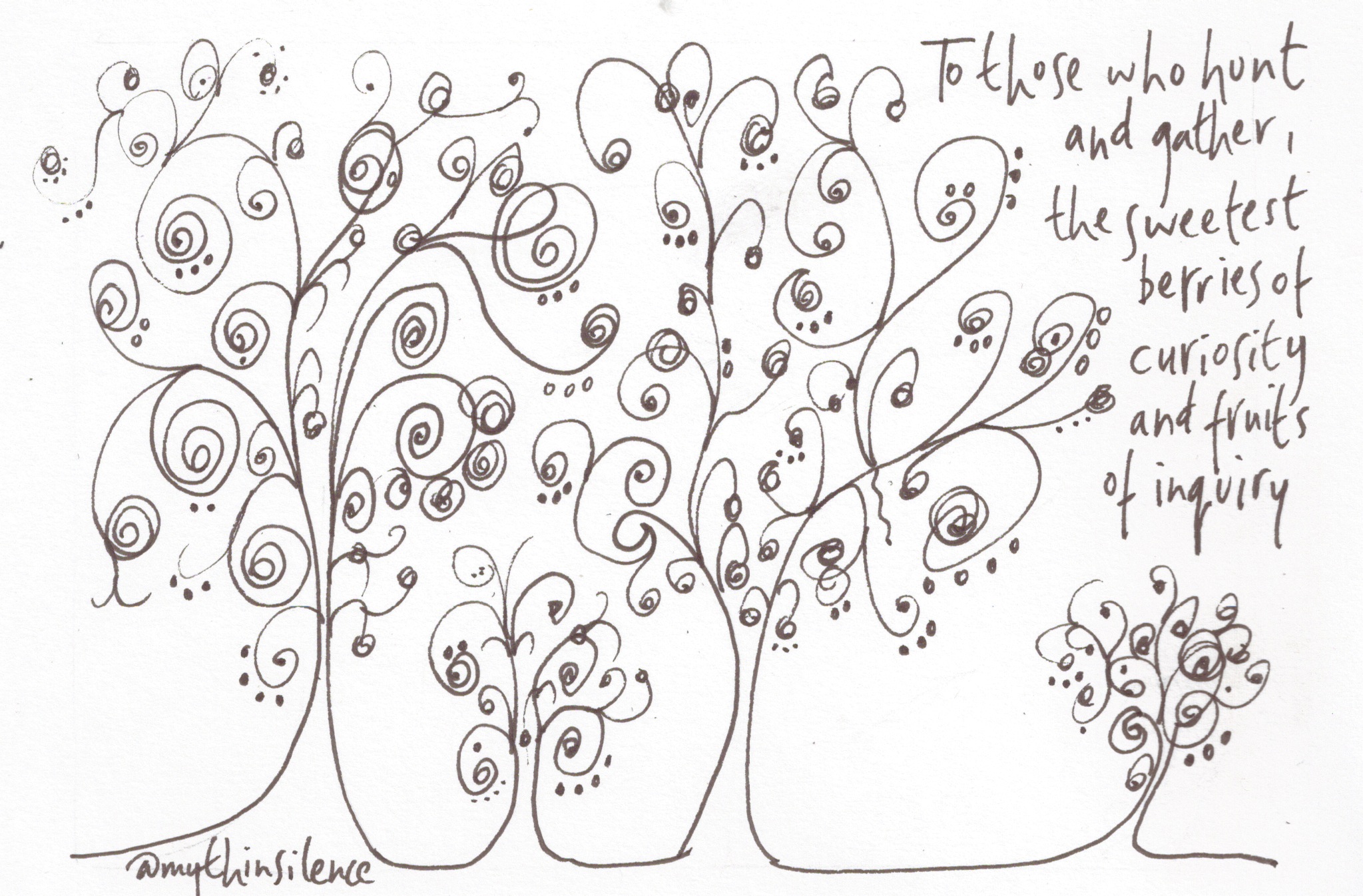
12 to those who hunt and gather

For millions of years before the dawn of the Agricultural Age Humans were hunter-gatherers.

Perhaps we miss some of this – though not the uncertainty of food and the amount of time spent hunting and gathering.

A comment on the radio this morning caught my attention.  About the rising numbers of relatively young people having strokes and the possible link with the stress of modern living.

There’s certainly a lot being written about how the most affluent generation is seeing rising figures for depression.

(I’m playing with an idea here.)

I wonder about the relationship between curiosity and asking, and healthier living.  What if we could be hunter-gatherers in a different way?  Not expected to come up with the answers, but rewarded for asking questions:

‘The missing ingredients in most conversations are curiosity and willingness to ask questions to which we do not already know the answer.’*

We miss so much to wonder about.  Every day we are presented with clues and possibilities in the happenings, meetings, situations, and conversations we find ourselves in.  To become more present is what our cognitive, agricultural, industrial, and digital revolutions have set us free for: “Liberté, égalité, fraternité.”

The infinite player lives this possibility of shaping a different future, whilst the finite player plays to get the same results as the past:

‘A finite player is trained not only to anticipate every future possibility, but to control the future, to prevent it from altering the past.’**

The infinite player opens up the future by the means of curiosity and questions, to increase wellbeing for as many as possible:

‘GDP is blind when it comes to whether it is human suffering or human thriving that increases the volume of goods and services.’^

(*From Edgar Schein’s Humble Inquiry.)
(**From James Carse’s Finite and Infinite Games.)
(^From Martin Seligman’s Flourish.)