how might we?

20 an infinite

What should we do?
What can we do?

Both these questions are good but have limitations.

What may already be assuming there is a single answer.  Should presumes we know what we ought to be doing.  Can focuses on our resources as we see them in this moment.  We is possibly a limited group of people.  Do anticipates action, sooner rather than later.

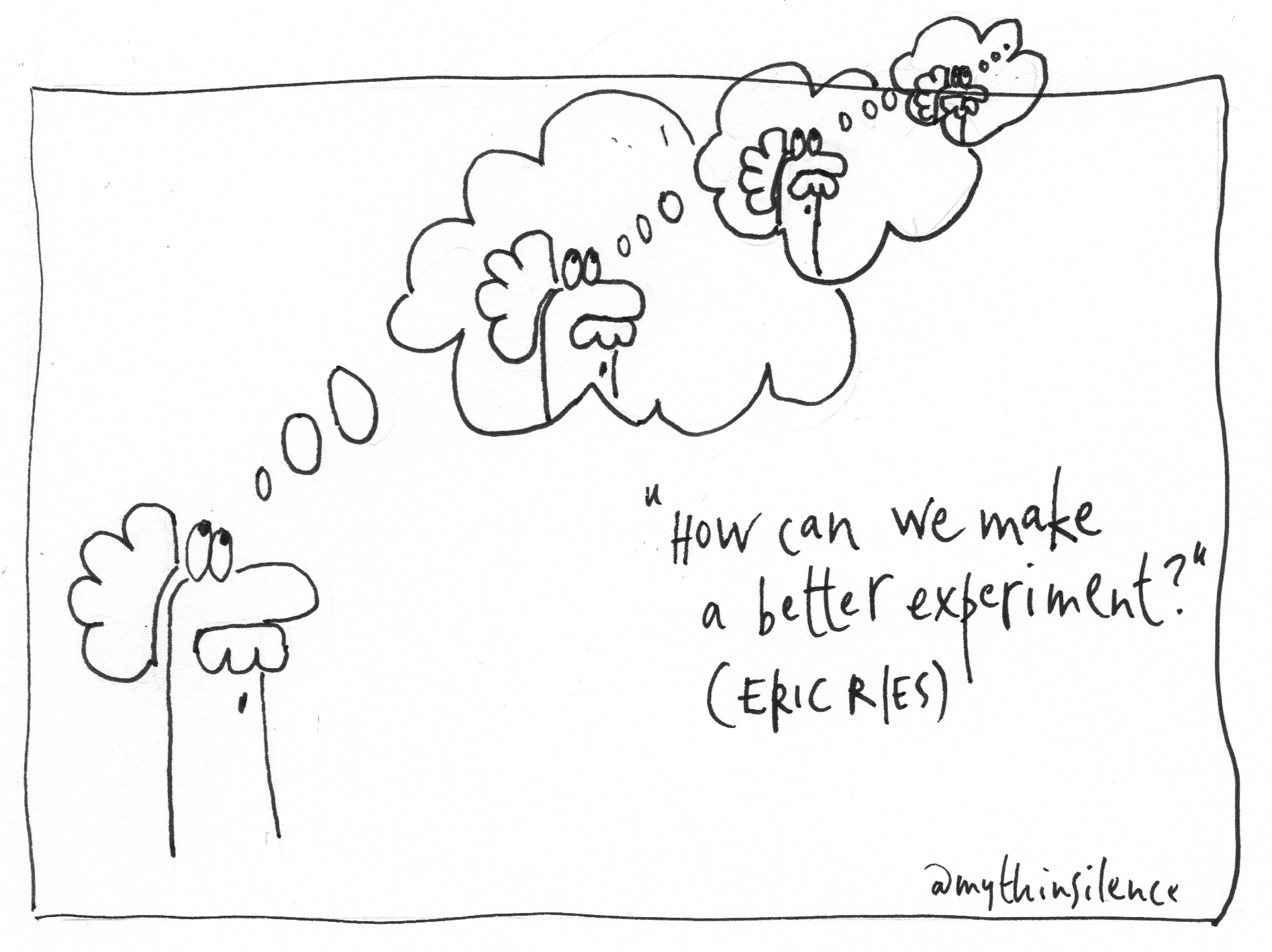
Perhaps I’m overcooking these questions but, in comparison, here’s the power of the question: How might we?

To ask how opens up the possibility of more creativity.  Might allows ideas which may or may not work to be offered up.  And there’s we, again, but, as part of this question which has opened things up twice-over, this we likely includes more people.

“The how part assumes there are solutions out there – it provides creative confidence.  Might says we can put ideas out there that might work or might not – either way, it’s okay.  And the we part days we’re going to do it together and build on each other’s ideas.”*

Life is best when faced with questions which open it up, not close it down.  Without rulebooks and owner’s manuals, life is often more intriguing and beautiful when it emerges from messiness rather than tidiness.

‘Because change is now a constant, the willingness to be comfortable with, and even to embrace, ambiguity is critical for today’s leaders.’**

(*IDEO’s Tim Brown, quoted in Warren Berger’s A More Beautiful Question.)
(**From Warren Berger’s A More Beautiful Question.)
each person is a world

19 pleasedon't

There are as many important questions as there are people.

‘Each person’s life – each life form, in fact – represents a world, a unique way in which the universe experiences itself.  And when your form dissolves, a world comes to an end – one of countless worlds.’*

These words from Eckhart Tolle remind me of my friend Alex McManus‘s observation, about how we each have a unique perspective on life, a way of seeing no-one else has which is lost when we die.

We must dig deep to find what this might be if we believed the lie that we have no singular contribution to make.

Paypal founder Peter Thiel offers this helpful question: “What is something I believe that nearly no-one agrees with me on?”**

Many are successful who pursue something which matters very much to them.  Start-up business coach David Kashen offers what he feels is a better question: “Will this make people’s lives meaningfully better?”.^^

This is about more than what we do: it’s who we are, the contribution we can and must make, and our place in our world’s history.

If you think you’re still searching for what this might be for you, why not do something different, or ask a different question:

‘If you scratch the same way all the time, you’ll end up in the same place with the same old ideas.’^

When I open myself to what you are asking or bring, then I grow and what I must bring, develops.

(*From Eckhart Tolle’s A New Earth.)
(**Quoted in Warren Berger’s A More Beautiful Question.)
(^^From Twyla Tharp’s The Creative Habit.)

what does the world hunger for?

18 how can we

Another beautifully simple question from Keith Yamashita.*

When we’re more aware of our naturally recurring talents** (what we love to do and our lives want to do), these are great focusing questions:

‘What does the world need that we are uniquely able to provide?’^

This seeks our deeper answer.  Not the one someone else has told us.  Not the ones organisations have so often told us.  Our purpose is found where our deepest joy meets the world’s deepest need.

Instead of our response being, “Someone should do something about this!”, we wonder what we can do.  These questions open up the possibility of amazing contributions.

Coming up with a different but simple question to the ones we normally ask opens the more beautiful possibility.

‘Bold innovation, limitless generosity, and the opportunity to save a life.’^^

(*Quoted in Warren Berger’s A More Beautiful Question.)
(**By “naturally recurring,” I mean talents and abilities we’ve developed through our curiosity and intention, though not necessarily aware of.)
(^From Warren Berger’s A More Beautiful Question.)
(^^The wonderful subtitle to the book End Malaria.)

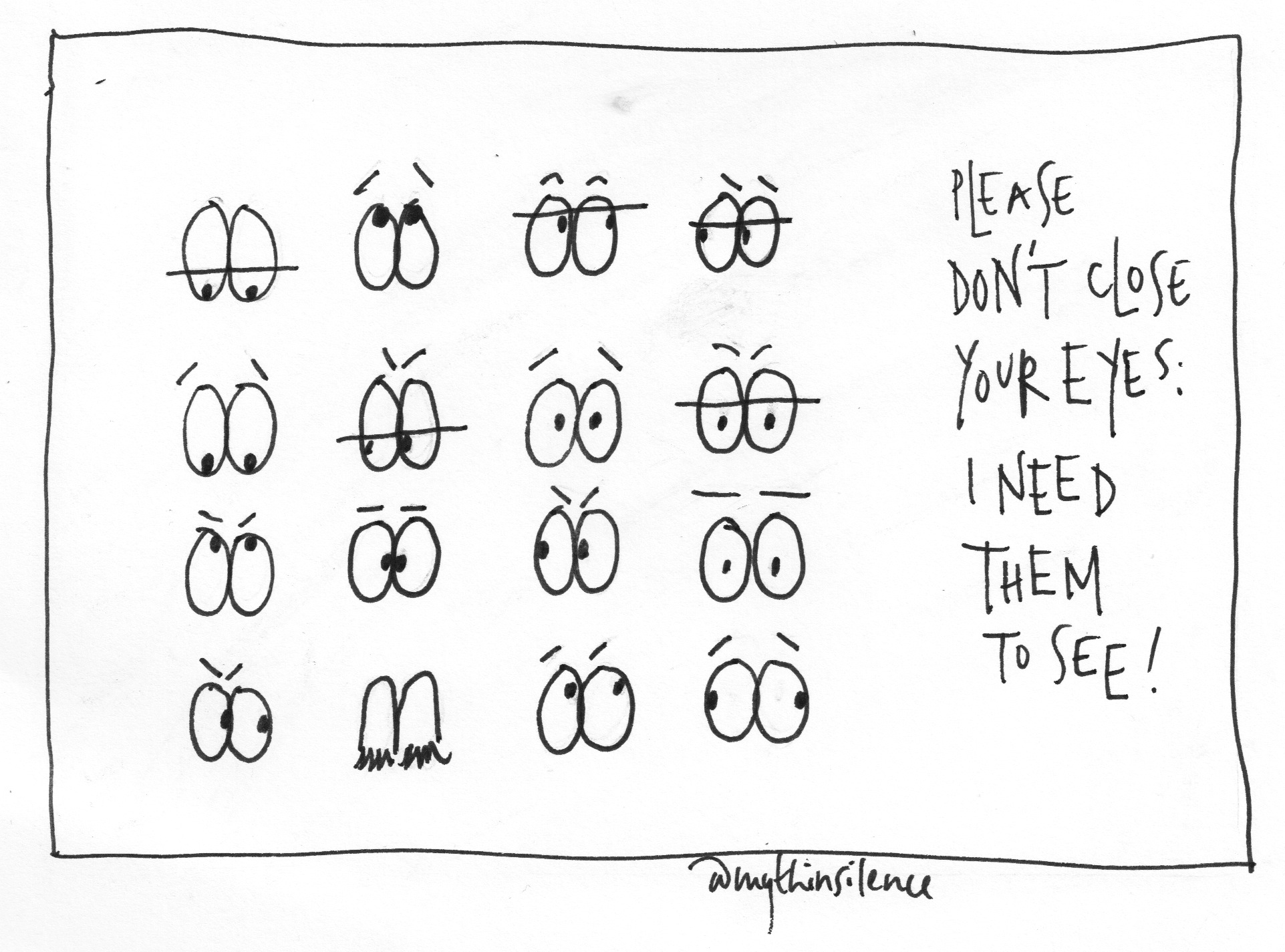
squinting eyes and wide-open eyes

17 big eyes 1

Sometimes we need to intensely focus on something or someone:

‘Other distracting features fall away when you squint, and it helps you determine what gives the object its objectiveness.’*

Sometimes, though, we need to take a big look, with eyes wide open, seeing the edges of fields and domains and people and where these intersect – where new things can happen:

‘People at the intersection, the, can pursue more ideas in search of the right ones.’**

Perhaps looking intently and closely at one thing for too long can be called a comfort zone.

Michael Heppell claims one of the characteristics of brilliant people is, they leave their comfort zone.  Perhaps, though, comfort is an illusion, being more about what we have to work hard not to see?  (Try it: look at something a few feet away, then squint hard at it and see your field of vision narrow, and notice how much effort this takes.)

James McQuivey suggests we need comfort, but also connection and variety and uniqueness.^  The larger world and truth overtakes and envelops us anyway, eventually: think about how you live your life now to ten years ago or twenty years ago.  So, why not be more intentional about this?

‘Only the whole is true, but the whole cannot be spoken or thought.’^^

(*From Sunni Brown’s The Doodle Revolution.)
(**From Frans Johannson’s The Medici Effect.)
(^From James McQuivey’s Digital Disruption.)
(^^From Eckhart Tolle’s A New Earth.)

messy is real, messy is human

16 oh dear

16 oh dear 2


Shared by one of the speakers at the event I mentioned yesterday, dealing with risk and fear and failure.

Order is an illusion.  All the time there are all kinds of forces at play; we are constantly adjusting and aligning to these, often through the contribution or work of others.*

Keith Yamashita (I offered two of his questions yesterday – slightly altered) offers two more really helpful questions.  Again, he is asking these of businesses but they work for the individual:

“Whom must we fearfully become?”
“What is true about us at our core?”**

These two questions offer us important anchors in what is a constantly shifting and more-messy-than-we-dare-to-admit world.

The first anchors in the future and what we hope to be: imagine what you’d have written on your gravestone to sum up your life.

The second identifies who we most essentially are in this moment: which is about presence.

Both involve listening very carefully to what our lives are saying to us – which we can trust when we are constantly seeking to connect with our highest values (including worldviews and gods), with others (“We are Human” before “I am Human”), the world (seeing how everything I do affects the world and vice versa); and my Future Self (who and what I am capable of).

This essential person is shaped by our relentless honesty about ourselves and what we have, and generously contributing for the sake of others.

We become the kind of people who can constantly mix things up in a world which  relentlessly asks new questions of us.  We won’t hide away in our political, philosophical, religious, or relational bubbles.  We anticipate the questions and seek to be ahead of what is happening in a lean-forward attitude, anticipating there is more hope than we dare admit.  We haven’t got anything all-figured-out but we’re willing to bring energy and enthusiasm to our primal efforts.

But we are often surprised by what takes shape in all the messiness.

(*I’m slowly reading through George Friendman’s The Next 100 Years, which is fascinating read because of what Friedman suspected will take place around the world, includwe’ve been seeing taking place in Ukraine – a constant shifting of political powers and players most of us are unaware of.
(**Quoted in Warren Berger’s A More Beautiful Question.)
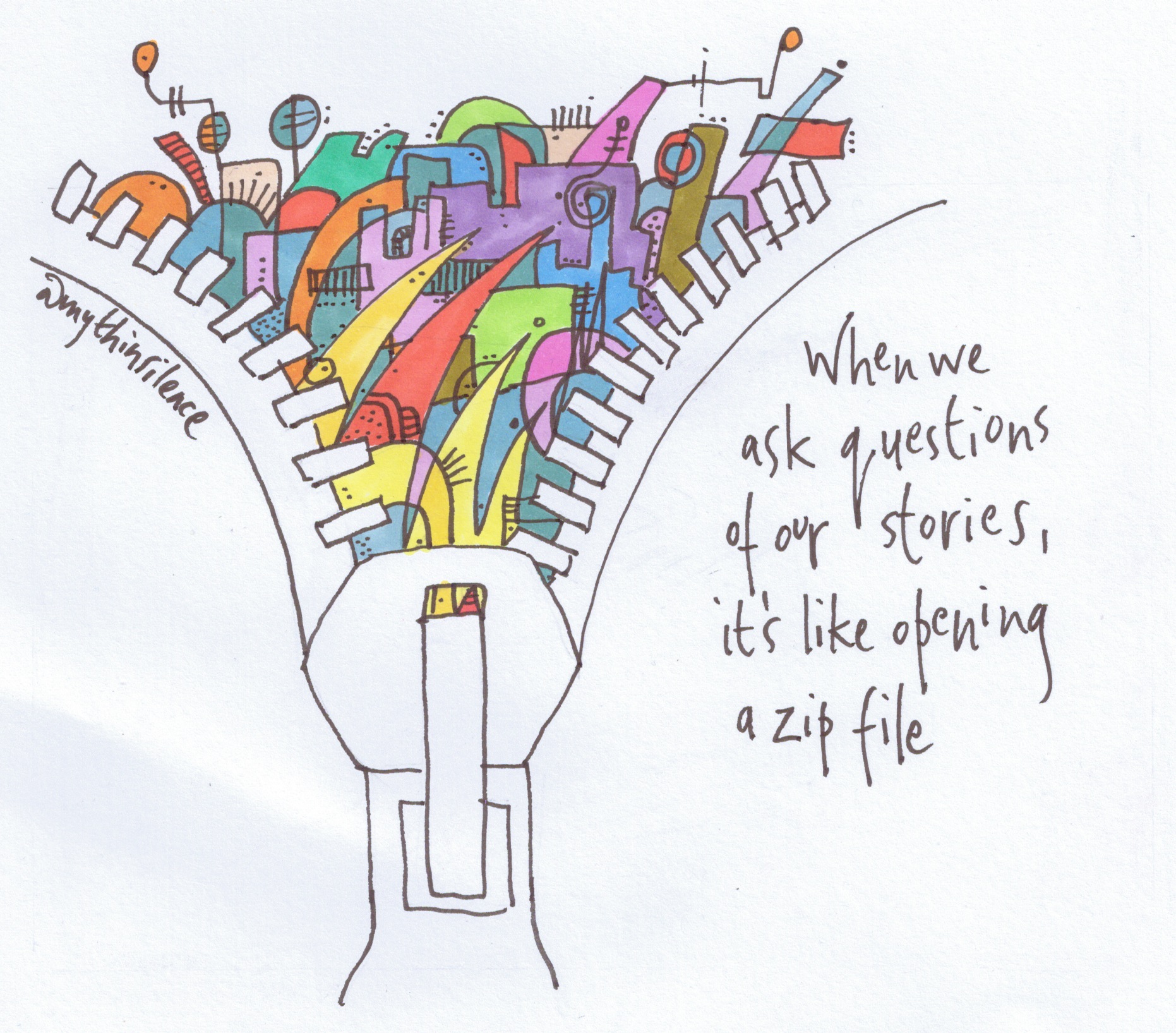
stories with questions

15 when we ask questions

Last night I listened to four people speak on how they were taking risks in being creative in their work.  Each used story in order to do this.  The audience were fully tuned and engaged throughout the evening.

My guess is we all learnt a lot, also inspired and encouraged.  I certainly made loads of notes, ending up adding some “colour” to a couple of meetings I’ve been planning.

The four didn’t share everything about how they risked – the details were often sketchy as they offered less than historical, step-by-step accounts of their work, leaving plenty of things out and rearranging their material so it worked better as story.  At the same time, I took what they shared to be a real and true account.

Story is fascinating, and I never ceased to be amazed at how it works – because it clearly does.

Our lives are immersed in stories.

There’re stories happening to us right under our noses ‘because we lack the ability to recognise them and the language to talk about them.*  The stories others appear to allow us the opportunity of looking our lives in different ways to how we normally do.  Martin Seligman writes about how some adversity (A) does not lead directly to some consequence (C).  In between A and C there are our beliefs (B) about the adversity: as it were, the stories we tell ourselves but possibly don’t recognise.**

Questions help us to dig down into these beliefs, these stories, whilst not asking questions leaves something as it is: the most dangerous and most risky place to be.

Here are two questions I’ve adapted from Keith Yamashita for you to identify elements of your story with:^

What is your purpose on this earth?
What have you historically been when at your best?

(*From Peter Senge’s The Necessary Revolution.  I’m using Senge’s words about invisible issues here as they work well when it comes to the stories which are invisible to us.)
(**From Martin Seligman’s Flourish.)
(^Quoted in Warren Berger’s A More Beautiful Question.)

we are myth

14 okay, who took the lid off

The ancients devised their myths to explain the world and universe, and their place within these.

The most important myths are not only enacted by battling gods and demigods but those entered into by real people.

Perhaps the greatest myths tell of the struggle between chaos and order.

Our heroes are not those who tell us everything is pointless and anarchic; neither those who we must focus on order and efficiency.

Our heroes are those who are prepared to step into the chaos and struggle for order.

“[W]e’re coming off a twenty five-five year posteighties period of efficiency, efficiency, efficiency.  I think the unintended consequence of that entire efficiency era is that people diminished their questions to very small-minded ones.”*

The best and highest Self we can be, is not the product of being overwhelmed by chaos, nor having everything in our lives working sweetly, but the Self emerging from the struggle to overcome the chaotic, forging perseverance – because we know the world will change again and will will have to step into the fray once more.

“Why isn’t this working anymore?” is not the cry of the clueless but the deep question from someone prepared to admit Voldemort is back and work out how to defeat the Dark Lord.

(Keith Yamashita, quoted in Warren Berger’s A More Beautiful Question.  Consider what efficiency has covered up, the “suicide machine” of “make more, faster” which means we live in the chaos of consuming the resources of 1.5 Earths.)

making sense of it all

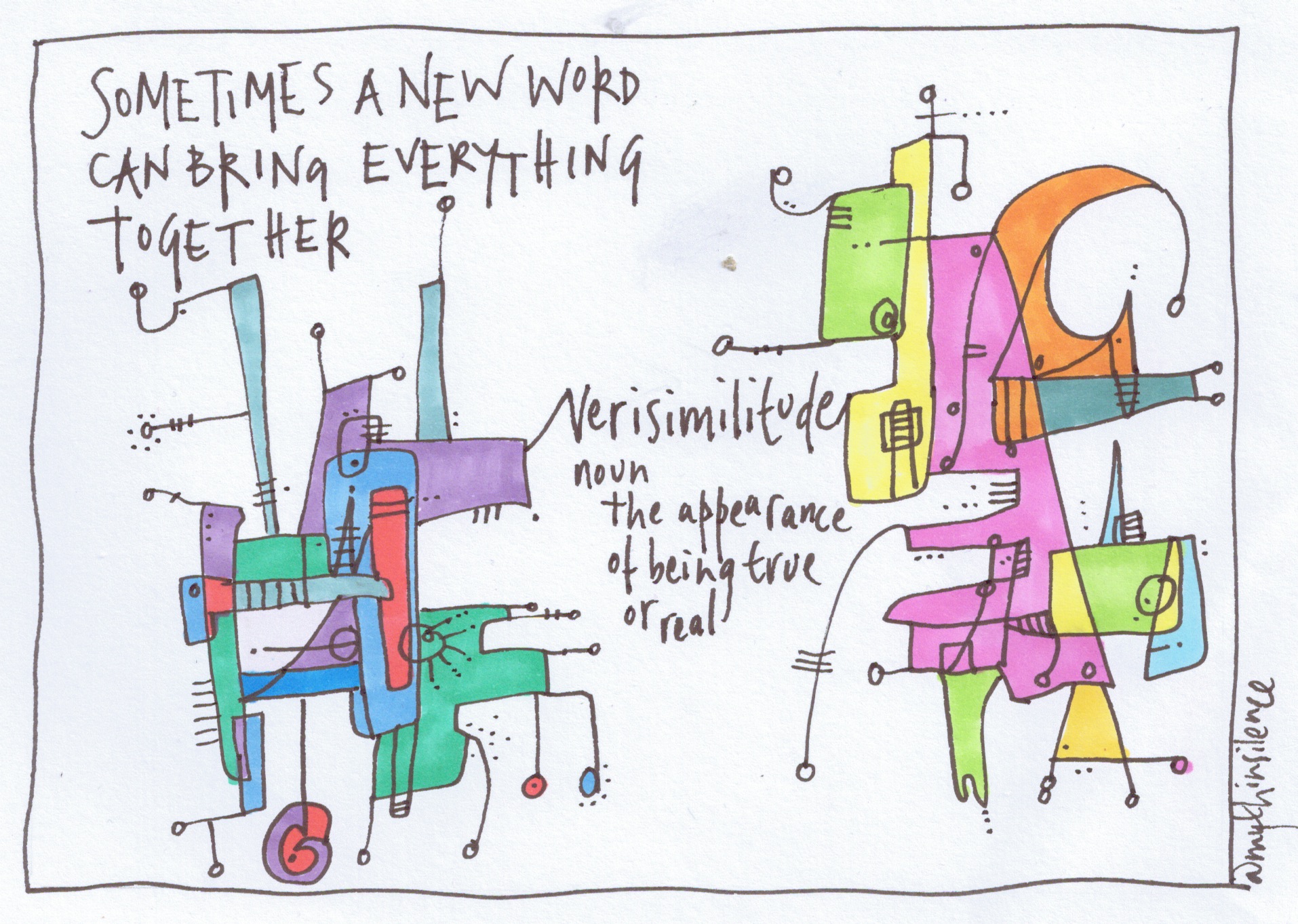
13 sometimes a new word

How come we’re here, doing the things we’re doing, wrestling with all these things happening to us?

To use Twyla Tharp’s term for finding ideas for her choreographic work, we’re scratching around through our stories to make sense of it all.  When we do, we begin to spot some possibilities for what our futures can be.

Adding a little new language can do this, making the invisible visible, or highlighting something important: a word or a phrase articulates everything we’ve been trying to figure out – and we play with it – paths open before us:

‘When you learn new responses, or any new language, you create new pathways of brain cells.’*

‘I sounds obvious, but I wonder how many people, whatever their medium, appreciate the gift of improvisation.  It’s your one opportunity in life to be completely free, with no responsibilities and no consequences.’**

Things don’t have to line up perfectly or be complete before you try out new ideas and thoughts.  Neither do you.  You don’t have to feel like it, either.

Tell yourself your story, even if it’s so far a hypothesis, and see what happens.  Talk positive to yourself and you’ll find you’re different and things are different.

Interesting, isn’t it?

‘Pleasure is way of feeling.  But joy is a way of seeing.’^

(*From Michael Heppell’s How To Be Brilliant.)
(**From Twyla Tharp’s The Creative Habit.)
(^From Mark Rowlands’ Running With the Pack.)

mission questions

12 mission questions

‘Should mission statements be mission questions?’*

Statements sound like we have everything figured out.  Maybe it’s just my love for questions, but good questions suggest futures with more possibilities.

Mission statements can be a way of saying: This is what we’ve been doing so far and we think this will work in the future.  Like stories, they tell us how we got here.

What if, instead of seeing our past stories – personally or collectively – as explaining why we’re as we are, we ask questions like: Why did I make this decision?  Why did we react in this way?

Where we are now is only one of many places we could have ended up.  The future is full of many possibilities.  Statements take us to one place.  Questions open up many possibilities:

Which of my skills do I want to hone the most?
Why am I more interested in these?
Who will help me to do this?
Who do I want to help or where do I want to make a difference?
Who could I work and collaborate with?
What new things might we need to begin?
What are my/our resources?
What do I need to let go of?

Just a few of the mission questions which begin to branch out.

(*From Warren Berger’s A More Beautiful Question.  I have to admit, I haven’t read this section yet; I really like the question.)

there’s no time like the present

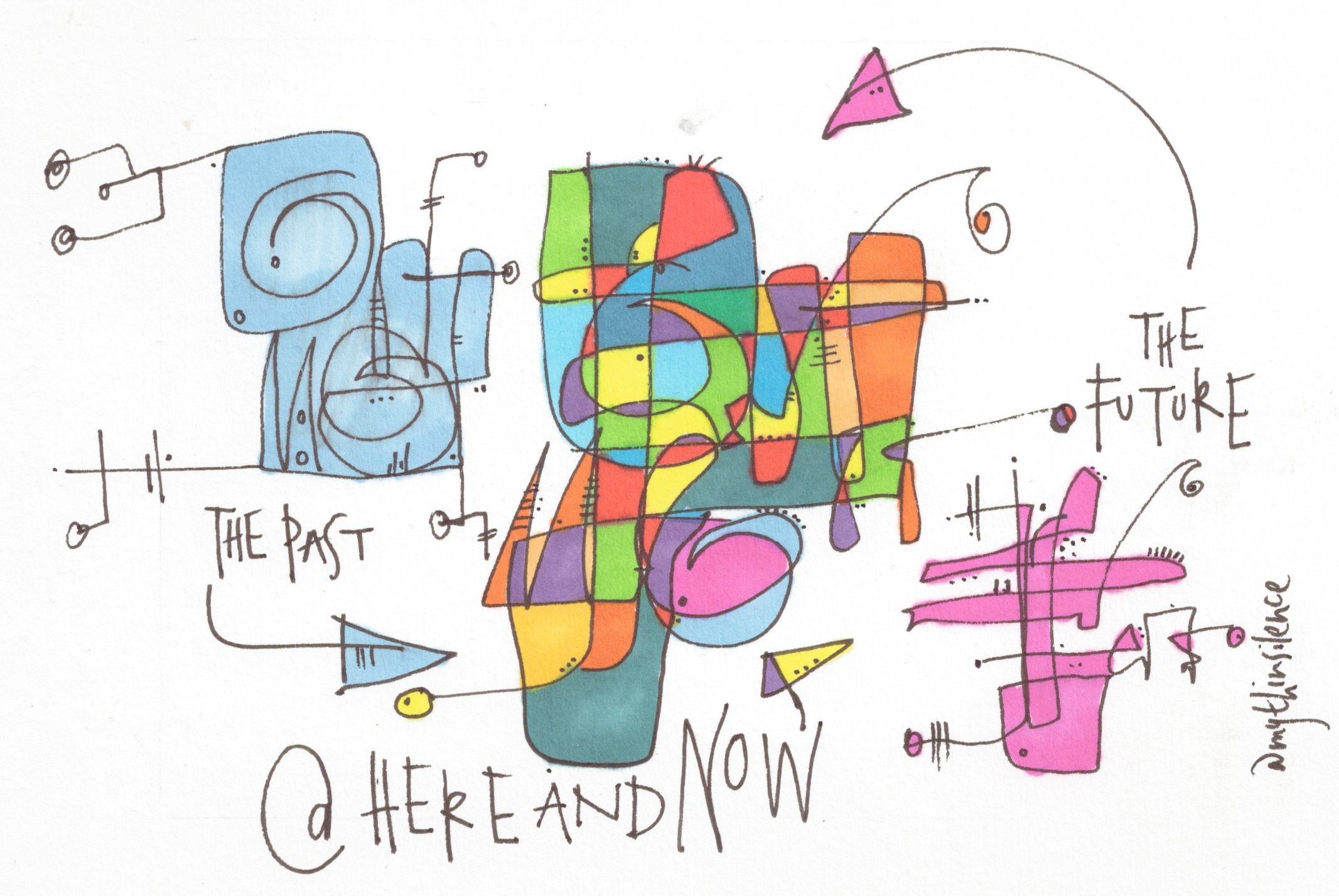
11 @hereandnow

‘There is no substitute for finding true purpose.’*

There’s no time like the present for living our purpose.  We certainly can’t do this in the past.  And the future is about imagining how to live our purpose now.

Purpose is something we’re awakened to.  This awakening takes place when our inner and outer lives align, when our dreams are given shape and form.  It includes our thinking but is more than thinking: ‘Awareness takes over from thinking.  Instead of being in charge of your live, thinking becomes the servant of awareness.’*

When this happens, my past begins to look different.  It isn’t so much messy and full of flaws and errors as making it possible to come fully to this moment of understanding, of alignment.

I realise I’m more than the total sum of my parts.  And I realise, through all those I am connected to, we are more too.

This is about what we want to be and be about now; not more of what we’ve been.  We’re more than we have been.  Imagine the significance of this for peoples who’ve been at odds with each other for centuries, when we allow our hopes for now to reinterpret our pasts, becoming the ways we have come to a better now.

This is where I want to be and where I’m scared to be.

(*From Eckart Tolle’s A New Earth.)