stories for letting go and letting come (25)

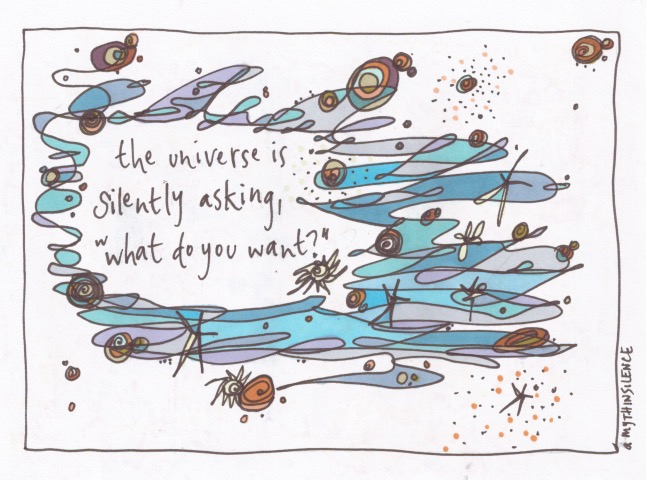
15 the universe is asking

‘There is nothing in the patient that I do not have in me.’*

We seek autonomy, mastery, and a cause greater than ourselves.

Free to live as we dream.

Doing something really well.

Living the adventure for a cause greater than ourselves.

Psychologist Erich Fromm’s remark, above, caused me to ponder whether I urge others towards a heroic path because I want to journey with them.

By hero, I mean someone who is striving to be more human – towards themselves, towards others, towards their world.

Their courage isn’t bravado but the highest form of humility – knowing themselves, they believe they can grow exponentially.

I’m making this up.  It’s a story, but it’s one story among many.

We tell ourselves political stories, economic and humanitarian stories, love stories and hate stories.  Our stories are how we make sense of the disorder of life.  Paradoxically, the best stories are not easy ones: ‘The path of least resistance is a poor teacher.’**

The best stories are full of questions – questions asked of us and questions we ask of life.  And to ask questions, we must let go of our answers.

(*From Erich Fromm’s The Art of Listening.)
(**From Ryan Holliday’s The Obstacle is the Way.)
stories for letting go and letting come (24)

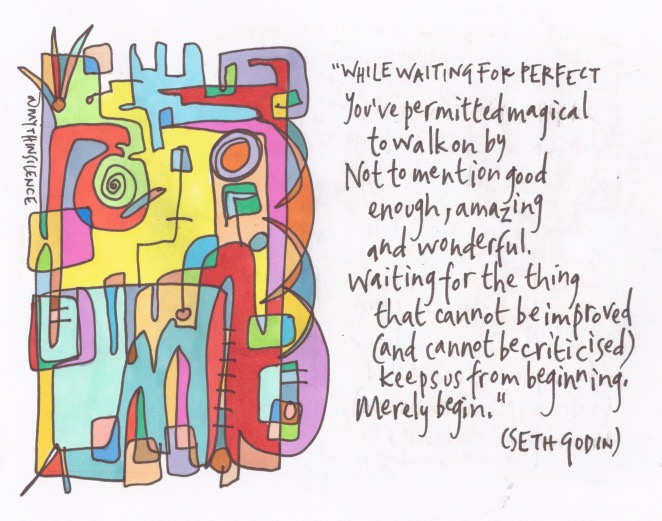
14 while waiting for perfect

There’ll be something which captures your attention and intention more than anything else.  Around this lies the possibility of bringing your creativity and generosity in the form of beauty and goodness.

Yesterday, I met with two others to plan something which will provide a space for people to find their “voices.”  Towards this, two of us were helping the other to imagine what that something could be, and it felt like Richard Rohr’s description of ‘authentic soul friends … Guiding the soul across all the scary borders.’*

If you’re pursuing the right things for you at the right time, for the right reasons with the right spirit, then you’re you’ll be able to move adeptly towards the future – such poise is important because the future is tricky.  So here are a number of future-orientated skills to develop – and better together:

Anticipation, opening us to more, often whispers from the future
Reflection, allowing us to think deeply about what we’re discovering
Imagination, making it possible to see future possibilities
Synchronisation, connecting deeply with what is possible
Design, playing with possibilities sooner rather than later.
Creation, shaping something of beauty and goodness which responds to what was first anticipated.

(*From Richard Rohr’s Falling Upward.)

stories for letting go and letting come (23)

13 no matter where

We’re always on a journey from brokenness to wholeness, from disconnection to connection, and from giving up to keeping going.  So, this may be the twenty third story for letting go and letting come, but it’s about taking care of the basics – something we can never lose sight of.

Pixar’s Ed Catmull uses the phrase “the Beast and the Baby” to describe the need to keep creating stories that feed the movie system as well as the original new ideas which lead to films that tell great and inspiring stories.

It’s not as simple as saying the beast is bad and the baby is good – a beast can be trained and a baby may never mature.*

This left me thinking about how there is a beast and a baby in each of us.

The beast is the every hungry me with all kinds of cravings, and the baby is the potential me, who I can become.  Cravings are not bad in and of themselves but it’s about how I feed them.  And I have to remember, I have hopes and aspirations which I need to give shape to as well.

There are basic things we train ourselves to do in order not to let the beast have its way.*  Choreographer Twyla Tharp describes her daily routine: shower, dress in her gym clothes, call a taxi cab, and then two hours in  the gym at the beginning of the day.

Her creative habit was not the two hours in the gym, however.  It was more basic than that – it was calling the cab.

The difference between foolishness and wisdom are the faithful habits and practices we shape so avoid overfeeding the beast, making it possible to develop the baby.

(*Dan and Chip Heath’s Switch makes interesting reading: the brothers picture our thinking and behaving as an elephant, rider, and path.)


stories for letting go and letting come (22)

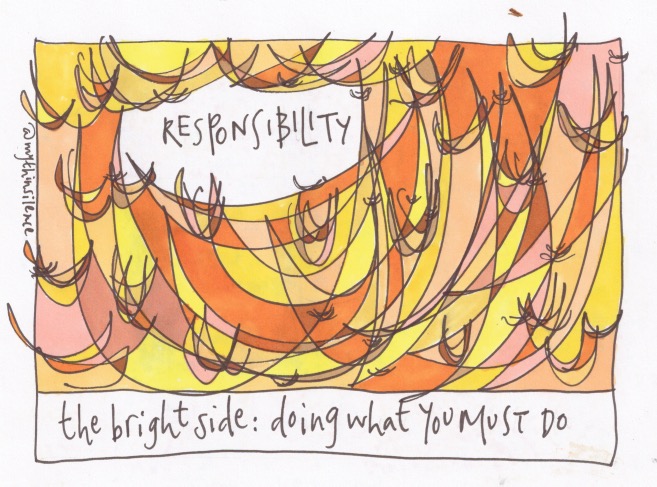
12 responsibility

‘Freedom is not something we have; there is no such thing as freedom.  Freedom is a quality of our personality: we are more or less free to resist pressure, more or less free to do what we want and to be ourselves.  Freedom is always a question of increasing the freedom one has, or decreasing it.’*

‘Will is the discipline of the heart and the soul.  The will is the one thing we control completely, always.’**

There’s something you must do.  Don’t sit back for someone else to do it, or for someone to give you permission.  Taking hold of this will lead to both your growth and fulfilment, and will bring goodness into the world.

You must take responsibility.

Responsibility does have a dark side.  Taking on too many things others ask of us – because we’re responsible people –  can lead to angst and guilt when we take too much on, and not leave any time to do what we should be doing.  (I’ve been there and done that.)

The responsibility I’m thinking about is the kind that takes firm hold of what it is we MUST do and does it.

And when good things happen, we don’t say, “It wasn’t really me … it was someone else … it was god.”

No, it was you.  Take full responsibility.

When you do, you’ll not only do some amazing things – all kinds of things – but you’ll also grow because of it.

(*From Erich Fromm’s The Art of Listening.)
(**From Ryan Holliday’s The Obstacle is the Way.)

stories for letting go and letting come (21)

11 everyday opportunities

We are born to a heroic adventure.

Not the Hollywood, CGI’d kind, nor the one that closes with a Disneyesque Happy Ever After.

It’s the kind which invites us to explore what it is to be human.

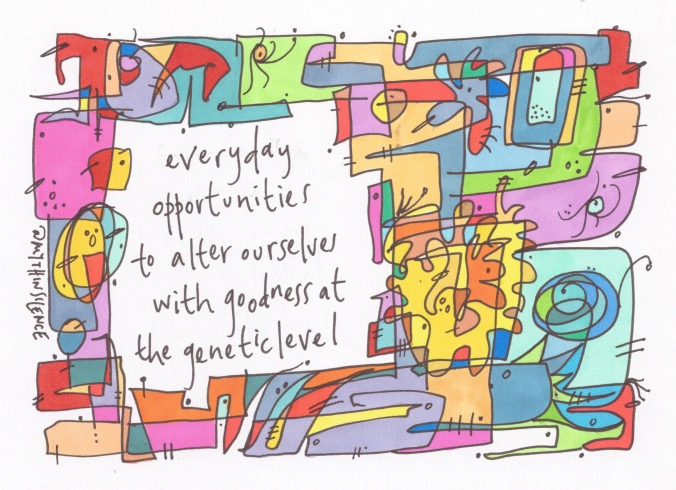
On a macro-level, human craft and creativity makes it possible for us to step outside of natural selection and survival of the fittest.  There appears to be nothing we cannot do as we stand on the brink of altering ourselves at a genetic level and contemplate colonising other planets.

Whilst there are attempts to curb these kinds of research and development, it’s hard to see how such a trajectory can be halted.

The challenge and question is about whether we will continue to explore living selflessly, generously, and wisely.

On a micro or personal level, we get to focus every day on the things which capture our attention.  We get to be divergent with these, developing something that is different to, and not a copy of, what others are doing.

As well as this craft and creativity, we also get to practice being people who bring qualities like love and joy and peace and patience and kindness and goodness and gentleness into the world.

stories for letting go and letting come (20)

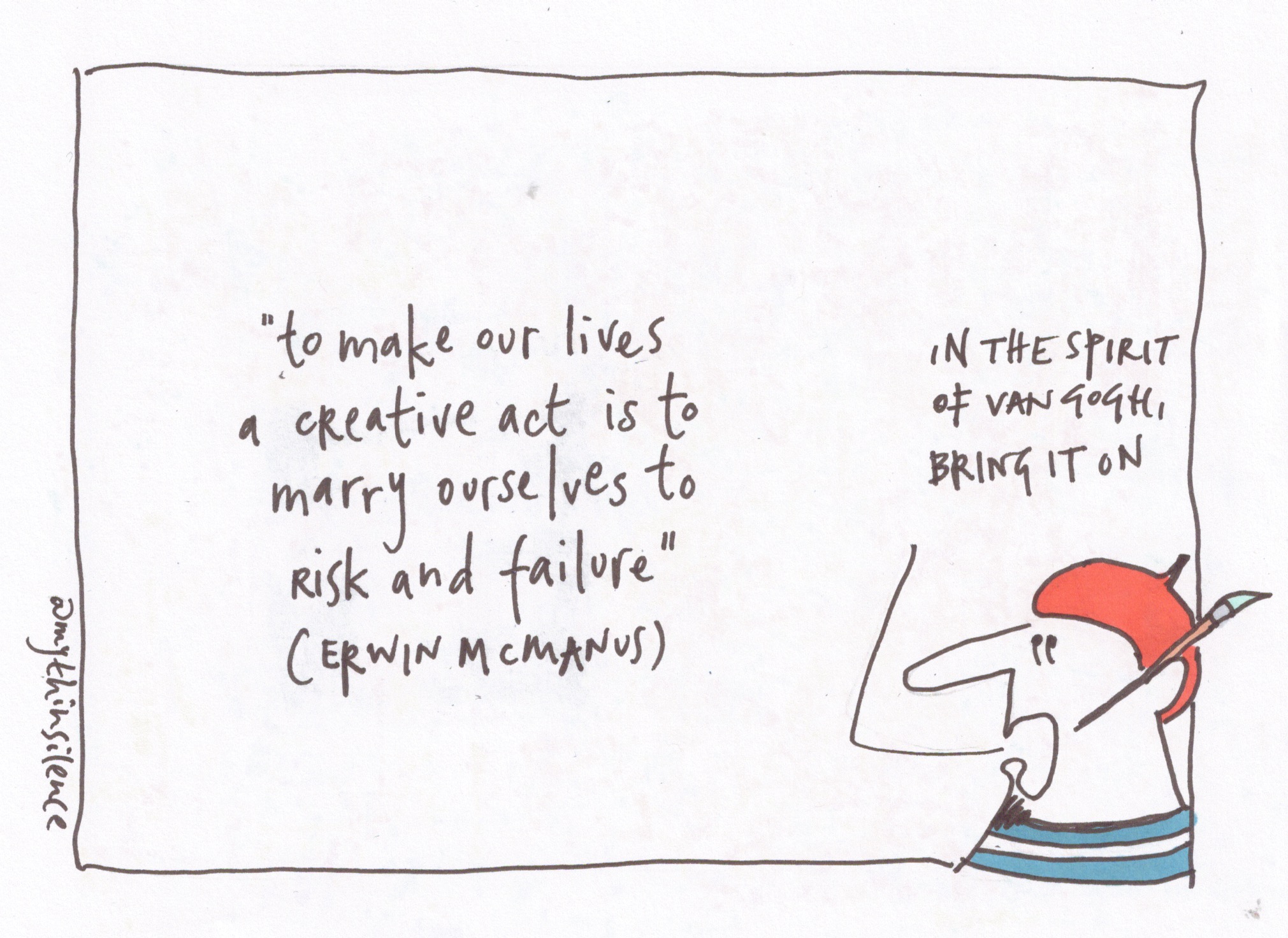
10 in the spirit of van gogh

‘In every situation, that which blocks our path actually presents a new path with a new part of us.’*

Surely being powerful means removing the obstacle.

“Traveller, there is no path, the path must be forged as you walk.”**

I’ve changed my mind.  Finding a new path sounds more powerful.

True power comes from within, from integrity.  We trust people who have integrity.  Being an integrated person means we can trust ourselves to make the path, too.

The hero in this story is the person who falls through what they thought their life was about to something deeper.  She finds there’s more to who she is and allows the journey to change her – finding new parts or facets of her life.

‘The hero or heroine is by definition a “generative” person.’^

The ability to generate comes from knowing who we are and what we have, and making this available to wherever we can.  All we are comes together as one, we realise this is enough, and with that, we are willing to move: to make, to give, to do, to will – to shape the future.

‘Will is our internal power which can never be affected by the outside world.  It is our final trump card.’*

(*From Ryan Holliday’s The Obstacle is the Way.)
(**Antonio Machado, quoted in Brené Brown’s Daring Greatly.)
(^From Richard Rohr’s Falling Upward.)

stories for letting and letting come (19)

9 the best way

‘[T]he process of living itself, if you please, is a work of art, as a masterpiece of anybody’s life, holds the optimal strength and growth, and which in his life is the most important thing.’*

Every life contains a world of stories.  Stories lived and stories neglected, and potential stories too.

Though we may have chosen what we now think of as the wrong stories – the ones which satisfied us for a moment, or that pleased someone else – there are still more stories to choose from.   The alternative may be to live with a low-level discontent. It seeps into how we think about and talk to people, how we get up in the morning, the ideas we have and what we’re prepared to say yes to, and what we daydream about.

The right story allows us to “Enjoy now.”**  This word always reminds me of creativity and generosity, from which enjoyment is a product.  Erich Fromm identifies how people ‘want to live happily without know how to live happily’.*

But living happily is an art and we can all learn it.

‘In such a [well-being] culture the main purpose of life is the full development of man and not thing and not production, not wealth, not riches.’*

We know the achievement of these things, in and of themselves, doesn’t make us better human beings.  But to seek integrity, that is, an integrated life with ourselves, with others, and with our world, leads us to the stories we want to live, stories with courage and honour: works of art and masterpiece stories.

(*From Erich Fromm’s The Art of Listening.)
(*From Gretchen Rubin’s The Happiness Project.)


stories for letting go and letting come (18)

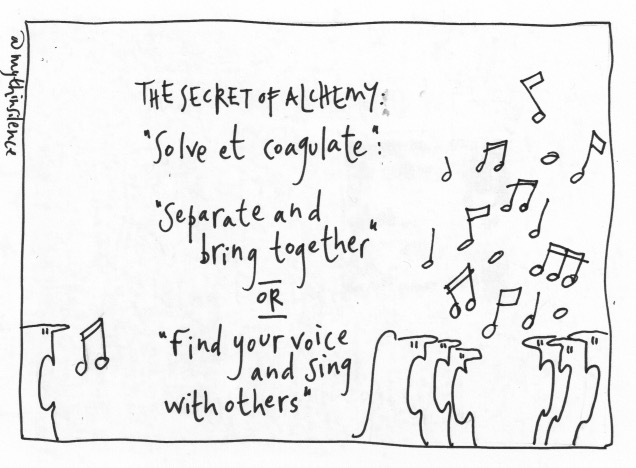
8 the secret of alchemy

‘But wouldn’t it be amazing if we could somehow encourage acts of greatness?  No order them, but create an environment where people feel they can embrace the superhero within and achieve great things.’*

Such environments would build on the best from our past and be stronger than the worst moments.

Spaces like this connect and reconnect us to our story: ‘the human mind was shaped for story, so that it could be shaped by story’.**

When we lost sight of our story, or we don’t believe we have one, we experience the “uneasiness” Erich Fromm observed in twentieth century Western society when he was speaking as a social psychologist, which we might also say, characterises ours:

‘No symptoms at all, but feeling unhappy, strange not even sleeplessness, life has no meaning, no zest for life, drifting, a feeling of vague malaise … people suffer from themselves … . Nobody who suffers from the malaise can be successfully analysed without a radical change and without  a transformation of character,’^

Richard Rohr would see our first attempts at creating our story as identifying our ego – in order that we might ‘let go of it and move beyond it’.^^  We’re not strong in our ego, though, but in our true Self.  Our ego has a victim part which Eckhart Tolle names the “painbody,” the part of us that wants to be offended, and, in extreme cases, wants to be offended in order to affirm its view of the world,*^ but, to go back to Rohr:

‘The True Self … is very hard to offend.’^^

We find ourselves in order to let go of ourselves by entering into the eco (from oikos, the whole house), into company (originally, those with whom we share bread).

Others not only help me to see what I’m doing badly and what I shouldn’t be doing, but, also, what I should be doing.

(*David Marquet in 99U’s Make Your Mark.)
(**From Jonathan Gottschall’s The Storytelling Animal.)
(^From Erich Fromm’s The Art of Listening.)
(^^From Richard Rohr’s Falling Upward.)

stories for letting go and letting come (17)

7 stories to connect

I met Rick briefly eleven years ago.  He’d made himself available to escort and look after Chip Anderson – the man who was to open my eyes to my talents and set me on a path to developing dreamwhispering.  Chip was living with cancer and Rick was going to make sure he was cared for throughout the day.

Erwin McManus writes of Rick Yamamoto:

‘He became living proof at individuals of great power can live under submission.’*

What I didn’t know about Rick at the time was that he was responsible for a two billion dollar investment company.

‘Humility gives us the mobility to adapt to whatever context we are placed within.’*

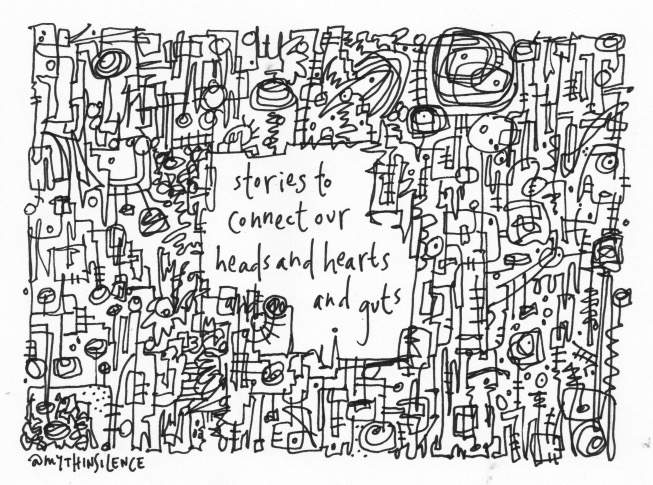
This is a story about developing human capacity.  The best stories, like myths, operate at the soul level: ‘not always true in particular but entirely true in general … they hold together the paradoxes that the rational mind cannot process by itself’.**  When we focus on the intelligence of the mind we can forget there’s an intelligence of the body and heart, too.   Together, these form the whole me or, as some would say, my soul.

Here is the power of story for our lives.  They provide a vessel for more than our minds and our ideas.

This morning, I had a choice of waiting for a little while for a bus or to walk on a number of stops to where I could look over the city where I live.  So, I walked on so I could enjoy looking over the city in the cold Spring sunshine, realising the wow I felt was not in my head but in my chest.

Stories help us to sense and make sense of the whole.

(*From Erwin McManus’s Uprising.)
(**From Richard Rohr’s Falling Upward.)

stories for letting go and letting come (16)

6 submission

submission

səbˈmɪʃ(ə)n/

noun:
1. the action of accepting or yielding to a superior force or to the will or authority of another person.”they were forced into submission”

2. the action of a skillmaster who submits her mission to the fulfilment of the mission of another

Submission is a skill of heart and mind which, when sought and mastered, offers everything we are in service to another so their life mission can be achieved.