the second way

28 curiouser

“We all have but a short time on this earth.  As slow as time can be it is also fast, swift, furious and might, and then it’s over.”*

“If I were to wish for anything I should not wish for wealth and power, but for the passionate sense of what can be, for the eye, which, ever young and ardent, see the possible.”**

We can live out our days, or …

We can live out our days with passion.

Pursuing the thing we feel MUST do with out lives is easier than we think, and that’s the scary thing about it.

In Alice’s Adventures in Wonderland, Alice is intrigued to see a talking and clothed white rabbit, and follows him down a rabbit hole.  She suspends her disbelief in order to follow what she is seeing.  She doesn’t know how deep the rabbit hole is but once inside there’s no going back.  Lewis Carroll must have written this story just for us.

Living with passion is about noticing our curiosity and pursuing it.  At first this will mean we have to suspend our belief and disbelief to find ourselves “falling slowly” enabling us to notice more and more about what is all around us.  We’re falling and full of questions, and we have just begun.

Alice’s curiosity focused on a white rabbit.  My curiosity focuses on the potential people have to live amazing stories.  What’s yours?

We can live out our days, or we can choose the second way.

(*Photographer Thomas Hawk, quoted in Chris Guillebeau’s The Happiness of Pursuit.)
(**Soren Kierkegaard, quoted in Rosamund and Benjamin Zander’s The Art of Possibility.)

holes and walls

27 if we turn up (colour)

The future is deeper than we know – a rabbit hole of possibilities.

Two people can look at the same thing, though, and one sees a rabbit hole, while the other sees a wall.

I don’t know where the rabbit holes will lead, I don’t know how deep they will go.  I only know I am getting to see some amazing things and meeting some remarkable people, and trying a few new things along the way.

Possibilities are what they are.  Randomness, as the way the universe is, will determine the number of possibilities there are.  Our curiosities and beautiful questions will not only determine which holes we find, but will also ensure we’re more likely to turn up when they appear.  Then it’s all about how we see them:

“I can’t go there,” or

“I wonder where the rabbit hole goes?”


the way things are

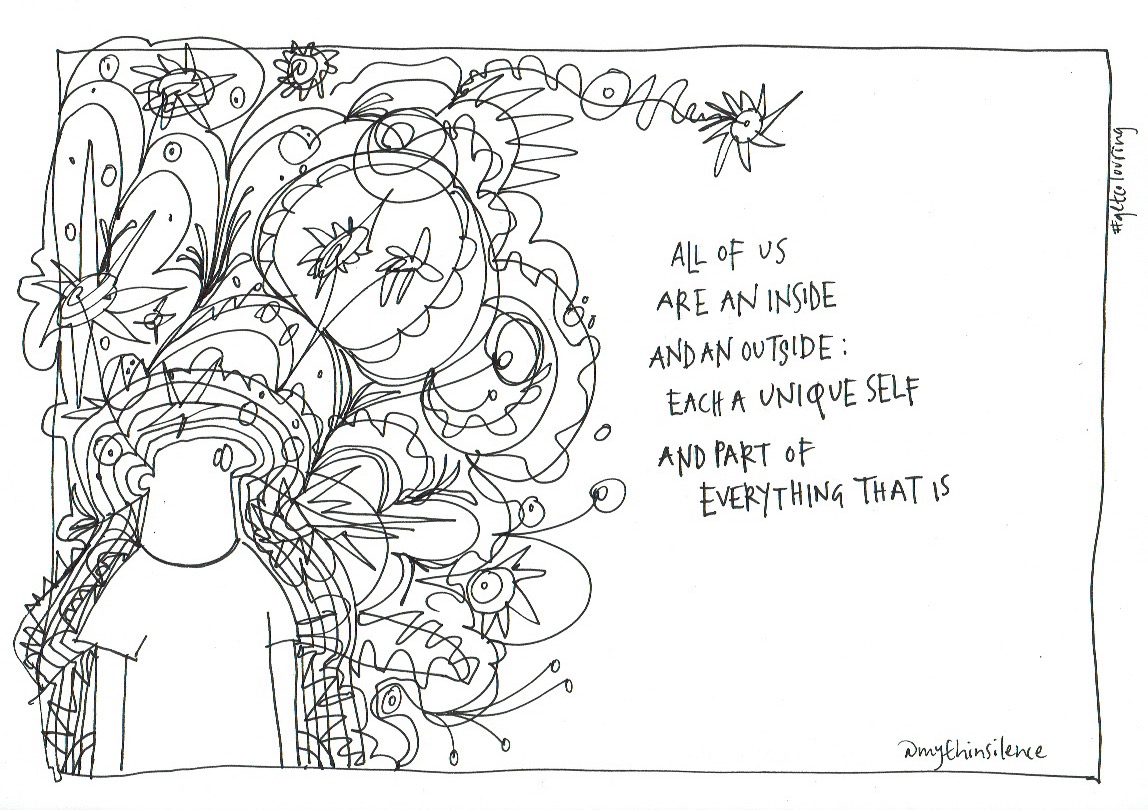
26 doodling inside

‘[T]he capacity to be present to everything that is happening, without resistance, creates possibility.’*

How many times have you heard heard or talked about “out of the box thinking”?

There’s a lot of value to thinking outside the box.  It implies we’ve defined or designated the box, which often is not the case.  When we do this, rather than resisting the box or trying to escape it, we can find more comes into view that was previously invisible.

We can take someone’s life as an example.  Many people think the have to escape their lives in order to follow their dreams, when maybe all they need to do is to notice more of what is already in their lives.

Being present is really just noticing more – without barriers – to the people around us, the world in which we live, and absolutely to our own lives.  When we do, from the way things are, more happens.

26 doodling inside (colour)

(*From Rosamund and Benjamin Zander’s The Art of Possibility.)

undivided heart

25 when i listen

‘The fact is that most of us are half asleep while we believe ourselves to be awake.’*

Some lives never identify their unique voice.

More than twenty years ago, I was lost in the general, feeling – though, I didn’t know what I was feeling – there had to be something specific.

It is from the specific that we come to ask our beautiful questions.  And the most beautiful questions are always disruptive ones.

There are some who appear very clear about what they must do in their lives, but the test is whether they remain open to, and are changed by, the new and the unknown.  The wide awake life is both specific and permeable, resulting in flow.

Inasmuch as this flow life works, we’re able to say the universe is amenable to it.

(*From Erich Fromm’s The Art of Listening.)

living the dream

24 the dream

Though many dream about a different life, sadly that is what it remains – a dream.

I don’t mean dreaming opulence, sunshine days and open-top car, drinks on the beach.  Rather, it’s the dream that frames our sense of deep purpose and meaning.  So, how do we live present to this dream-wide-awake life?

It’s important to be moving – not only reading and imagining.  We also need to identify others who can help us – specific people who’ll give their time and help us move forward.  And we need to make attempts – to prototype things.

When we move, the dream sharpens.  Holding a dream for many years means it never gets the chance to grow up.  But moving with it will find it changing and growing and gaining an identity to excite and stimulate us.  This is a process of attraction.

There is a need for both process and points.  Points are when we actually do something, when things change.  Process is about “This isn’t it” –  there’s an unfolding of a dream that can accompany us through a lifetime.

If there’s no movement, then there’s nothing to attraction, and when there’s no attraction miss the possibilities which open to points and process.*


(*Movement, Attraction, Process and Points are ideas Alex McManus explores. Thank you, Alex.)

the awakening

23 questioners (colour)

“I have no idea where I am going.  I do not see the way ahead of me.  I cannot know for certain where it will end.”*

It can be scary setting out to do the thing you know you must do.

Yesterday, I was sat in a meeting of the organisation I have been part of for thirty six years, but am stepping out of so I can pursue what I know I must do.

I see how this is because my world has been shaped by others, people who’ve pursued the clearer purpose for their lives, and, in doing this, have changed the trajectory of mind.

This is the powerful thing about living what it is we must do.  We become a force of nature.

Now it’s my turn.

And it’s yours, too.

So what is it you must do?

‘Awakened doing is the alignment of your outer purpose – what you do – with your inner purpose – and awakening and staying awake.’**

(*Thomas Merton, quoted in the Northumbria Community‘s Morning Prayer.)
(**FromEckhart Tolle’s A New Earth.)

in our living

22 you?

The reward comes to us in secret.

When we  know, and are able to be and to do the thing we MUST do – the contribution we must make, it’s as though all the joy in the universe is present within us.

Others may recognise this, even offer their adulation.  Whether it comes from  one or thousands, it’s not why we do the thing we must.  People will leave, but the secret reward is always there, in the idea, the grind, the failure, the recovery, the next attempt, and we are able to exclaim: “This is why I’m alive; to do this!”

All we need from others is their permission to be able to nervously give them what it is we love to make.  And when they do, though they will not perceived it, there’s the hidden reward within.

This is, of course, all about relationships: how we relate to ourselves, to others, and our world and universe.

I think this is what Eckhart Tolle has called “awakened doing.”*

(*See Eckhart Tolle’s A New Earth.)

move it

21 listen to your life

Meghan Baker had assembled her life list – all the things she wanted to do before she died.  Then she became ill and discovered she was suffering from a fast-spreading cancer.  One month before she died, Meghan married Adam Warner.  She never got to do the things on her list, but Adam decided to make her goals his own, posting his progress.

Of this experience, Adam says:

“Every time I mark off one of her goals, I think Megan unintentionally chose goals that would make anyone a better version of themselves.  I feel I grow with each notch.*

I found myself wondering, “What if others were to take up my life goals; are they the kind of things that would enable people to grow, even thrive?”

How about yours?

“Listen to your life.  See it for the fathomless mystery it is.”**

Each of our lives are capable of so many things – adjacent possibilities to explore.  We find these best of all by journeying together – moving in our thinking, in our connecting, and in our doing.  We’re journeymen and journeywomen, moving towards something we’ll discover together.

In the movement, we find more than community; we find communitas^ – a community which forms around purpose or cause.  We’re not content with the static.  If we’re not moving then a malaise or disease comes over us.

We’re at our best when we’re moving together into the unknown, into the mystery of life.

(*From Chris Guillebeau’s The Happiness of Pursuit.)
(**Frederick Blechner, quoted in the Northumbria Community‘s Morning Prayer.)
(^See Victor Turner’s The Ritual Process.)

speak up

20 when our words

I love words; I love what they can do; how they can open up a universe of possibility.

Once upon a time, someone said something to you – perhaps words of encouragement or permission or an insightful story – and you set out on your unique adventure.

Get words right and worlds are created; get them wrong, and worlds comes crashing in.

I’m reminded of those who spoke important words to me – sometimes hardly knowing what they were saying, but they loved the things they spoke of – and they changed me.  This is the power of words we get to be a part of, as we share words with others from our unique, unrepeatable perspective on life.  When we live the things we speak about, then we speak with authority:

‘Each person’s life – each life form, in fact – represents a world, a unique way in which the universe experiences itself.  And when your form dissolves, a world comes to an end – one of countless worlds.’*

Which is why it’s so important, while we have breath, that we speak up.

(*From Eckhart Tolle’s A New Earth.)

discernment

19 two ways

Some days are just chaotic.

‘Randomness is a concept that defies categorisation; by definition, it comes out of nowhere and can’t be anticipated.’*

Randomness is the stuff we navigate every day of our lives, though often don’t notice.**

From childhood, we are doing just this.  Former MIT researcher in Brain and Cognitive Sciences Frank Sulloway suggests that personality is our strategy for surviving childhood.  Ron and Ben Zander pick up on this, suggesting:

‘A child comes to think of himself as the personality he gets recognition for, or, in other words, as the set of patterns of actions and habits of thought that get him out of childhood in one piece.’^

Personality propels us from childhood into adulthood, but often with an unquestioning acceptance of everything, positive and negative.

When unaware we continue to think in survival terms when there’s no longer any need,  The Zanders call this the “calculating self” – surviving or progressing within the human hierarchy, the world of measurement.

When we become aware of this, we see how the human journey is an incredible odyssey of discerning what we need and do not need in order to become more human, into the universe of possibility.  We’re only just beginning:

‘When one person peels away layers of opinion, entitlement, pride, and inflated self-description, others instantly feel connection.’^

(*From Ed Catmull’s Creativity, Inc.)
(**Arriving on time with everyday journeys relies on hundreds if not thousands of things working together in the right way.  Normally the differences may alter the journey by a few minutes, but add an accident and roadworks and diversion (like today!) and the journey time doubles – including the person who drove out of a side road straight in front of me.  Though, all of this is pretty mild stuff in a universe as random as ours, and this is what we must grow up into.)
(^From Rosamund and Benjamin Zander’s The Art of Possibility.)