Knowledge, stories and paradigms

I have a problem.  What I know becomes a filter to what you know.  

I can end up thinking that what I know is more valuable than what you know because it’s wrapped in my stories but I do not see your stories.

Knowledge wrapped in stories produces my paradigm, my worldview – and a worldview is hard to displace.

What we need are new stories we can create and own together around what we know.  Our understanding is that we are living in a world – intra-, inter- and extra-personal – that is far more complex than it is complicated.  New ways of knowing are needed, new ways of finding answers being required of us.  (I also anticipate that the visual will be an important part of this, images helping different worlds to come together when words struggle.) 

If I think I have the answer, I don’t.  I am trying to live my way into the answer, though, and I think I need your help in this.

When we notice what we’re noticing we are noticing

We’re moving through the levels of noticing.

We’re noticing things all the time.

When we notice what we are noticing then we’re turning our attention towards some person, idea, thing.

When we do this, there’s the possibility of noticing just how we feel about this and a connection can be formed which may be short-term of longer-term.

When this kind of noticing happens then we open ourselves to the possibility of doing something – a noticing through activity.

The problem is, these levels of noticing demand so much of us.  Like muscles stretching, tearing and repairing they require great intention and discipline, but after all the effort, we find we have grown.

It’s certainly easier to limit our noticing of all there is to notice, reducing the possibility of having to notice what we are noticing we are noticing.  Of such a person, Theodore Roosevelt declared:

“The poorest way to face life is to face it with a sneer. There are many men who feel a kind of twister pride in cynicism; there are many who confine themselves to criticism of the way others do what they themselves dare not even attempt.”*

When we open both our mind and heart towards the other, we open fields of growth possibilities for ourselves and for others, so Keri Smith writes about the Wander Society:

‘I believe its members exist to aid us in our quest to discover our own deepest should life, to help us move to a higher plane of consciousness.’**

When describing communities of gifts, Lewis Hyde writes:

‘As in the case with any circulation of gifts, the commerce of art draws each of its participants into a wider self.  The creative spirit moves in a body or ego larger than that of any single person.’^

John O’Donohue adds in his usual helpful way:

‘It seems that in a soul sense, we cannot be fully ourselves without others.  In order to be, we need to be with.‘^^

It’s as if we’re creating a map of possibility that is able to teach, enchant and guide us.*^

Noticing in deeper ways is akin to laying down more detail on the map.

(I want to write here about how maps combine images, shapes and words, but I’ll resist the temptation and leave this for another day).

The more complex the journey we want to take, the more details we need on the map.  Maps are about getting somewhere but they are also about how we choose to get there, what we want to experience on the way.

Most of us would not want to think of ourselves as a cynic or of being cynical, but oftentimes cynics don’t have a sneer on their faces but an unwillingness to notice, to connect, to cross borders in order to enter new lands.

(*Theodore Roosevelt, quoted in Maria Popova’s Brain Pickings: Theodore Roosevelt on the Cowardice of Cynicism and the Courage to Create rather Than to Criticise.)
(**From Keri Smith’s The Wander Society.)
(^From Lewis Hyde’s The Gift.)
(^^From John O’Donohue’s Eternal Echoes.)
(*^These three dimensions are borrowed from Otto Scharmer’s characteristics of a living field of possibility: Theory U.)


Attention, everyone

But with everybody so busy these days, who has time for thinking? […]  In a world where most people spend their days rushing around, to have the time and space to actually think properly, at a deep enough level to where you’re actually solving real problems; is for real people, one of the great privileges of the western world.*
(Hugh Macleod)

Most people have no idea how to generate Attention like this.  Most people think about listening as linear.  They think that listening is lined up waiting, waiting to speak. […] Most people miss the creator.  Most people miss the ignition that is inside the listening.’**

To slow down, to notice more, to listen deeply, to think deeply.  All of these are enhanced by the visual.

Forget the arguments about not being able to draw.  We are visual creatures living in an increasingly visual-information world, and everyone can include shapes and images alongside words – the building blocks for being a visual thinker, creating:

‘an incubation formula where art and science co-exist’.^

Time to visualise the future.

(*From gapingvoid’s blog: Where ideas are born.)
(**From Nancy Kline’s More Time to Think.)
(^Misha Mercer, from Drawn Together Through Visual Practice.)

Listen, listen, listen …

You must remain attentive in order to be able to receive.*
(John O’Donohue)

Attention is an act of creation.**
(Nancy Kline)

You say listen but I want to act.

We have to do something.

There has to be a decision.

Instead of making a mighty leap, why not create a process, take a walk?

This is about creating a living, breathing transition between what has been and what is needed, between the past and the future.

When we move forward through listening, we’ll find much more to inform us about what might be.

The first listen is to listen with our heads.  The second listen is to be heart-attentive.  The third listening occurs in our taking a walk, trying things out, letting more speak to us that we cannot hear whilst we’re careering through the air, wind whistling past our ears in the mighty leap.

(*John O’Donohue, quoted in the Northumbria Community‘s Morning Prayer.)
(**From Nancy Kline’s More Time to Think.)


Containers of learning

To ensure life doesn’t feel too full or too empty, learn as much as you can and teach as much as you can.

Don’t wait for someone else to provide the place of learning in and learning out.  Create your own and it will last for a lifetime.

Wait here

Life becomes a matter of showing up and saying yes.*
(Richard Rohr)

There is nothing quite so tragic as a young cynic, because it means the person has gone from knowing nothing to believing nothing.**
(Maya Angelou)

Before the one willing to say yes the darkness recedes.

Feeling more, all becomes their teacher.

To see and feel more leads them into a world of possibilities for doing more.

Not so for the cynic who finds the darkness closing in around them as they remain closed to the the other.

Unable to feel more, they feel less.

Not feeling the stirring within, the urge to create is small.

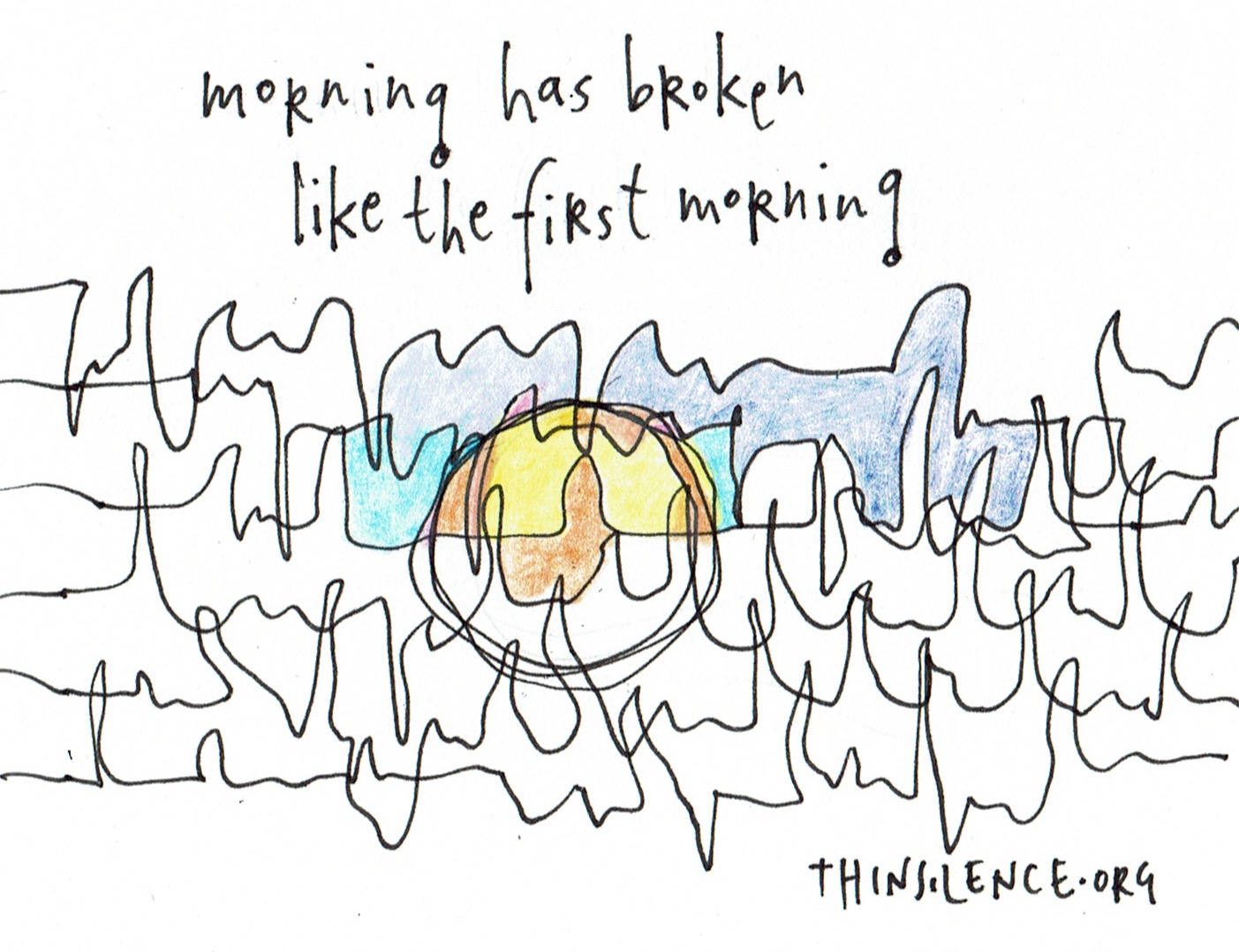
Each morning I search for the birds in flight, to wait within a moment and wonder.

I must turn again from pride to humility.

From greed to gratitude.

From foolishness to faithfulness.

(*From Richard Rohr’s The Divine Dance.)
(**May Angelou, quoted in Maria Popova’s Brain Pickings: Theodore Roosevelt on the Cowardice of Cynicism and the Courage to Create Rather Than Criticise.)

Johariness

science describes accurately from outside, poetry describes accurately from inside, [and] both celebrate what they describe*
(Ursula Le Guin)

Any organization of more than two people has a structure, intentional or not.**
(Seth Godin)

Back in 1955, Joseph Luft and Harry Ingham created the Johari Window, with four “panes” describing different types of personal awareness: characteristics and awareness that we are aware of and are willing to tell others about; the things we know about ourselves and don’t tell others; the things we don’t know about ourselves but others can see about us; and, the things that are hidden to both ourselves and to others.^

It’s a really helpful and revealing way to understand there is both an inside and outside to each of us – the things we’re constantly exploring.  Stretch that some more and we come to realise that none of us know all the truth about ourselves or about others, and about our world and our affects upon it.

Tom Rath wrote about “vital friends,” a necessary antidote to “friends lite,” the cheapening of friendship we find especially in so much social media.  Emerging out of Gallup research into the workplace that uncovered how people are far more engaged in their work if they have someone they count as a friend, Rath took a closer look at the different kinds of friend we can be.  There isn’t a friend, any more than we can feel supported in a rounded way by one person.  He identifies eight different friend types: Builders (develop us), Champions (stand up for us), Collaborators (work with us), Companions (walk with us), Connectors (put us in touch with others), Energisers (encourage us), Mind-openers (help us to see new things), Navigators (pilot us from here to there).  Rath suggests we’re two or three of these more strongly than others.  I like to think they make it possible for us to extend ourselves in a friendship way towards people who may never be our friends.^^

This is something really necessary for figuring out a better future for one another, our planet and, so, ourselves.  They provide us with ways of taking relationships deeper, and with these, opening greater possibilities for something Jennifer Shepherd sees being made possible in her visualising work with individuals and organisations, bringing out the invisible:

‘learn[ing] to surface the wisdom hiding with us and between us and connect it with what we already know’.*^

We are not just our role or job title, we are not simply a cache of data or understanding, we are inside-outside people, meeting with the inside-outside of each other, searching together for the future.

(*Ursula Le Guin, quoted in Maria Popova’s Brain Pickings: Astrophysicist Janna Levin Reads Ursula K. Le Guin’s “Hymn to Time”.)
(**
(^See Mikael Krogerus and Roman Tschäppeler’s The Decision Book.)
(^^See Tom Rath’s Vital Friends.)
(*^Jennifer Shepherd, from Drawn Together Through Visual Practice.)

Art and writing and life and friends

Here’re are a few things to play with:

A doodle to print off and colour in with a “slow pen.”

Find a pen you love and play with your handwriting to create a font that is yours.

Look at a view you love and take in all the details that want to flood into your life.

Meet with a friend, have your favourite drink and laugh a lot.