Visible and invisible ways

I felt connected not only to the stars but to all of nature, and to the entire cosmos.  I felt a merging with something far larger than myself, a grand and eternal unity, a hint of something absolute.*
(Alan Lightman)

It was during his time as a school-teacher that Arkady learned of the labyrinth of invisible pathways which meander all over Australia and are known to Europeans as “Dreaming-tracks” or “Songlines”: to the Aboriginals as “Footprints of the Ancestors” or the “Way to the Law”.**
(Bruce Chatwin)

In a material universe, two of the visible ways we know our physical bodies keep moving are through food and healing – we require fuel to burn and we go wrong.

Life is more than these, more than the visible, though; it seems to shine brightest where the visible and invisible ways cross and intertwine.  And there are so many.

(*From Alan Lightman’s Searching for Stars on an Island in Maine.)
(**From Bruce Chatwin’s The Songlines.)

The goal, the distraction and the wonder

The question then is how to get lost.  Never to get lost is not to live, not to know how to get lost brings you to destruction, and somewhere in the terra incognito n between lies a life of discovery.*
(Rebecca Solnit)

This truth works out in many places at many levels but today it may be in the person who stops you doing what you have a mind to do and in your turning towards them and giving your attention to them something wonderful appears.

(*From Rebecca Solnit’s A Field Guide to Getting Lost.)

The impossible call

In out-of-the-way places of the heart,
Where your thoughts never think to wander,
This beginning has been quietly forming,

Waiting until you were ready to emerge.

[…]

Awaken your spirit to adventure;
Hold nothing back, learn to find ease in risk;
Soon you will be home in a new rhythm,
For your soul senses the world that awaits you.*
(John O’Donohue)

I began this morning with the following words before me:

‘Love, wisdom, grace, inspiration – how do you go about finding these things that are in some ways about extending the boundaries of the self into unknown territory, about becoming someone else?’**

Some years ago, I had read an electronic copy of James Carse’s Finite and Infinite Games.  I have now bought a paper copy.

I’m a little surprised by how thin it is – 149 pages – something I was unaware of when reading is slowly through on my Kindle.  Again and again Carse’s thoughts had caused me to stop and think, to see from new perspectives.  As I begin to read my paper copy, he’s doing it again.  I find myself marking only the third sentence:

‘A finite game is played for the purpose of winning, an infinite game for the purpose of continuing the play.’^

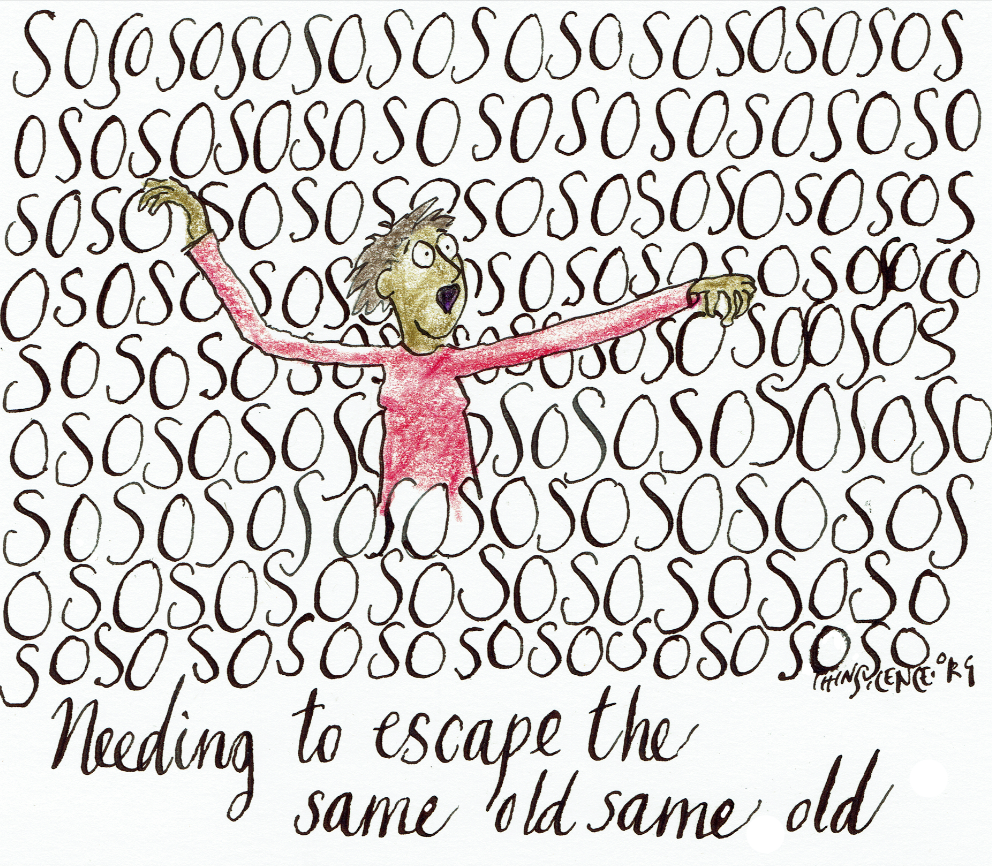
Rebecca Solnit is suggesting that we can only find some things about ourselves by losing ourselves – becoming purposefully lost.

Wherever we are, we can lose ourselves even when we know the place so well it’s impossible to become lost:

‘To lose yourself: a voluptuous surrender, lost in your arms, lost to the world, utterly immersed in what is presents that its surroundings fade away […] to be lost is to be fully present, and to be fully present is to be capable of being in uncertainty and mystery.’**

The person who chooses to lose themselves is the person who is “continuing the play”:

‘Then the delight, when your courage kindled,
And you stepped onto new ground,
Your eyes young again with energy and dream,
A path of plenitude opening before you.’*

Infinite players select themselves, finite players are chosen by others.  Solnit takes a moment to share where the word “lost” comes from:

‘The word “lost” comes from the old Norse los, meaning the disbanding of an army, and this origin suggests soldiers falling out of formation to go home, a truce with the wide world.  I worry now that many people never disband their armies, never go beyond what they know.’**

We all participate in finite games but not everyone chooses themselves and joins in an infinite game.

We need time to lose ourselves.  We can try to find time – waiting for someone or something else to move first – or we can choose ourselves and make time:

‘Though your destination is not yet clear
You can trust the promise of this opening;
Unfurl yourself into the grace of beginning
That is at one with your life’s desire.’*

I offer today’s doodle for colouring, a means of losing ourselves.  Enjoy.

(*From John O’Donohue’s To Bless the Space Between Us: For a New Beginning.)
(**From Rebecca Solnit’s A Field Guide to Getting Lost.)
(^From James Carse’s Finite and Infinite Games.)

The garden, ballet dancer and mirror

We watch Nureyev leap.  We think, “Beautiful.”  Maybe we even think, “Wow.”  But we probably don’t think, “That took a 70ᴼ external rotation on the sagittal axis, a shift from sensory to vestibular feedback intake of 6 millilitres of water per kilo of weight per hour, perfect polymeric contraction, 20 years of stretch of the quadriceps femurs, 6 production departments, a $5,000 costume and 2 ounces of base makeup.”*
(Nancy Kline)

When you’ve identified what it is you most want to do with your life, you’re not going to get away with just wearing your fanciest clothes, hairstyle and makeup, and tweaking it all in the mirror to make it happen.  Well, you could but it’s probably not a great idea.

When I look at my garden, I know what I can see above ground is because of what I did below ground level, specifically shifting tons of stones, ripping up the old groundsheets, discovering what looked like a lunar landscape beneath, breaking open and turning over the clay soil with a spade, waiting for it to dry hard, breaking it down with the same spade, moving the soil around to create a sloping from house-to-gate-look, putting down new sheets, washing the stones and replacing them, deciding where to plant the shrubs, creating wells of good soil and watering for the shrub.

Of course I could have done a little more of what the previous owner had, using a thicker layer of stones to disguise the unevenness beneath and to put a couple of plants in pots and left it at that – but then the pots were stolen, anyway.  I could have tweaked it in this way but it wouldn’t quite be the same.

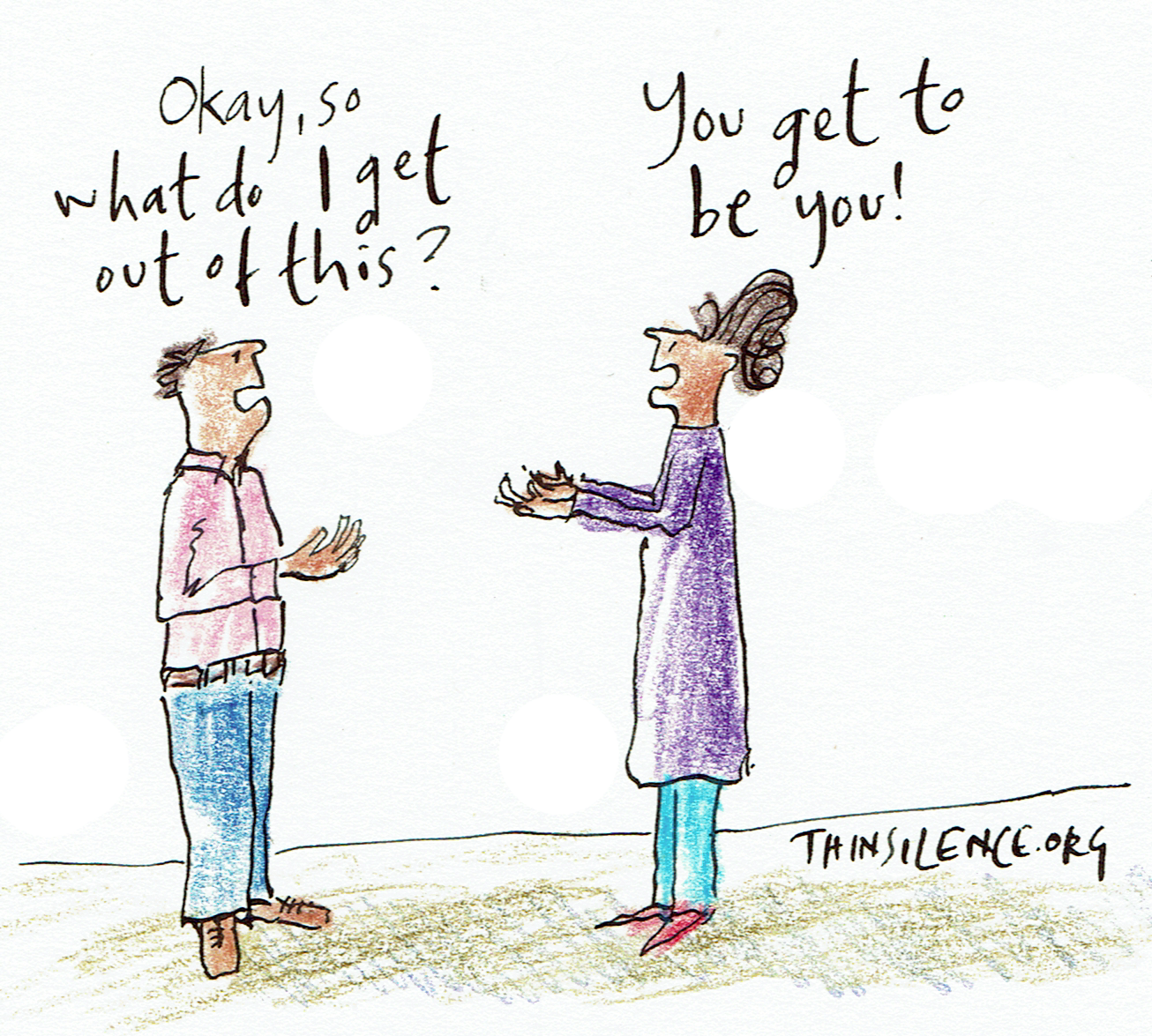
When we put this kind of effort into our lives, we not only produce “better art” – whatever it is we want our contribution to be, but we are changed in the process, for the better, making even more possible:

‘The larger the world we live in, the larger our lives develop in response.’**

Beneath the surface is where we find our problems but it’s also where the identify the possibilities, as Vera Rubin pointed out:

“If there were no problems it wouldn’t be much fun.”^

(*From Nancy Kline’s More Time to Think.)
(**From Richard Rohr’s The Naked Now.)
(^Vera Rubin, quoted in Alan Lightman’s A Sense of the Mysterious.)


A field guide to getting lost*

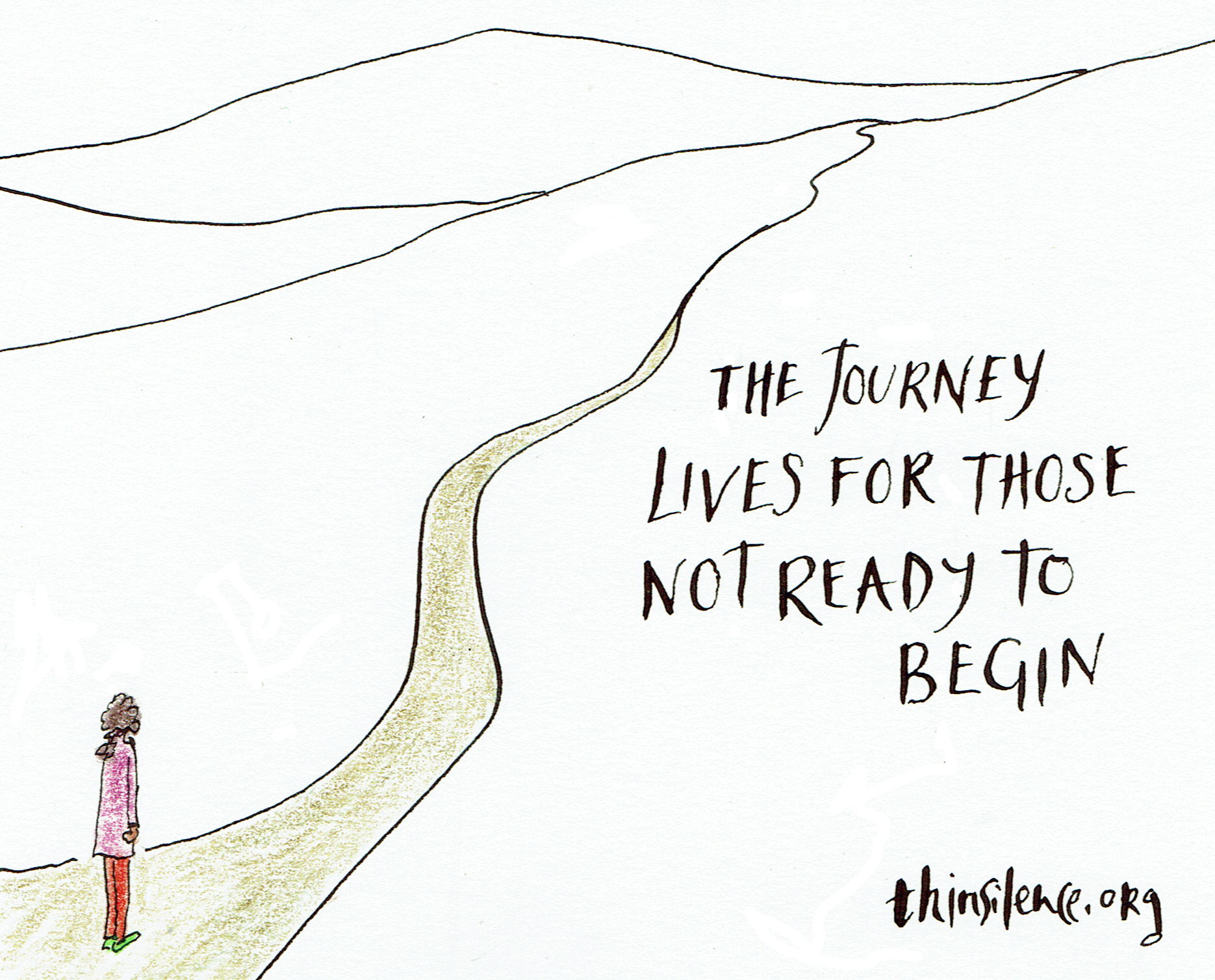
Leave the door open for the unknown, the door into the dark.  That’s where the most important things come from, where you yourself came from, and where you will go.*
(Rebecca Solnit)

When I begin writing in my morning journal, I’ve no idea what my prompting thoughts will be or where they will lead me.  It will include certain books over others, but which books?  What will I be thinking by the end of all of this, and what will I need to do as a result?

As I open myself to these new thoughts, some will excite me more than others.  It’s more than just thinking about different things, my heart is getting involved, too.

Nancy Kline tells of when she was gifted a Morning Glory plant, just a stem and two leaves, but soon that tiny plant would become a:

‘purple, blousy, blossom-festooned, soon-to-be-galloping glorious things, hundreds of them.’**

Her next words catch my interest more particularly:

‘They were in there […] not so much they were in there, as the means to make them.’**

From one stem and two leaves comes an incredible virulent mass of leaves and flowers.  Kline is thinking, as am I, how this is true of each of us.

We have generative hearts.

We become generative when we move from what we know to what we feel.  We find ourselves asking big, interesting, amazing, glorious, fantastic questions.^

Not answers.

Questions.

I am 59 and feel it more than ever.  I am encouraged by T. S. Eliot when he asserts:

“Old men ought to be explorers.”^^

It’s no wonder, then, that Brené Brown catches my eye when she tells me of her practice when setting out on research that’s going to challenge long-held beliefs or ideas:

‘In these uncertain and risky moments of vulnerability,  I search for inspiration from the brave innovators and disruptors whose courage feels contagious.  I read and watch everything by them or about them that I can get my hands on – every interview, every essay, every lecture, every book.’*^

We don’t explore what we know, we explore what we do not know.  It’s why questions are so important over answers.

Rebecca Solnit follows the words which open today’s post by quoting the philosopher Meno:

“How will you go about finding that thing the nature of which is totally unknown to you.”^*

Living out a question is a good place to begin.  While some want us to live in their answers, they certainly don’t want us to upset the status quo and ask our stupid questions:

‘”You’re doing it wrong.”  But at least you’re doing it.  Once you’re doing it, you have a chance to do it better.  Waiting for perfect means not starting.’⁺

You find yourself somewhere.

Somewhere you didn’t know existed before.

(*From Rebecca Solnit’s A Field Guide to Getting Lost.)
(**From Nancy Kline’s More Time to Think.)
(^I am indebted to Neil Gaiman for this phrase in Art Matters when he is thinking of mistakes rather than questions.)
(^^T. S. Eliot, quoted in Richard Rohr’s Falling Upward.)
(*^From Brené Brown’s Braving the Wilderness.)
(^*Meno, quoted in Rebecca Solnit’s A Field Guide to Getting Lost.)
(⁺From Seth Godin’s blog: You’re doing it wrong.)


Always thinking the best


When you focus on what others are thinking about what you are thinking, you aren’t thinking.  Not very well.*
(Nancy Kline)

The mind, once stretched by a new idea, never returns to its original dimensions.**
(Ralph Waldo Emerson)

Being more concerned with what others think about you will prevent your best work.  Anxiety, anger, hurt, worry and perfectionism will all prevent our best thinking and feeling and best work.

Thinking improves after ‘kindness, clarity, ease and genuine interest,’ claims Nancy Kline.  Writer Neil Gaiman admits that for fifteen years or so he was worrying about the next thing and he didn’t enjoy the ride at all.  It’s not about taking pleasure but finding happiness.:

‘Pleasure is short-term, addictive and selfish.  It’s taken, not given.  It works on dopamine.  Happiness is long-term, additive and generous.  It’s giving, not taking.  It works on serotonin. […] More than ever, we control our brains by what we put into them. […] Scratching an itch is a route to pleasure.  Learning to productively live with an itch is part of happiness.’^

Happiness is ultimately about being okay about who we are and what we have and what we are able to imagine out of these and make happen.  Whatever others think about us.

(*From Nancy Kline’s More Time to Think.)
(**Ralph Waldo Emerson, quoted in Ben Hardy’s article: How to Fully Commit to Goals that Terrify You.)
(^From Seth Godin’s blog: The pleasure/happiness gap.)

Treasures of the heart

When we are grateful, we are most fully alive.*
(Erwin McManus)

Every day, we’re able to lay up treasure in our hearts that we’ll have when, some day, it is needed, perhaps for others, perhaps for ourselves.

It is the kind of treasure that helps us face the most difficult things in life that external treasures never will.  When we bring these out then perhaps, in the words of Iris Murdoch, we are providing something sacred:

‘A sacrament provides an external visible place for an internal invisible act of the spirit.’**

Treasure is everywhere in what we often think of as the ordinary and John O’Donohue’s words gently offer how we can be open to receive it:

‘I place on the altar of the dawn:
The quiet loyalty of breath,
The tent of thought where I shelter,
Waves of desire I am shore to
And all beauty drawn to the eye.’^

This treasure does not remain inactive and cold within us waiting for the day of need, though, it also makes it possible to be open to even more each new day and in this we are being changed:

‘May my mind come alive today
To the invisible geography
That invites me to new frontiers,
To break the dead shell of yesterdays,
To risk being disturbed and changed.’^
(John O’Donohue)

(*From Erwin McManus’ Uprising.)
(**From Iris Murdoch’s The Sovereignty of Good.)
(^From John O’Donohue’s To Bless the Space Between Us: A Morning Offering.)

The only way to know

You have no idea what you’re doing.  If you did, you’d be an expert, not an artist.*
(Seth Godin)

Make your art.  Do the stuff that only you can do.**
(Neil Gaiman)

If it matters to you then you must do it.

And if it goes wrong then you must do it again, with all you’ve learned to help you.

Rohit Bhargava caught my eye with his four mindsets for intersection thinking – ways for allowing different fields or domains or ideas or worlds to overlap.  They may help you go deeper so you’re not simply repeating the same experiment or manoeuvre or behaviour.^

See the similarities instead of the differences: what went right?

Purposefully look away from your goal: what else is happening here?

Wander into the unfamiliar – is this something else happening here that may be worth pursuing for a while?

Be persuadable – can you pivot?

You gave it everything last time and it failed.  You can give it all again, in a smarter way.

(*From Seth Godin’s The Icarus Deception.)
(**From Neil Gaiman’s Art Matters.)
(^See Rohit Bhargava’s Non Obvious 2018.  There are a lot of similarities with the moves in Theory U.)