There are people, there are tribes and then there’s everyone

As cosmopolitans, as humans, when our other identities [as members of a state, nation, race, ethnic group, affinity group] come into conflict with our shared humanity, shared humanity wins.*
(Anne Lamott)

The true poem is not the work of the individual artist; it is the universe itself, the one work of art which is forever perfecting itself.**
(Ernst Cassirer)

Wallace Stevens speaks of imagination in a primal way for human existence:

‘To regard the imagination as metaphysics is to think of it as part of life, and to think of it as part of life is to realise the extent of artifice. We live in the mind. […] If we live in the mind, we live with imagination.’^

We note that imagination can be used by us in many ways, to tell many stories, to posit many possibilities. With our imaginations we make life smaller or bigger. Kosuke Koyama insists:

‘Struggle against our greediness is a frustrating, yet vitally important, undertaking.’^^

We can be greedy for the individual, the family, the team, the tribe, the nation, but everyone is waiting for what we have to bring, the contribution we imagined into being. Seth Godin wrote a wonderful book about the amazing things people want to be about together, but he warns:

‘the tribe is open to hearing from you – they’re not yours.’*^

Walt Whitman uses his imagination in a larger way when he looks upon the procession of everyone:

‘Each has his or her place in the procession.
All is a procession,
The universe is a procession with measured and beautiful motion.’^*

We judge others too quickly and such a procession requires the most open of imaginations, leaving our smaller scripts behind.

(*From Anne Lamott’s Hallelujah Anyway.)
(**Ernst Cassirer, quoted in Wallace Stevens’ The Necessary Angel.)
(^From Wallace Stevens’ The Necessary Angel.)
(^^From Kosake Koyama’s Three Mile an Hour God.)
(*^From Seth Godin’s blog: It’s not your tribe.)
^*From Walt Whitman’s Leaves of Grass.)

Where are we going?

In the sphere of material things giving means being rich. Not he who has much, be he who gives much.*
(Erich Fromm)

For as soon as we touch a You, we are touched by a breath of eternal life.**
(Martin Buber)

Love has to be the most amazing thing the universe has produced.

At the end of our lives, it is by love we measure meaningfulness:

“What remains of us is love”.^

And there are literally countless ways of expressing love.

What many of these ways have in common is that they are giving something rather than wanting something.

It has to be my daily experiment.

(*From Erich Fromm’s The Art of Loving.)
(**From Martin Buber’s I and Thou.)
(^Philip Larkin, quoted in gapingvoid’s blog: What lives forever?
)

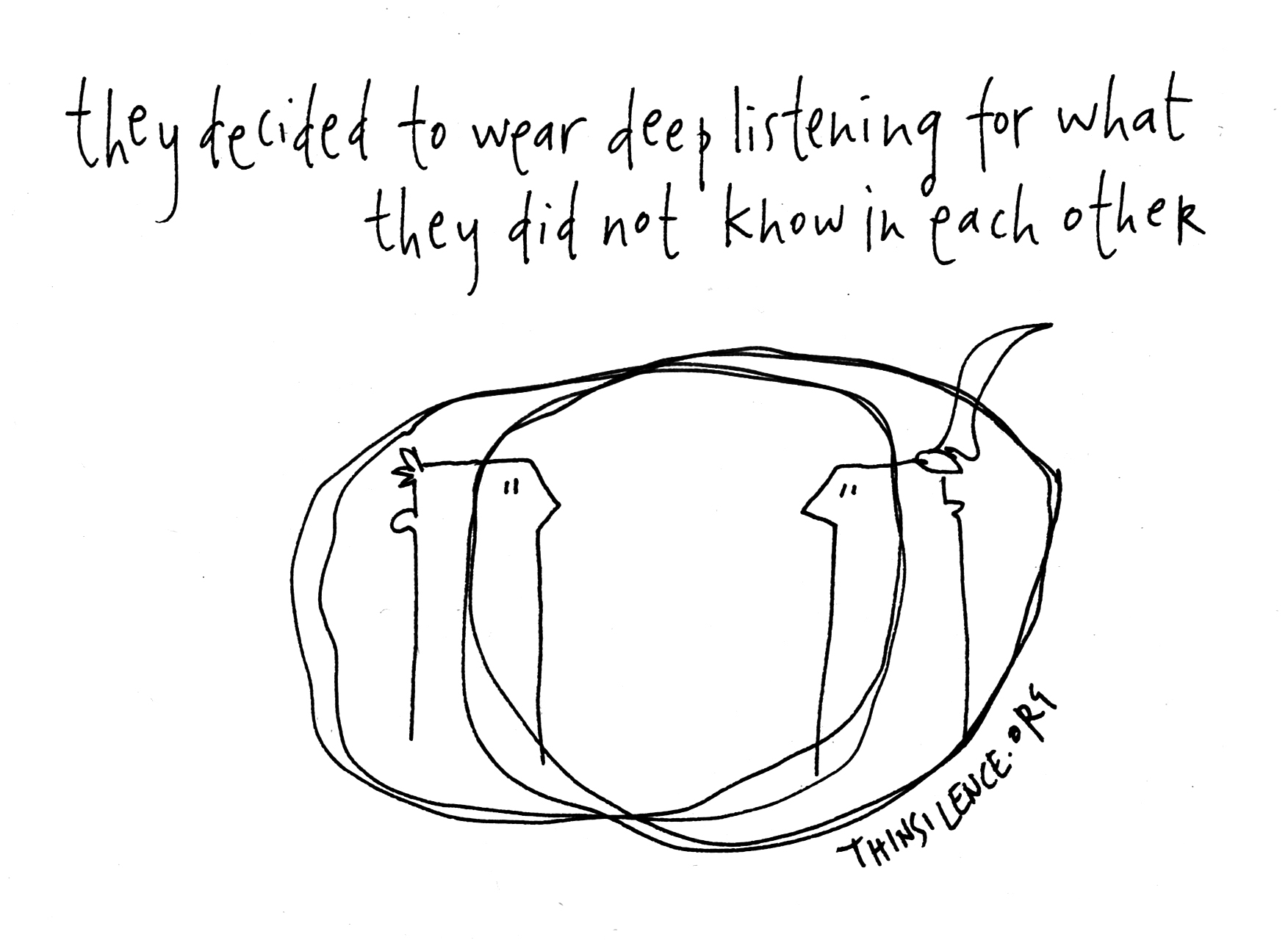
What to wear?

It is vital (in all senses of the term) that we enter into a dialogic relation to what is around us, and that we acknowledge the extent to which the knower is implicated in what comes to be known.*
(Annie Pirrie)

Life and reality are not things you can have for yourself unless you accord them to all others.**
(Alan Watts)

If we only wear business and knowing, we will never be able to move from what we know into what we do not know. Nan Shepherd, understanding that all things have an inside, confesses on our behalf:

‘I knew when I looked for a long time that I had hardly begun to see.’^

Better to wear compassion, kindness, humility, gentleness, patience and love – clothes we can only wear slowly, clothes that are taking a lifetime of learning to wear.

(*From Anne Pirrie’s Virtue and the Quiet Art of Scholarship.)
(**Alan Watts, quoted in Maria Popova’s Brain Pickings: I and Thou.)
(^From nan Shepherd’s The Living Mountain.)

Why we never give up on each other

He told her about a spring within her, a well that wouldn’t run dry, a holy breath that connected her to the whole, to the illimitable, to love.*
(Anne Lamott)

The type of inquiry I am talking about derives from an attitude of interest and curiosity. It implies a desire to build a relationship that will lead to more open communication.**
(Ed Schein)

Anne Lamott is reflecting on an encounter Jesus of Nazerath had with a Samaritan woman outside the town of Sychar.^

She was something of an outcast in her own community, used and rejected many times. The reflection comes with hindsight but it must have felt different the other way around, when a life was closed to its own wonder and some way of opening up possibility was necessary.

This is what Edgar Schein offers. When it’s hard to not make up one’s mind about someone and to stay open to the wonder that exists in everyone, we need to develop our interest and curiosity.

The other then becomes more important than ourselves:

‘when you wonder, you are drawn out of yourself’.^^

When we wonder it is as if we are touching what it is we are here for:

“when the universe makes me wonder, all is as it should be”.*^

(*From Anne Lamott’s Hallelujah Anyway.)
(**From Edgar Schein’s Humble Inquiry.)
(^See John 4: 1-26)
(^^From John O’Donohue’s Eternal Echoes.)
(*^From Cirque de Soleil’s Varekai, quoted in Alex McManus’ Makers of Fire.)

The pollen path

My Lord God,
I have no idea where I am going.
I do not see the road ahead of me.
I cannot know for certain where it will end.*
(Tom Merton)

Oh, beauty before me, beauty behind me,
beauty to the right of me, beauty to the left of me,
beauty above me, beauty below me,
I’m on the pollen path.**
(Navaho saying)

We must find our pollen path:

‘Pollen is the life source. The pollen path is the path to the centre.’^

Joseph Campbell’s closing words in The Power of Myth assert:

‘Eden is.’^

What is this pollen path that connects our small stories to the greater story – given to us by those who have gone before, left by us to those who will follow?

A not so eloquent way of putting this is, we want to live in the zone. We know what this means, this being fully engaged. And the wonder is, it means something different to every one of us.

It’s wonderful.

It’s also hard work to get here, every day, which is why the pollen path though beautiful is difficult to find each day. Difficult, but not impossible. The apostle Paul looked back on his life then wrote about having fought the fight, finished the race, kept the faith. That’s how it feels, whether we’re religious or not: a battle, a race, our faith.

Keep coming to your pollen path: Eden is.

(*Thomas Merton, quoted in the Northumbria Community‘s Morning Prayer.)
(**Navaho saying, quoted in Joseph Campbell and Bill Moyers’ The Power of Myth.)
(^Joseph Campbell, from Joseph Campbell and Bill Moyers’ The Power of Myth.)

Still walking after all these years

Walking came from Africa, from evolution and from necessity, and it went everywhere, usually looking for something.*
(Rebecca Solnit)

[W]hen we go, we find we’re not just entering new territory. We are becoming new people.**
(John Ortberg)

I need to keep journeying from somewhere to somewhere, to experience the journey in-between. We can end up thinking that life is about the destinations and the journeys are simply how we get there.

We can be inspired by what someone has done with their lives, but in the end, it is their honesty about the journey – those struggles, failures, inspirations, encounters, growing, becomings – that will help us most of all.

(*From Rebecca Solnit’s Wanderlust.)
(**From John Ortberg’s All the Places to Go.)

Capturing and provoking

Real learning gets to the heart of what it means to be human. Through learning we re-create ourselves.*
(Peter Senge)

You cannot look to the future by naive projection of the past.**
(Nassim Taleb)

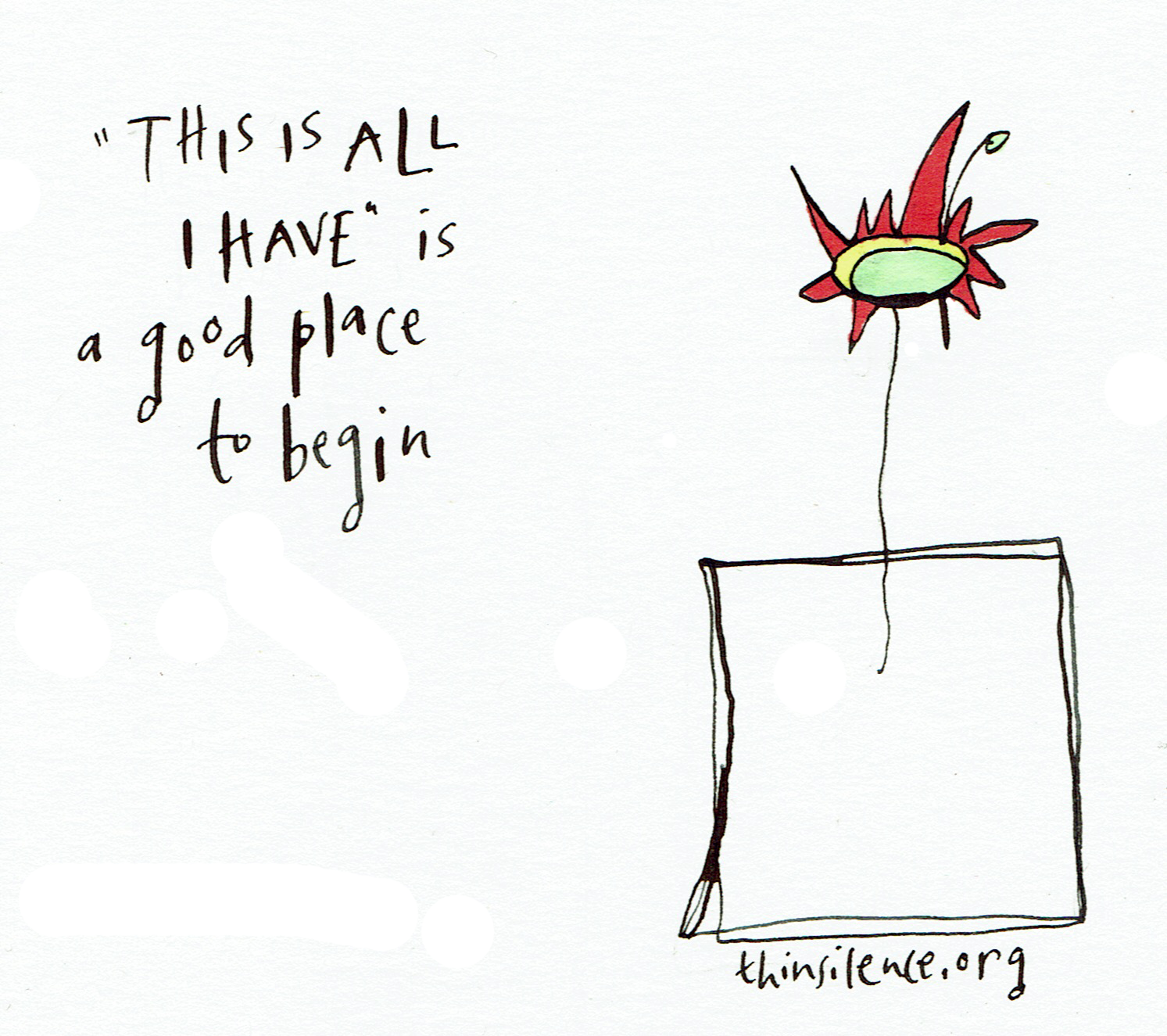
Our limitations and constraints are a good place to begin because they are a capturing of past learnings, failures and achievements, but they are there to push out from and to provoke the new.

We are more plastic than we know; our environments, too.

Game on.

(*From Peter Senge’s The Fifth Discipline.)
(**From Nassim Taleb’s Antifragile.)

I don’t think I’m alone

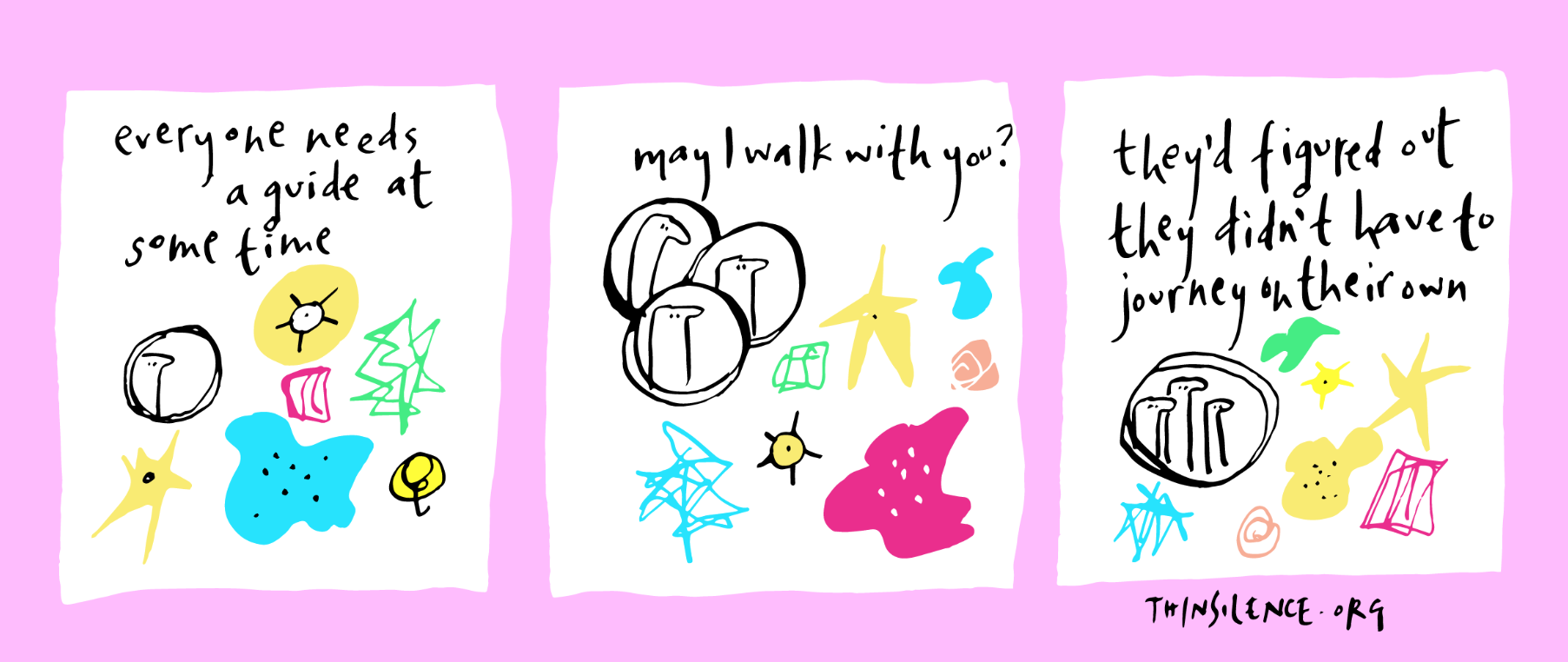
The second [route] is to fall in step with a teacher, briefly or forever, a real teacher who makes it clear that even as he or she points to the moon, we have to stop staring at the person’s fingers. […] Every one of us sometimes needs a tour guide to remind us how big and deep life is meant to be.*
(Anne Lamott)

I listen to many people talking about the things that matter to them and how they want to make a difference.

I am both wowed by the things they share and wonder whether they will make it. Specifically, will they find the ways and means, and the people they need to realise their hopes.

Seth Godin remarks on doing work that matters:

‘It might be a more difficult route, but it’s worth it.’**

He goes on to share the importance of finding others towards doing the work that matters to us:

‘And it involves surrounding yourself with people in a similar journey.’**

Some will journey with us throughout our lives, others we’ll meet and walk with for a time. Some, we’ll connect with face-to-face, others via technology, including the old technology of books.

That I need others to help me towards my meaningful work, I do not doubt. I’m going to be connecting with a couple of my guides today; we may be in Sacramento, Detroit and Edinburgh but we’re going to make it happen. I’ll be sitting with them, via technology, with a notebook open and a pencil in my hand.

(*From Anne Lamott’s Hallelujah Anyway.)
(**Grom Seth Godin’s blog: Where are you headed?)

An interpretation of time

But each incarnation, you might say, has a potentiality, and the mission of life is to live that potentiality. How do you do it? My answer is, “Follow your bliss.” There’s something inside you that knows when you’re in the centre, that know when you’re on beam or off the beam.’*
(Joseph Campbell)

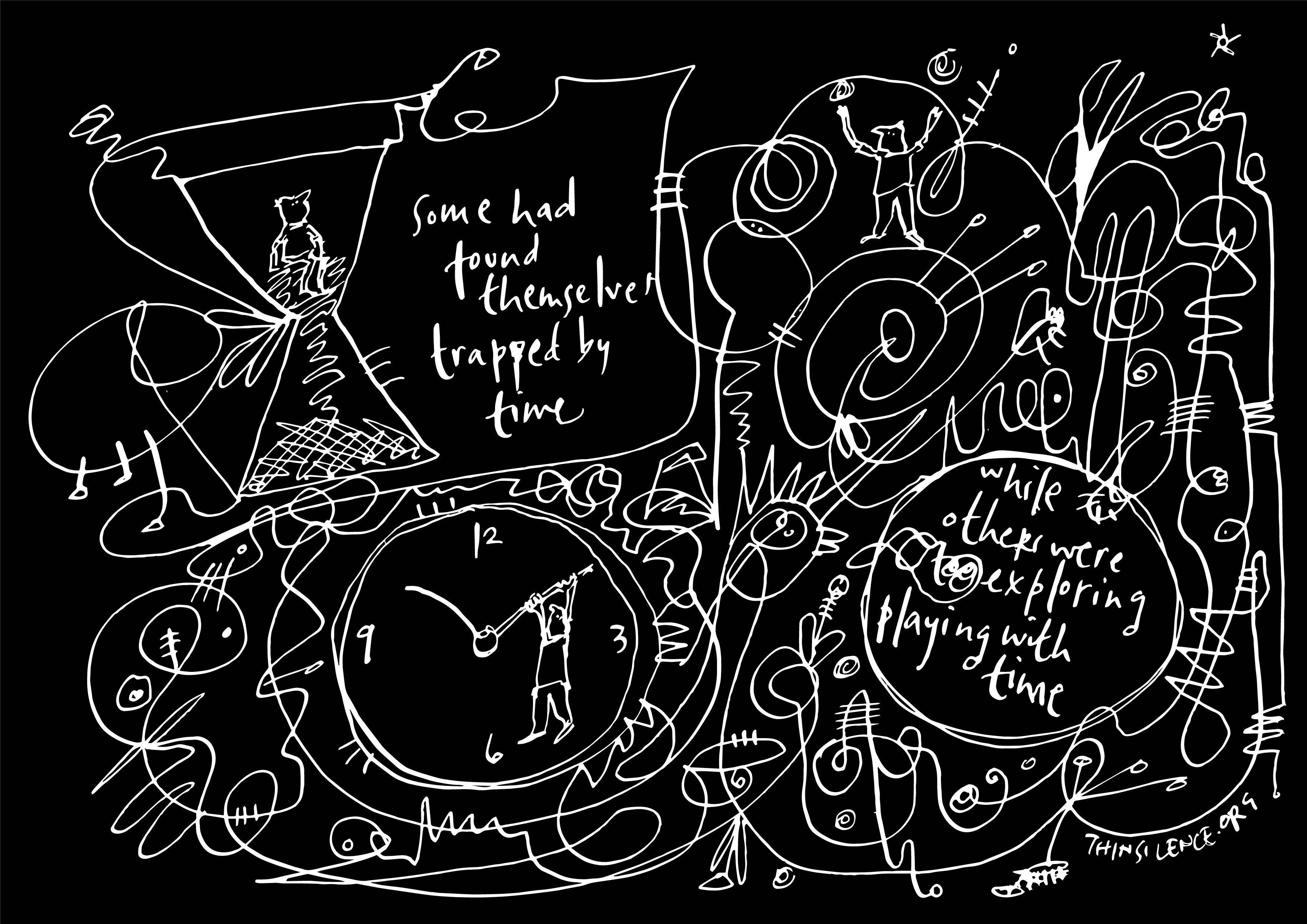
Some people see to have more time than others.

I suspect it is because they are playing with kairos time, the power of moments, rather than being fixated on chronos time, which always plays out linearly.

Their lives are increasingly becoming a unique interpretation of time.

(*Joseph Campbell, from Joseph Campbell and Bill Moyers’ The Power of Myth.)