Only because we do not understand everything and because we cannot control the future is it possible to live and be human.* (Iona Heath)
All types of skill teach us the same deep truth:that the ore we can immerse ourselves into the forces at place, the more freedoms we have.** (Bill Sharpe)
Clutching a physical book, like holding someone’s hand, tenders its own special sensations.* (Diane Ackerwood)
The very nature of the universe invites you to a journey and to discover it.** (John O’Donohue)
I only really began reading at the age of thirty eight. Previously I’d managed to get through a few books a year but in 1998, something significant happened in my life and I knew I would have to read more to make the most of it.
In her letter to young readers, one of the many in Maria Popova and Claudia Bedrick’s wonderful tome of text and picture, Dianne Ackerman writes of her love for books:
I love the comforting weight of a book, and the way your finger’s skim across the creamy puddles of its pages, one after another, following the darting minnows of words. You can stroll through a book’s compact, neatly bound world, hold it open in both hands, and stare thoughtfully into its face, then close it and see it whole.*
There are now many books that are sacred to me, holy scriptures that have helped and guided me to arrive in this moment, which is a moment of possibility:
This is now what matters, your readers. The moment we’re living in is whatcounts – how will this moment, the stories we’re living inside of, change us … forever?^
Scriptures as in writings that come to us from others.
Sacred as in setting me aside to live the life only I can live, and for you to live the life you must.
Holy in terms of the best things we can live for, such as love:
Love is the thing that pushes us to succeed. Love is a thing that we have to feel for ourselves, for our family, for our friends, for our partners. Love is what we want to come home to, but it’s also what we want to come in to in the morning. We need love everywhere. And that’s the whole point. We’re building a system with love inside.^^
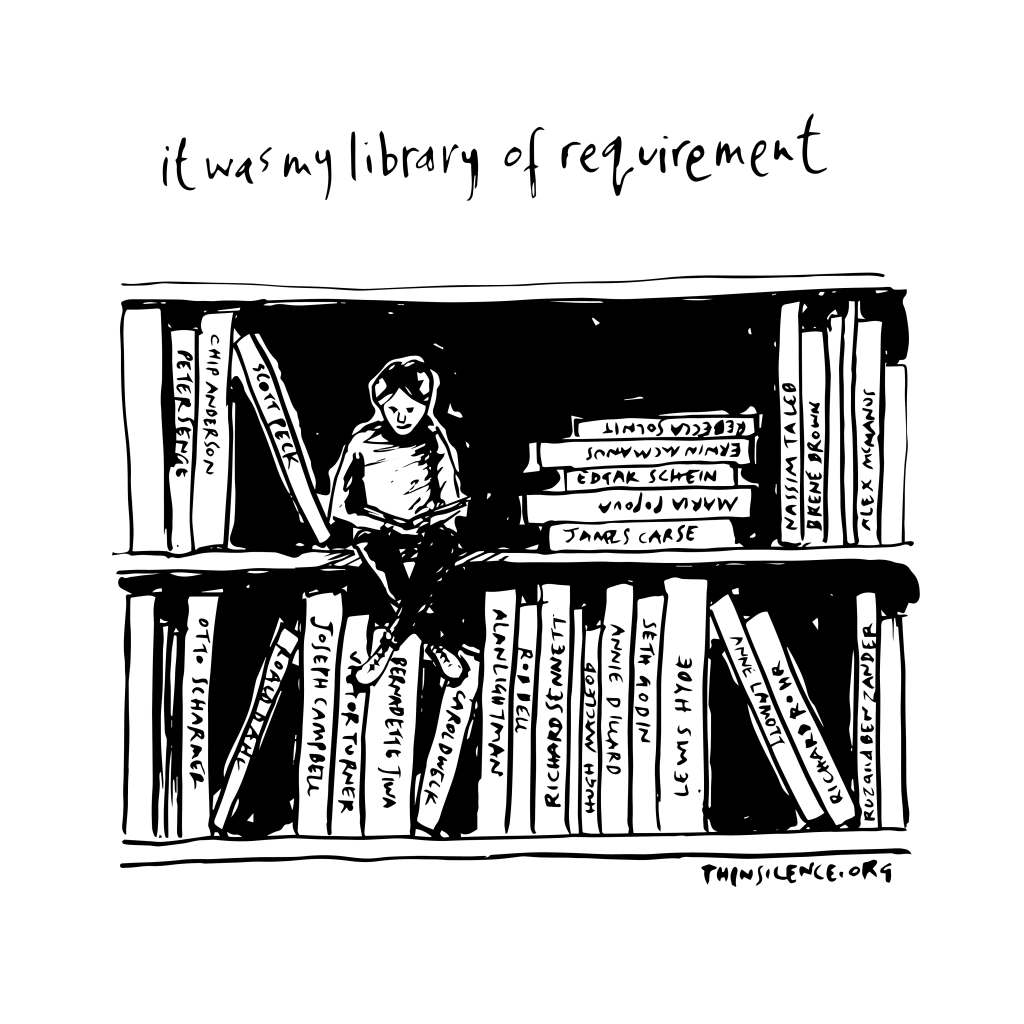
Sometimes these scriptures are entire books, sometimes only an excerpt, but we know they are are holy scriptures because of what they open for us; they are our library of requirement:
No matter where life takes you, you’re never alone with a book, which becomes a tutor, a wit, a mind-sharpener, a soulmate, a performer, a sage, a verbal bouquet for a loved on.*
These libraries are always growing, opening adjacent possibilities, constantly a garden of forking paths:
The “adjacent possible” is theoretical biologist Stuart Kauffman’s wonderful term for all the myriad paths unlocked by every novel discovery, the multitude of universes hidden in something as simple as an idea.*^
Read on.
(*Diane Ackerwood’s letter to young readers, from Maria Popova and Claudia Bedrick’s A Velocity of Being.) (**From John O’Donohue’s Eternal Echoes.) (^Jacqueline Woodson’s letter to young readers, from Maria Popova and Claudia Bedrick’s A Velocity of Being.) (^^From gapingvoid’s blog: Love is the mission.) (*^From Peter Diamandis and Steven Kotler’s Bold.)
It isn’t just fear of failure that stifles creativity and innovation – it’s the pursuit of the ‘sure thing’ that closes us off to the possibilities. If we always knew exactly where we’d land we would never discover how high or how far we might have gone.* (Bernadette Jiwa)
Walking changes activity in the parts of the brain that are concerned with seeing, and it changes then in a variety of positive ways, designed to make responding to what is happening in the real world quicker and more effective.** (Shane O’Mara.)
It may seem obvious, but when we’re stuck, we need to move.
I don’t mean find the thing we need to do. There’s nothing worse than looking at a screen, fingers hanging motionless over a keyboard, or with pen in hand staring at a notebook.
Get up, walk around.
Moving can also mean opening a book and reading a little. Better still, read some pages from a few books.
Drawing is also moving:
When I’m stuck, I find a picture to copy. […] Drawing changes the way I think and see. […] Copying lets my hand “see” new things.^
One thing for sure is that as complexity increases, so will stuck-ness and we will need to find playful ways forward:
We cannot analyse our way through this level of complexity, but we can play with it.^^
[A]cts of the imagination are exactly that: acts. They are neural acts with activations that can be detected.* (Shane O’Mara)
A writer can fit a whole world inside a book. Really. You can go there. […] You can look out of another person’s eyes, think their thoughts, care about what they care about. […] Books give you worlds of infinite possibility. […] Somewhere there is a book just for you. It will fit your mind like a glove fits your hand. And it’s waiting.** (Neil Gaiman)
I sometime suggest to those I work with that they create their “dream home,” a house representing all that matters most to them.
Mine includes a library-lounge – walls of books are magical to me, a co-creating kitchen – in which we could cook up things together, a city-square-cafe front-yard – in which I can sit and read and watch the world and have conversations, and an into-the-woods-and-hills back garden – to escape and be in nature.
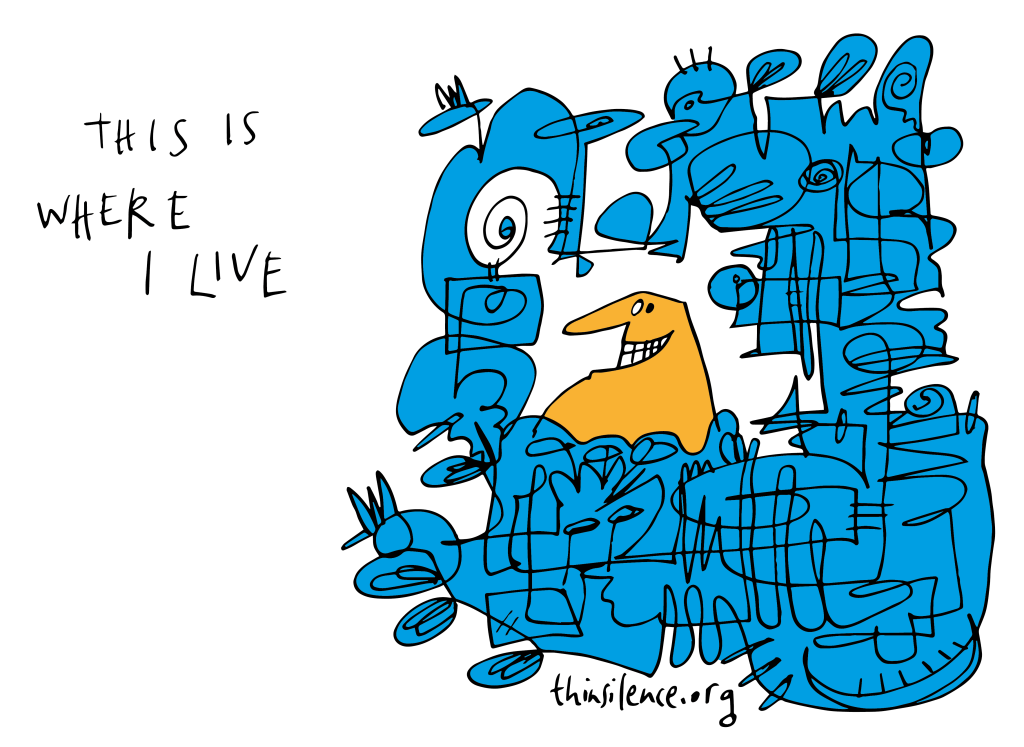
There’ll never be such a physical place for me but this is my home. As I reflected on these things some more, I realised how they express my values.
Learning new things, conversations with amazing people, cooking things up together and wandering through nature are the things I value most of all.
These values are my home and I need to come home to them each day.
You may like to imagine your dream home.
Imagining can employ both our visual and motor areas of the brain, the same areas we would be using if we actually doing the things imagined. This is interesting. I can remember reading how practising certain movements in our minds has some benefit and I wonder whether myelin is being wrapped around the synaptic connections in our brains. Perhaps someone reading this has some more information. Imagination is something and something important.
Steven Covey‘s thinking is that to imagine something is the first creation. We then move to the second creation and live out values every day.
“I think everyone is just trying to get home,” said the mole.^
Structure without life is dead. But life without structure is un-seen. Pure life expresses itself within and through structure. Each moment is absolute, alive and significant.* (John Cage)
If you want to go fast, go alone. If you want to go far, go together.** (African proverb)
Trust isn’t what it used to be. Seth Godin’s observation of our internet age is true both in statistics and personal stories:
The result is a moment in time when more people are connected and fewer are trusted.^
Friends aren’t what they used to be and now we need to identify meaningful friendships by inserting the word vital.
Fellowships are now more likely to be institutions providing awards of one kind or another, when they used to be how people came together to make some important happen:
To be part of an organised fellowship is a responsibility and also the chanceto leap forward. Join the others, people like you, eager to see and to be seen, and most of all, to be of service. (Worth noting that ‘fellow’ it is not gender-specific and in fact is used in the Old Testament in reference to women).^^
The thing about fellowships of this traditional kind is that we don’t have to wait for them to come along, we get to start them ourselves with others.
So special are the dynamics of these groups that anthropologist Victor Turner came up with the term communitas to set them apart from our normal understanding of community: a group of people bound together by a common purpose.
When you liberate yourself from the pressure of having to win, you’re free to try things that haven’t been done before. You can permit yourself to develop your unique perspective – share and alternative worldview. Walk an untrodden path.* (Bernadette Jiwa)
This may seem an obvious point, but when we’re walking our brains are in motion too. In fact, as we shall see, we evolved as a mobile species: we walk about, we move, we seek new sources of information from the world.** (Shane O’Mara)
Sometimes we can’t see it because we don’t want to.
To see something new or to see something more clearly is not always to our advantage, as we perceive it.
To change our mind or our worldview can mean losing much.
But, in a universe in which we collectively know less than 5% of all that is, is that really an option?
What your customers want from you is for you to care enough to change them.* (Seth Godin)
Story is a powerful way of making wholes from disparate parts, weaving elements together to provide an instinctively satisfying sense of coherence.** (Graham Leicester)
Every idea has to be communicated at some point in time.
The first to hear an idea is the person who came up with it.
This is marketing and it begins with the story I’m telling myself:
It is the marketing we do for ourselves, to ourselves, by ourselves, the story we tell ourselves, that can change everything. It’s what’s going to enable you to create value, to be missed if you’re gone.*
Every one of us has great ideas, ideas to make things better, to change someone’s world for the better.
And what ideas need are great stories to be wrapped in.
In my work with people, there are at least nineteen great ideas identified. The twentieth is the story they become.
And the story of now is the critical pivot. The story of now enlists the tribe on your journey.* (Seth Godin)
This now is what matters, young reader. The moment we’re all living in us what counts – how will this moment, and the stories we’re living inside change us … forever?** (Jacqueline Woodson)
Seth Godin outlines three stories developed by Marshall Ganz: the story of self, the story of us and the story of now.
The first two echo Joseph Campbell’s personal myth and societal myth, necessary for us to find our bliss and know we are alive.
I feel that the story of now ensures these are lived out fully.
Daphne Loads points out that the word anecdote means “unpublished” in the original Greek (a-necdote). The story of now ensures that our personal and societal myths or stories do not go unpublished.^
I want to be playful with seven reasons Loads offers for why she loves anecdotes – the words in bold font are hers, the explanations are mine.
Anecdotes are:
Short: lots of small expressions of our stories every day are better than waiting for something big to come along;
Funny: make sure these are also fun and that you get to laugh a lot;
Particular: embrace specific, avoid generalising;
Personal: keep checking that what you’re doing matters to you;
Memorable: they should become a part of who you are, defining you;
Distil insights: through failure and success let them teach and guide you for all that lies ahead
Don’t have to be true: this is the one to avoid – if we get the first six right then we’re really living them and avoiding this one.
It is up to the wanderers to remake the city into something that ignites the imagination.* (Keri Smith)
All types of skill teach us the same deep truth: that the more we can immerse ourselves into the forces at play the more freedoms we have.** (Bill Sharpe)
We don’t have to just get through another day; Seth Godin asks:
What if we saw opportunities instead of tasks? Chances instead of risks?^
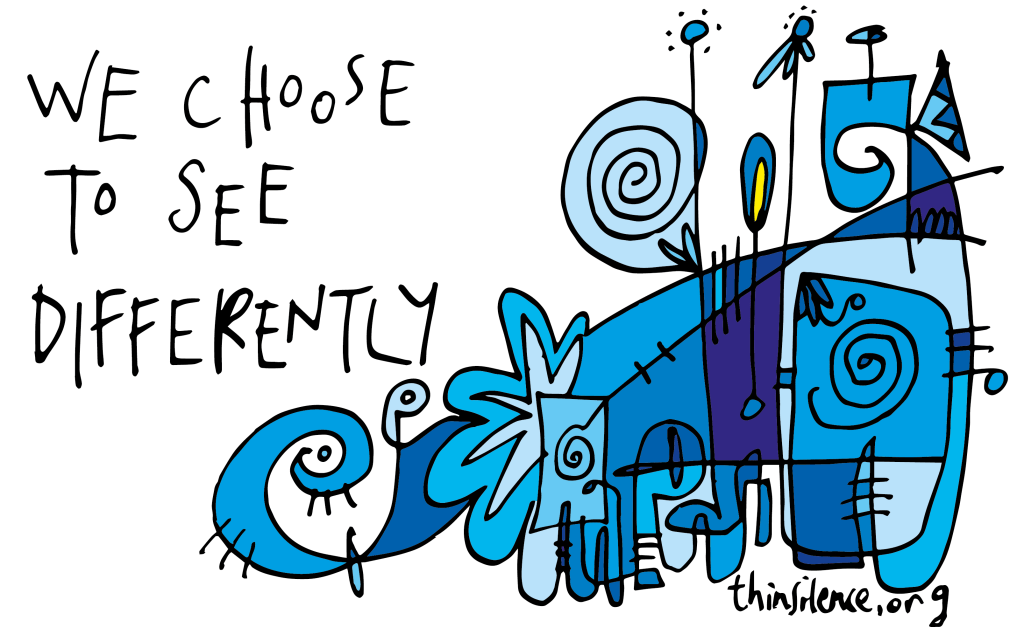
It’s a different way of seeing, and how we see is a choice.
I began my day trying to be more mindful of the things I do not want to take for granted: electricity, a shower, clean clothes, clean water … .
I take this into being more open to the things that prime my day, such as the readings that lead into this blog and the story I came upon from Barry Yeoman who was told that although he was a really good writer he would never be able to become a reporter:
Years ago, an editor told me outright that he wouldn’t hire a stutterer, eventhough I was the best-qualified candidate.^^
This story connects for me with seeing, Yeoman choosing to act upon rather be acted upon, developing a sensitivity in his reporting to those who have their own struggles, and he would also become a better listener rather than an interrupter:
The other lesson my stutter has offered me is simple: Shut up and listen. I don’t particularly like the physical effort of speaking. So I’m content to ask others to tell me their stories, then sit back, take notes, and make eye contact. I don’t feel compelled to fill the silences; I know someone will fill them, and I prefer it be the interviewee. By listening intently, then following up with gentle questions about missing details, I often wind up with richer, more nuanced stories.^^
Today could be another day to get through or we can change the day, but without the pixie dust:
Only because do not understand everything and because we cannot control the future is it possible to live and to be human.*^
Wallace Stevens wrote about how we must bring the power of our imagination to the pressure of reality. When we get this right, neither overcomes the other but something new is formed. We can choose to notice more and find ourselves more than able to act upon our day.
The starting place for change is accepting oneself and taking an interest in one’s inner world.* (Edward Deci)
So if I, your Lord and Teacher, have washed your feet, you also ought to wash one another’s feet. I have set you an example, that you also should do as I have done for you.** (Jesus of Nazareth)
There’s a difference between being treated like a servant and acting like a servant. This about the latter.
It is likely that the better world we hope for will only come about through our servanthood. Here’s a good question for the would-be servant from Seth Godin:
What change do I seek to make?^
Here’s something else really helpful for the servant who doesn’t come as an expert – indeed, it could be their lack of expertise that is most disturbing to those who wish to be served rather than serve:
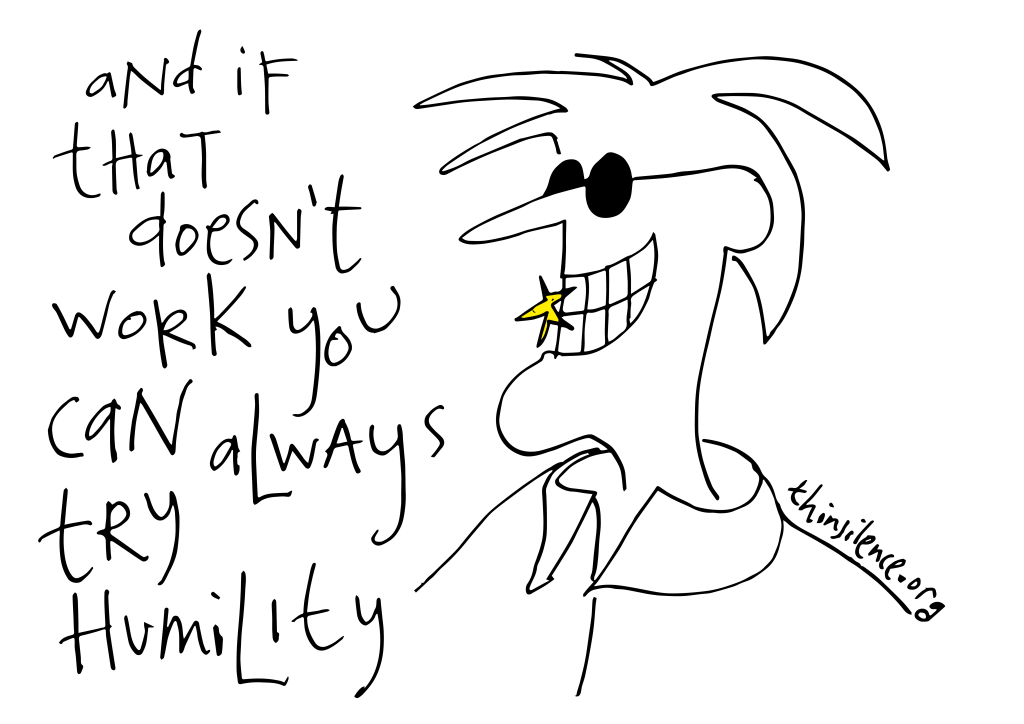
The secret to being good at anything is to approach it like a curious idiot, rather than a know-it-all genius.^^
Servanthood can mean we’re more open to discovering things about ourselves, things we hadn’t known before. We’re connecting to our story, our myth and to the greatest story of all. Notice what is happening here when we step outside of our known and into the unknown, something Joseph Campbell wants to suggest has mythological proportions:
Furthermore, we have not even to risk the adventure alone, for the heroes of all time have gone before us. The labyrinth is thoroughly known. We have only to follow the thread of the hero path, and where we had thought to have found an abomination, we shall find a god. And where we had thought to slay another, we shall slay ourselves. Where we had thought to travel outward, we will come to the centre of our own existence. And where we had thought to be alone, we will be with all the world.*^
We will come to what we have longed for, overcome the real enemy, understood our true worth and have found ourselves both belonging and contributing.
In a statement of simplicity beyond complexity, Charlie Mackesy has his character the boy ponder:
Isn’t it odd. We can only see our outsides, but nearly everything happens on the inside.^*
All the time we were thinking that we were helping someone – and, of course, we are – something significant was happening inside of us.
The path of the subversive servant is found in our ancient stories but is still so important for us today:
Sophistication may bring increased knowledge and, perhaps, a refined sensibility. But it may also encourage a cult of experts, dull sensitivity, and may reward flatulence in thought and language. Every society needs a barefoot Socrates to ask childishly simple (and childishly difficult!) questions, to force its members to reexamine what they have been thoughtlessly taking for granted.⁺
We know how remarkable it is to be served by someone, taking more care and paying more attention than we expected. Every day we have the opportunity to bring the unexpected to others:
Think about an instance of great service you experienced in the past week. I can guarantee what made it special was how it was delivered, not what was delivered.⁺⁺






You must be logged in to post a comment.