Mindful Doodling

I’m offering a free-to-join Mindful Doodling Session on Thursday, 4th February (2-3pm, UK time).

I’ve mentioned mindful doodling in some of my posts and I thought you might like to try some for yourself.

It’s basically going to be an opportunity to slow down and relax for an hour, bringing a little illustration into the day.

Doodling is for everyone, a kind practice of drawing without judgement. Everyone can do this and the world could do with more pictures and less words.

I’ve tried to time it for different parts of the world. All you need to do is grab some plain white paper and black pens and follow the following link:

Topic: mindful doodling
Time: Feb 4, 2021 02:00-03:00 PM (Edinburgh, UK)

Join Zoom Meeting
https://ed-ac-uk.zoom.us/j/83240400024

Meeting ID: 832 4040 0024
Passcode: mH1xk17E

Embracing flexibility

In our own search for beauty and what is good in life, we could do well to head outside and wander around.*
(Ryan Holiday)

In a few moments, I’m going to step outside.

It’s a driech day. Very foggy, damp, temperature just above freezing. There’s more than enough work to stay inside for and get on with, but I know I need to move, moving physically helps me to move mentally, emotionally and spiritually, too.

I’ll be back soon.

I am becoming rather than become. Rigidity is my foe, flexibility my friend. Maria Popova offers these words which feel full of flexibility:

I walk the ferned, mossed woods daily to lose my self and find myself between the trees; […] to let the rustling of the leaves beckon forth the stirrings and murmurings on the edge of the psyche, which we so often brush away in order to go on being the smaller version of ourselves we have grown accustomed to being out of the unfaced fear that the grandeur of life, the grandeur of our own untrammelled nature, might require of us more than we are ready to give.**

I know that I am susceptible, even prone, to shrinkage. I must replenish regularly for who I am and what I must do to grow, staying flexible and avoiding rigidity.

Popova is introducing David Whyte’s poem “Sometimes.” I found the words leading me into a special place as I listened to them:

Sometimes
if you move carefully
through the forest,
breathing
like the ones
in the old stories,
who could cross
a shimmering bed of leaves
without a sound,
you come to a place
whose only task
is to trouble you
with tiny
but frightening requests,
conceived out of nowhere
but in this place
beginning to lead everywhere.
Requests to stop what
you are doing right now,
and
to stop what you
are becoming
while you do it,
questions
that can make
or unmake
a life,
questions
that have patiently
waited for you,
questions
that have no right
to go away.**

Included in Popova’s blog there’s also a link to a commentary from Whyte on the poem, including these words which struck me forcibly as I listened:

A life sincerely followed is always surprising and always leads you into places you did not feel you could either enter or that you could deserve. And part of the ability to hold the silence as we move and as we tiptoe or walk or take our pilgrim path from one epoch of our lives to another is our ability to not name things too early and to allow yourself to be surprised as to where you’ve arrived.^

We are being invited to bring flexible attention as Steven Hawes would name it:

Processes of rigid attention show up as ruminating about the past, or worrying about the future, or mindlessly disappearing into our current experience the way teenagers disappear into video games.^^

Rigidity cannot hold the silence of our becoming – the sense of this is all we can be, a hiding from the “grandeur of our own untrammelled nature.” Only flexibility can be present in the moment, hesitating in naming things too soon and be open the possibility of surprise, something I have found myself holding in the phrase “slow journeys in the same direction.”

There is more to all of us than we know.

(*From Ryan Holiday’s Stillness is the Key.)
(**From Maria Popova’s Brain Pickings: Sometimes.)
(^David Whyte from Brain Picker’s David White Reads “Sometimes.”)
(^^From Steven Hawes’ A Liberated Mind.)

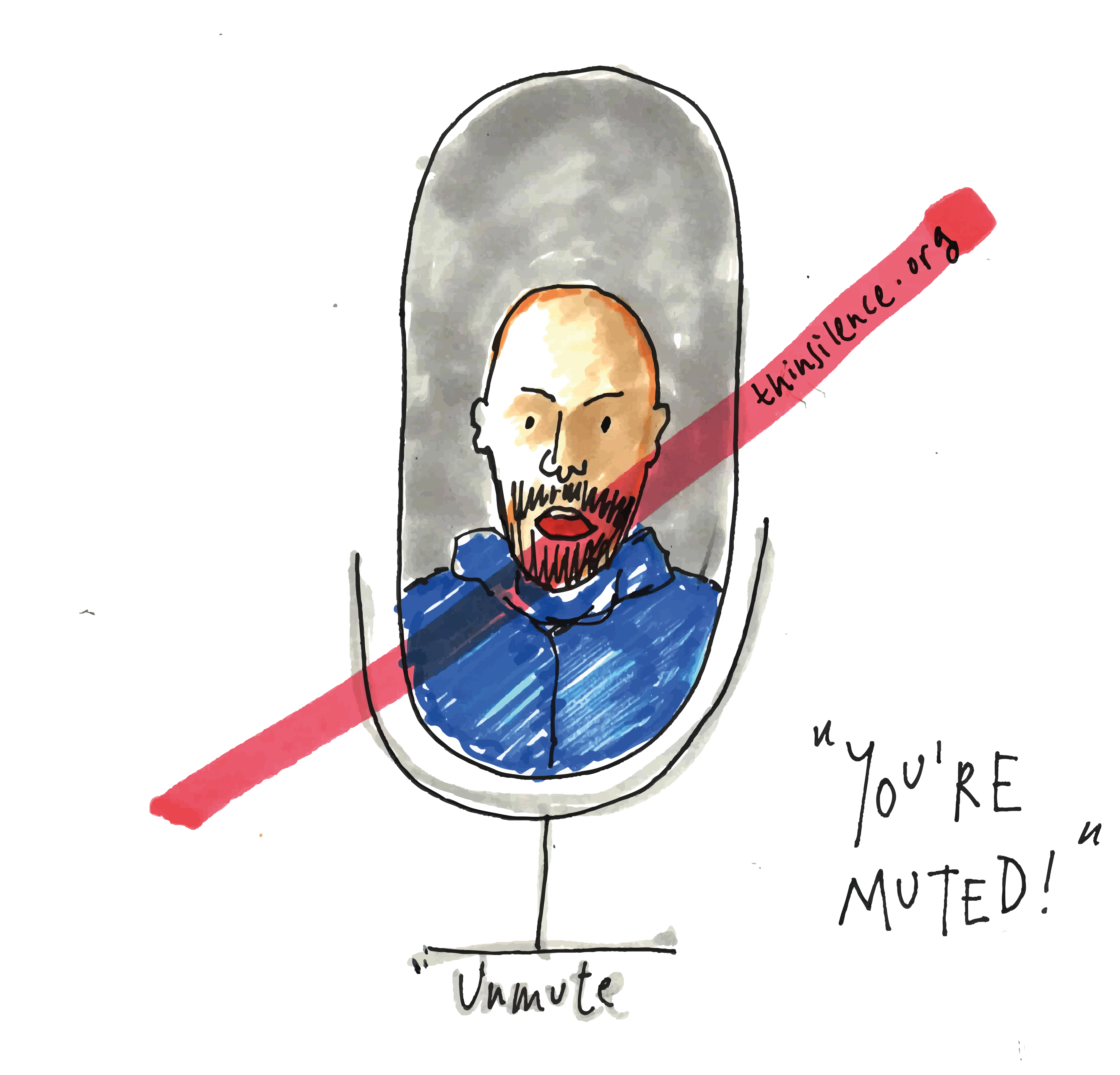
You’re muted!

Living with our strength in the world requires far more of us than distraction, avoidance, and indulgence. If you want to find peace of mind and purpose, you will have to let go of finding a way out and instead pivot toward finding a way in.*
(Steven Hayes)

My guess is that if you’ve found yourself in a Zoom or Teams call over this past year at some point the person or persons at the other end will have had to let you know “your muted!”

My bad! – self-muting.

But muting was a thing before Zoom or Teams came our way and Steven Hayes throws up three ways we can do this.

We avoid and don’t go near or acknowledge the most difficult things; or we distract, busying ourselves with something else, or we indulge, finding something that gives us comfort. Yet our strength comes through facing these.

They are a part of us, and what is meaningful and purposeful and satisfying for us may be tied in with them.

My own experience was that when I turned towards my pain it wasn’t what I thought it was, and in facing it – I still must – I grew stronger.

We find our true voice when we embrace our pain and difficult circumstances.

(*From Steven Hayes’ A Liberated Mind.)

Up imagination

Like with everything else, Covid-19 is very good at finding the weak spots in our game, and zapping them with painful, laser-like precision.*
(Hugh Macleod)

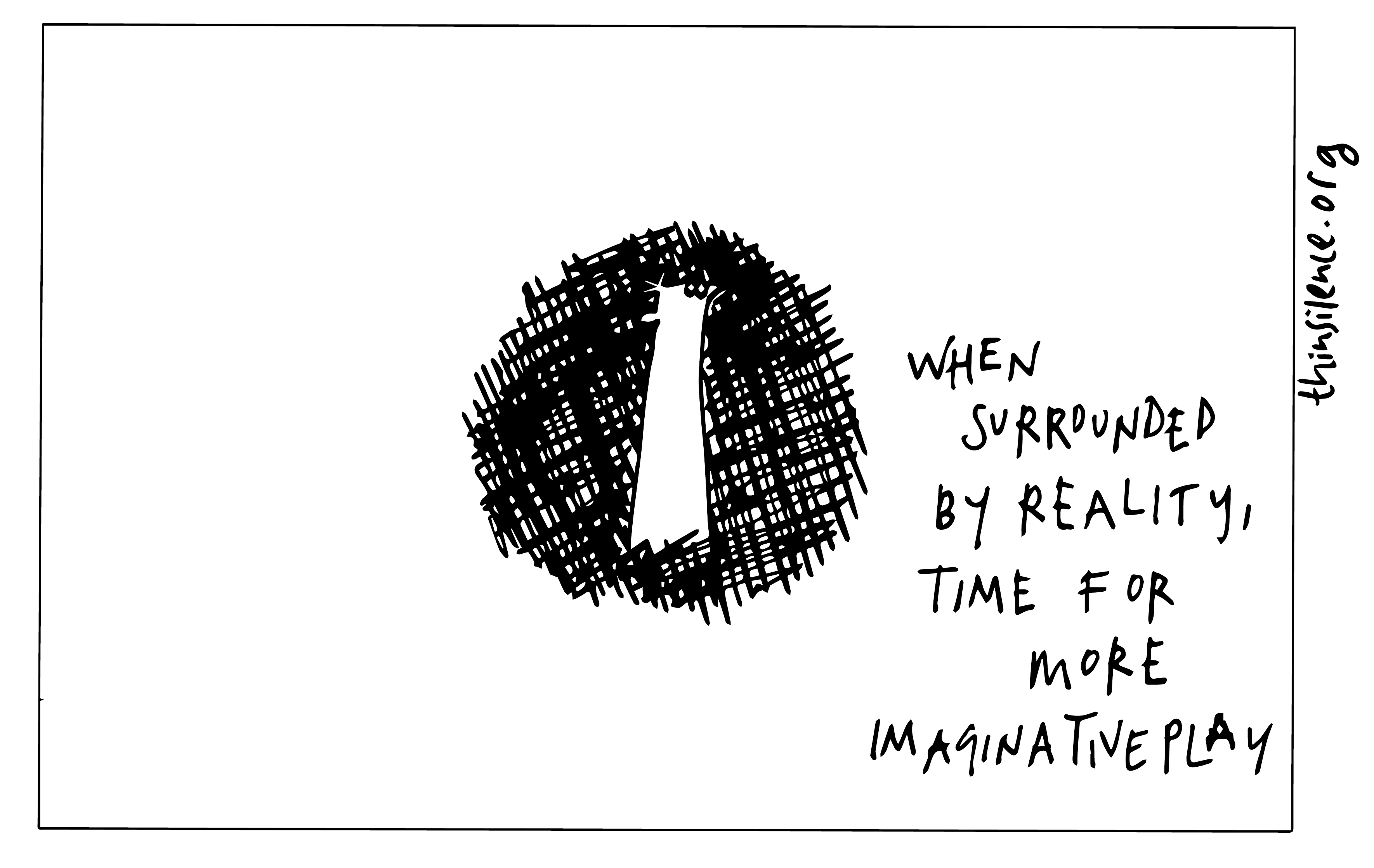
Partly winter and partly Covid-19, I’m noticing that getting up in the morning can take me a little longer. I’m just glad for the process of habits and behaviours that I can slip into that help me to get to the place I want and need to be, but I’ll be upping playfulness and imagination.**

It’s what we have to do in response to the pressure of reality.

(*From gapingvoid’s blog: Are you rethinking what’s important?)

Cape-fitting

The challenge, then, is to have one superpower. All out of balance to the rest of your being. If, over time, you develop more, that’s fine. Begin with one.*
(Seth Godin)

We are all sculptors and painters, and our material his our own flesh and blood and bones.**
(Henry David Thoreau)

We’re not born with superpowers but we can all develop one.

Identify your values, talents and energies.

Notice what moves you from curiosity to concern to commitment.

Explore every day in multiple ways.

Order your cape if you want one, but, remember Edna and never wear one on the job.

The aim is to use our superpowers as much as we can before we run out of days.

(*From Seth Godin’s The Practice.)
(**Henry David Thoreau, quoted in Ryan Holiday’s Stillness is the Key.)

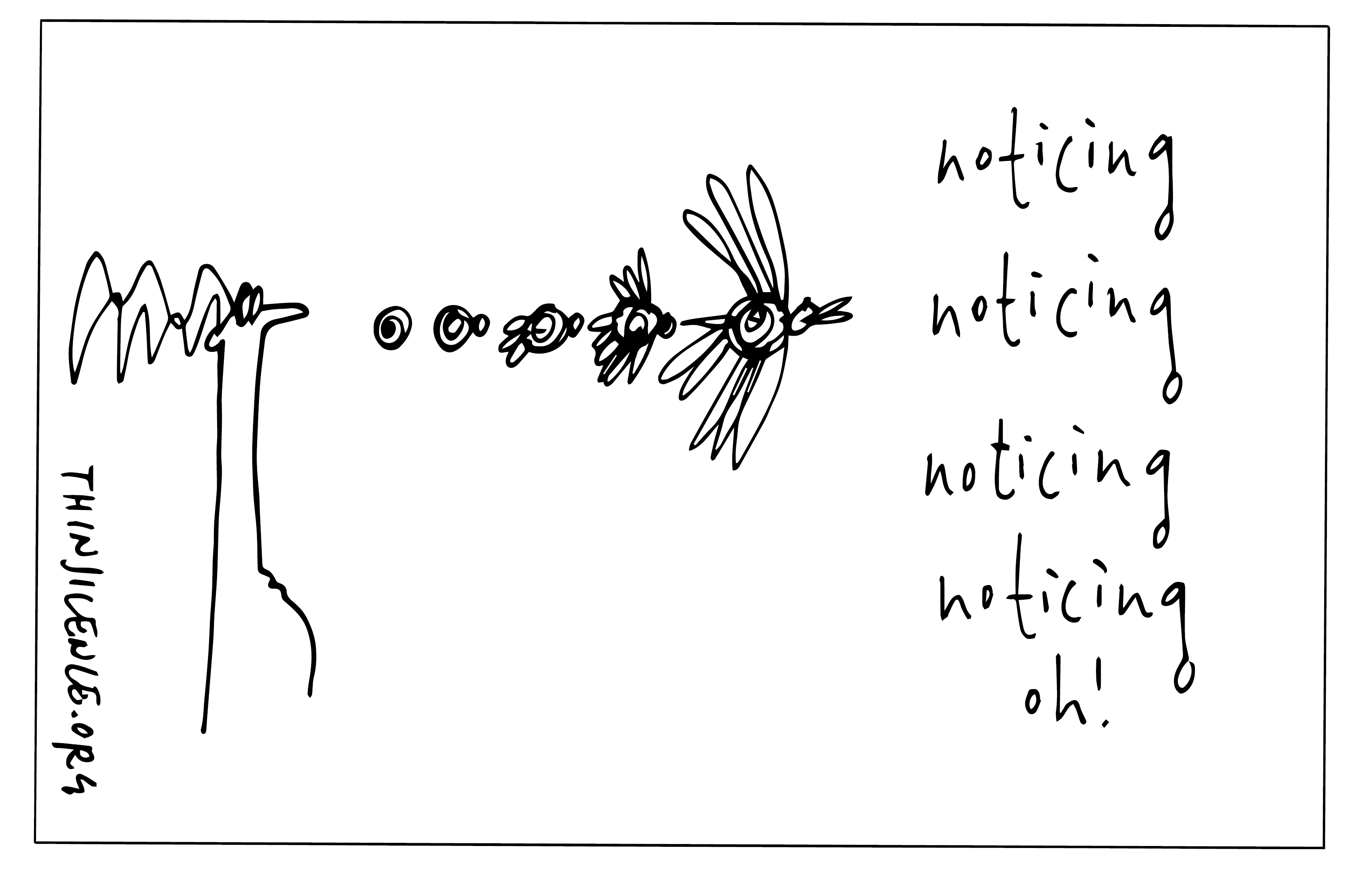
Deeply noticing

Routine, done for long enough and done sincerely enough, becomes more than routine. It becomes ritual – it becomes sanctified and holy. […] A master is in control. A master has a system. A master turns the ordinary into the sacred.*
(Ryan Holiday)

routine becomes a
rite, ordinary becomes
sacred – alchemy!

(*From Ryan Holiday’s Stillness is the Key.)

Set your mind free

Psychological flexibility is the ability to think and feel with openness, to attend voluntarily to your experience of the present moment, and to move your life in directions that are important to you building habits that allow you live life in accordance with your values and aspirations.*
(Steven Hawes)

When 3 and 4-year olds draw, the thing they are drawing can change from one thing into another, surprising them.**
(Lynda Barry)

We can rediscover the ability to change something into something else.

Especially important when it comes to the more difficult thoughts and feelings we have as adults.

I’ve been invited to read Steven Hawes’ A Liberated Mind alongside someone I’m in conversation with. Hawes writes out of personal experience about the Dictator Within, the story his ego had been telling him until he realised he could do something about this, he could change this into something else, identifying six pivots by which he would do this.

In the beginning there are yearnings.

Good yearnings.

Yet the ego’s story tells urges us to feed these in what are harmful ways. Hawes identifies our yearning for coherence and understanding, belonging and connection, to feel, orientation, self-direction and purpose, and, competence.

For coherence and understanding, instead of buying into what our story is telling us, we need to pivot to see this for what it is – simply thoughts rather than the way things really are.

For belonging and connection, instead of believing our conceptualised self-story we need to pivot to a perspective-taking self through noticing and attention.

To feel, instead of avoiding our experiences we need to pivot to acceptance in an empowered state.

For orientation, instead of being rigidly attentive to the past and future (what has happened, what could happen) we must pivot to being flexibly attentive to what is good and is happening now – presence.

To be self-directed and purposeful, rather than being socially compliant we must pivot to personal values – from should to must.

And for competence, instead of perpetually avoiding we must pivot to committed action – step-by-step, habit-by-habit.

Hawes is identifying how we turn from the False Self to the True Self, from the Ego to the Eco. I am already noticing how these pivots can be laid over the U-journey of Theory U and therefore I suspect to to Joseph Campbell’s Hero’s Journey.

Thin|Silence doesn’t aim to be finished and polished, rather it is about listening for whispers and reflecting on what is emerging.

Here’s something to play with through reflective journaling: let’s take each of the six pivots and reflect on where we sense ourselves to be at this moment.

(*From Steven Hawes’ A Liberated Mind.)
(**From Lynda Barry’s Making Comics.)

Humble truth

The path forward is about curiosity, generosity, and connection. These are the three foundations of art.*
(Seth Godin)

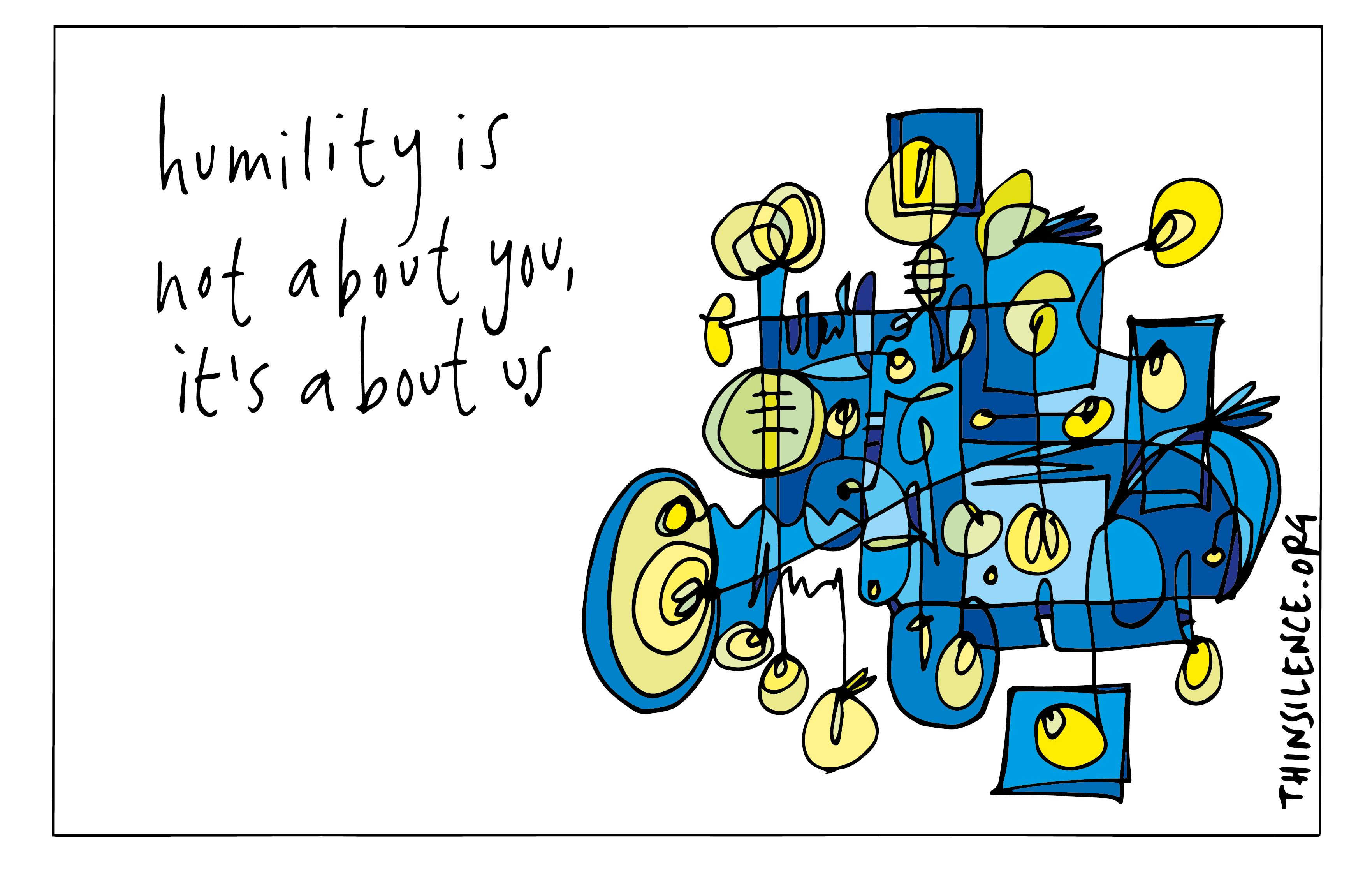
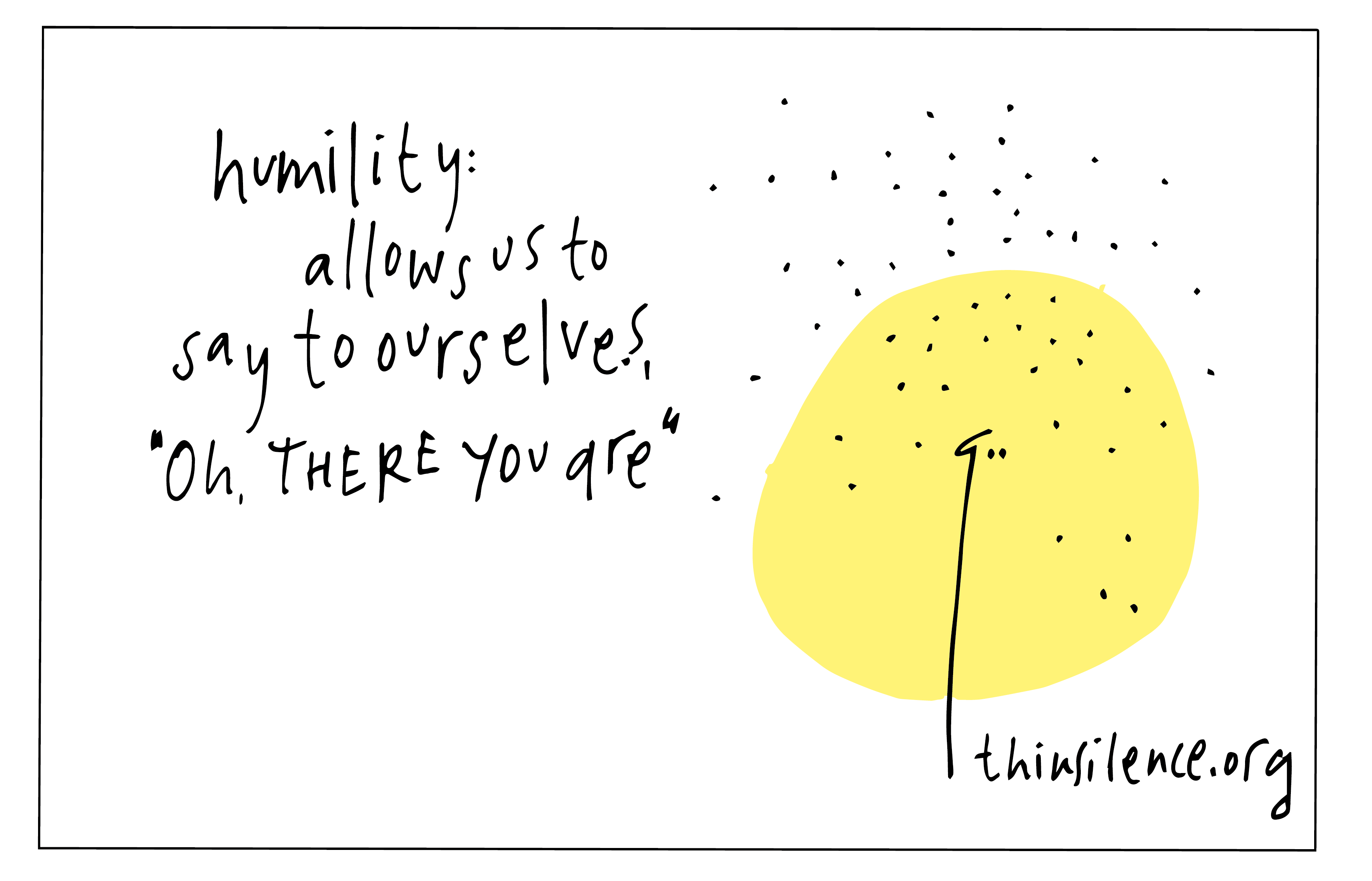
Humility is a seeking of truth: the truth of who we are and what we do in relationship to others, the world, ourselves, god, ideas, things. And there’s a lot more truth in each of us than we allow:

other thoughts, feelings, or behaviours that could benefit others and ourselves but don’t fit the story**.

Identify your curiosity and you will discover your generosity, discover your generosity and you will build connection – what catches you attention and draws you in, what are the values, talents and energies that accompany this from which you make things for others that they need?

Obversely, connect with others and you will be led to your generosity, led to your generosity, you will find your curiosity – what are the needs of those you connect to, how would you like to meet these needs from your values, talents and energies, what is it that you notice to feed these?

(*From Seth Godin’s The Practice.)
(**From Steven Hayes’ A Liberated Mind.)

The generous game

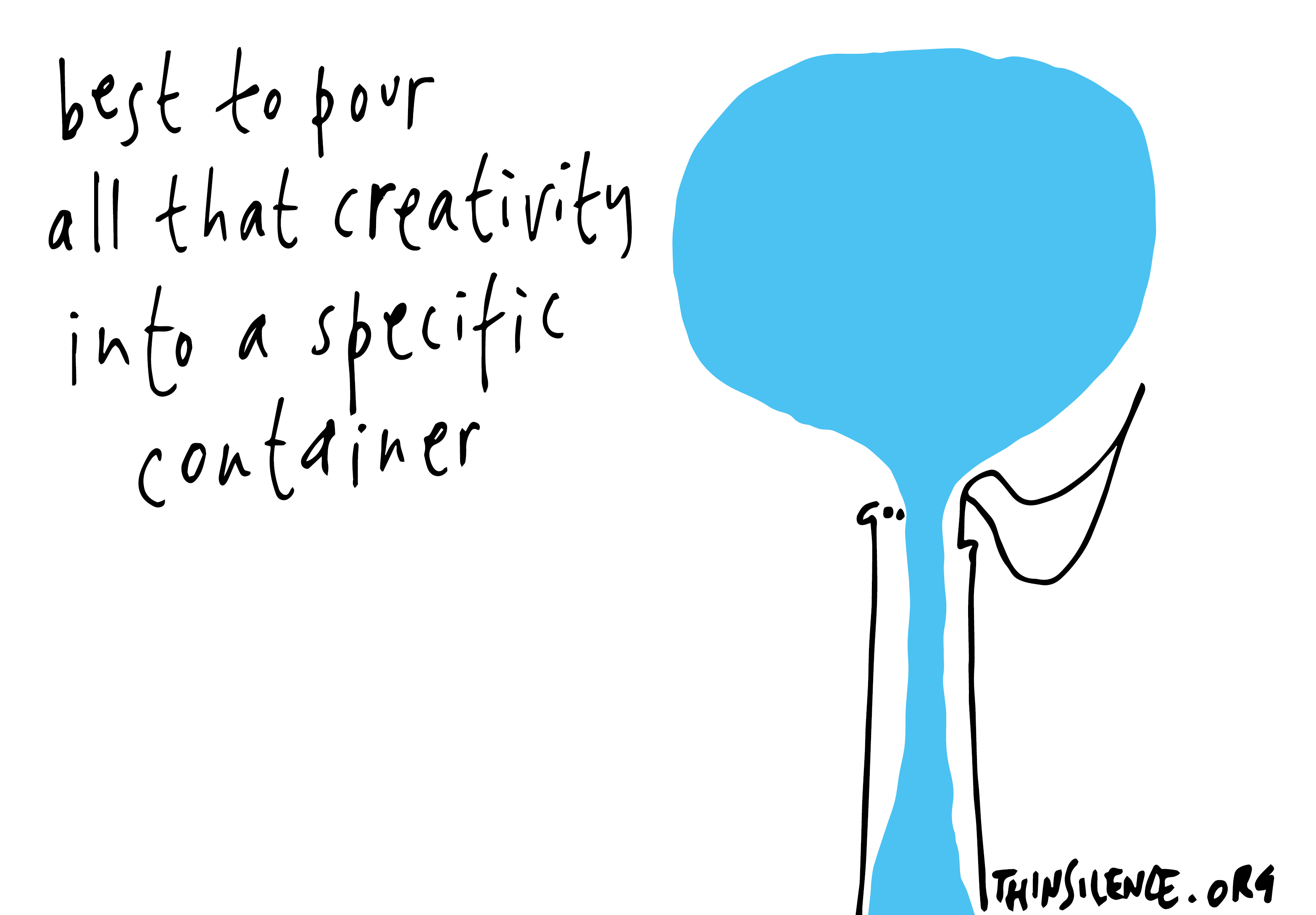
All creative work has constraints, because all creativity is based on using existing constraints to find new solutions.*
(Seth Godin)

Enough comes from the inside.**
(Ryan Holiday

The generous game seeks to include as many as possible for as long as possible.

Some say they don’t have much to play with.

Noticing our constraints, though – basically, what we have and we have not – makes it possible to do our most creative work and bring it to others.

We must notice our quality rather than quantity.

Here’s James Carse writing about how infinite players see time:

Time does not pass for an infinite player. Each moment of time is a beginning of a period of time. It is the beginning of an event that gives time its specific quality.^

Not only does the generous game play with time differently, but within time, also with values, talents and energies. When applied within a purpose, with passion, we find we have enough:

We don’t ship because we’re creative. We’re creative because we ship.*

(*From Seth Godin’s The Practice.)
(**From Ryan Holiday’s Stillness is the Key.)
(^From James Carse’s Finite and Infinite Games.)