Middle time

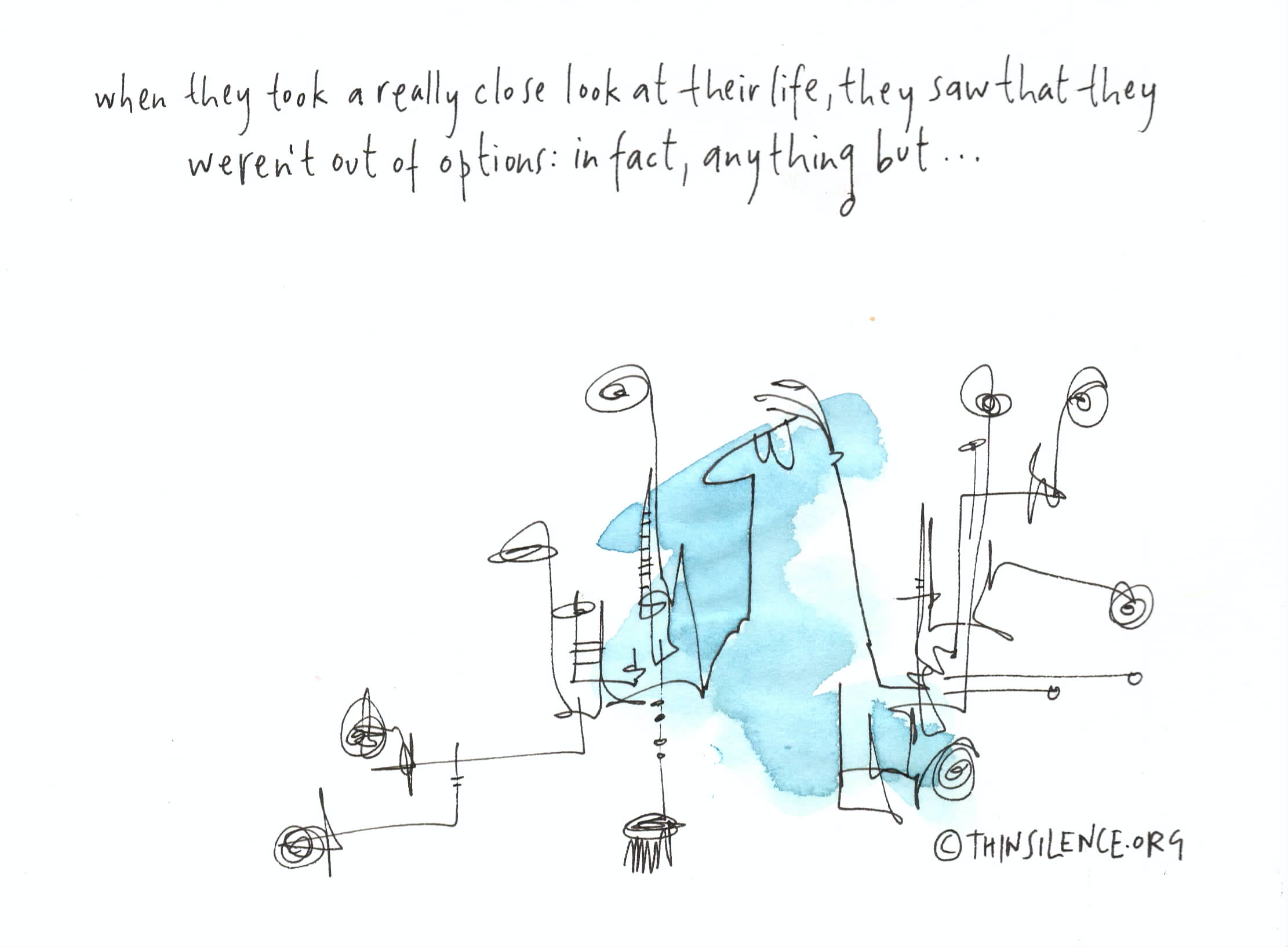
The Greeks believed that time had secret structure.  There was the tie of “epiphany” when time suddenly opened and something was revealed in luminous clarity.  There was the moment of “krisis” when time got entangled and directions became confused and contradictory.  There was also the moment of “kairos”; this was the propitious moment.**
John O’Donohue

There were times when nothing played back.**
Lynda Barry

We love the moment of epiphany:
An idea and its pursuit.

We dream of the kairos moment:
Creation completed and delivered.

In-between lies the ‘land” of krisis:
Plans don’t work, direction is lost, motivation wanes,
Failure looms.

Our habits are important if we are to keep turning up in
krisis
and move on through to
kairos.

You’re in the right place because:

Scientists have … found that to achieve a state of flow, a task must be roughly four percent beyond your current ability.^

But our habits will need to be smart;
That is,
Developing in response to the shape-shifting challenge:

Habits + Deliberate Practice = Mastery^

Make your habits work harder by reflecting and revising.

*John O’Donohue’s Benedictus;
**Lynda Barry’s What It Is;
^James Clear’s Atomic Habits.

Time to confess

This strategy of stepping back and observing our minds at work in the present moment is what unites Buddhist thought, mindfulness-based self-help, [Eckhart] Tolle’s philosophy, and [Accepteance and Commitment Therapy] interventions.*
Anna Katharina Schaffner

Reduce the friction associated with good behaviours. … Increase the friction associated with bad behaviours.**
James Clear

Sometimes I play with the word confession:
Confess what is good and wonderful about
yourself.

Try this at least once a day
Journaling being a great place to be both
playful and serious about confessing.

We become aware,
Though,
How other things impede our goodness and wonder,
And then the more traditional sense of confessing
becomes a blessing
for getting out
and sorting through the rough and not so splendid stuff.

Better out than in.

Whether to the universe, a journal or your god,
A practice of resetting and realigning at least once a day,
And perhaps several times,
Is a great way of getting back to living
life in all its fullness.

*Anna Katharina Schaffner’s The Art of Self Improvement;
**James Clear’s Atomic Habits.

Our silent places

In their intense meditation the hidden sound of things approaches them and they listen reverently while in the street outside the people hear nothing at all.*
Nassim Taleb

TO FOLLOW A WANDERING MIND means having to get lost. CAN YOU STAND BEING LOST?**
Lynda Barry

Where are your silent places?

I find myself increasingly drawn into
silence.

Whilst the world becomes noisier and busier,
Many still shape
or fall lost into
wandering and wondering spaces,
Open to about what
may want to be,
within but also
between them.

*Nassim Taleb’s Fooled by Randomness;
**Lynda Barry’s What It Is.

Welcoming problems?

The function of the artist is the mytholisation of the environment and the world.*
Joseph Campbell

Not all problems, of course, but certainly some,
The kind that bring the best out of me
and grow me as a person.

It’s been said that life is basically coming up with solutions
for one problem after another –
What will I eat?,
My clothes need replacing,
How can I get there on time? …

How can I better serve my customers?
What kind of design will work best?
How to give expression to that idea? –

I’ve been on holiday for a couple of weeks,
Something I really enjoy and feel privileged to have,
But while returning to work takes me back into a different pace of life,
Into a different routine,
I’ll also be returning to some more chewy problems,
The kind that are more satisfying to work on,
The kind that demand more of me.

As storytelling animals,
We have the ability to shape our days to be more
enriching and
fulfilling.

In his book Hero on a Mission
Donald Miller writes about how

In stories, there are four primary characters:

  1. The victim is the character who feels they have no way out.
  2. The villain is the character who makes others feel small.
  3. The hero is the character who faces their challenges and transforms.
  4. The guide is the character who helps the hero.**

In our daily stories,
We’ll play each of these characters.
Being aware of this allows us to be less of a victim and villain,
And more of a hero and guide.

*Joseph Campbell and Bill Moyers The Power of Myth;
**Donald Miller’s Here on a Mission.

Just a doodle 39

alacrity/əˈlakrɪti/noun – brisk and cheerful readiness.

Attention is like energy in that without it no work can be done and in doing work it is dissipated. We create ourselves by how we invest this energy. Memories, thoughts, and feelings are all shaped by it.*
Mihaly Csikszentmihalyi

A “flamboyant” worker, exuberant and excited, is willing to risk control over his or her work: machines break down when they lose control, whereas people make discoveries, stumble on happy accidents.**
Richard Sennett

*Mihaly Csiksentmihalyi’s Flow;
**Richard Sennett’s The Craftsman.

Just a doodle 38

Why does confessing to a journal make people feel better? The main benefit of catharsis is that it gives people the opportunity to shape a new narrative.*
Jonah Lehrer

It’s time to let go. It might be time to sacrifice what you love best, so that you might become who you might become, instead of staying who you are.**
Jordan Peterson

*Jonah Lehrer’s A Book About Love;
**Jordan Peterson’s 12 Rules for Life.

Just a doodle 37

It is art that sings to us and opens our hearts to one another.  It is art that gives meaning to things that otherwise go unnoticed.  And that connects us to our past.  And that laughs at our hubris and limitations, while speaking to us of the darkness we cannot say out loud.*
Brian Mau

The point of curating trends is to see what others don’t and to predict a future that can inspire new thinking.**
Rohit Bhargava

*Quoted in Warren Berger’s Glimmer;
*Non Obvious 2019.

Just a doodle 36

[T]he human individual lives usually within his limits; he possesses powers of various sorts which he habitually fails to use. He energises below his maximum, and he behaves below his optimum.*
William James

You are strong, self-sufficient, you make time for reading, thinking, quiet contemplation, meditation, or prayer. This need not cost a penny.**
Tom Hodgkinson

*Quoted in Angela Duckworth’s Grit;
**Tom Hodgkinson’s Business for Bohemians.