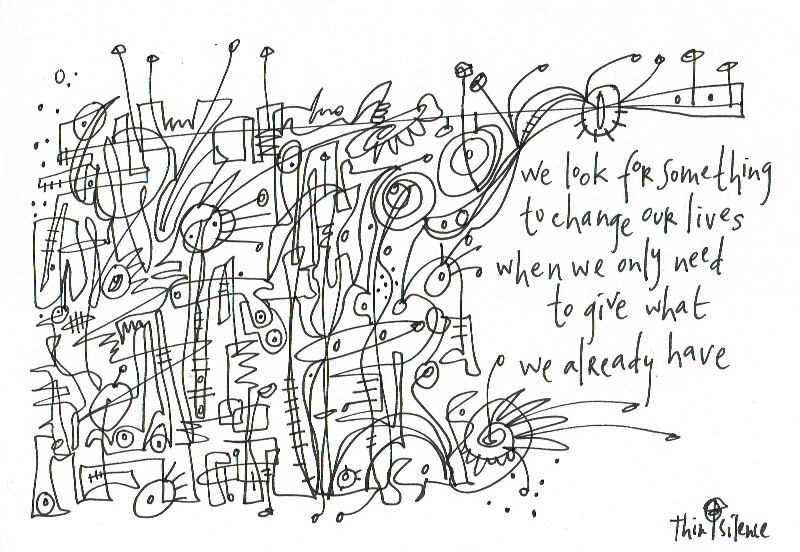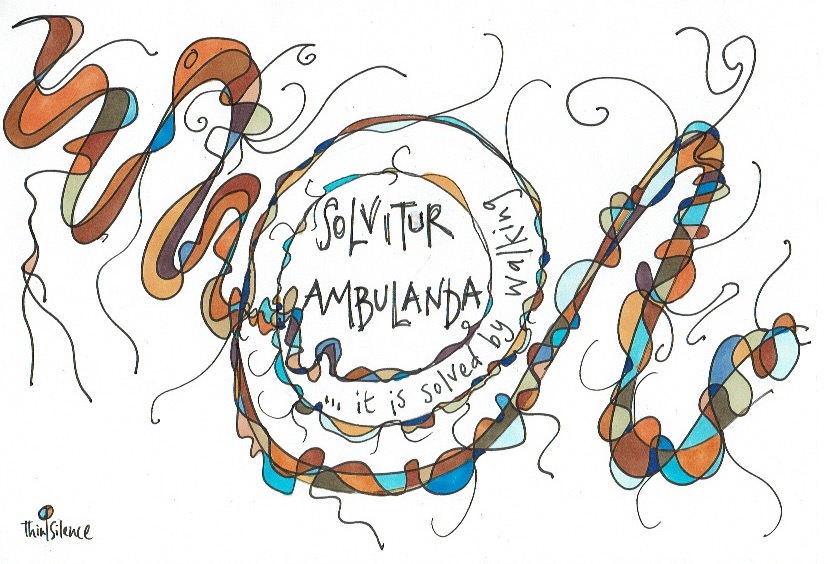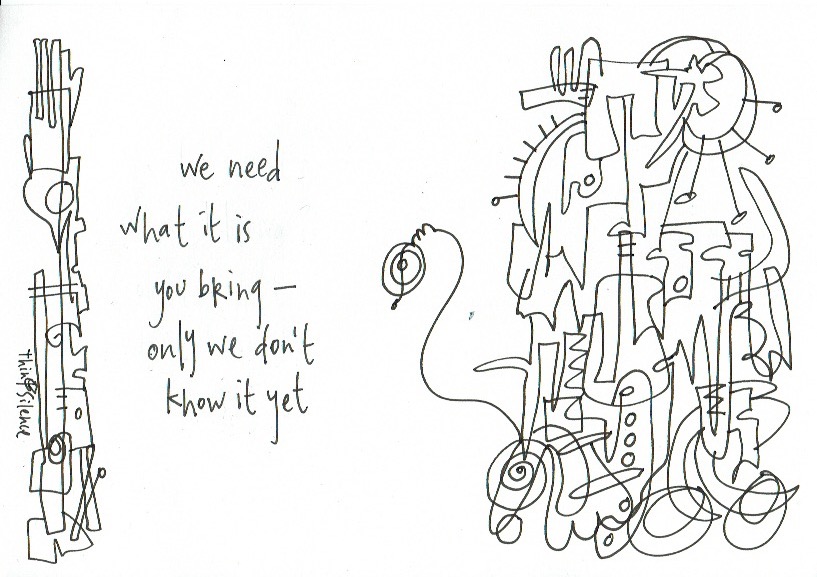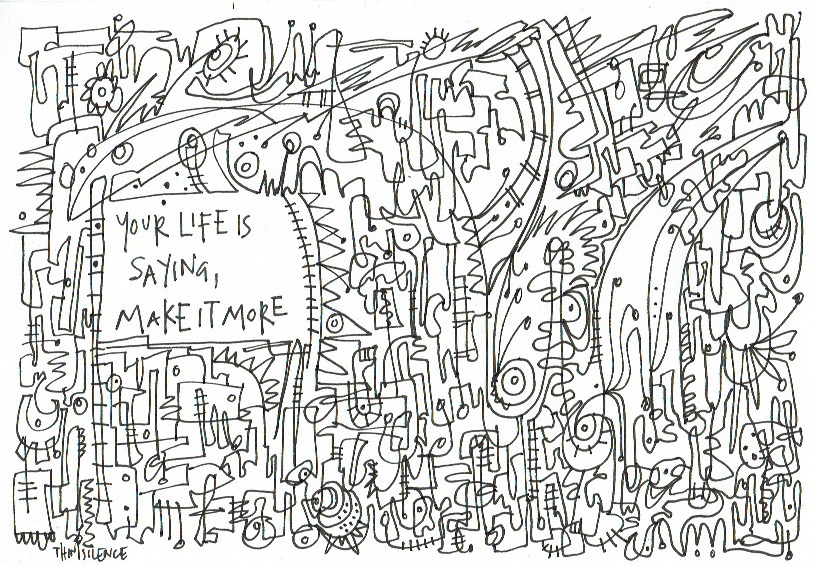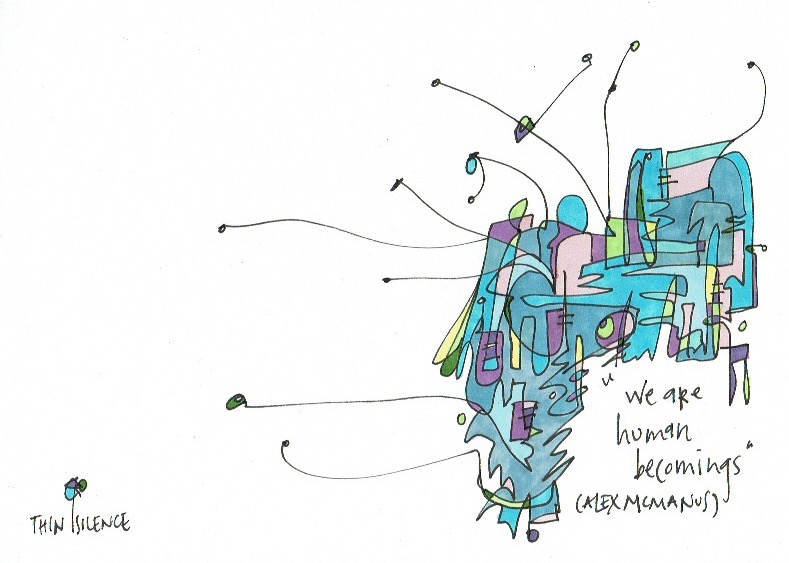
this day has never happened before so how can we stay on track?

8 we are curious

‘You must remain attentive in order to be able to receive.’*

‘To the loving eye, everything is real.’

I might try and focus on what’s important to me at the beginning of the day, but I find myself wandering the further I get into the day.

Here are two things I’ve been trying to keep focused with:

A loving eye – which changes everything I may see in the day – including compassion, kindness, gentleness, and patience.

The second thing is curiosity, which keeps me open to the new and unfamiliar.

Then imagination and goodness get a chance.

(*John O’Donohue, quoted in the Northumbria Community’s Morning Prayer.)
(**From John O’Donohue’s Anam Cara.)

itchy, cranky people

7 scratch

‘Mortals must do what they are here to create or they will become cranky.’*

‘Every missed rite of passage led to a new rigidification of the personality, a lessening ability to see, to adjust, to understand, to let go, to be human.’**

We all get itches. Have you noticed, when you thoughtlessly scratch an itch it gets worse?

And when we go through life with an itch of something we could contribute, some art to bring, but thoughtlessly scratch it, the art doesn’t emerge and we just get crankier.

Here are three rites of passage we can use to do some thoughtful scratching and move from itch to art:

Notice your itch, what it is, why it’s there, who’s causing it, when is it’s most itchy.

Allow yourself to feel the itch, for it to guide you, even define you, transforming from an itch to an urge.

Do something about what you are seeing and feeling.  Try out the art that emerges from the itch. Offer it to others.

Now who’s cranky?

Not you.

‘When you make a dream come true for yourself, it’ll be a dream come true for someone else too.’^

(*From Seth Godin’s Tales of the Revolution.)
(**From Richard Rohr’s Adam’s Return.)
(^From Derek Siver’s All You Want.)

telling the story

6 telling the story

‘”What was most useful for you about this experience?”  Answering that question extracts what was useful, shares the wisdom and embeds the learning.’*

“All sorrows can be borne if you put them into a story or tell a story about them.”**

When we take time to reflect, we can pick out the things that we don’t want to pursue, but maybe valuable to others.

Other things intrigue us, but knowing so little about them, we set out to learn more.

Some things fall into our category of “not welcome here anymore,” and we take steps to rid our lives of them.

And then there are the things which we identify as being what our lives must be about – these are the things to pursue.

We’re learning how to tell the stories rather than allowing the stories to tell us.

(*From Michael Bungay Stanier’s The Coaching Habit.)
(**Karen Blixen, quoted in Stephen Grosz’s The Examined Life.)

did you see that?

5 reflecting

You did, but you’ve probably already forgotten.

A key ability for doing astonishing work is interrupting our forgetting.

Others may have considerable skills and intelligence, but if they forget what they’ve come upon and you don’t, you provide yourself with an advantage for doing something valuable to bring to others. In fact, giving away what you’ve seen – in your own words – is a way of interrupting forgetting.  Reflecting is another way – reflecting being a way of practising remembering.

What did you learn?

What do you want to remember?

What was most useful to you?

‘The shortage is in people willing to do it.  To take a leap.  To walk onto the ledge and start.’*

Why not use what others forget?

(*From Seth Godin’s Poke the Box.)


yes, that’s good

4 how do you

‘People don’t really learn when you tell them something.  They don’t even really learn when they do something.  They start learning, start creating new neural pathways, only when they have a chance to recall and reflect on what just happened.’*

I often hear people sharing things they miss the “glory” of.

Robert McKee writes about how movies allow us to both experience something and to reflect upon it.  We don’t get the chance to reflect on life very often.**

It doesn’t particularly matter what kind of reflection you make your own, but reflecting on life opens up possibilities of greater glory, like being able to mark an experience on a map so you can go there many times.

(*From Michael Bungay Stanier’s The Coaching Habit.)
(**See Robert McKee’s Story.)

personal myths and what comes from beyond

3 living our personal myths so others may live theirs

“It takes the ancient form of the quest: the hero journeys to a far-off place, gains something valuable and returns.”*

Many great stories begin because of an interruption.  The main character or protagonist is thrown off their expected path, tries frantically to get back, but realises the only way to go is forward, discovering things about themselves – good and bad – that they didn’t know, and, dealing with their demons and growing in their humanity, return to a new beginning.

There are everyday interruptions that can be used to live out our personal myth-quests in our day-to-day lives.  The interruption from beyond can take different forms – a person, an idea, a challenge, an invitation, a question … .

These are thin|silence moments, when we’re open to that which comes to us from beyond, altering the way we frame a day.  These myths are personal because we all discover and prepare for our own from the beginning of the day.

(*Philip Pullmann in the introduction to Lionel Davies’s Kolymsky Heights.)

the important no

2 heart and mind and will in flux

‘The leading edge thinkers in physics … suggest that nature is not a collection of objects in interaction but is a flux of processes. The whole notion of flux and process in fundamental to the indigenous sciences.’*

“To be on a quest is nothing more or less than to become an asker of questions.”**

There is the way of the mind, by which we progress through using all the information we can.

There is the way of the will, by which we move forward through trials, testing, and experimentation.

There is the way of the heart, by which we move forward according to what we must say yes to.

Many cannot wait to discern their heart and act on the information to hand, whilst others believe the best way to progress is to start moving, throwing themselves into activity.

Those who discern their heart, know the value of information and the importance to act, but also understand in order to say yes to the right things for themselves, they have to say no to the wrong things.

Of course, this is the way we have always progressed, through choice after choice, saying yes to this and no to that, yes to this and not to that – it’s almost binary.

“Thinking of the heart”^ is simply about doing this better, searching for more information and knowledge and moving faster into action (specifically, prototyping) from a deeper place of knowing and motivation, because this is the right path for us.

(*From Joseph Jaworski’s Source.)
(**Sam Keen, quoted in Michael Bungay Stanier’s The Coaching Habit.)
(^See Peter Senge’s The Necessary Revolution.) 

quirks

1 quirkiness

“Live from day to day, just from day to day.  If you do so, you worry less and live more richly.  If you let yourself be absorbed completely, if you surrender completely to the moments as they pass, you live more richly those moments.*

We’re all quirks in this universe.

Quirkiness is about being present to who we are and what we have and being true to living this out.  It is about being present to ourselves in a way that makes it possible to bring this powerfully into the moment.  Not to be pulled away wishing we were someone else, or feeling we need something more.

Then, amazing things are possible when people find each other in their quirkiness in a place of mutual surrender that makes it possible ‘for bringing a very diverse group to a profound place of connection with one another and with what it is we are her to do.’**

(*Anne Morrow Lindbergh, quoted in the Northumbria Community‘s Morning Prayer.)
(**Oran Hesterman, quoted in Joseph Jaworski’s Source.)

the immigré

30 what you ask for

‘Emotionally and socially, when you ask for help you are putting yourself “one down.”  It is a temporary loss of status and self-esteem not to know what to do next or to be unable to do it.  It is a loss of independence to have someone advise you, heal you, minister too you, help you up, support you, even serve you.’*

“Wholeness is built into the universe – there is no hierarchy.”**

In the present climate, labelling someone an immigrant feels like “down-grading” their life; it’s something beyond temporary – it might well be the status they must live with and be know by for the rest of their life.

If in the normal course of life so full of helping, we hardly notice the one-upness and one-downiness Edgar Schein is referring to in the quote, above.  The greater the down-ness, the greater the up-ness.  The person being asked to help is being invited to play a noble role, the “helpee” bestowing their potential helper with power and value.

Whether this relationship of help is temporary or more permanent, it is a relationship of imbalance marked by vulnerability on one side and power on the other, but as quantum physicist Basil Hiley proffers, the universe doesn’t encourage hierarchy.

We know we cannot say yes to everything – even Carl Allen understands this now.  In between Yes and No, though, there is a third response.  It is what Michael Bungay Stanier calls a “slow Yes”:

‘Saying Yes more slowly means being willing to stay curious before committing.’^

This slow Yes allows us to open our minds, open our hearts, and open our wills in an imaginative and creative way; it makes it possible for us to see people with hopes and dreams, and pain and dis-ease.

We provide the person who is not like us – the stranger, the alien, the immigrant – with respect and dignity.  Emmigrés are those who have left us to settle in another country.  Why not think of those who join us as immigrés?

(*From Edgar Schein’s Helping.)
(**Basil Hiley, quoted in Joseph Jaworski’s Source.)
(^From Michael Bungay Stanier’s The Coaching Habit.)

delicious

29 it is in our delicious stories

Umami is the Japanese word for delicious flavour.

Until French chef Auguste Escoffier and Japanese chemist Kikunae Ikeda proved otherwise, it was thought that the human tongue could only detect four tastes: sweet, sour, bitter, and salty.

Ikeda was able to identify the amino acid L-glutamate behind the delicious seaweed soup his wife would make him; this led to the creation of monosodium glutamate – the connecting of the acid with a salt being necessary for stability.

Another interesting dimension is that the amino acid is only released from life-forms by proteolysis: ‘a shy scientific term for death, rot, and the cooking process’*

All of this set me to wondering about our experiences of life.  There are sweet and sour experiences, salty and bitter ones, but what about the ones we can only describe as delicious.  What if delicious adds something more to the other flavours?

‘Helping is, therefore, both a routine process of exchange that is the basis of all social behaviour and a special process that sometimes interrupts the normal flow and must be handled with particular sensitivity.’**

What if helping is the basic component of the delicious life in a similar way to how L-glutamate is essential to delicious taste?  As it were, our different experiences of life make it possible for us to be better helpers of others?

With the knowledge that something has to die or decline for this amino acid to be released, I found myself wondering about the five elemental truths, identified in ancient cultures as children moved into adulthood, towards a contributing life.  They each require something to die in order for a larger life to be lived:

Life is hard
You are not as special as you think
You life is not about you
You are not in control
You are going to die.^

What if each of these truths is meant to be completed in a delicious way?

Maybe the salty and bitter and sweet and sour and delicious things in life help us to know we are alive?

Umami.

(*From Jonah Lehrer’s Proust was a Neuroscientist.  Apparently humans produce 40 grams of L-glutamate a day and need to replenish it.)
(**From Edgar Schein’s Helping.)
(^See Richard Rohr’s Adam’s Return.  In a meeting with two others at lunchtime today, we decided to share a cheese and maple syrup muffin, to see what a savoury-sweet muffin tasted like.  I was telling them about these thoughts and one mentioned how restaurants can order the course of a meal so they flow through each flavour.)