i think you’ve mistaken me for someone else

28 the great i am

Me? I am Geoffrey.

‘Any time that we move from personal names to abstract labels or graphs or statistics, we are less in touch with reality and diminished in capacity to deal with what is best and at the centre of life. … For a name addresses the uniquely human nature.  A name recognises that I am this person and not that person.’*

When we find ourselves living increasingly within our roles and titles and functions, or the expectations of others or of self, we become less than who we are.

A long time ago my parents named me.  Many years later I was named again, by a group of people who had come to know me well.  The way it worked, I could not name myself, but could accept or reject the group’s name for me:

“To be called by his true name is part of any listener’s process of becoming his true self.  We have to receive a name by others; this is part of the process of being fully born.”**

We all need moments when we are able to simply rest in who we are.  And when we are who we are, then we can know what we want to make:

‘[Cézanne] knew that the mind makes the world, just as a painter makes a painting.’^

(*From Eugene Peterson’s Run With the Horses.) 
(**Eugen Rosenstock-Huessy, quoted in Eugene Peterson’s Run With the Horses.)
(^From Eugene Peterson’s Proust Was a Neuroscientist.)

more or less

27 we have called your name

‘Some people as they grow up become less. … Other people as they grow up become more.’*

This is a choice we make.

Today I become 57 years young, and I am moving on.  Out of the organisation I’ve been with for 36 years and into dreamwhispering and doodling.

A number of people think I’m retiring – I certainly I know people my age who are doing just that, but this is a beginning.

I have come to know what I must do and am moving forward.

All those 57 years ago, my parents Marjorie and Jack gave me a name, and life got personal.  And I remember when Christine and I named our own children: Matthew, Charlotte, and Luke.  This was a thing of hope.

My work with others is on first name terms, journeying together, something hopeful lived towards the future.  About life being more, not less.

How we go about it is our choice: it’s personal.

‘Life is a continuous exploration of ever more reality.  Life is a constant battle against everyone and anything that corrupts and diminishes it’s reality.’*

(*From Eugene Peterson’s Run With the Horses.)

isn’t that a little … radical?

26 where the adventure

Usually asked when we think someone has gone too far.

‘[You are] called to a life of purpose far beyond what you think yourself capable of living [and you have] adequate strength to fulfil your destiny.’*

Radical’s etymology is in rootedness and going to the source.  What we point to as being too radical may simply be someone exploring life.

Tragically, many have give up on living long before they die.  This place of exile from life can be arrived at when it is wrongly believed that more is needed to be able to live a better and more significant life.

What each have enough, all we need to begin now.  We simply have to reorganise it by noticing our energy, valuing our experiences, and identifying our talents.

One thing radicals share is their orientation towards the future; being ‘anchored in the future rather than the past, drawn forward by what they truly want to see exist in the world.’**

(*Slightly adapted from Eugene Peterson’s Run With the Horses.)
(**From Peter Senge’s The Necessary Revolution.)

the salon of the refused

25 welcome to

In 1863, Emperor Napoleon III held a Salon of the Refused for those artists rejected for the annual art exhibition of the Academy of Fine Arts.

The meaningful work you believe you must do will not necessarily be recognised by the establishments and powers that be.

You need to get used to this and move on in order to continue developing the unique contribution just where it matters most, in the eyes and lives of those you produce your art for.

One day the establishment may recognise what you’re doing, but let’s be honest, that’s not the reason you’ve taken this path.  And, just like Napoleon, you too can create salons of the refused.*

(*Following writing this, I found myself listed amongst the members of just such a salon; we are living in interesting times.)

the journey makes us

24 it is the journey 1

‘The puzzle is why so many people live so badly.’*

‘At the deepest level of the human heart there is no simple, singular self.  Deep within us there is gallery of different selves.’**

In Florence’s Academia Gallery, four unfinished statues of slaves line the approach to Michelangelo’s David.  These four are also by Michelangelo and they have fascinated me ever since I first heard about them.  They epitomise the quest we find ourselves born into – to free ourselves in order to become all that we can be.

IMG_1303

The struggle is to be free of judgement (this is it), cynicism (who cares?), and fear (what will happen if … ?) – from both within and without.  Someone once told me there’s a theory that Michelangelo never intended finishing these statues.  Maybe the quest will remain an unfinished one, and, yet, this is where we find life.

The journey makes us.

(*From Eugene Peterson’s Run With the Horses.)
(**From John O’Donohue’s Anam Cara.)

clarity is elusive

 23 did you know

“I have no idea where I am going.”*

‘Creative people must accept that challenges never cease, failure can’t be avoided, and “vision” is an illusion.’**

‘Instead of giving us fully realised forms, Cézanne supplies us with layers of suggestive edges, out of which forms slowly unfurl.  Our vision is made of lines, and Cézanne has made the lines distressingly visible.’^

Our eyes sees lines; our brains fill in the rest.  If for whatever reason this doesn’t work then we ‘see the world as such a hopeless commotion of fragments.^

848548dc507572c3771d5efa053e2349

If we can’t see the “lines,” the clarity we seek in life is difficult to find, too – and there’s always something we fail to see, always something new to see.

We need to find the kind of lines that will allow the bigger picture clarity to emerge.  We’re all able to find the lines of our curiosity, identify the lines of our talent, and practice the lines of your resulting “art.”  The rest will emerge, but these words from Pixar’s Ed Catmull are worth repeating:

‘Creative people must accept that challenges never cease, failure can’t be avoided, and “vision” is an illusion.’**

(*Thomas Merton, quoted in the Northumbria Community’s Morning Prayer.)
(**From Ed Catmull’s Creativity, Inc..  Pixar has to work very hard to produce a great movie out of the chaos and complexity of production – an illustration of life.)
(^From Jonah Lehrer’s Proust was a Neuroscientist.)


what do you see?

22 i love it

‘This is Cézanne’s genius: he forces us to see, in the same static canvas, the beginning and the end of our sight.  What starts as an abstract mosaic of colour becomes a realistic description.  The painting emerges, not from paint or light, but from somewhere inside our mind.’*

‘In shaping life beyond the Bubble, many visions will be needed.’**

Whilst we each see our world similarly enough to make everything we have made together work, we know that we each see our world significantly differently to make everyone’s contribution important – and the most complete picture only comes into view when we allow for the time dimension, including the future and the the past as well as the present.^

We have to admit, we don’t know what humans are capable of yet.

All of this means that it is important that you bring your seeing, and the art that emerges from how you see.

Life is coming into focus.

(*From Jonah Lehrer’s Proust was a Neuroscientist.)
(**From Peter Senge’s The Necessary Revolution.)
(^I dropped my watch into a sink-full of water this morning, so I wasn’t wearing it as I lost track of time earlier today; I realised how I need my watch to “see” where I am in time.)

we are explorers of today

21 today is

“all moments are key moments, and life itself is grace”*

‘This is what Proust knew: our memories remain wonderfully volatile,  In their mercurial mirror, we see ourselves.’**

We are strange creatures.  We do not remember well, we struggle to notice the present, and we do not have time to think about the future.  Yet we live in an incredible and colourful playground which everyday invites us to learn how to see more:

‘full spectrum light, clear water, deep sky, red squirrel, blue whale, grey parrot, green lizard, golden aspen, orange mango, yellow warbler, laughing child, rolling river, serene forest, churning storm, spinning planet’.^

We have a lifetime pass to this astonishing playground in which we are not only discovering “out there” but also “in here,” coming to terms with being creatures who dwell not only in the present, but also in the past through our dynamic memories, and the future through our imaginations.

Reality really is more fantastical than Disney’s Magical Kingdom.^^

Even lifetime passes expire eventually, mind, but we can become explorers of today through opening our minds, opening our hearts, and opening our wills.

(*Frederick Buechner, quoted in the Northumbria Community‘s Morning Prayer.)
(**From Jonah Lehrer’s Proust was a Neuroscientist.)
(^From Brian McLaren’s We Make the Road by Walking.)
(^^Other magical experiences are available.)

if you must

20 the best things

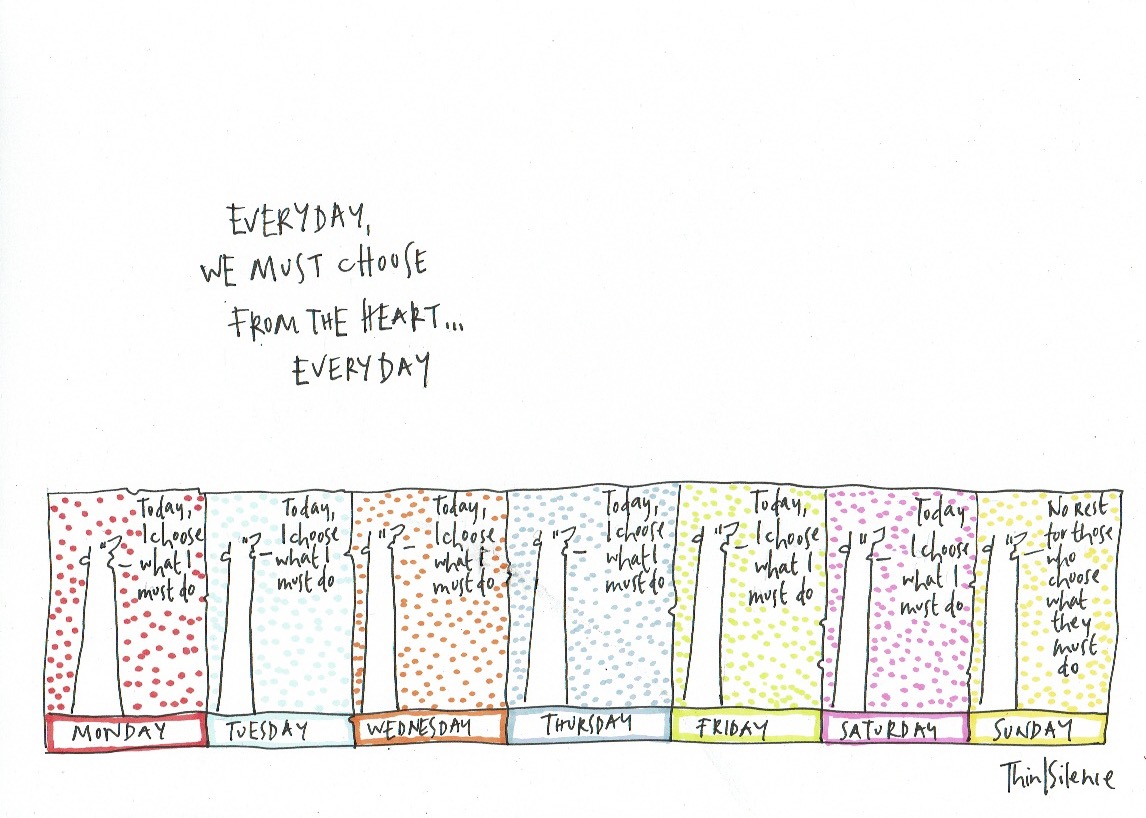
We cannot be given must, we can only uncover it.

The most helpful people we’ll come across are those who enable us to go deeper, they are not those who come to us with the answer – their answer, or the one they know we want to hear, otherwise:

‘The client not only abdicates responsibility for making the diagnosis … But assumes, in addition, that an outsider can come into the situation, identify problems, and remedy them.’*

This underlines how, in order to help you, I need to know what you really need, and you need to have reasonable expectations of what I can do.

Otherwise this can translate into a quick-fix answer being expected, and quick-fix answers rarely help.  Instead we need to slow things down, develop trust, and be willing to collaborate – I’ve been identifying recently how, through my dreamwhispering how I’ve often found myself exploring a new path with others.  It’s not the one they’ve been walking, nor is it the one I want them to walk, but it’s a new path discovered together, which they take the lead on.^

Values are a great place to begin when it comes to identifying our mustness.  Finding someone you can trust and collaborate with towards identifying and articulating your values is to find a great helper and to identify the path you must use.

When we connect what we must do to our highest values – all found within you – then something powerful and lasting begins:

‘I want you to live these values, I want you to feel these values every day.’**

(*From Edgar Schein’s Helping.)
(**From Michael Heppell’s How to be Brilliant.)
(^Check out this great little blog from Hugh Macleod on how results come from trust and collaboration.)

others and me

19 others and me

‘People creating together work in different ways. … They learn how to let go of having to have everything worked out in advance and to step forward with boldness into immense uncertainty.  And they learn that tapping these capacities cannot be achieved without people being who they truly are and learning how to integrate their own lives.’*

The question, What do you need? perhaps is really asking, Who do you need?

We need others if we are to become who we can be; that’s certainly been my experience. It’s been about finding the people who know how to get to what our lives are ultimately capable of.

When we begin with what we have, bringing our art into the world, we find others to connect with.  These, in turn, help us become more who we are.

This is the dynamic relationship between others and me.

(*From Peter Senge’s The Necessary Revolution.)