without precedent

28-between-an-unprecedented

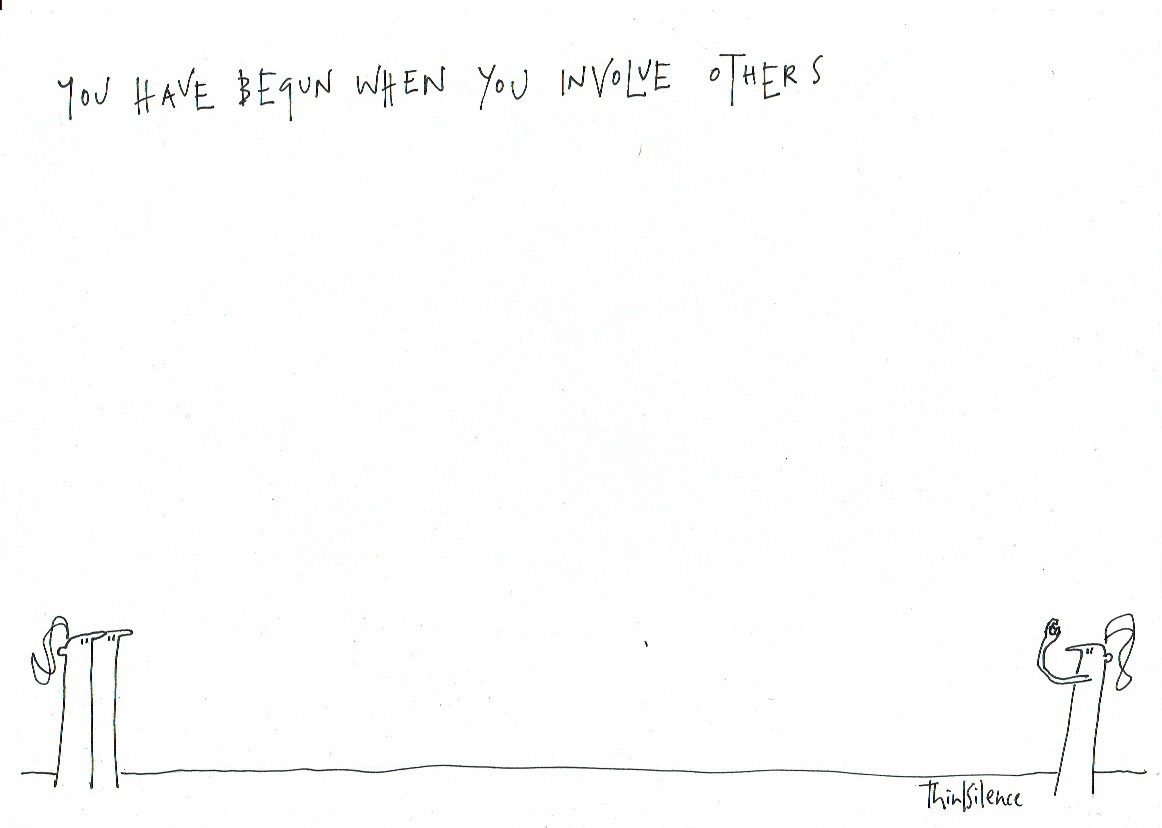
This has never happened before doesn’t mean this can’t happen now.

This has never happened to me doesn’t mean that this cannot be begun by you now.

What can the future be that the past has not been?  What is your dream?

Beginning with your kind of electricity, the energy unique to you, what are you noticing and others don’t – the things others miss you can’t help dreaming about?

‘The wanderer becomes one with himself or herself and the universe.  We connect with the energy of all living things.  We live according to ur inner nature.’*

You create precedence.

(*From Keri Smith’s The Wander Society.)


and in the end

27-and-every-day

I seize today as another opportunity to fill my days.

This doesn’t require something big and momentous; it’s said of Walt Whitman that he gained pleasure from the ordinary things he came upon while sauntering and strolling.

It’s not what we have but what we appreciate about and/or do with what we have.  I sense this to be a great adventure opening for 2017.

It’s in this effort life invites us to make, so incomprehensible to those who look for the least disrupted and safest path, when wrapped up in the vulnerability that is about trying and failing and trying again that in the end  produces the gift we make to others.

blessed are those who look for they will see more

‘The very nature of the universe invites you to a journey and to discover it.’*

‘I closed my eyes and tried to remember the way everything had looked as I walked home.  As soon as the image started to form in my head, I began to draw.’**

Our lives and their purpose emerge from what we see.

All see differently and this is because of the universe of possibilities we live in.  Everyone is capable of bringing some different perspective to enrich others, contribute to the world that is our home, and grow ourselves.

The difficult thing is to keep seeing, to be open to see more and more – to always hold an attitude that we have not seen enough of the infinite-more there is to see.  Those who hold this sense of life always see more, and then more still.  It is not about being privileged or celebrity-special in some way but is simply about being prepared to keep looking.

The universe opens to those who seek.

(*From John O’Donohue’s Eternal Echoes.)
(**From Alette Willis’s How to Make a Golem.)

you are the one

“Wherever the hero may wander, whatever he may do, he is ever in the presence of his own essence – for he has the perfected eye to see.”*

‘There is delight in seeing something unexpected … Embrace your flaws.’**

You are the one we have been waiting for.  Rejoicing in your birth, we wait for what it is you bring, the imperfect thing that fascinates and energises you that is better than perfect.

In this, your life is for a greater purpose, it is for our salvation.

Today can be a day of births and beginnings and becomings.

(*Joseph Campbell, quote in Keri Smith’s The Wander Society.)
(**From Rohit Bhargava’s Non-Obvious.)

what we do not see

24-local

‘Read, look into other areas, use different learning mediums, ask better questions, reflect, be open to ideas, be surrounded by learners, and prioritise learning.’*

If we can begin to do what we feel we must do with our lives with what we have – and we all can – who knows what will follow.

That’s the problem, of course: we don’t know.  We fear what we do not know.

There’ll always be fear when it comes to this place of beginning.  An important question then is whether this thing you want to do is worth the fear.

Before this, we must be sure wee’ve opened ourselves to all the adjacent possibilities our lives can be about – there’re an infinite number of outworking to our talents and passions and experiences.

Then we need to be sure that this thing we have settled upon is the most energising of all the possibilities.

If it is then it’s okay to feel the fear – because there will always be fear.  But there’s a trick we can use with fear.

Stare it in the face.  Right now, where you are, with what you have … begin.

More will follow.

(*From Michael Heppell’s The Edge.)

now what?

23-i-am-not-a

“I have no idea where I am going.  I do not see the road ahead of me.”*

You are journeying into the unknown.  Following your learnings and your hunches.  The mix of the two feels odd.  Learnings are tangible, verified by others: hunches are the unknown and very personal.

But what can you do?  This is where you are.  You have a desire to make something invisible become visible:

“You see, there are invisible problems all around us, ones we can solve. But first we need to see them. to feel them.”**

It began with a thought, but the thought became charged with an energy only you can feel, and now what?

It doesn’t feel right.  All of your life you’ve been about settling more and more into knowing exactly what a day should contain and what you have to do within it – from morning to night.  Now there’s some kind of unknown, a mystery, a randomness about which you have no idea of the destination.

‘When we repeat the same activities, day in and day out, we limit our ability to have new experiences.’^

If you dare, take a moment and write down what you must do.  Leave it somewhere for someone to find.

23-i-am-not-a-2

Now what?

(*Thomas Merton, quoted in the Northumbria Community‘s Morning Prayer.)
(**Tony Fadell, quoted in Bernadette Jiwa‘s Meaningful.)
(^From Keri Smith’s The Wander Society.)

who’s listening to you?

22-time-for-some

‘Slowing down … is about allowing room for others and otherness.  And in that sense, slowing down is an ethical choice.’*

“If you can see your path laid out in front of you step by step, you know it’s not your path.  Your own path you make with every set you take.  That’s why it’s your path.”**

This is about being stuck and getting unstuck, about being lost and finding the way again.  And we all get stuck, we all get lost.

Perhaps those who are stuck most of all are the ones who are trapped in the kind of busyness that is more about answers and rarely about questions.

Slow time, contrarily, is about questions – having the time to find things out, including about finding out about ourselves.  Slow listening is open and inquisitive about the whole person, the larger world, and the universe of possibilities.

Over the millennia, humans have developed many tools to help them find some movement with purpose, tools to be used with their most powerful capacities of imagination and reflection: drawing, recording, music, creative writing, books and journals.  Getting unstuck will involve these things in our lives in some personally pleasing way:

‘Intentional silence: Pick a practice that helps you connect to your source.’^

Who’s listening to you?

Who’s your slow listener?

A slow listener doesn’t tell you what you ought to do – more answers – but helps you to hear what is coming from within you by asking questions:

‘When we are in rhythm with our own nature, things flow and balance naturally.’^^

One thing we can do is step outside of our plans and routines and simply wander.  Wandering can be physical or metaphorical but I believe it’s always about exploring the Self we’ve neglected because we’ve been seduced by technologies.  This very capable self has been there all the time, if only we’d listen.

In order to wander, simply provide yourself with some unplanned empty moments when you’ll allow your feet or nose or eyes or ears take you where they will.  There are no rules.  If you want to take pictures, write things down, sit in one spot or journey through many, that’s entirely up to you.

One thing to be discovered, though, is to feel the whole universe is listening to you and what you have to think, feel, and do.

(*From Maggie Berg and Barbara Seeber’s The Slow Professor.)
(**Joseph Campbell, quoted in Elle Luna’s The Crossroads of Should and Must.)
(^From Otto Scharmer’s Theory U.)
(^^From John O’Donohue’s Eternal Echoes.)

have you heard the good news?

21-the-wholehearted

“Listen to your life.  See it for the fathomless mystery it is.”*

‘Rising strong after a fall is how we cultivate wholeheartedness in our lives: it’s how the process teaches us the most about who we are.’**

You’re not just the messenger – the good news is for you, too.

You are a messenger, though.  When you receive some good news, some gift that sets you free, you become a good news giver to others.

Good news doesn’t just appear fully formed.  It comes about by unwrapping a promise through personal work, often hard work in difficult circumstances.

Part of this is the emotional work and more we have to do – and nothing we do is free from emotion.  It’s often how we feeling think about things that forms the prison the good news is able to set us free from: when we identify what we most want to do – must do – we don’t want to carry our prison around with us.

You can’t turn your prison into a garden.  By this, I mean the things which emotionally, physically, mentally, and spiritually de-energise you are very unlikely to be turned into the things which energise you.  Better to see these for what they are and work on them from the outside.  That is move away from them altogether or manage them through the things which energise you.

And knowing this is good news worth sharing.

(*Frederick Buechner, quoted in the Northumbria Community‘s Morning Prayer.)
(**From Brené Brown’s Rising Strong.)

a slow society

20-what-can-i-discover

“Society wants us to live a planned existence, following paths that have been travelled by others.  Tried and true.  The known, the expected, the controlled, the safe.  The path of the wanderer is not this!  The path of the wanderer is an experiment with the unknown.  To be idle.  To play.  To daydream.”*

Those who gain light give light.

Then how do we become people of light, enlightened?

Eugene Peterson suggests the need to go slowly, imaginatively, reflectively,** and obediently.  Theory U points us to opening our minds (slowly, imaginatively), our hearts (reflectively), and our wills (obediently).

Slow helps us to avoid rushing to judgements (often involving substituting the difficult question for an easier one and the use of heuristics).imagination frees us from the same old, same old.  Reflection takes us deeper to the heart of the Self and the Other, and obedience is about making everyday opportunities to live out what we discover.

‘Knowing that there is a global movement for slowing down can fuel us … . Slowing down is about asserting the importance of contemplation, connectedness, fruition, and complexity’.^

Core to this enlightenment is knowing who we are and who others are, knowing what we have and that it is enough, and knowing we can keep going.  These things are like sticks to be rubbed together to create fire and light for others.

(*From a Wander Society leaflet, quoted by Keri Smith in The Wander Society.)
(**From Eugene Peterson’s A Long Obedience in the Same Direction.  Peterson points to prayerfulness, which I have expanded to being reflection)
(^From Maggie Berg and Barbara Seeber’s The Slow Professor.)

in the end

19-in-the-end

“The essential thing ‘in heaven and earth’ is that there should be a long obedience in the same direction; there thereby results, and has always resulted in the long run, something which has made life worth living.”*

‘Don’t wait for it.  Pick yourself.  Teach yourself.’**

We don’t have to wait until the end to find out what we will be.

No surprises.  What lies at the end of a journey of long obedience’s everything that has comprised the journey.

I am reminded by my friend Charlotte Bosseaux that each person’s unique voice is formed by many things. These things are what we choose on the journey.  Each is different, an opportunity to be taught, enchanted, and guided by the what we choose.

“That’s why they always have two blank pages at the back of the atlas.  They’re for new countries.  You’re meant to fill them in yourself.”^

(*Friedrich Nietzsche.)
(**From Seth Godin’s Whatcha Gonna Do With That Duck?)

(^From Roald Dahl’s The BFG.)