Complacency and the gift of randomness

Struggling with one’s own shadow self, facing interior conflicts and moral failures, undergoing rejection and abandonment, daily humiliations, experiencing any kind of abuse, or any form of limitation: all are gateways into deeper consciousness and the flowering of the soul.*
(Richard Rohr)

True meaning in life is to be discovered in the world rather than with man or his own psyche.  I have termed this constitutive characteristic “the self-transcendence of human existence” [-] self actualisation is possible only as a side-effect of self-transcendence.**
(Viktor Frankl)

We must create our most enriching environments but there is no such thing as a perfect one.  We are in danger if we believe there is.  They are all gardens full of rocks and weeds.

Then we must break out of our environment, disrupt the danger of complacency with some randomness, some practice that is different or reading someone who brings us something new or we disagree with.

It’s not easy because our environments are woven together with our emotions, making them tricky places for us, as David Brooks points out:

‘far from being a cold engine for processing information, neural connections are shaped by emotion’.^^

Journaling is always really helpful for capturing this, making whatever other means for inquiring of our lives more effective:

‘Journaling makes the other keystone activities ten times or a hundred times more powerful.  If you’re not using your journal daily, then your meditation, visualisation, and prayer will be far less effective.’^

The mythologist Joseph Campbell writes about the critical nature of our myths or big stories that we tell:

‘The ancient myths were designed to harmonise the mind and the body.  The mind can ramble off in strange ways and want things that the body does not want.’*^

Journaling becomes a way of capturing and unwrapping the myths we live within, to be able to change them when we become complacent within them and re in danger of ceasing to grow.

(*From Richard Rohr’s The Naked Now.)
(**Viktor Frankl, quoted in Benjamin Hardy’s Willpower Doesn’t Work.)
(^From Benjamin Hardy’s Willpower Doesn’t Work.)
(^^David Brooks, quoted in Maggie Berg and Barbara Seeber’s The Slow Professor.)
(*^From Joseph Campbell and All Moyers’ The Power of Myth.)

Bland moments

Recording your history is a crucial component of journal writing.  It provides context to your ideas, goals, and plans.*
(Ben Hardy)

Tenda began telling me how tired she was, with days full of work and studies, including extra degrees of difficulty – there wasn’t a lot of time for sleep.

At the end of hour-long conversation I simply had to mention that she had been wide awake the whole time.  The reason being, she was telling me about what she loved and that mattered to her.

Our conversation was a verbal journal.  It was a way for Tenda to be able to articulate the things that mattered to her and, through my questions, bring greater form and detail to these.

This is what journaling helps us to do.

When we get up in the morning and journal, we find ourselves joining in the story that we have been writing over many months, even years.  We know where to pick up, where to take it next, how to lay it down in the evening with satisfaction ready to pick up again the following morning.

When we do this, it’s difficult to have bland moments:

‘A key component of writing big-picture is that it re-connects with your “why.”‘*

While we may think journaling is about changing ourselves, it’s really about changing our environment.  As Ben Hardy points out:

‘Because the environment prompts your behaviour, it is the environment that needs to be disrupted.’*

If we begin the day in a bland way, we ought to not be surprised that we live in blandness.  If we read blandness, if we don’t focus our thoughts, if we connect with bland people, we shouldn’t be taken aback by blandness.

Just beneath the surface, though, there is a dynamic self simply needing a dynamic environment to surface to.

Journaling is a dynamic environment.

The books we read can come from dynamic thinkers and activators.  The people we seek out to connect with at work and in play and around our hobbies can be the dynamic people we need for disrupting our environment.

Ban the bland.

(*From Benjamin Hardy’s Willpower Doesn’t Work.)

Defying gravity

The gravitational pull holding you down is the struggle you must learn to transcend.*
(Ben Hardy)

The most spiritual thing you will do today is choose.**
(Erwin McManus)

We imagine that life is richer when we have more options.

Options, though, emit a gravitational pull on our lives.

Choice, though, sets us free from these, places us on a trajectory of releasing our joy and purpose.

(*From Benjamin Hardy’s Willpower Doesn’t Work.)
(**From Erwin McManus’ The Last Arrow.)

This is my spirituality

Since then something within me
strains through closed pores
of words to get its echo out,
but becomes dumb again
when it hears their foreign voices
mangle outside what is tender within.*
(John O’Donohue)

Your little “I Am” becomes “We Are.”**

Human consciousness means life is more than food, shelter and procreation.

Whether we think of this as being our spirituality, what emerges through our imaginations is nothing less than astounding and sometimes exquisite.  There’s something trying to come together from the day we are born, straining to express itself through each and every life.

It is a tenuous and fragile thing at first, struggling to meet the expectations of others, even being stopped by these.  There is something in this that is about joining with all things – with the universe, with each other, with ourselves and, perhaps, god.  We know we need to connect, but not anyhow.

When our connections are smart – that is, we bring our best selves to join with each other – we step into the higher and the sublime.  When are connections are less than this – when we meet in our unexplored selves – the results can be mediocre or even dangerous.

But when we are doing what we love and love what we do, bringing our ever developing talents and imaginations and hopes and practises to bear, then all things are possible.

(*From John O’Donohue’s Echoes of Memory: Arrival.)
(**From Richard Rohr’s The Naked Now.)

To die for

The reason people consider peak experiences to be rare is because they haven’t set up their lives to live them on a regular basis.  Most people are disconnected from themselves.*
(Ben Hardy)

But that future is energising only for those for whom the present has become unbearable.**
(Walter Brueggemann)

We live with huge imaginations in a world where a day has only 24 hours.  We have to choose carefully what we do.

What Ben Hardy names peak experiences I think of as being bright moments.

These are the moments where our energies (passions), talents and experiences are fully present and together.  When we notice what these moments look like for us – and they are different for everyone, we can make more of them happen … and then can diversify them.

These are our enriching environments.

With only 24 hours in a day, there’ll be things we have to let go of.  To be at our creative best – which requires plenty of rest and refreshment – there’ll be things we have to get let go of, things to die to.

It could just be the things that need to go are stopping you from identifying your peak experiences.

(*From Benjamin Hardy’s Willpower Doesn’t Work.)
(**From Walter Brueggemann’s The Prophetic Imagination.)

Calling: present and imperfect

Some are waiting for their call.

Some don’t think people like them will ever receive a call.

Others think once they are called, that’s it.

But what if calling is present imperfect?

What if you’ve already been called?

What if you’ll be called again today?

What if there’ll be another call tomorrow, different to the degree you responded today?

Responding to a call will bring you into enriched environments that enhance calling.

It’s, like, this, or, it’s like this

Put simply, epigenetics is showing that who a person becomes is based far more heavily on which genes are present.  And gene expression is based in large part on environmental signals and choices.  Thus, a person’s biology is not fixed, but highly fluid and malleable.  It’s an exciting and empowering message.*
(Ben Hardy)

Never stop looking for what is not there.**
(“Monte Wildhorn”)

I like the the word “like,” but it’s increasingly used to replace “er” or a pause or silence (   ) in speech.

Like has a much more interesting use, though.

When we delve into the unsure, unknown, unfamiliar, discovering something new or different, we have to liken it to something.  It’s the only way we can understand and communicate it.  I found myself doing this yesterday when someone asked me about dreamwhispering: “Well, it’s a little like coaching and mentoring but it’s different, too …”.

I think it also comes into play when someone is talking about their potential.  Ben Hardy’s opening words tell us that potential is quite a tricky thing to know.  Our potential looks different in different environments.  He shares how he began discovering things about himself he never knew when he moved into a more challenging environment:

‘I didn’t know what I didn’t know.  And thus, I was unaware of the latent potential within me.  Moreover, I was unaware of what true productivity could look like.’*

If you can describe your potential to me then you probably don’t know your potential.  You only know what it looks like where you are now.  It’s more than this, I know, because everyone has way more potential than they know.  We need to move into more challenging environments to discover how much more, the kind of more that leaves us floundering for ways of describing it: “Well it’s a little like this …” we say.

Graham Leicester and Bill Sharpe describe well the uncertainty, and so, the possibilities of the future when they write:

‘a landscape of uncertainty, in which we too are actors’.^

Those who adapt and learn to play in such an uncertainty will become transformative innovators, those who will bring the future into view, those willing to explore the uncertainty of “er” and (   ):

“I and this mystery, here I stand.”^^

It doesn’t have to be big but there’s definitely something beyond this now.  Something that we’ll only be able to describe in the first place as “like this.”

Here’s a blessing for your exploring:

‘May you have the courage to listen to the voice of desire
That disturbs you when you have settled for something safe.

[…]

May you come to accept your longing as divine urgency.’*^

(*From Benjamin Hardy’s Willpower Doesn’t Work.)
(**Morgan Freeman’s Character in the movie The Magic of Belle Isle.)
(^From Graham Leicester’s and Bill Sharpe’s Transforming Higher Education.)
(^^Walt Whitman, quoted in Jonah Lehrer’s Proust was a Neuroscientist.)
(*^From John O’Donohue’s To Bless the Space Between Us.)

Paying attention

The problem with thinking is that it causes you to develop illusions.  And thinking may be such a waste of energy!  Who needs it?*
(Nassim Taleb)

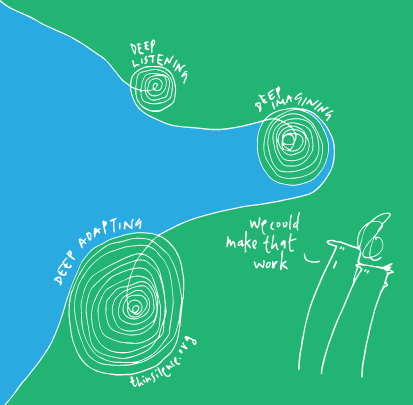
In his book The Last Word and the Word After That, Brian McLaren identifies the community of knowing.  It’s really a community of unknowing because each member encourages and is encouraged to explore and attempt more.  When the group ceases to do this, either they must be challenged to step up or members must leave and find or form another community.

I recently came across how difficult it is to be openly listened to in a possibility of exploring way in a group just like this.  One person offers input, the others listen openly and reflect back but do not give advice.   This felt unnerving, a different kind of experience for the one inputting.

When we are being deeply listened to, our thinking is taken to new places, places we have not had to go to before when others have produced the answers for us.

Those listening were equally honest, confessing how hard it was not to deeply listen, not to make their ideas the centre of the conversation or follow distracting thoughts out of the room.

These words from Richard Rohr, identifying the kind of disorientation likely to be personally experienced when moving from the past to the future, provide a description for moving into deeper listening:

‘You normally have to let go of the old and go through a stage of unknowing and confusion, before you can move to a new level of awareness or new capacity.’**

This being with others in an increasingly open way is unsettling, as Nassim Taleb points out what’s normally going on:

‘We unwittingly amplify commonalities with friends, dissimilarities with strangers, and contrasts with enemies.’^

These commonalities, dissimilarities and contrasts probably have little basis, “heuristics and biases”* we tell ourselves and they must be broken through with deeper listening.  Rainer Maria Rilke knew how hard this is:

“for one human being to love another … is perhaps the most difficult of all our tasks … the work for which all other works is but preparation”.^^

Rilke is positing the closest of all human relationships but the work of relationships are true for all.

To listen deeply, with all our heart, soul, mind and strength – because it will take all – creates the new environments we need to move into futures we cannot imagine on our own.

We have to go to the difficult places, counsels entrepreneur Jim Rohn:

“Don’t join an easy crowd; you won’t grow.  Go where the expectations and demands are high.”*^

Uncanny are surprising things that can change and grow us:

“The uncanny is always crouching, ready to spring.”^*

(*From Nassim Taleb’s Fooled by Randomness.)
(**From Richard Rohr’s The Naked Now.)
(^From Nassim Taleb’s The Bed of Procrustes.)
(^^Rainer Maria Rilke, quoted in Maria Popova’s Brain Pickings: How to Break Up with Integrity.)
(*^Jim Rohn, quoted in Benjamin Hardy’s Willpower Doesn’t Work.)
(^*Tom Cunning, Quoted in Charlotte Bosseaux’s Dubbing: Film and Performance.)


Running away

The world would be better for our being here if we started every day with the tension of being missed tomorrow.*
(Bernadette Jiwa)

But what about the rest?  What about the ones […] who can’t even put words to their dreams?**
(Hugh Macleod)

Some people are running away from their past, others are running from their future.

Running from the past may look like we’re running towards the future, but it can be just running.

Running from the future may look like we’re valuing the present, but it can simply be an avoidance of change.

I believe a person’s future can be so many things that it’s not possible to open it all.

Something will be missed because of tiredness or distraction, something will be held back on … just in case something else is going to appear.  We’re not omniscient or omnipresent or omnipotent.  Accepting our limitations will make it possible to open something of our future and this will be more than enough, and I am sure, life will grow bigger.

Another term for what is at play here is indifference.  Not worrying and even ignoring some of the possibilities for the ones that matter most to us.  We need to listen to our bodies, to our lives, hear what they are saying to us.  It’s not just a head-logical-linear thing; it’s whole messy body thing:

‘The philosopher proves that the philosopher exists.  The poet merely enjoys existence.’^

We love certainty, but somewhere between our certainties, we need to get lost.  Here’s a blessing for doing just this from John O’Donohue:

‘May the Angel of Awakening stir your heart
To come alive to the eternal within you,
To all the invitations that quietly surround you.

[…]

May the Angel of Wildness disturb the places
Where your life is domesticated and safe,
Take you to the territories of true otherness

Where all that is awkward in you
Can fall into its own rhythm.’^^

Here is the you we will miss.

(*From The Story of Telling blog: Missed.)
(**From gapingvoid’s blog: Deciding who needs a hand.)
(^From Wallace Stevens’ The Necessary Angel.)
(^^From John O’Donohue’s To Bless the Space between Us: A Blessing of Angels.)

We’re not done yet

We are human becomings, after all.

Joseph Campbell writes of a story he finds being told in many beliefs and religions through the millennia:

‘Have you been spiritually reborn?  Have you died to your animal nature and come to life as a human incarnation of compassion?’*

It’s a journey of becoming fully human and we do not know what we can become.

Jesuit Bernard Lonergan claims:

‘conversion is the experience by which one becomes an authentic human being”.**

In its most universal form, conversion is moving from this to this, a capability we seem to have in abundance, though we can be held back.

So forgiveness becomes a huge deal when it comes to setting one another and ourselves free from our pasts, hence the doodle today.

The Jesuits also emphasised indifference as a critical attitude towards what we must let go of if we are to move into a brighter future.

Whilst forgiveness can be more about when things go wrong, indifference can be more about letting past successes (or dreams of certain kinds of success) go so we can move on.

The future can beckon in these two forms, too.  There can be thing that is wrong or not working right and we want to do something about it.  There’s can also the dream of something, we don’t know where it comes from, and it seeds itself in our imaginations and we wonder, What if … ?

We’re not done yet.  We’re just beginning.

(*From Joseph Campbell and Bill Moyers’ The Power of Myth.)
(**Bernard Lonergan, quoted in Richard Rohr’s The Naked Now.)