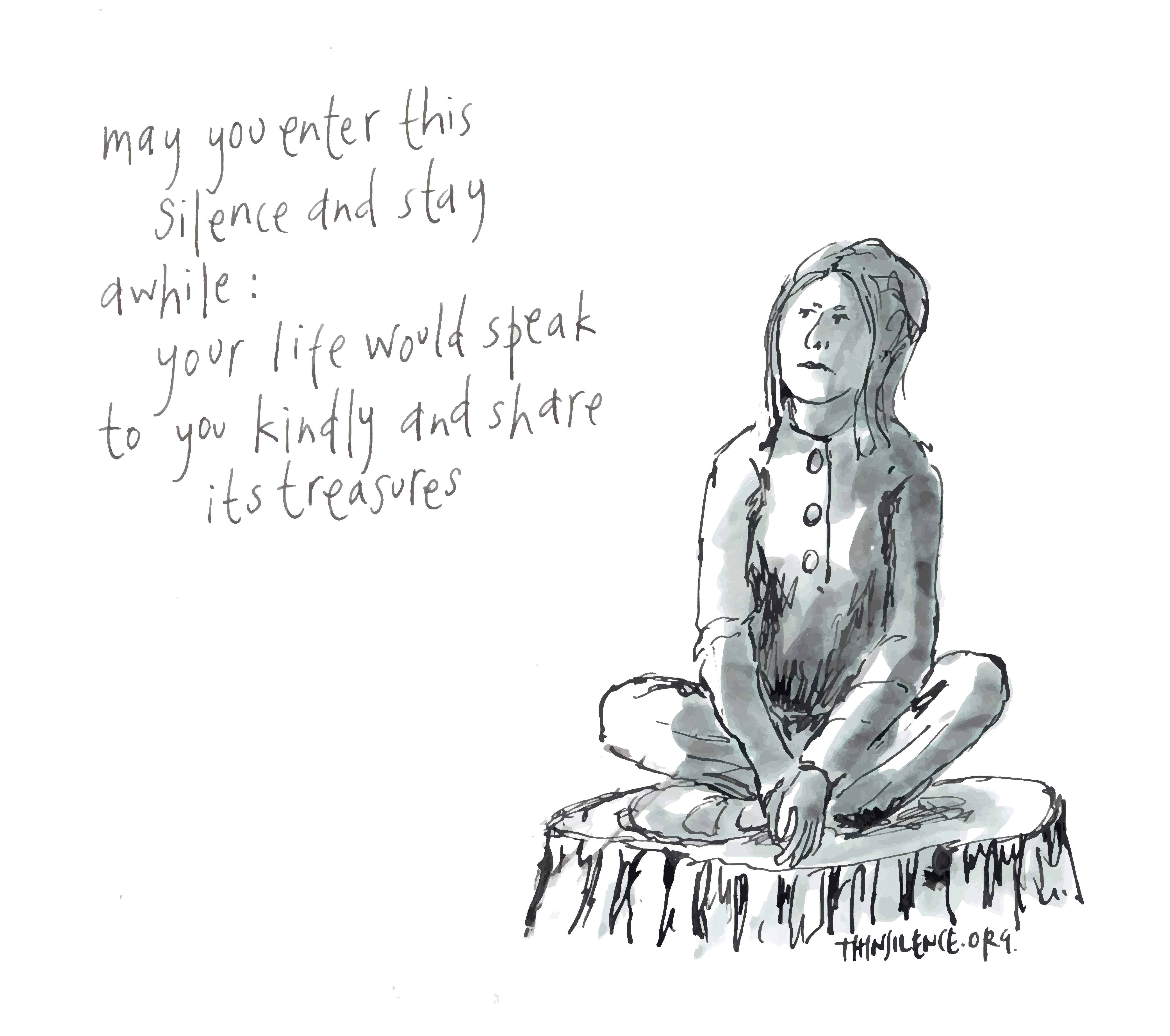
Out of linearity, into oscillation

close the gap between who you are and who you want to be – between how you manage your energy now and how you want to manage your energy to achieve whatever mission you are on*
(Jim Loehr and Tony Schwartz)

This may be counterintuitive, but we develop and grow when we rest and recover following stressful activity.** Peter Senge writes about what happens in quietness and solitude, helping us see more of what’s happening in recovery:

An inner alignment starts to develop that can release extraordinary energy and creativity, qualities previously dissipated by denial, inner contradictions, and unawareness of the situation and oneself.^

If we just keep going in a straight line of stress, be it physical, mental, emotional or spiritual – it’s usually a mix of all four – then the only thing we’re likely to be developing is an illness, or worse:

There is […] considerable evidence that highly linear forms of behaviour – too much eating, too little sleep, too much hostility, too little physical activity, too much continuous stress – lead to a higher incidence of illness and even early death.

Karoshi is the Japanese term for death by overwork because it’s a thing.

Short of the worst, there’s the likelihood of a higher at-rest heart rate and blood pressure, poor sleep, irritability, emotional instability, loss of motivation and increased injury and illness.

When we’re busy, we can try to conserve energy in order to keep going. What Jim Loehr and Tony Schwartz are saying is the best thing to do is to increase stress and then recover, just like a physical muscle:

We grow at all levels by expending energy beyond our normal limits, and then recovering.*

They call this antidote to the linearity of stress, oscillation. It’s important not to have too much linearity in recovery as well as too much stress. What we’re trying to do is build energy capacity.

Curation in its widest sense is creating new possibilities out of the vast resources available to us through specking, arranging and enhancing. As such it is a dynamic activity. Yet within its dynamism lies the original meaning of the word which is to care:

Curation that doesn’t have the sense of taking care, preserving, nurturing is more likely to lead to negative outcomes.^^

In my university work, I’m collaborating with others on an idea intended to release abundance rather than be imprisoned within scarcity. The word we are using for recovery is replenishment, to supply abundantly, from plenir, to fill.

I haven’t got it figured out yet but I’ll keep both working and wandering at it. As I mentioned earlier, it’s where the good things begin to happen.

(*From Jim Loehr and Tony Schwartz’s The Power of Full Engagement.)
(**Have you noticed how your best ideas come to you when you’re not trying to come up with your best idea?)
(^From Peter Senge’s The Necessary Revolution.)
(^^From Michael Bhaskar’s Curation.)

The power of curiosity in a familiar world

Talking to people I’ve never met before is my adventure.*
(Kio Stark)

A designer does not have the luxury of cynicism. A cynical designer? That shouldn’t exist. That’s a joke.**
(Bruce Mau)

The familiar looks different to unfamiliar eyes, The School of Life naming children, travellers and artists amongst those who possess such eyes:

One of the things it’s easiest to forget about children is that they are aliens recently descended from another planet. In the way they look at everything around them, in the wide open stares they give to ways of living and being that have grown utterly familiar and therefore invisible to our eyes, they may as well have stepped off a galactic aircraft in an unobserved corner of a wheatfield. Coming from so far away, everything on our earth is to them new, interesting and worthy of examination. Nothing is to be taken for granted. There are so many questions to ask. The whole world is, via their as yet unmarked minds, born anew.^

The world becomes a bigger place when with curiosity we appear as learners, discovering everything and everyone is a teacher.

Humble openness allows us to see something outside our ken, is open to seeing this for what it is, and does not desire to own it.

This is wisdom, humility uncovering simplicity on the far side of complexity:

There is an elegance and beauty to wisdom. She brings simplicity out of complexity.^^

(*From Kio Stark’s When Strangers Meet.)
(**Bruce Mau, quoted in Warren Berger’s Glimmer.)
(^From The School of Life’s article: How to be Curious.)
(^^From Erwin McManus’ Uprising.)

The desires of our hearts

[W]e are most poetic when we are most in tune with created Presence – person, place, thing. Which means that we may not divide life into poem and un-poem but see that experience itself may be poetic.*
(M. C. Richards)

Desire paths and desire lines are the names given to the unofficial paths that appear across urban landscapes because they work better than the official ones architects and planners have put in place.

There are desire lines running through our lives, too.

Life comes with many formal or official paths that are put in place by the “architects and planners” of culture and society and all their fractals, many being necessary or well-intended, yet so many aren’t quite in the right places.

Here are some tests to help see if we’ve found our desire lines, which I borrow from Seth Godin; the best desire paths:

Open us to our passions rather than inertia
Create originality and generosity rather than dogma
Encourage service and adventure rather than ease
Follow convictions rather than wilt under criticism
Are willing to apologise rather than blag it
Offer kindness rather than trying to be clever at the expense of others
Find us as builders rather than a cynics.**

(*From M. C. Richards’ Centering.)
(**From Seth Godin’s blog: Choices.)

A day’s journey from here

Middle English: from Old French jornee ‘day, a day’s travel, a day’s work’ (the earliest senses in English), based on Latin diurnum ‘daily portion’, from diurnus (see diurnal).

Every day’s a journey. A helpful picture of how we’re always moving: perhaps in our thinking, sometimes in our feeling, maybe in our doing.

We are most in motion when we identify our artist or artisanal spirit posits M. C. Richards:

Man as artist is on the move. He is not an institution, but a moving pillar of light.*

This need to be on the move is a desire for creativity, continues Richards:

My hunger for freedom is my hunger for myself, for my creative initiative.*

We notice where we are and knowing this is not the end of journey, we continue:

re-examine all you’ve been told at school or church or in any book; dismiss whatever insults your own soul, and your very flesh shall be a great poem and have the riches fluency not only in it words but in the silent lines**.

Writing to young readers, Anne Lamott see this as the greatest journey we will ever find ourselves on:

Books are paper ships, to all the worlds, to ancient Egypt, outer space, eternity, into the childhood of your favourite musician, and – the most precious stunning journey of all – into your own heart, your own family, your own history and future and body.^

I note that this journey is not only ‘into your own heart’ but also into the lives of others. Richards recognises the kind of human community that forms when people are moving together, beyond institution:

Communitas is built into the spirit of men. They have but to perceive it to create it.*

Such perceiving of the kind of community that forms around an enlivening purpose is itself a journey we find ourselves upon each day.

Perhaps we are not so much moving from the past to the present to the future but from a fixed future to one that is created in journey:

It struck me that the only voice that spoke about the future as the result of a creative act was the one person whose view of reality was not shaped by this fixed view of the future.^^

We have a long way to journey today.

(*From M. C. Richards’ Centering.)
(**From Walt Whitman’s Leaves of Grass.)
(^From Anne Lamott’s letter to young readers, in Maria Popova and Claudia Bedrick’s A Velocity of Being.)
(^^From Erwin McManus’ The Last Arrow.)

In pursuit of the day

A creative person. Initiating, enacting. Out of personal being. Using his lifetime to find his original face, to awaken his own voice, beyond all learning, habit, thought: to tap life at its source. When the human community finally knows itself, it will discover that it lives at the centre. Men will be artists in their life and labour.*
(M. C. Richards)

Do not rush into the day.

Connect with your joy, follow your curiosity, form your questions.

(* From M. C. Richards’ Centering.)

The artist awakes

The surface of the earth itself acts to transmit the presence of the beloved. The earth vibrates like a wire with his step, and sees the impulse directly into the body of the poet. It is the nature of the earth and of our dust to be in constant contact with the impulses of life. If we listen, we will hear the continuous tread of love, moving up our limbs like sap, like an electric current, impelling us as well to “stir and
step out.”*
(M. C. Richards)

it is the heart that makes us human. The heart is where the beauty of the human spirit comes alive. Without our heart, the human would
be sinister’**

(John O’Donohue)

How do we come to the day?

With our art – artfully, artisanly?

With our “to do” list – functionally?

The former is more demanding, knowing nothing is at it appears on the surface It knows it must ask more, search more, knock more, more conscious, more intentional to the impulses of life:

How much of the beauty of our own lives is about the beauty of being alive? How much of it is conscious and intentional? That is the big question.^

(*From M. C. Richards’ Centering.)
(**From John O’Donohue’s To Bless the Space Between Us.)
(^From Joseph Campbell and Bill Moyer’s The Power of Myth.)

Where we find hope

Crises tend to accelerate society along.*
(Hugh Macleod)

Will we wake up in a few months and lament that we haven’t made more of this time in isolation? There are two questions we can ask ourselves at the end of each day. What did I do today that I’m proud of? What am I glad I did today?**
(Bernadette Jiwa)

When we went into lockdown, we didn’t leave behind the things that matter to us most, the difference we want to make. These are always with us because they’re part of us. It’s proving to be a testing time for all of us, with extremes for some, but we may be surprised at what comes out of this. Robert McKee encourages writers to take notes whilst in lockdown because there’ll be some intriguing stories to tell:

This will pass. We’ve been through such things before; there have been plagues, the Spanish flu, and more. The important thing is that in time, this will pass. In the meantime, we will discover who the good people are, and which people are evil. People who we thought were selfish and venal might turn out to be heroic and self-sacrificing. People who we thought were loving and selfless might turn out to be greedy. Either way, we will find out who people really are by the way they act in the face of adversity. […] take notes.^

We may not be writers wondering how to work through the lockdown but we can all daily reflect on how we’re responding and what we would like to be about to “accelerate society along” both now and also in the new future.

This is about finding or reconnecting to our true Self, our best response to what is happening, as Frederick Buechner reminds us:

The original, shimmering self gets buried so deep that most of us end up hardly living out of it at all. Instead we live out all the other selves, which we are constantly putting on and taking off like coats and hats against the world’s weather.^^

We find hope where the reality of what is meets our imagination.

(*From gapingvoid’s blog: A new remote era unfolds.)
(**From Bernadette Jiwa’s blog: Two Questions For Days Like These.)
(^From Robert McKee‘s newsletter: How Can You Write at a Time Like This?)
(^^Frederick Buechner, quoted in Ian Morgan Cron’s The Road Back to You.
)

It’s never too late to see

Use your senses. Open your eyes, your ears, your smeller, your taste buds, your skin, your throat, your lungs, your heart, your blood, your interstices. Listen. If we listen, we will not have to ask. If we listen, we will find ourselves at the centre of the entertainment.*
(M. C. Richards)

first take the log out of your own eye, and then you will see clearly to take the speck out of your neighbour’s eye**
(Jesus of Nazerath)

Normally I begin the day following whatever path emerges from the different things I’m reading. This continues to find its shape as I move it from journal to blog.

This morning, though, I tried to force the path. I wanted to explore the theme of gratitude for something I will be writing with four university colleagues.

Along the way, I slightly altered a closing from John O’Donohue, replacing unforgiven with ungiven:

May all that is ungiven in you
Be released.

May your deepest fears yield
Their deepest tranquilities.

May all that is unloved in you
Blossom into a future
Graced with love.^

That kind of worked but I knew there was so much I was not hearing or seeing about how someone or something wanted to be seen and heard but it was as if I was wearing glasses made out of logs and everything I saw looked like wood.

And doesn’t gratitude begin when we see someone or something simply as they or it wants to be?

(*From M. C. Richards’ Centering.)
(**Matthew 7:12)
(^From John O’Donohue’s To Bless the Space Between Us: To Come Home to Yourself.)

Openness can be the hardest word

If you spot something interesting, look closer.*
(Rob Walker)

We want our minds to be clear – not so we can think clearly, but so we can be open in our perceptions.**
(M. C. Richards)

We are both free and trapped in our seeing, being able to see so much and yet miss even more.

M. C. Richards writes, ‘the laws of physics are the laws of our nature:’

We can only receive what we already have! We can only become what we already are! We can learn only what we already know. It is a matter of realising potentialities.**

Yet we come to the aid of each other.

Whilst being prepared to see, being present to see what is there and even prescient in seeing what is not there, being open to what others see seems to me to be critical. It is also very difficult because our own ways of seeing try to dominate and yet seeing more through each other is the reality of we are:

We see that it is not a matter of trying to be related but rather of living consciously into the actuality of being related.**

Asking open and generous questions of what each other sees is one of the most helpful ways for developing this openness.

What we also notice, over time, is how our ability to see more is growing.

(*From Rob Walker‘s The Art of Noticing newsletter: Look Out.)
(**From M. C. Richards’ Centering.)

The future of the gift

The future is dynamic, active, interconnected. For some reason many of us would rather know the future than create it.*
(Erwin McManus)

The world is alive, generous,
and waiting patiently for us
to figure it out.**

(Tom De Blasis)

Gifts help us to create the future; they create disequilibrium and wait to see what effects they may have caused.

Everything we are can be used in this direction:

We are only as much as what we can give to others.^

It turns out that when we give ourselves some space and engage our imagination we’re a lot.

It is quite possible that more happens when a gift is not commoditised, when it is able to stay free to not only be the gift, to also contain the spirit of the gift and the community of the gift.

Bring on the future.

(*From Erwin McManus’ Uprising.)
(**From Tom De Blasis‘ letter to you readers in Maria Popova and Claudia Bedrick’s A Velocity of Being.)
(From gapingvoid’s Love in the time of coronavirus – part 2.)