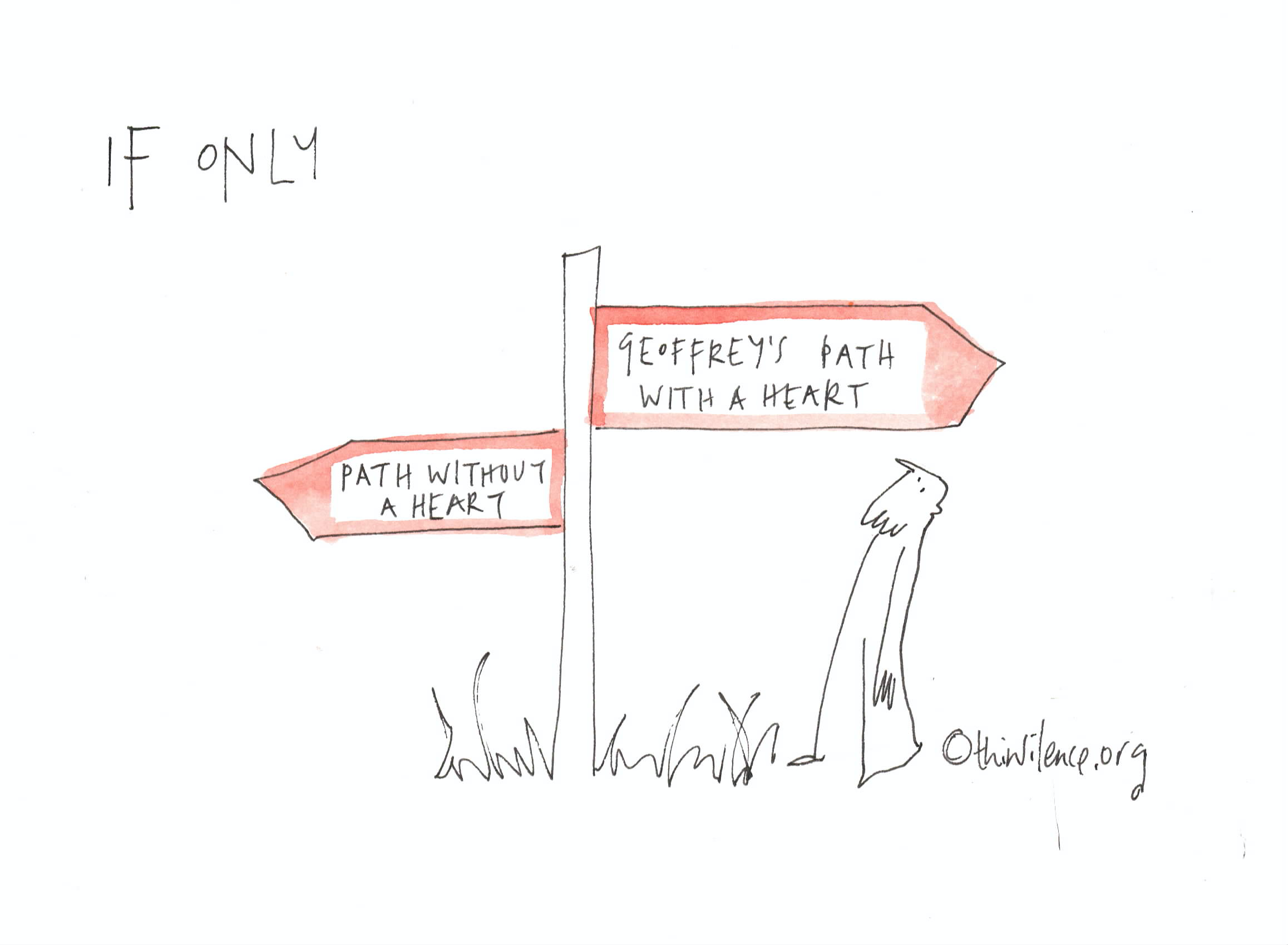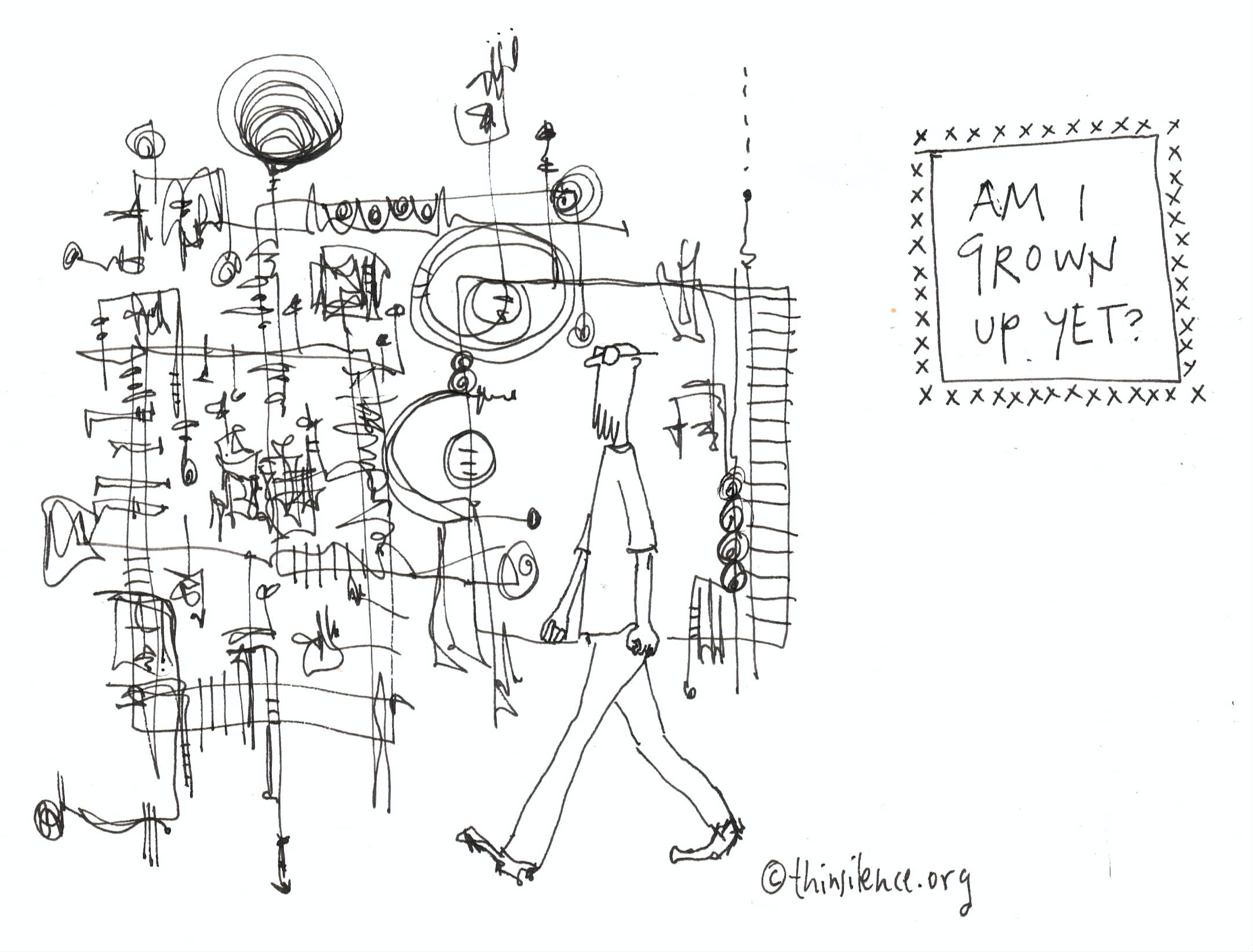
Just a doodle 16

Intentional change is emotionally rigorous – it doesn’t exactly feel good and can even be shockingly painful. If you’re unwilling to put yourself through emotional experience, shift your perspective, and make purposeful changes to your behaviour and environment, then don’t expect huge changes (at least in the short run).*
Ben Hardy

*From Ben Hardy’s Personality Isn’t Permanent.

It’s all a game

For humility is … the only effective antidote to narcissism, and all its associated evils. It is, in essence, a readiness to admit to shortcomings coupled with a willingness to learn, be that from people, animals, plants, or even machines – whoever masters something we do not. The opportunities are infinite.*
Anna Katharina Schaffner

In this game, we only get one choice Once we are born we are players. The only choice we get is if we want to play with a finite mindset or an infinite mindset.**
Simon Sinek

We have the one choice at the beginning of each day.

If we decide to play infinitely, this will mean being open to and respecting others.

Humility is the way that not only allows me to see me, but also to see you.

*From Anna Katharina Schaffner’s The Art of Self-Improvement;
**From Simon Sinek’s The Infinite Game.

Getting gritty with it

To be fully alive, fully human, and completely awake is to be continually thrown out of the nest.*
Pema Chödrön

The royal road to self-improvement is … a form of perseverance that, far from bring put off by failure, accepts it as essential.**
Anna Katharina Schaffner

What I am enjoying about Anna Katharina Schaffner’s book on self-improvement is the long view she provides of different themes considered necessary over millennia for our development.

I’ll be mentioning all ten of these soon as I think that each is important for growth.

A number of these have been promulgated as the only important thing to pursue. It’s also noticeable that different times bring different emphases.

In a time when we are struggling with resilience, one of these has popped up in the form of Angela Duckworth’s Grit^ – now on my reading wishlist. Duckworth names grit’s attributes as being purpose beyond ourselves, resilience, learning from failure, having a growth mindset, and valuing success. (Watch this space.)

I list them here as points to reflect upon (perhaps think smaller rather than bigger):

What do you want to bring into the world that will improve the lives of others?
Which difficult experiences have you gone through that have made you stronger?
Which failures stand out as being pivotal for learning and growth?
How do you define your possibility for growth?
What are some of the important finishing lines you have crossed?

Some people get lucky and do what they want to do without being tested, for everyone else there’s a demanding path of inner growth.

*Pema Chödrön, from Sam Radford’s blog: Killing the moment by controlling the experience;
**From Anna Katharina Schaffner’s The Art of Self-Improvement;
^I’d also recommend Nassim Taleb’s Antifragile.

Passion isn’t what it used to be

Passion: Middle English: from Old French, from late Latin passio(n- ) (chiefly a term in Christian theology), from Latin pati ‘suffer’.

The artist rarely says, “I’d like to do less.” Instead she wonders how to contribute more, because the very act of creativity is the point of the work.*
Seth Godin

We speak of our passion when describing what it is that moves us and energises us into activeness.

What if the thing that propels us in this modern sense is also the thing of suffering and sacrifice of the original meaning?

Such a thing would be the deepest passion of all.

*From Seth Godin’s blog: But what could you learn instead?

And the beat goes on

We have a choice whether wish to continue evolution on this planet or not. I vote “yes.”*
Keith Haring

People evolve before organisations do.**

We’re all adding our little bit of evolving to the human species.

This ongoing exploration of what we might be as Human unfolds through our desire to self-improve – something that has been happening for millennia, as Anna Katharina Schaffner identifies through her very insightful book The Art of Self-Improvement: Ten Timeless Truths.

There are some who believe our evolution will only come through technology, but I am more intrigued by our naked, or un-enhanced, humanness: in how we relate to each other, yes, but also how we embrace our world and all of its fauna and flora, as well as how we relate to ourselves – an area in which it seems we’re having a lot of problems of late.

As Keith Haring noted, this choice to encourage evolution is critically ours.

I was taken by John O’Donohue’s five Transcendentals when I first came upon them and am finding myself revisiting them. I offer them here as something you may enjoy reflecting upon – Being, the One, the True, the Good and the Beautiful:

Being is the deepest reality, the substance of our world and all things in it; the opposite would be Nothingness, the things that are not.  The One claims that all things are somehow bound together in an all-embracing unity: despite all the differences in us, around us and between us, everything ultimately holds together as one; chaos does not have the final word.  The True claims that reality is true and our experience is real and our actions endeavour to come into alignment with the truth.  The Good suggests that in practising goodness we participate in the soul of the world. … Beauty brings warmth, elegance and grandeur.  Something in our souls longs deeply for that graciousness and delight.^

Enjoy.

*From Keith Haring’s Keith Haring’s Journals;
**A gapingvoid doodle for Zappos;
^From John O’Donohue’s Divine Beauty.

Opening

Often, without knowing it, we are waiting for a new idea to come along and cut us free from our entanglement.*
John O’Donohue

Our crisis, if we can get through it, is an attempt to dislodge us from a toxic status quo and constitutes an insistent call to rebuild our lives on a more authentic and sincere basis. It belongs, in the most acute and panicked way, to the search for self-knowledge.**
Alain de Botton

Pain and awe cover most of the ways new ideas get into us.

We do not have to wait for these to come to us, they can be a part of our daily openness.

We then need the means to get new ideas out of us.

John O’Donohue offers five Transcendentals: Being, the One, the True, the Good and the Beautiful. I offer them here in a larger quote to help our reflecting on where our ideas may be leading us:

Being is the deepest reality, the substance of our world and all things in it; the opposite would be Nothingness, the things that are not.  The One claims that all things are somehow bound together in an all-embracing unity: despite all the differences in us, around us and between us, everything ultimately holds together as one; chaos does not have the final word.  The True claims that reality is true and our experience is real and our actions endeavour to come into alignment with the truth.  The Good suggests that in practising goodness we participate in the soul of the world. […] Beauty brings warmth, elegance and grandeur.  Something in our souls longs deeply for that graciousness and delight.*

*From John O’Donohue’s Divine Beauty;
**Alain de Botton, from Maria Popova’s The Marginalian: Alain de Botton on the Myth of Normalcy and the Importance of Breakdowns.