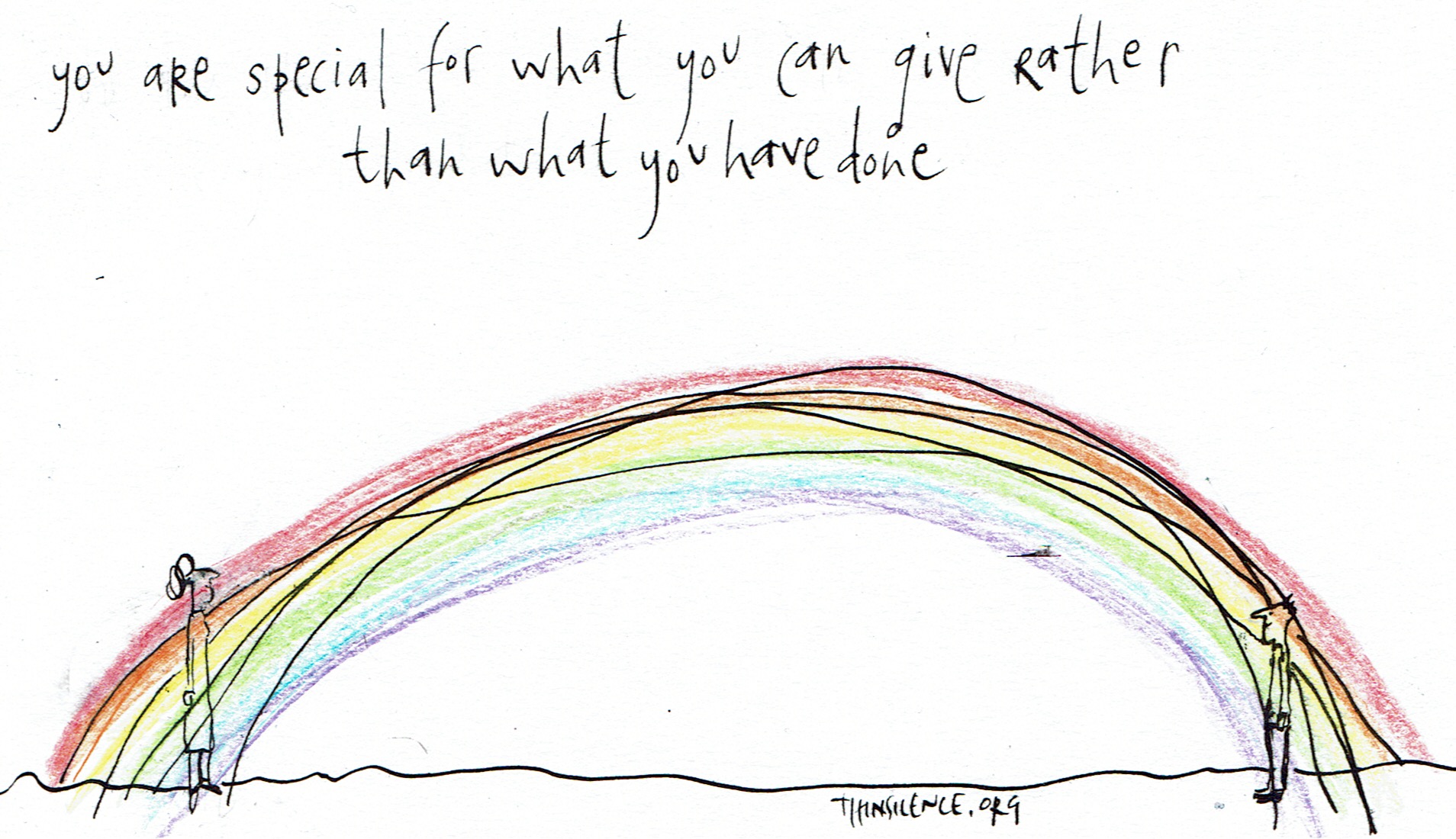
All the time in the world

Because without time, there could be no reactions to actions, no consequences.  Without time, decisions need not be considered for their implications and effects.  We had all been drifting in a comfortable Void without responsibilities.*
(Alan Lightman)

There’s an awful lot of time in the world, it’s just that it isn’t all ours.  We, do, however, have a little of it.  Maybe eighty years or so.

As I think Alan Lightman is alluding: time helps us to act, to make a difference.

Time helps us to pursue autonomy – to be in control of our own lives, mastery – to be skilful at something, and, have purpose – to produce meaning.

This sense of time allows us to try and fail and learn and develop and try again. :

‘If you show up and show up and show up, and care enough to learn to connect, you will have a skill for life.’**

Seth Godin is writing about what a salesperson is really about but the sense of his words fit well with anyone wanting to make the most of their time.  In another place, Godin writes about the importance of attempting things around what it is we want to do:

‘The person who fails most wins.’^

In his fifteen trends for 2018, Rohit Bhargava identifies “brand stand,” the trend produced by companies marketing what they believe in.  The five elements Bhargava goes on to identify as effective for this also help us make more of our time on a personal level: relevance means what we live for is helpful to others, timeliness increases its impact, proactivity means we don’t wait to be invited to contribute, meaning ensures we never lose sight of why we are doing this, and, commitment means we get up each day looking to take what we are about further.^^

(*From Alan Lightman’s Mr g.)
(**From Seth Godin’s blog: The born salesperson.)
(^From Seth Godin’s What to Do When it’s Your Turn.)
(^^From Rohit Bhargava’s Non Obvious 2018.)

The friendly planet

Some friends play at friendship but a true friend sticks closer than one’s nearest kin.*
(Proverbs)

Humans are slow animals […] and what we excel at is distance, sustaining a pace for hours or days.**
(Rebecca Solnit)

We know we can be great at relationships when we set our mind to it.

(*Proverbs 18:24)
(**From Rebecca Solnit’s Wanderlust.)

Boundaries and borders

Only when an organism shares in the ordered relations of its environment does it secure the stability essential to living.*
(John Dewey)

I think we’re realising quiet is important, and we need silence; that silence is not a luxury, but it’s essential.  It’s essential to our quality of life and being able to think straight.  When we become better listeners to nature, we become better listeners to each other.**
(Gordon Hempton, Sound Tracker®)

Boundaries say, “we are here, you are there,” “that is yours, this is mine.”

They are firm and they define who we are:

‘”Mental models” are deeply ingrained assumptions, generalisations, or even pictures or images that influence how we understand the world and how we take action.’^

Mental models, though, are not set in stone; we can change them, and we begin at the borders.

Borders are more hopeful: “you have that, I have this – let’s trade.”

In their most extreme extreme forms, borders are where new things emerge, where transformation occurs.  An experience is one thing.  We enter into something for a while and then we leave.   Transformation means something changes for ever.

James Carse would probably encourage us to employ playfulness in order to move from boundaries thinking to borders thinking:

‘To be playful is not to be trivial or frivolous. […] On the contrary, when we are playful to each other we relate as free persons and the relationship is open to surprise.’^^

Boundary thinking can witness several sides looking on the same intractable problem and employing the same old solutions.  Maggie Berg and Barbara Seeber see this in action in universities, helping us to see how boundary thinking sees the other as something to use for our own benefit:

‘Conversation is instrumentalised and colleagues are turned into “either resources or hindrances.”*^

Border imagines the different sides working together to come up with new solutions:

‘There’s no shortage in today’s world of wicked problems wrapped around beautiful questions – meaning that somewhere deep inside that thorny issue, embedded at the core lies an undiscovered question of great value.’^*

See you at the border.

(*John Dewey, quoted in Richard Sennett’s The Craftsman.)
(**Gordon Hempton, quoted in Rohit Bhargava’s Non Obvious 2018.)
(^From Peter Senge’s The Fifth Discipline.)
(^^From James Carse’s Finite and Infinite Games.)
(*^From Maggie Berg and Barbara Seeber’s The Slow Professor, quoting Frank Martela.)
(^*From Warren Berger’s A More Beautiful Question.)

“Before” is the new “after”

When we thoroughly know how good we are, we can readily (and creatively) think well about how to improve.  It is as simple as that.*
(Nancy Kline)

There’s a link between appreciation and thinking better.

Appreciation enables blood to flow to our brain, making it possible to improve our thinking:

‘Thinking needs blood, and blood needs Appreciation.  Lovely.’*

We’re all capable of having better ideas and better ideas are what we need for a better world; as James Carse says:

‘Finite players play within boundaries, infinite players play with boundaries.’**

Perhaps we are more able to become those whom Richard Rohr refers to as ‘seers of alternatives.’^  Instead of waiting for something to happen and react or respond to, we’re initiating possibilities.  These ‘seers of alternatives’ create space for others to explore as they’ve forward by influencing events and inspiring people’:

‘Somebody said that what the world needs is not more geniuses but more genius makers, people who enhance and don’t diminish the gifts of those around them.’^^

Anne Lamott and Ben Hardy help me to see that appreciative people and environments will be marked by kindness and mercy and faith:

‘Pope Francis says the name of God is mercy.  Our name was mercy, too, until we became more productive, more admired and less vulnerable.  We tend to forget it’s still there.’*^

‘Faith is action, and thus also power.  Faith and fear cannot co-exist in the same person at the same time.  Thus action (i.e., faith) and inaction (i.e., fear) are opposites.  Do what you love.  Do it more.  Output all the time.’^*

When we get things this way around, we’re exploring more of what it means to be human.

Before and after pictures are used to provide us with powerful images for how we have moved on.  But the after is not it in the appreciative world, it is the new before.

The best answers will always open up bigger questions.

(*From Nancy Kline’s More Time to Think.)
(**From James Carse’s Finite and Infinite Games.)
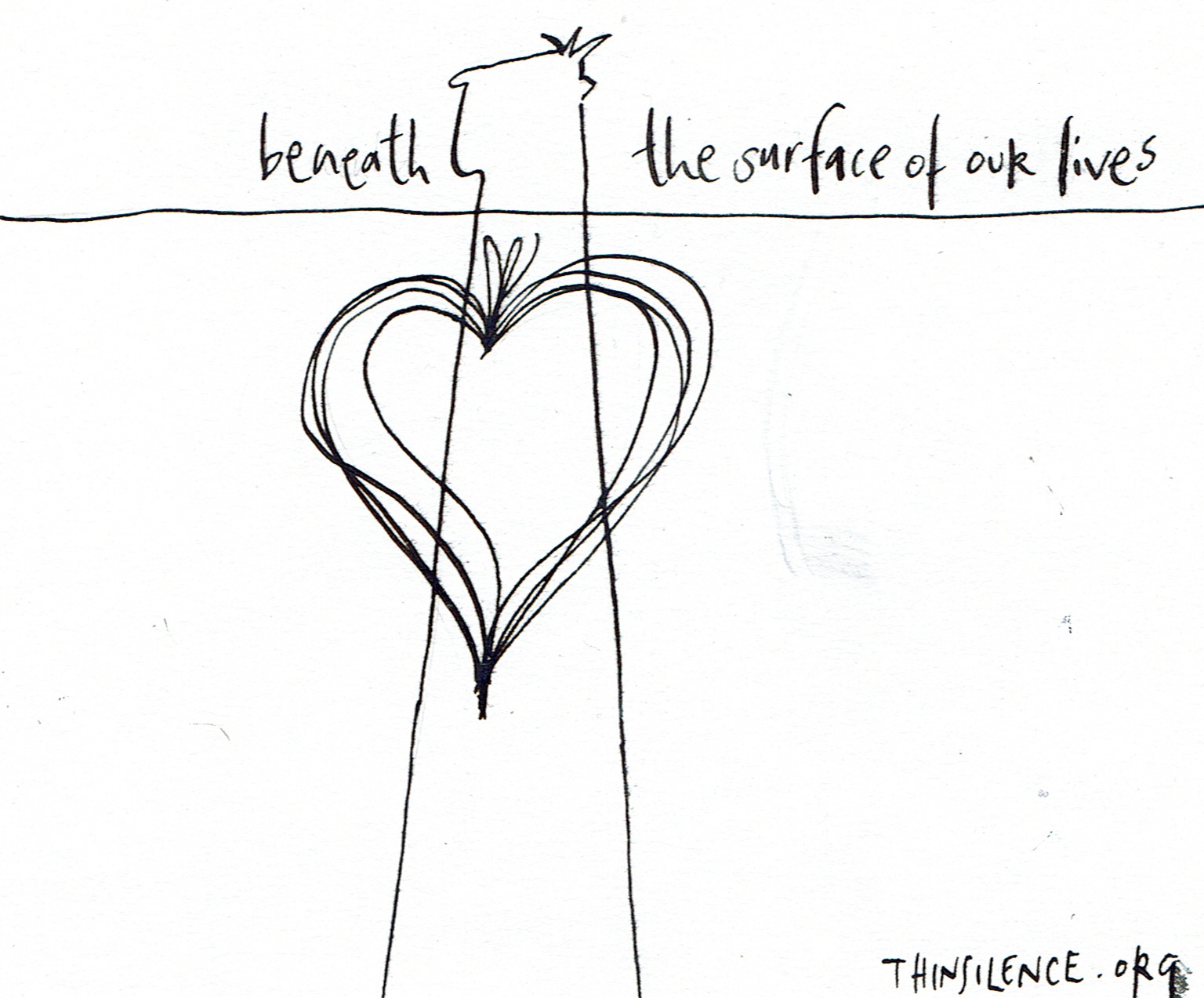
(^From Richard Rohr’s The Naked Now.)
(^^From John Ortberg’s All the Places to Go.)
(*^From Anne Lamott’s Hallelujah 
Anyway.)
(^*From Ben Hardy’s article: These 20 Pictures Will Teach You More Than Reading 100 Books.)

Fake truth

Mihaly Csikszentmihayi proffers our next challenge as humans as he closes his iconic book on how achieving flow (‘joy, creativity, the process of total involvement with life’*).

Flow is about differentiation – basically to know who I am as different to who you are, to know what my contribution is compared to yours.

Now, he says, we must explore how my flow merges with your flow,  with the flow of the universe from which we have emerged, else we face increasing alienation:

‘But complexity consists of integration as well as differentiation.  The task of the next decades and centuries is to realise this under-developed component of the mind.  Just as we have learned to separate ourselves from each other and the environment, we now need to learn how to reunite ourselves with other entities around ys without using our hard-won individuality.’*

We notice how, as we grow up, we move from dependence to independence – when our motivation and goals come from within us.  Now we live in a world where personal independence has never been so powerfully expressed – as individuals, societies, nations.  We need to move from independence to interdependence:

‘Recognising the limitations of human will, accepting a cooperative rather than a ruling role in the universe, we should feel the relief of the exile returning home.  The problem of meaning will then be resolved as the individual’s purpose merges with the universal flow.’*

Rohit Bhargava labels one of the cultural trends he has noticed for 2018 as truthing:

‘As a consequence of eroding trust in media and institutions, people are engaging in a personal quest for the truth based on direct observation and face-to-face interaction.’**

Truthing makes no sense, though, unless we use it on ourselves as well as others.  Otherwise, we may become our own fake news, that is, fake truth.  It’s why the end of the journey is not about knowing something, or feeling something, but doing something, not just once, but repeatedly and in a developing way.  Only as this serves others, however, will we see the kind of reality Csikszentmihalyi hopes for, perhaps expressed here by Roz and Ben Zander:

‘The WE appears when, for a moment, we set aside the story of fear, competition, and struggle, and tell its story.’^


Some more reading about this development from the self to the we, from dependence to interdependence can be found in Tribal Leadership from Dave Logan, John King and Halee Fischer-Wright, and Seth Godin’s Tribes.

(*From Mihaly Csikszentmihalyi’s Flow.)
(**From Rohit Bargava’s Non Obvious 2018.)
(^From Rosamund and Benjamin Zander’s The Art of Possibility.)

Our must (and our chance of wisdom)

The way to find your happiness is to keep your mind on those moments when you feel most happy, when your really are happy – not excited, not just thrilled, but deeply happy.  This requires a little bit of self-analysis.  What is it that makes you happy?  stay with it, no matter what people tell you.  This is what I call “following your bliss.”*
(Joseph Campbell)

If you must […].**
(Kerry Hillcoat)

Everyone must.

Everyone has a must, what mythologist Joseph Campbell refers to as “bliss.”

Here we find our wisdom, too.  This life of must or bliss emerges from our humility – that is, our true self (not thinking too high or too low of ourselves); our gratitude – our growing appreciation of all that we have and all that is around us; and our faithfulness – daily seeking ways of living who we are and what we have into some or other expression.  Wisdom is what we know and imagine, and also what we do and give:

‘Activity and reflection should ideally complement and support each other.  Action is blind, reflection impotent.’*

Wisdom cannot be grown in simple systems, either.  It isn’t about repeating, but moving and developing.  Like the sprinter when the gun has fired, human consciousness has taken our hands away and we have to run ourselves upright or stumble and fall.

This must is what Mihaly Csikszentmihalyi would call our authentic project, meaning it comes from within:

‘Authentic projects tend to be intrinsically motivated, chosen for what they are worth in themselves; inauthentic one are motivated by external forces.’^

While must or bliss will produce our systems, the inauthentic project depends on external systems to operate well in order to gain the maximum benefit from it.  The authentic, however, doesn’t wait on the external but is always moving forward.  It produces its own wisdom, whilst at the same time, fully appreciating what it has to receive from those who have gone before, as Csikszentmihalyi reminds us:

‘To discard the hard-won information on how to live accumulated by our ancestors, or to expect to discover a viable set of goals all be oneself, is misguided hubris.’^

Wisdom is the result of each person’s journey of activity and reflection: via activa and via contemplativa as they were once understood and practised.  When we discover and invent ways of bringing this together then we are exploring what David Weinberger is imagining in the delightful long subtitle to his book Too Big To Know, which ends with:

and the Smartest Person in the Room Is the Room’.^^

(*From Joseph Campbell and Bill Moyers’ The Power of Myth.)
(**Kerry Hillcoat, quoted in the Northumbria Community‘s Morning Prayer.
(^From Mihaly Csikszentmihalyi’s Flow.)
(^^From David Weinberger’s Too Big to Know.)

It all begins with gratitude

“You should just be grateful.”

Gratitude isn’t an end, it’s only a beginning, like a seed planted.

Gratitude grows into wholeness, a sense that we have enough – maybe not everything, but enough.

And wholeness is generative, allowing us to see al manner of possibilities for giving all we are and have to others.

And when others are grateful for this, more seeds are sown.

Of course, other worlds are available …


Autotelicity

Ah.  So you spend the first two decades of your life being told that you’re special, that the future belongs to you.

Then, SPLAT!  You hit the real world and realise JUST how low on the totem pole you are.*
(Hugh Macleod)

The term [autotelic] literally means “a self that has self-contained goals,” and it reflects the idea that such an individual has relatively few goals that do not originate within the self.**
(Mihaly Csikszentmihalyi)

Hugh Macleod reflects how some, on realising they are not the centre of the universe, find themselves set free:

‘But for a lucky few, it comes as a moment of joyous, amazing liberation.

Because now you don’t have to pretend anymore.  Because all that’s left is for you is do, is to find something genuinely useful for other people, or face starvation.’*

Mihaly Csikszentmihalyi identifies three practices employed by autotelic people to set themselves from from the ego self and become people able to transform their situations and circumstances.  They practice unselfconscious self-assurance; focus their attention outwardly upon the world; and, are open to discovering new solutions

This brought to mind for me, Richard Rohr’s five elemental truths, gleaned from the rites of passage from traditional cultures (hence my doodle).  They shout as loudly today as they ever have.  Their intent is not to put people down but to liberate them to live life fully:

Life is hard;
Your are not as special as you think;
Your life is not abut you;
You are not in control; and,
You are going to die.

These are saying, Okay, got that?  Now we’re ready to live:

‘they are not self-centred; their energy is typically no bent on dominating their environment as much as finding a way to function within it harmoniously’.**

Philip Newell points to life being richer where things happen between people rather than in people:

‘We find our true centre not within the limited confines of our own individuality, family, or nationhood but within the connections between us.’^

There’s a difference between just wanting stuff and needing to provide for the mission we’re on.

There is nothing contradictory between this and Csikszentmihalyi’s self which claims the autotelic person’s goals mostly originate within her or him:

‘A person who pays attention to an interaction instead of worrying about the self obtains a paradoxical result.  She no longer feels like a separate individual, yet herself becomes stronger.’**

(*From gapingvoid’s blog: Where’s my trophy?)
(**From Mihaly Csikszentmihalyi’s Flow.)
(^From Philip Newell’s The Rebirthing of God.)

What’s that in your hand? (the recyclers)

You may think there is something else you need when you already have enough to begin.

The very thing you love is the place to look more closely.  Hugh Macleod says it simply:

‘The more you love, the harder you work.’*

Love not only provides you with what you need but also to take it further for the benefit of others, providing you with the sensitivity to find your way through the thing that stands in your way.  As Richard Sennett sees this, how instead of cursing something, to treat it as something to love:

‘when something takes longer than you expect, stop fighting it […] The identification a good craftsman practices is selective, that of findings the most forgiving element in a difficult situation’.**

It is your love for something that will take you through the pain and hurt that will surely come when pursuing the things that matter most to you.

Who’d have thought that love is such a crucial element of making more of what is already in your hand?

Mihaly Csikszentmihalyi, in writing of the flow we seek to find for our lives points to this being where we are most alive, that is, most imaginative and creative as a species:

‘In fact, according to some views of evolution, complex life forms depend for their existence on a capacity to extract energy out of entropy – to recycle waste into structured order. […] all life on earth is ultimately made possible by dissipative structures that capture chaos and shape it into a more complex order.’^

This, we might argue, is one of the most critical challenges for our species today.  We may even see the development of a new hominid species – to take the waste we make and turn it into something hopeful instead of simply living with it.  Stephen Pyne writes of how are relationship with fire is different for us to those who went before us, instead of tending fire, making fire :

‘If tinder were nearby, the toolmaker became a fire maker.  Home erectus would maintain but probably not until Homo sapiens could humanity make it.’^^

Roz and Ben Zander write about the human capacity of turning around what spirals down, transforming it:

‘It is about restructuring meanings, creating visions, and establishing environments where possibility is spoken – where the buoyant force of possibility overcomes the pull of the downward spiral‘*^

When it comes to what is in your hand – the thing that allows you to recycle the chaos, what Richard Sennett calls ambiguity and the Zander’s the downward spiral – Warren Berger provides us with some helpful questions:

‘What do you want to say?  Why does it need to be said?  What if you could say it in a way that has never been done?  How might you do that?’^*

Csikszentmihalyi offers three practices of people who are able to cope with chaos and transform it into something more hopeful.  They are unselfconsciously self-assured, which I interpret as having humility, a true sense of Self (who they are and what they can do); they focus their attention on the world, which I translate as looking out or have gratitude for what is around them); and they are open to the discovery of new solutions, that is, they initiate (or are faithful for making something new out of what their humility and gratitude brings to them – the practice of letting go and letting come).^

One thing more I will add is that we were never meant to do this alone.  You need to join with others.  It’s a critical step and if you’re not prepared to do this, you may never really appreciate what you have in our hand:

‘It’s time to show up.  Find your people and get your show on the road.’⁺

(*From gapingvoid’s blog: Love is the only driver.)
(**From Richard Sennett’s The Craftsman.)
(^From Mihaly Csikszentmihalyi’s Flow.)
(^^From Stephen Pyne’s Fire.)
(*^From Rosamund and Benjamin Zander’s The Art of Possibility.)
(^*From Warren Berger’s A More Beautiful Question.)
(⁺From gapingvoid’s blog: Leaders 4 Leaders.)