Creativity is the product of wasted time.** (Albert Einstein)
to stay hungry and unsettled is not the conventional wisdom. It clearly psychological demands on the individual. The attraction of the opposite state – satisfaction, expertise and security is almost irresistible^ (Maureen O’Hara and Graham Leicester.)
Perfect days tend not to be free from worry and concern – these are the kind of days that tend to get a little mergy, one looking just like another. A perfect day tends to set us up for something that matters, one that stretches and grows who we are as well as what we are doing. We don’t have to always e dong things either, often this can get in the way. It’s more about a direction.
there is an element of scarcity in what you do and how and why you do it, a combination your story and your superpower** (Bernadette Jiwa)
Some people seem to be capable of amazing things. It’s almost magical to us mere mortals looking on. We probably walk away thinking we could never do something like that, or, if we did, we’d have to figure out a way to fake it.
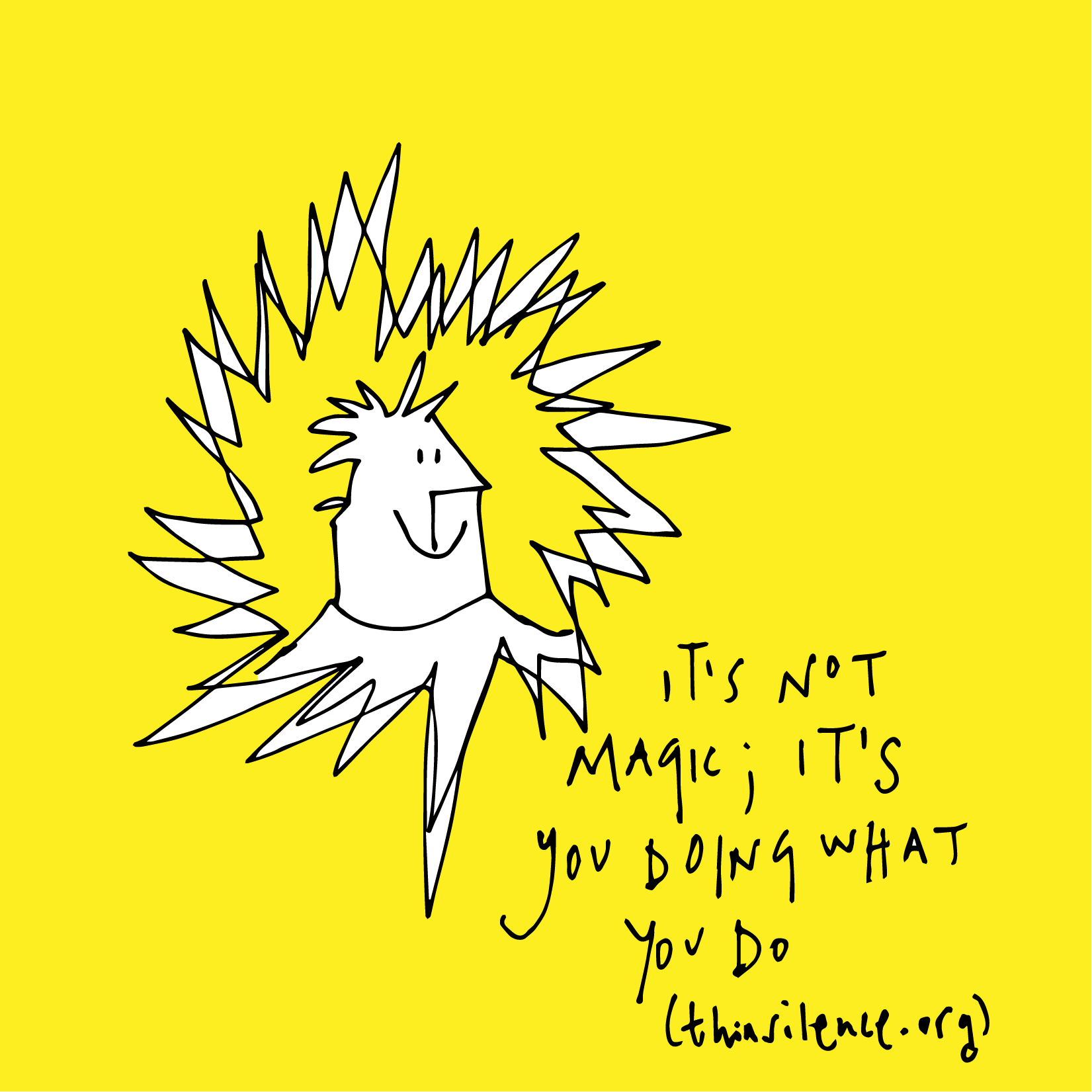
It isn’t magic, though.
It’s simply someone taking what they love and are good at as far as they possibly can. And this is a truth for everyone. There could be someone looking at you, right now, wondering how on earth you do this thing.
From your perspective, everyone can do this. But they can’t.
In art the self becomes self forgetful.* (Flannery O’Connor)
Desire leads to conception and conception leads to birth. This is the efficacy of desire.** (Philip Newell)
It’s important to know what it is you most want to do, to begin to give form to this, to help it develop and to finally bring it into being. This is our art. Art isn’t what some do, it’s what everyone does.
When our heart and should and mind and strength are invested in this, the last thing we’re thinking about is ourselves. We are living within the art of our humility and, contrary to popular belief, it is a very big place indeed:
But what happens when those cultural patterns are in flux? When the old rules no longer function well because they are not up to the new levels of complexity, uncertainty and rapid change in society.* (Maureen O’Hara and Graham Leicester)
In an odd way, my growing understanding of the vast forces that shape modern life has only increased my resolve to counter those forces, to build a parallel universe for my inner life and spirit. I am convinced that such an interior life is both possible and necessary.** (Alan Lightman)
We can do this.
We can face the “vast forces,” but it will require that we restore and maintain the vast forces of our inner universes, especially, as I keep mentioning, opening our minds, our hearts and our wills.
These inner places do not become places to hide. In another of his books, Alan Lightman writes of his openness to more:
And I hope there will always be an edge between the known and the unknown, beyond which lies strangeness and unpredictability.^
“Progress” is some kind of ordained imperative of our species, an abstract conception of evolution, an inevitable development like the increase in entropy, the future.* (Alan Lightman)
I say, follow your bliss and don’t be afraid, and doors will open to you where you didn’t know they were going to be.** (Joseph Campbell)
Alan Lightman confesses that we can lose ourselves as we progress but get caught in our smaller world of speed, information overload, consumption, accommodation of the virtual, loss of silence and loss of privacy. Before penning the words, above, he wrote:
I believe I have lost something of my inner self. […] I mean that part of me that dreams, that explores, that is constantly questioning who I am and what is important to me.*
The hopeful thing, I find, is that Lightman is naming the things he wants to recover, though there is no going back, only going forward, start-overs that are like being born again. This is the progress of a different kind:
Stop worrying about technology. Start worrying about people.^
When mythologist Joseph Campbell writes about following our bliss he understands this is not only about what we do but who we are.
Human activity has increased complexity. Dancing at the Edge is Maureen O’Hara and Graham Leicester’s description of what developing our competency with complexity looks like, part of what it means to start-over forwards. Here is the need:
When too much is in motion at the same time, it is harder for the brain to separate what is important from what is just noise. Certainty becomes more fleeting, mistakes are made more frequently, anxiety increases.^^
Yet just before these words, O’Hara and Leicester write about the amazing human brain and what it is capable of, being more than able to deal with everything if we help it – I would say through our practices (especially open minds, hearts and wills), disciplines, dreams and actioning:
Human consciousness is astoundingly complex. A healthy human brain contains over 200 million nerve cells or neurons, linked to one another via hundreds of trillions of synapses. Through this system flows information that drives both our actions and how we think and feel about them. But this arrangement is not fixed like wiring in a house with robust and resilient circuits that can be depended on to deliver the same results over time. It is more ephemeral, acting more like waves passing through crowds of individuals locking and unlocking their arms. One instant a connection is made and a signal travels, the next moment the connection is dropped and a new one made to another cell carrying another kind of input. In a vast, dynamic orchestration, sense is made and actions taken. Because memories of past actions persist, learning occurs.^^
Here is what we each have to pursue our bliss, even when we become thwarted, we can start-over.
And there’s a beauty that is harder to define or understand, because it occurs not just in the body but where the body and the spirit meet and define each other.* (Ursula Le Guin)
Hence the fundamental importance of the so-called “double task”: to be able to act and reflect on one’s actions at the same time.** (Maureen O’Hara and Graham Leicester)
We all get things wrong, we all fail. Facing up to these and yet not dwelling on them is what real forgiveness makes possible.
In a real way, forgiveness makes it possible for us to both act and to be reflective, to deal with our mess ups in a way that learns and integrates, keeping moving towards greater beauty.
This kind of forgiveness is like the lacquer resin mixed with gold or silver dust in the Japanese art of kintsugi (kin tsugi = golden joinery), making what was broken not only whole again but also beautiful in a way that defines us and the gift we bring into the world.
Life is ambiguous. There are loose ends. It takes maturity to live with the ambiguity and the chaos, the absurdity and untidiness.* (Eugene Peterson)
nothing is fixed. Everything is becoming. […] Everything, without exception, requires additional energy and order to maintain itself. […] Existence, it seems, is chiefly maintenence.** (Kevin Kelly)
Without maintenance, what we are becoming is worn out or redundant within what is – I borrow Ursula Le Guin’s phrase (note the hyphens):
a long-drawn-out death.^
It is the way of a material universe. What we are all capable of, however, is bringing curiosity and imagination and creativity to what is inevitable, slowing down or even reversing the process in some regards, making it one heck of a journey:
Being invited to the dance that is humanity, that is what we’re here for.’^^
Keep dancing, learning new steps, finding new partners, listening to new music. Such things are, according to Maureen O’Hara and Graham Leicester, what people who are competently fit for the 21st century look like:
In a disciplines yet engaging way they are always pushing boundaries, including their own. They dance at the edge.’*^
When we maintain ourselves, we make it possible for others to maintain themselves. We will always, then, bring to others a necessary asymmetry, an adjunct thought or possibility, something not expected, with which we can roll or reject, though I suspect that life is found in the roll.
Competence is culturally determined. What works in one culture fails in another.* (Maureen O’Hara and Graham Leicester)
Almost anyone can learn to think or believe or know, but not a single human being can be taught to feel. Why? Because whenever you think of you believe or you know, you’re a lot of other people: but the moment you feel, you’re nobody but yourself.** (E. E. Cummings)
You may recall, I am using Keri Smith’s Wreck This Journal as my morning journal right now. Here’s the instruction on a page I’ve used today:
A PAGE for FOUR-LETTER WORDS^.
I search for the four letter words I’ve used and I find these (perhaps not the ones Smith anticipated): good, keep, evil, life, live, rain, felt, open, feel, grow, hold, holy.
Of course, many of these words won’t remain as four letters when they’re translated into other languages, and in some becoming characters rather than letters.
I often think, though, this is where the fun begins for those willing to play. An idea or thought can be at its most dynamic when it has to cross a border, when it has to be interpreted.
When I say playfulness, I don’t only mean I am open to think about something that has come from beyond my borders, but also what I feel about it. We hold possibility in our hearts, where what we feel joins with what we think. And something new emerges.
What are we going to do with all the wonder coming towards us from here, there and everywhere?
Angelica Sprocket lives next door. Her overcoat has pockets galore.* (Quentin Blake)
If you begin and end with focus groups, all you’re going to do is what’s been done before.** (Seth Godin)
I’ve just completed a two-day immersion exploring ways for building competence with complexity. The last participation for the twenty of us was to share in groups of four what we saw in each other in terms of power and edge – something to develop beyond our comfort zone.
The challenge, then, is not only to find our authentic voice but also to enlarge it.^
We will never know our reach unless we stretch.^^
The best kinds of feedback see both our unique contribution and how this can be grown, and it was quite something to see just how accurately this cohort of people had noticed things in one another even after only a couple of days.
We each are able to bring to others what they are not looking for, some way they have not thought of, a response they have not imagined.
Angelica Sprocket, our “pockets” contain all manner of things:
There’s a pocket for mice, and a pocket for cheese and a pocket for hankies in case anyone feels that they’re going to sneeze. […] And in case anyone is thinking of dropping off to sleep, there’s a pocket for motor horns that go PAH-HEE-HAR-HAR and BEEP-BEEP.*
I don’t imagine our “pockets” will contain mice and cheese and hankies and motor horns, but they will be crammed with many wonderful things. What’s in your pockets?



You must be logged in to post a comment.