Out of the randomness

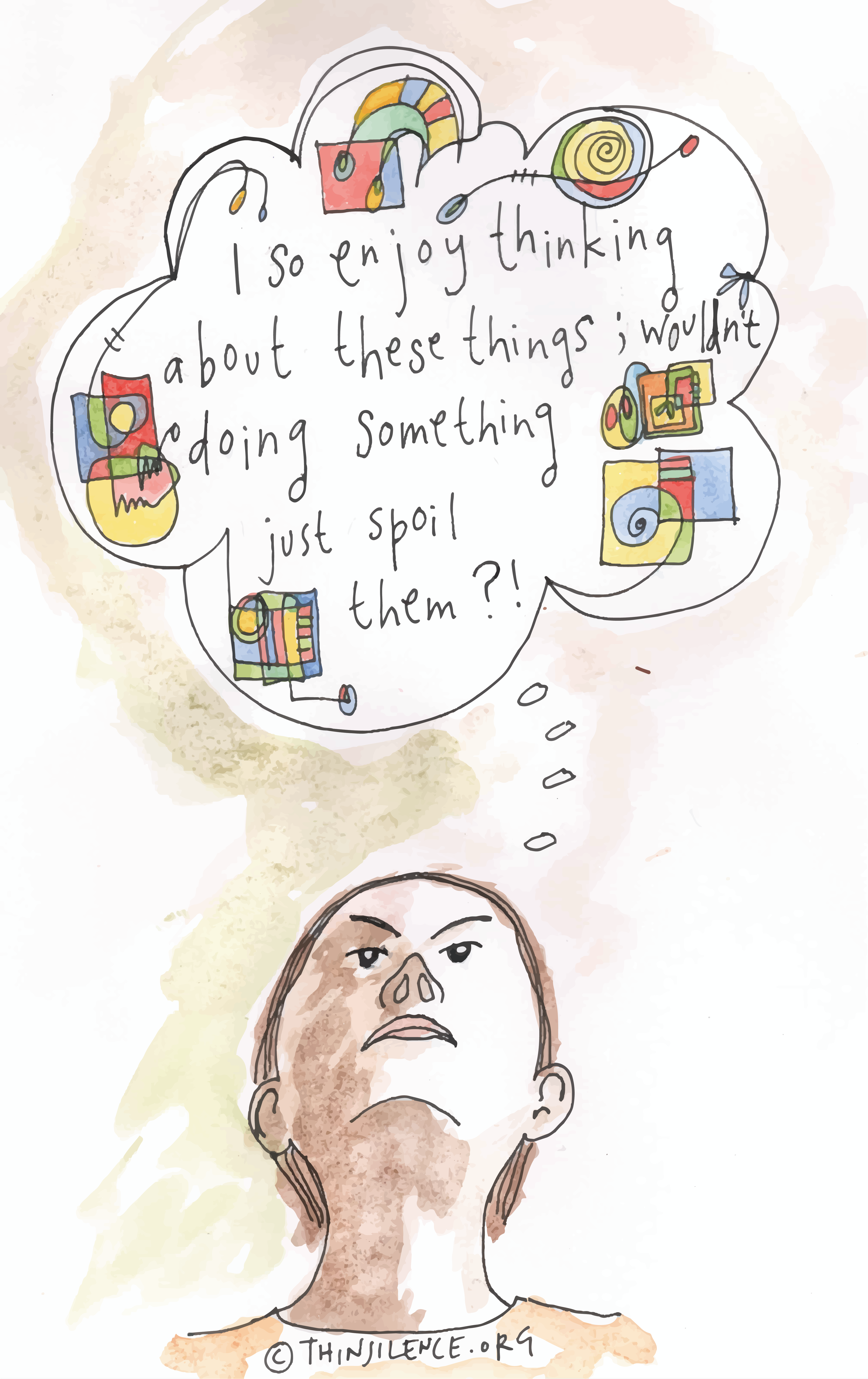
New research confirms that random choices lead to preferences, and then it follows that preferences lead to habits and habits lead us to become the person we somehow decide we were born to be.*
(Seth Godin)

While finite games are externally defined, infinite games are internally defined. The time of an infinite game is not world-time but the time created within the play itself. Since each play of an infinite game eliminates boundaries it opens to players a new horizon of time.**
(James Carse)

As far as we know, humans are the only creatures whose lives don’t go round and around with the seasons, understanding our lives can be on a journey to the future we want to be meaningful.

It all begins in the interesting place that is randomness, when we choose this rather than that. When this has been happening for around eighteen to twenty years, you end up with something really interesting: you.

Slowing down to notice who you are allows you to realise that you really like the things that have become: powerful values, talents and creative energies.

I included James Carse’s words because they provide one way of spotting the things we love most of all. Notice the things you do when time looks and feels different., when you’re not reacting to the time of others but are making your own time.

One of the exciting things about all of this randomness is how it leads to people who have a deep joy in what they do meeting the greatest needs in the world.

Each year, I work with a small number of people to notice the story that’s been developing in all of the randomness. If you would like to know more about this, drop me a line at geoffrey@thinsilence.org.

(*From Seth Godin’s blog: We like what we choose.)
(**From James Carse’s Finite and Infinite Games.)

Over to us

The rules of an infinite game must change in the course of a game. The rules are changed when the players of an infinite game agree that the play is imperilled by a finite outcome – that is, victory of some players and the defeat of others.*
(James Carse)

We not only create stories or metaphors for life, we create them as metaphors for a meaningful life. To live meaningfully is to be at perpetual risk. […]. If, should the protagonist fail, life would be back to normal, the story is not worth telling.**
(Robert McKee)

Ursula Franklin wonders why we have birth control but not machine control, human demography but not machine demography. It’s one example, she believes, of how our thinking has changed:

Just as prescriptive technologies have, in the real world of technology, over-whelmed holistic ones, so have production models now become almost the only pattern of guidance for public and private thought and action.^

When James Carse writes about infinite games, he is thinking more about people at the heart of holistic and growth technologies. To use his argument of infinite players knowing that sometimes they have to play finite games, sometimes we must use more prescriptive and production technologies, but in service of people. Obversely, Carse points out, finite players struggle to see a bigger game, an infinite one. Here is our dilemma when in the heartland of continent of finite thinking, we do no know there are oceans and beyond.

Robert McKee is also imagining growth and holism over prescription and production when he writes of how we are searching for meaningful life and want our stories and metaphors to reflect this – these would be technologies in Franklin’s way of thinking. When McKee writes about risk, he is imagining growth, and when he mentions normal, he is thinking of prescription. Growth requires risk, taking us into the unknown, stretching into the plentiful-more, and then, as Lewis Hyde points out:

The revelation of plenitude calls for a revelation of mind.^^

We grow, we change, we transform.

(*From James Carse’s Finite and Infinite Games.)
(*From Robert McKee‘s newsletter: A Little Risk Goes a Long Way.)
^From Ursula Franklin’s The Real World of Technology.)
(^^From Lewis Hyde’s Trickster Makes This World.)

What is it?

Children know something that most people have forgotten. Children possess a fascination with their everyday existence that is very special and would be very helpful to adults if they could learn to understand and respect it.*
(Keith Haring)

While working on a painting project with the five hundred students at a Chicago high school, Keith Haring was approached by one who said:

I can tell, by the way you paint, that you really love life.**

Wouldn’t it be something to rediscover our everyday fascination with our everyday existence, whatever it is we do, and to help others find theirs.

The wonderful thing is, it’s possible.

What is it?
How does it work?
Who did that?
Why does that happen?

(*Keith Haring, quoted in Maria Popova’s Brain Pickings: Drawing on Walls.)
(**From Maria Popova’s Brain Pickings: Drawing on Walls.)

Vernation

the true advances of my life could not be brought about by force but occur silently, and that I prepare for them while working quietly and with concentration on the things that on a deep level I recognise to be my tasks*
(Rainer Maria Rilke)

vernation/vəːˈneɪʃ(ə)n/nounBOTANY

  1. the arrangement of bud scales or young leaves in a leaf bud before it opens.

Here is the point Ursula Franklin makes and I mentioned a few days ago: Growth is not made but occurs.

We must each attend to those things we believe our lives to be about and the growth we do not know the limits of will take place.

What if, to use a word Robert Macfarlane introduced me to today, we are in a state of vernation, still to unfurl into the possibility of who we can be and what we can bring?

We must remind ourselves to be about those things today we know are our deeper tasks.

(*From Rainer Maria Rilke’s Letters on Life.)

The alternative

Life, which is infinitely abundant, infinitely generous, may be cruel only on the basis of its inexhaustibility: in how many cases has life lost altogether all claims for its validity because it has been repressed by so many secondary institutions that have grown lethargic in their existence.*
(Rainer Maria Rilke)

The alternative may be you.

Just saying.

Rainer Maria Rilke places his hope in life that is infinitely abundant and generous, but not irrepressible, able to fall victim to that which is tired or lost its way or going through the motions. There is an alternative, though:

Is there anyone who would not frequently wish for a ferocious storm that could tear down everything that stands in the way and that is already in decline to clear space for the newly creative, infinitely young, infinitely well-intentioned.*

Rilke causes me to remember my friend Alex McManus‘ words that the future will appear through foresight, intention and love.

There is a problem in Rilke’s mind for intentions alone can dissipate energy:

But there is nothing more reckless than intentions: you exhaust yourself in them by forming and by reinforcing them, and the there is nothing left for the act of carrying them out.*

Better to begin sooner rather than later, and one way we can do this is by creating some disequilibrium through giving. Giving connects us with our energy and we are able to create an alternative to what is, as Erich Fromm underlines here:

Giving is the highest expression of potency. In the very act of giving, I experience my strength, my wealth, my power. This … fills me with joy. I experience myself as overflowing, spending, alive, hence as joyous … in the art of giving lies the expression of my aliveness.**

(*From Rainer Maria Rilke’s Letters on Life.)
(**From Erich Fromm’s The Art of Loving.)

A product of our times

How do you bump into the thing you didn’t know you were looking for*
(Seth Godin)

Machines have sped up and lives have kept pace with them.**
(Rebecca Solnit)

I must go more slowly.

When we talk technology, we’re often thinking machines that enable us to do more faster, but Ursula Franklin highlights how, in simplest terms, technologies are processes comprising two forms: growth and production. Here we have a dilemma – we can make things fast but we cannot grow things fast:

Growth occurs; it is not made.^

Franklin offers an example of a growth technology that has been turned into a production technology:

if there ever was a holistic process, a process that cannot be divided into rigid, predetermined steps, it is education^.

Janine Benyus offers another example following witnessing the most devastating hail storm in a decade experienced in a corner of Minnesota:

Today’s farmer in Southwestern Minnesota has a huge, spread, and because the fields are planted in one species, one variety, and one growth stage, the losses, when they come, are catastrophic.^^

Maybe what we hope to find needs to be grown, not made?

(*From Seth Godin’s blog: Organised for browsing.)
(**From Rebecca Solnit’s Wanderlust.)
(^From Ursula Franklin’s The Real World of Technology.)
(^^From Janin Benyus’ Biomimicry.)

The untrue inside the true

The goal could be to become useful, remarkable and worth seeking out. To do something that’s hard to replace, groundbreaking or thrilling. Generous work that makes things better.*
(Seth Godin)

Blessed are the meek, for they will inherit the earth.**
(Jesus of Nazareth)

Humility is most accurately about knowing ourselves and what it is we can do, including how we can continue to grow and what we are able to imagine and aspire to.

Rainer Maria Rilke writes about not waiting for circumstances to be right but to become people the people who begin whatever these may be:

Not to wait (which has been happening until now) for powerful things and good days to turn you into something but to preempt them and to be it yourself already: this is what you ought to be capable of at some point.^

Some time ago, I was having problems in my work and I felt like giving up, but I made the decision not to blame the circumstances or the people who made these but to take responsibility. Many years later I would read:

The real block is inside the true one. The real problem is the untrue limiting assumption smirking in there […].^^

Nancy Kline’s words point to the untrue assumption that lies behind the true, and helps me to make more sense of how I was right not to assume everything was okay in me, even though my reading of my situation was pretty accurate. This allowed me to start out on a path of necessary personal development and creating the work I love to do, a path I still find myself on twenty two years later.

Your reading of circumstances may be accurate and true, but that won’t help you. Look within and find the untrue assumption about who you are and what you can do that is preventing you from being the only you and bringing your art into the world.

Replace the untruth with the truth.

(*From Seth Godin’s blog: It turns out that “beiger” isn’t a word.)
(**Matthew 5:5)
(^From Rainer Maria Rilke’s Letter on Life.)
(^^From Nancy Kline’s More Time to Think.)

Scale and scalability

Once you realise that you can improve, amplify and refine the things that other people call attitudes, you may realise that they are skills.*
(Seth Godin)

Scale was a term initially used solely to indicate differences in size: It was felt that the scale of a cathedral had to be different from that of a village church […]. Only when the notion of scale was applied to production technologies was an increase in scale perceived as an increase in effectiveness […].**
(Ursula Franklin)

Some people want to be a person of scale; they want to be big.

Which mean other people have to be small.

Other people want to awaken their scalability, improving, amplifying and refining who they are.

They are only happy when those around them are pursuing the same.

The former are a hangover from when kings and queens ruled the world. They are yesterday’s people.

The latter are a picture of our future and the challenge we have to extend this to more and more in our world.

It seems Rainer Maria Rilke was ahead of his time when he perceived a future where we would value the person:

The more human we become, the more different we become. It is as if suddenly human beings would multiply a thousandfold. A collective name that used to be sufficient for thousands will soon be too narrow for ten human beings, and we will be forced to consider each human being entirely on his own.^

Here are some scalable skills to try out:

Playfulness
listening deeply
seeing more
wandering
doodling.

(*From Seth Godin’s blog: Attitudes are skills.)
(**From Ursula Franklin’s The Real World of Technology.)
(^From Rainer Maria Rilke’s Letters on Life.)

Reach

To be close to another person who holds opposing views while being a deep, committed friend can be a wonderful, shaping influence*
(Rainer Maria Rilke)

The question then is how to get lost. Never to get lost is not to live, not to know how to get lost brings you to destruction, and somewhere in the terra incognito in between lies a life of discovery.**
(Rebecca Solnit)

On the other side of the coronavirus, we will need a great effort to reach out to one another in person. We have found it possible to Zoom (other video call providers are available) one another for so many tasks and reasons, and we’ll likely carry on in this vein for many of these into the future.

While such ways and means for staying connected have been quite marvellous in lockdown, the big picture is likely to be one of relational contraction. While I believe the future is connection, this needs to be increasingly conversational connection.

Sherry Turkle shares from her research on the use and effects of social technology:

A twenty-four yearly woman who works at a start-up tells me she is no longer able to focus on one thing or one person at a time. And that’s the problem with conversation; it asks for skill she can no longer summon.^

Conversation makes it possible to enter each other’s world and become lost in what can be quite alien to us. Part of this, according to Rainer Maria Rilke involves admitting that these other worlds exist – this world isn’t just as I see it but it includes:

I and the one who is most different from me. And only when such a complete world is admitted to and considered possible will one succeed in arranging one’s own interiority with its internal contrasts and contradictions generously, spaciously, and with sufficient air to breathe.*

Interestingly, Rilke connects this allowing for different world’s outside of our own being necessary for the ordering of different worlds inside our life. The person who is at war with others is at war within themselves.

There are many ways for getting lost in order to discover worlds unknown to us, but the simplest and most available to us is conversation. Here are three things to try next time the possibility of a conversation is available between you and a stranger:

Seek to discover what they know, to understand what they feel about these things, and then imagine something that it may be possible for you to collaborate on together.

(*From Rainer Maria Rilke’s Letters on Life.)
(**From Rebecca Solnit’s A Field Guide to Getting Lost.)
(^From Sherry Turkle’s Reclaiming Conversation.)

Better than easy

“A life of ease is not the pathway to growth and happiness. On the contrary, a life of ease is how you get stuck and confused in life.” […] But if you look closely at joyful people, you notice that very often the people who have the most incandescent souls have taken on the heaviest burdens.**
(Ben Hardy and David Brooks)

Every weekday morning I have my constitutional walk. It gets me out of the house when I would otherwise be working inside all day. Because it’s the same walk each time, it makes things easier for getting out for exercise and fresh air – no umming and ahing. The changing scenery is a delight, no two days are alike, but I wouldn’t want this to be the only path I ever walk.

I have found that the more I understand about what I must do with my life, the more difficult the path becomes.

You would think it would be the other way around, but finding my way brings me to many crossroads and forks. A pathway equivalent of the Ship of Theseus, through the choices I have made it is now quite a different path than the one I first set out on, although it looks like one.

When I look more closely, I see these crossroads and forks are really possibilities into richness, of creativity, community and commission – as in, purpose.

There has always been the easier option, which may be to continue on the way I have been travelling awhile, or even to select something easier than this, but there are often multiple better ways, too.

A more difficult path tends to do that, multiplying possibility, reflecting the complexity life is.

(*Ben Hardy and David Brooks from Brooks’ The Second Mountain.)