Some people as they grow up become less … . Other people as they grow up become more.* Eugene Peterson
Today I am 63 years old and I am determined to grow up, For the contents of my life and the state of my heart to outweigh my possessions.
I am my weaknesses, I know this so well, I am more than my weaknesses, And this is my exploration. May those stronger parts in me become denser, thicker.
The wanderer becomes one with himself or herself and the universe. We connect with the energy of all living things. We live according to our inner nature.**
Every life is a piece of art, put together with all means available. Pierre Janet
In the presence of the God of Beauty our own beauty shines.** John O’Donohue
This and that.
But we cannot do “anything” and we cannot do “everything” – This is the deception of “And.”
This or that.
We can do “something” and we can become “someone” – This is the freedom of “Or.”
We will know this path by its heart, service and suffering, But it is our home.
When I connected dreamwhispering with my university’s^ list of student attributes, I selected identity, resilience and creativity for their resonance. Only this morning, I found myself connecting these to Erwin McManus’ three human quests for honour, nobility and enlightenment^^
The quests lead us firstly through Humility, gratitude and faithfulness, helping us to determine identity.
These in turn grow integrity, wholeness and perseverance, All necessary to resilience, a garden of possibility.
The fruits of which are courage, generosity and wisdom, The gifts we bring to others.
I think love is fostered by a capacity to experience cosmos.* M. C. Richards
It’s while it’s being lived that life is immortal, while it’s still alive. ** Marguerite Duras
All I know is that whilst we rightly contemplate and explore whether there is life after death, it is positively critical to deeply ponder and curiously wander through life before death.
Whilst hedonistic and nihilistic extremes lose the plot, there are some elemental thoughts to have some fun with as you complete them:
Life is hard … I am not as special as I think … My life is not about me … I am not in control … I am going to die … .
I would rather wonder than know. … I think wondering is a way of inhabiting and lingering. There seems to be more dwelling. To dwell, inhabit and linger. I’m interested in those things. And you can do that when you don’t know.* Mary Rueffle
We do not need understanding, we do not want understanding, we want love. Understanding already separates the observer from the observed. It is faintly condescending, faintly superior.** M. C. Richards
To wonder or to understand? Such a difficult choice.
Is there is another way? To know and yet wonder?
It would be the most difficult way of all: To grow in knowledge and also in our sense of wonder in all our discoveries: In each other, in our world of things and ideas, In ourselves and beyond.
As creatures of wonder, It seems to me that it is this way Mary Rueffle and M. C. Richards desire to take them beyond understanding alone.
Read, look into other areas, use different learning mediums, ask better questions, reflect, be open to ideas, be surrounded by learners, and prioritise learning* Michael Heppell
The only thing we know for sure is that we will die one day. But before that we can try do do almost anything.** Margareta Magnusson
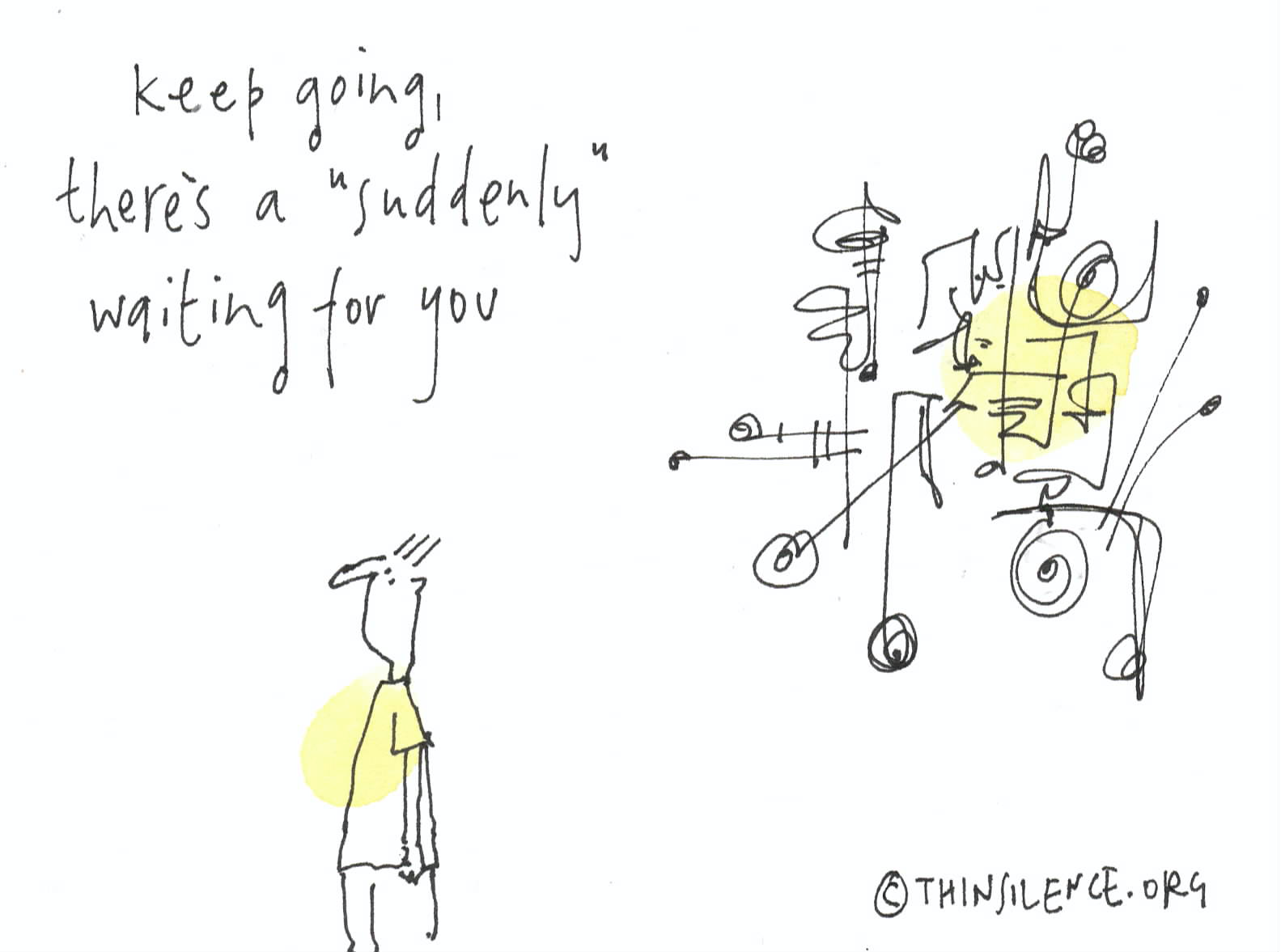
Nothing is really “suddenly.” A summating sentence can provide a false impression, That what we want will come quickly: Only a genie’s wish or some pixie dust away.
“Suddenly” is really our perception of something that has taken a long time to appear or to happen.
Transformation lies at the end of a slow, long road, So best to focus on the contents of the road.
The painting is like a thread that runs through all the reasons for all the other things that makes one’s life.* Georgia O’Keeffe
It is the time you have wasted for your rose that make your rose so important.** Fox to Little Prince
For Georgia O’Keeffe it was painting, And for you, The rich vein of your purpose and enjoyment – Often craftily disguised as discomfort and gritty determination – Will be one of eight billion possibilities, And you must mine it or be poor.
Blessed are the meek, for they will inherit the earth.* Jesus of Nazareth
They say that seeing is believing. But it might be more true that believing leads to seeing.** Seth Godin
It’s an argument for openness over judgement, To be open as if we believe. Nothing ventured, nothing gained, Or is that, Nothing gained, nothing ventured?
But breakthroughs, creativity and human connection don’t come from predictability. They come from unpredictable interactions with unknown ideas and voices.^
Inspiration is for amateurs. The rest of us just show up and get to work.* Chuck Close
Best not to wait for the muse or guide or godot to get here.
There’s plenty we can be getting on with, As Verlyn Klinkenborg writes helpfully for all of us:
And like “flow,” “natural” is one of the words behind writer’s block. So let’s suppose there’s no such thing as writer’s block. There’s loss of confidence And forgetting to think And failing to prepare And not reading enough And giving up on patience And hastening to write And fearing our audience And never really trying to understand how the sentences work. Above all, there’s never learning to trust yourself Or your capacity to learn or think or perceive.**
He’s not only penning these words for writers but for all of us.
Beginning with loss of confidence, Simone Weil writes:
If we go down into ourselves, we find that we possess exactly what we desire.^
So let’s go there first, And then we may know what to think, How to prepare, What to read, How to be patient, Where to begin and where not to, Understanding our “audience,” And most of all, Understanding ourselves.
When we arrive on earth, we are provided with no map for our life journey. Only gradually, as our identity forms and we get an inking of who we are, do possibilities begin to emerge that call us.^^





You must be logged in to post a comment.