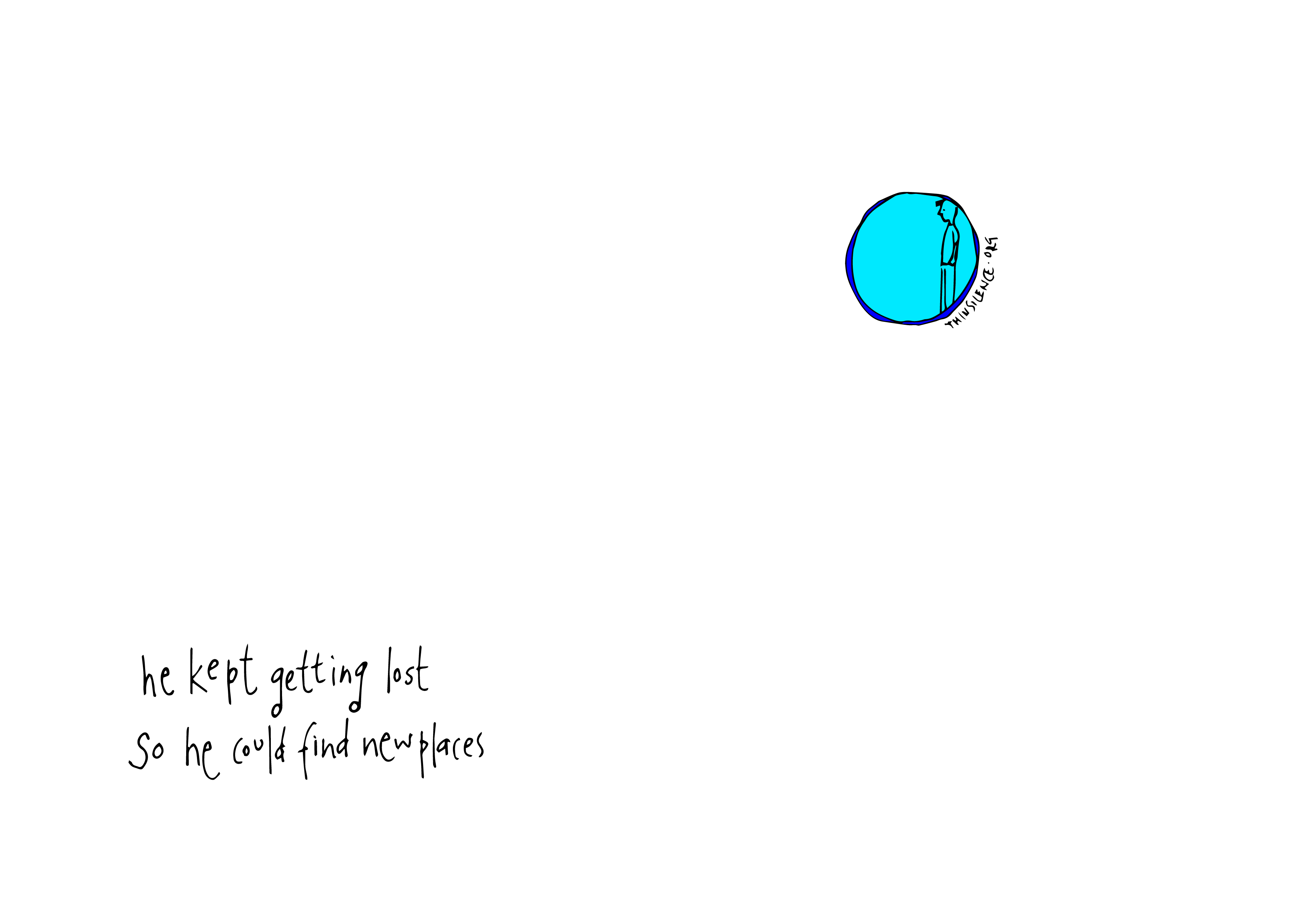
If there’s a map, someone’s already been there

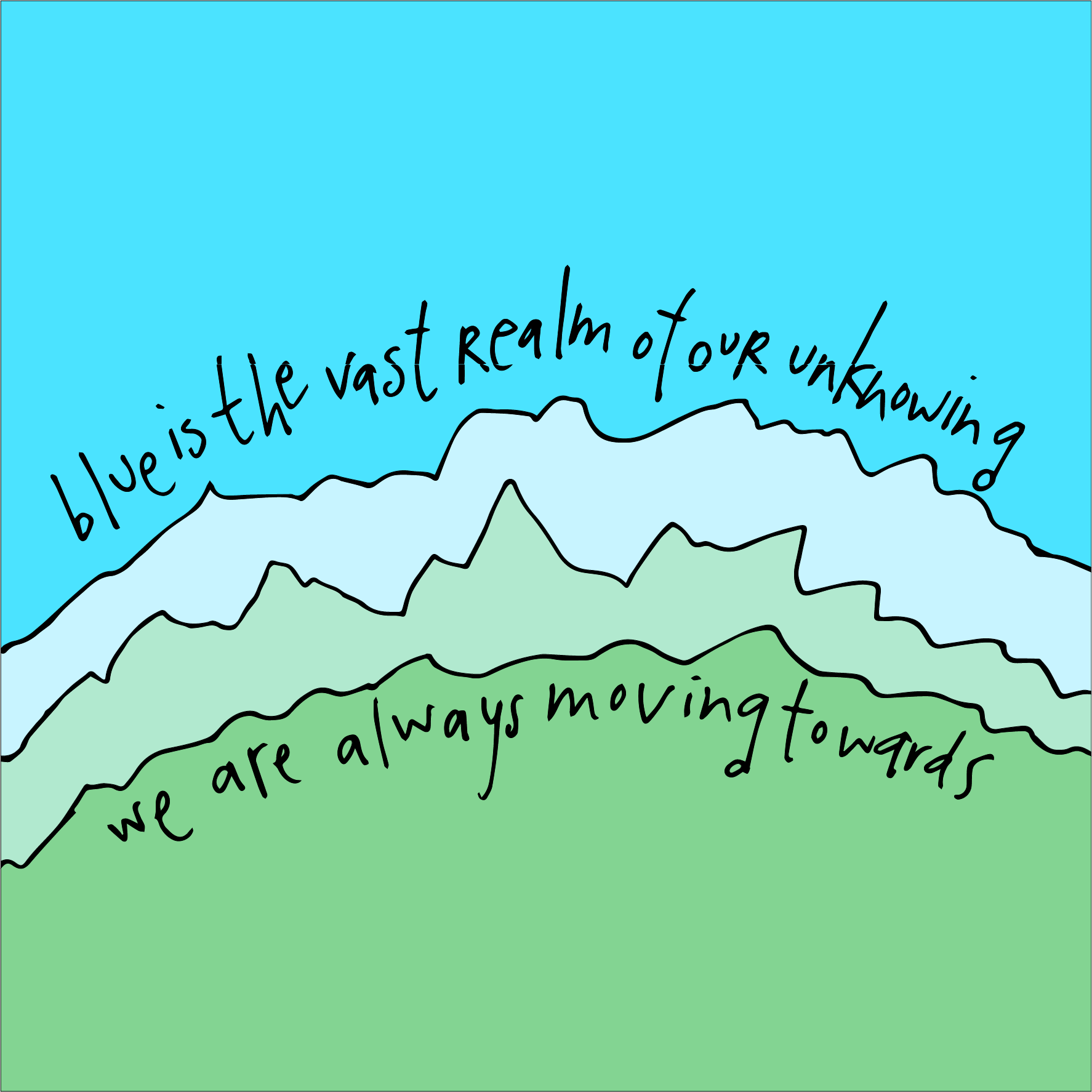
In her wonderful aid to moving from the familiar into the unfamiliar, Rebecca Solnit reveals the significance of blue for us as longing.  In longing there is something even more powerful than possessing:

‘For something of this longing will, like the blue of distance, only be relocated, not assuaged, by acquisition and arrival, just as the mountains cease to be blue when you arrive among them and the blue instead tints the next beyond.  Somewhere in this is the mystery of why tragedies are more beautiful than comedies and why we take a huge pleasure in the sadness of certain songs and stories.  Something is always far away.’*

I laugh in the moment of comedy, I continue to searching the significance of what is happening in a story containing sadness and its overcoming and an ending that is inconclusive – I am left with the blue.

I find it helpful to think of knowledge in three forms: general, specific and deeper.  I can know generally from outside of something, I can know specifically from inside and the deeper is top know this is never it – there is always more.

Of the infinite game, James Carse writes:

‘Infinite players cannot say when their game began, nor do they care.  They do not care for the reason that their game is not bounded by time.  Indeed, the only purpose of the game is to prevent it from coming to an end, to keep everyone in play. […] Since each play of an infinite game eliminates boundaries, it opens to players a new horizon of time.”**

Seth Godin asks:

‘How do you bump into the thing you didn’t know you were looking for?’**

This requires an infinite game.  There is the sense of a finite game when Solnit describes how some see longing as a problem:

‘We treat desire as a problem to be solved, address what desire is for and focus on that something and how to acquire it rather than on the nature and the sensation of desire, though often it is the distance between the object of desire that fills the space in between with the blue of longing.’*

There feels to be something here about living with longing rather than seeking to remove it that is about giving rather than receiving.  Erich Fromm dropped this itchy thought in my mind when I read:

‘Giving is the highest expression of potency.  In the very act of giving, I experience my strength, my wealth, my power.  This … fills me with joy.  I experience myself as overflowing, spending, hence as joyous … in the act of giving lies the expression of my aliveness.’^^

For  this, there is no map.

(*From Rebecca Solnit’s A Field Guide to Getting Lost.)
(**From James Carse’s Finite and Infinite Games.)
(^From Seth Godin’s blog: Organised for browsing.)
(^^From Erich Fromm’s The Art of Loving.)
To touch the earth quietly

Do not search for the answers, which could not be given to you now,
because you would not be able to live them.
And the point is to live everything.
Live the questions now.*
(Rainer Maria Rilke)

There are plenty of people willing to provide noisy answers, wanting their voices to be heard over the voices of others.

Rainer Maria Rilke points warns, though, answers don’t allow us to live everything.

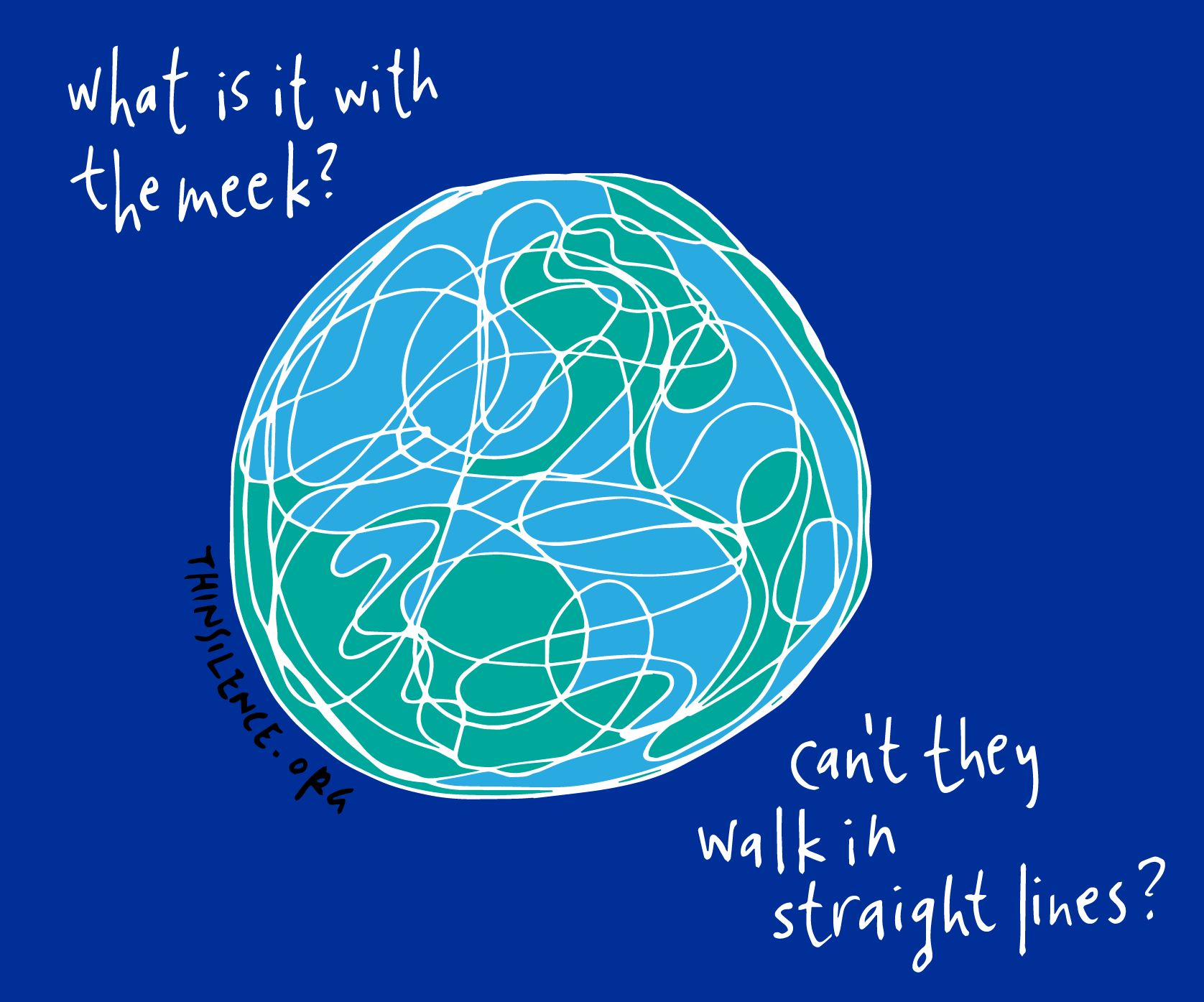
At the beginning of my day, I found myself wondering about something taught by Jesus of Nazareth.  To the crowds that came to the wild places to listen to him, he said, “Blessed are the meek because they will inherit the earth.”

Why inherit rather than rule or possess?

It feels as if there’s a moving of the inheritance-lines.  Most of the inheritance would go to the first-born male.

Now the important and valuable things will go to anyone who lives in an open inquiring way with everything that exists rather than to those with privilege by design or accident – my redefining of meekness.

Those who know they can’t have and keep something beyond the grave live in a different way through life.  To the person who knows they cannot possess a beautiful sunset, the oceans or mountains, a simple flower or the smile of another, there can be a great openness that allows them to more fully absorbs it.

The earth is truly theirs as they wander from the narrower paths of answers across the hidden ways of questions.

Here’s a blessing from Hugh Macleod for the meek:

‘Stay curious. Never settle.  Amen.’**

(*Rainer Maria Rilke, quoted in the Northumbria Community‘s Morning Prayer.)
(**From gapingvoid’s Stay curious.)

I once was found but now am lost

I rarely goof off.  I rarely follow a path I think might lead to a dead end.  I rarely imagine and dream beyond the four walls of a prescribed project.  I hardly ever give my mind permission to take a recess, to go outdoors, and play.  What have I become?  A robot?  A cog in a wheel?  A unit of efficiency myself?*
(Alan Lightman)

You are only free when you realise you belong no place – you belong every place – no place at all.  The price is high.  The reward is great.**
(Maya Angelou)

Hugh Macleod writes:

Value is the spaces between people.^

How often do we go directly to who we think the person is and what they have?

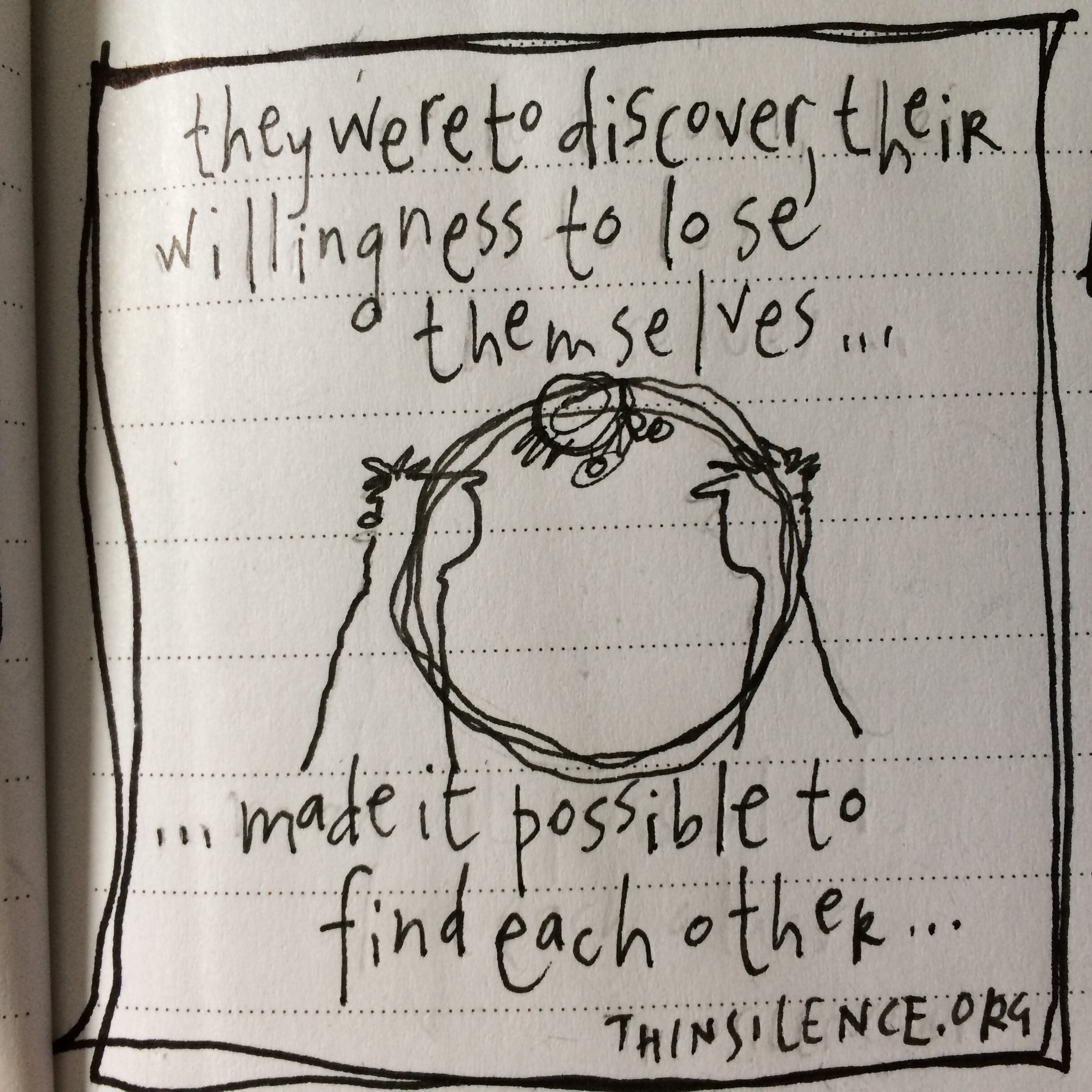
How often do we miss the possibility of what can come into being between me and the  other – what we can imagine together that is far more than the sum of our two sets of knowledge and experience?

We lay our maps down side by side and a new disorientating scape appears but also something new.  I like the way Rebecca Solnit introduces this:

‘Lost really has two disparate meanings.  Losing things is about the familiar falling away, getting lost is about the unfamiliar appearing […] in which car the world has become larger than your knowledge of it.’^^

In these words of blessing from John O’Donohue I find encouragement to enter the unfamiliar:

‘May morning be astir with the harvest of night;
Your mind quickening to the eros of a new question,
Your eyes seduced by some unintended glimpse
The cut right through the surface to a source.’*^

In a book of blessings of the spaces between, I cam upon this blessing of darkness:

‘Light cannot see inside things.
That is what the dark is for:
Minding the interior,
Nurturing the draw of growth?
Through places where death
turns into life.’^*

This darkness for me is the new-unfamiliar – disorientatingly unavailable to the measure by my familiar-light.

If I stay here, though, something new will appear:

‘Until the veil of the unknown yields
And something original begins
To stir toward your senses
And grow stronger in your heart
In order to come to birth
In a clean line of form,
That claims from time
Rhythm not yet heard,
That calls space to
A different shape.’*^

To become lost is an alternative response to our need that our foundness has not been able to meet.

(*From Alan Lightman’s A Sense of the Mysterious.)
(Maya Angelou, quoted in Brené Brown’s Braving the Wilderness.)
(From gapingvoid’s blog: What we learn from chickens.)
(^^From Rebecca Solnit’s A Field Guide to Getting Lost.)
(*^From John O’Donohue’s To Bless the Space Between Us: For the Artist at the Start of the Day.)
(^*From John O’Donohue’s To Bless the Space Between Us: For Light.)


WHY NOT HANG A LITTLE THIN|SILENCE?

I am framing some Thin|Silence signed originals for very reasonable prices, from £20 (plus postage and packing).  If you have a favourite, why not let me know (more information to follow)

If you don’t find what you want why not commission a doodle?

Here are a few examples …

Visible and invisible ways

I felt connected not only to the stars but to all of nature, and to the entire cosmos.  I felt a merging with something far larger than myself, a grand and eternal unity, a hint of something absolute.*
(Alan Lightman)

It was during his time as a school-teacher that Arkady learned of the labyrinth of invisible pathways which meander all over Australia and are known to Europeans as “Dreaming-tracks” or “Songlines”: to the Aboriginals as “Footprints of the Ancestors” or the “Way to the Law”.**
(Bruce Chatwin)

In a material universe, two of the visible ways we know our physical bodies keep moving are through food and healing – we require fuel to burn and we go wrong.

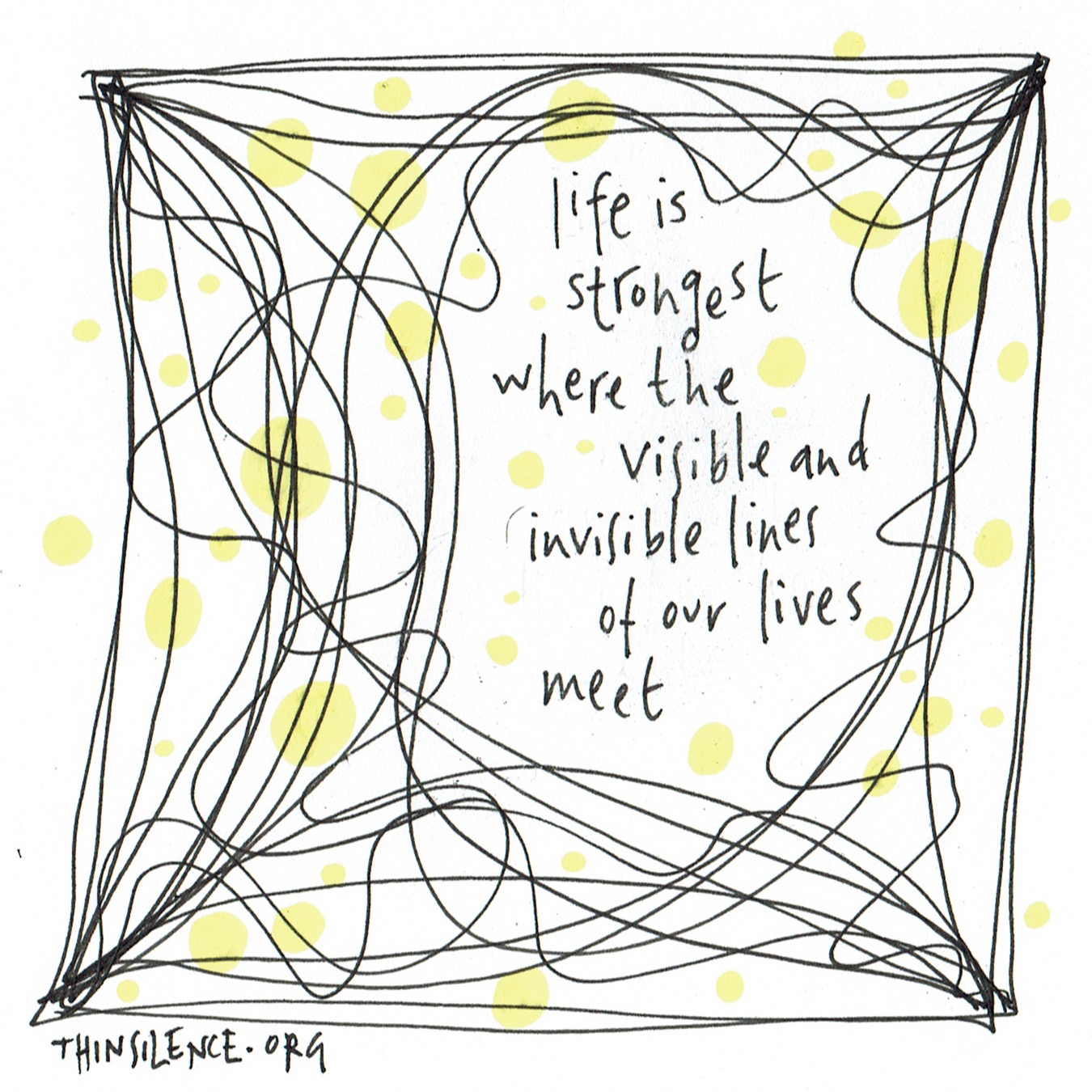
Life is more than these, more than the visible, though; it seems to shine brightest where the visible and invisible ways cross and intertwine.  And there are so many.

(*From Alan Lightman’s Searching for Stars on an Island in Maine.)
(**From Bruce Chatwin’s The Songlines.)

The goal, the distraction and the wonder

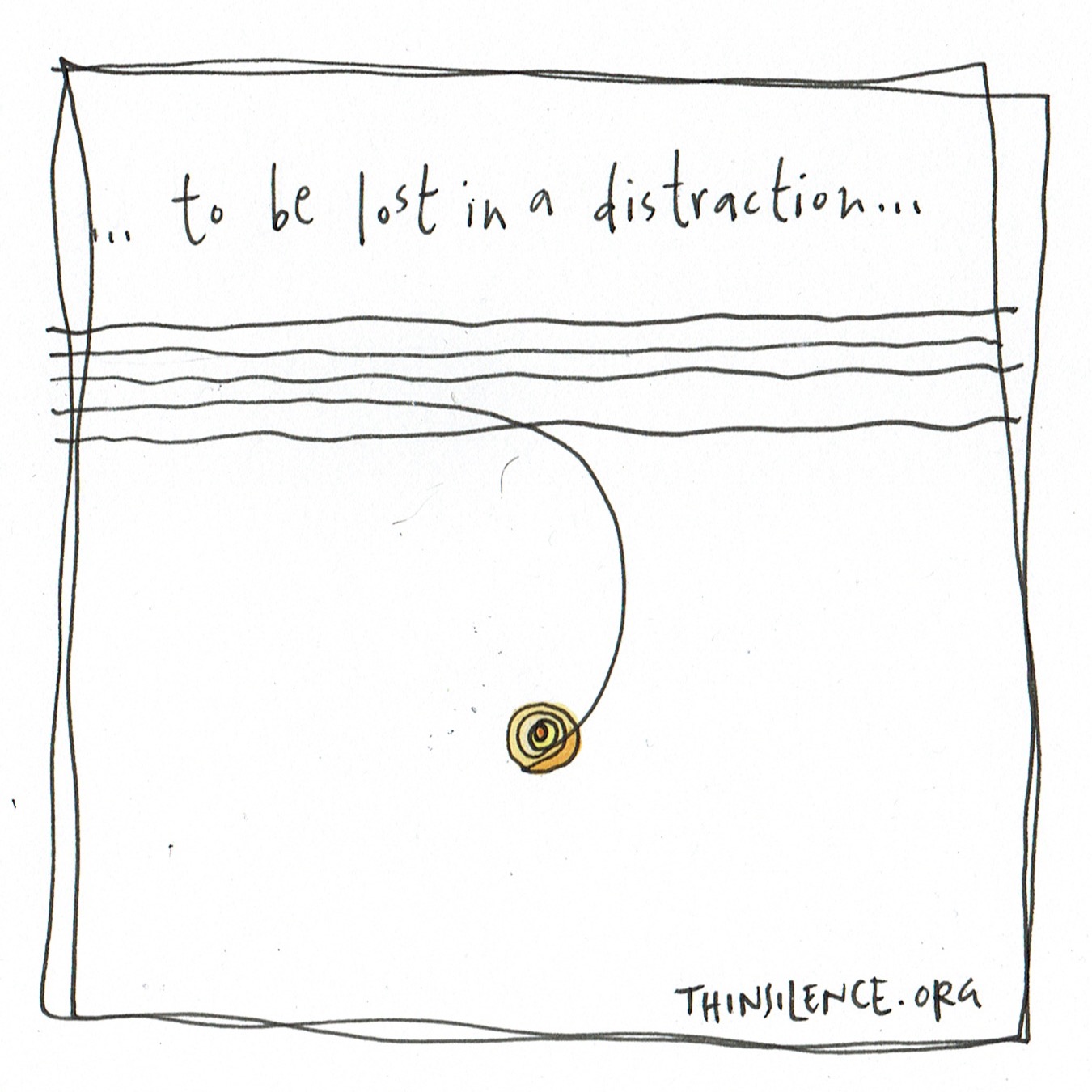
The question then is how to get lost.  Never to get lost is not to live, not to know how to get lost brings you to destruction, and somewhere in the terra incognito n between lies a life of discovery.*
(Rebecca Solnit)

This truth works out in many places at many levels but today it may be in the person who stops you doing what you have a mind to do and in your turning towards them and giving your attention to them something wonderful appears.

(*From Rebecca Solnit’s A Field Guide to Getting Lost.)

The impossible call

In out-of-the-way places of the heart,
Where your thoughts never think to wander,
This beginning has been quietly forming,

Waiting until you were ready to emerge.

[…]

Awaken your spirit to adventure;
Hold nothing back, learn to find ease in risk;
Soon you will be home in a new rhythm,
For your soul senses the world that awaits you.*
(John O’Donohue)

I began this morning with the following words before me:

‘Love, wisdom, grace, inspiration – how do you go about finding these things that are in some ways about extending the boundaries of the self into unknown territory, about becoming someone else?’**

Some years ago, I had read an electronic copy of James Carse’s Finite and Infinite Games.  I have now bought a paper copy.

I’m a little surprised by how thin it is – 149 pages – something I was unaware of when reading is slowly through on my Kindle.  Again and again Carse’s thoughts had caused me to stop and think, to see from new perspectives.  As I begin to read my paper copy, he’s doing it again.  I find myself marking only the third sentence:

‘A finite game is played for the purpose of winning, an infinite game for the purpose of continuing the play.’^

Rebecca Solnit is suggesting that we can only find some things about ourselves by losing ourselves – becoming purposefully lost.

Wherever we are, we can lose ourselves even when we know the place so well it’s impossible to become lost:

‘To lose yourself: a voluptuous surrender, lost in your arms, lost to the world, utterly immersed in what is presents that its surroundings fade away […] to be lost is to be fully present, and to be fully present is to be capable of being in uncertainty and mystery.’**

The person who chooses to lose themselves is the person who is “continuing the play”:

‘Then the delight, when your courage kindled,
And you stepped onto new ground,
Your eyes young again with energy and dream,
A path of plenitude opening before you.’*

Infinite players select themselves, finite players are chosen by others.  Solnit takes a moment to share where the word “lost” comes from:

‘The word “lost” comes from the old Norse los, meaning the disbanding of an army, and this origin suggests soldiers falling out of formation to go home, a truce with the wide world.  I worry now that many people never disband their armies, never go beyond what they know.’**

We all participate in finite games but not everyone chooses themselves and joins in an infinite game.

We need time to lose ourselves.  We can try to find time – waiting for someone or something else to move first – or we can choose ourselves and make time:

‘Though your destination is not yet clear
You can trust the promise of this opening;
Unfurl yourself into the grace of beginning
That is at one with your life’s desire.’*

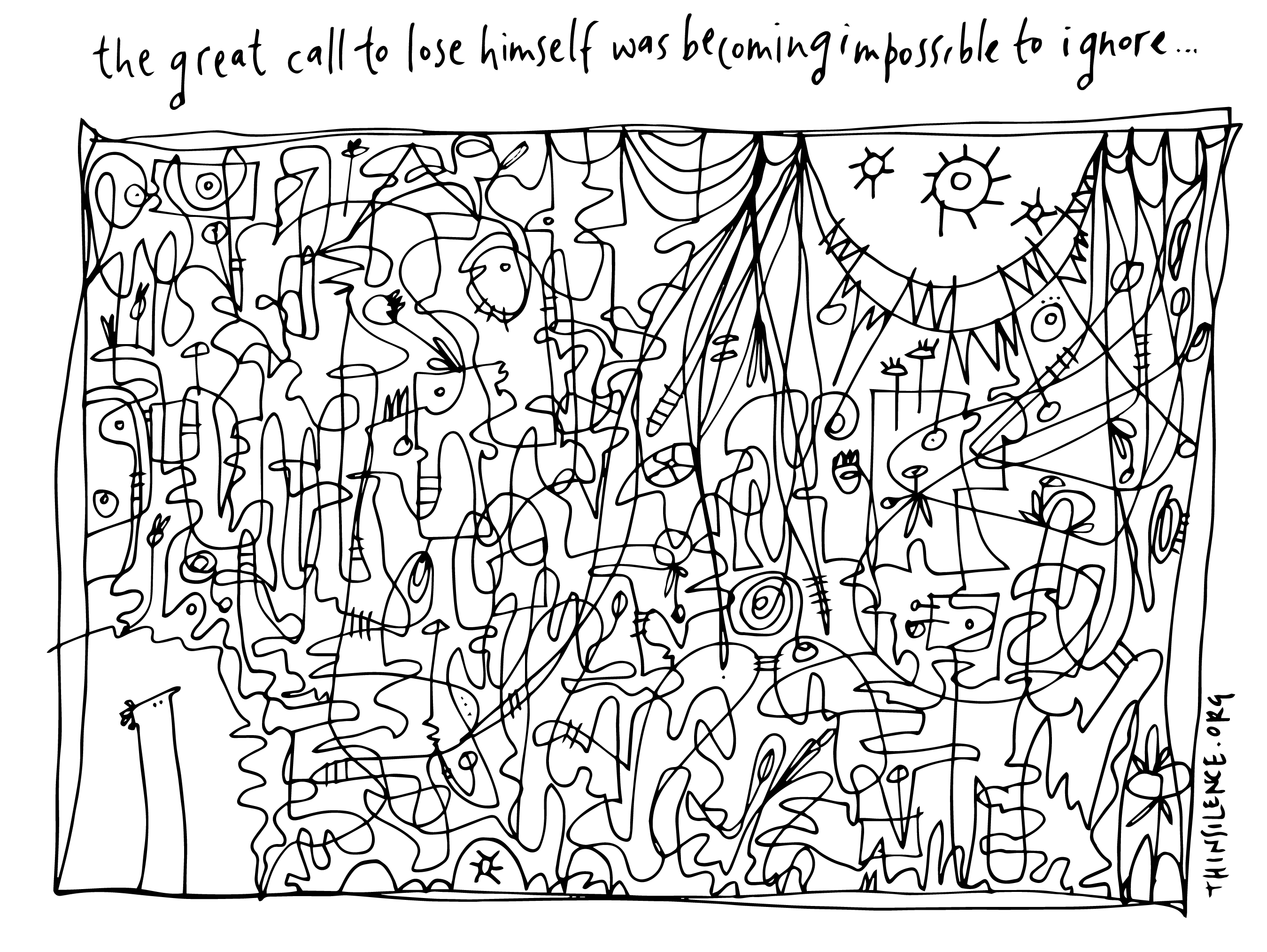
I offer today’s doodle for colouring, a means of losing ourselves.  Enjoy.

(*From John O’Donohue’s To Bless the Space Between Us: For a New Beginning.)
(**From Rebecca Solnit’s A Field Guide to Getting Lost.)
(^From James Carse’s Finite and Infinite Games.)

The garden, ballet dancer and mirror

We watch Nureyev leap.  We think, “Beautiful.”  Maybe we even think, “Wow.”  But we probably don’t think, “That took a 70ᴼ external rotation on the sagittal axis, a shift from sensory to vestibular feedback intake of 6 millilitres of water per kilo of weight per hour, perfect polymeric contraction, 20 years of stretch of the quadriceps femurs, 6 production departments, a $5,000 costume and 2 ounces of base makeup.”*
(Nancy Kline)

When you’ve identified what it is you most want to do with your life, you’re not going to get away with just wearing your fanciest clothes, hairstyle and makeup, and tweaking it all in the mirror to make it happen.  Well, you could but it’s probably not a great idea.

When I look at my garden, I know what I can see above ground is because of what I did below ground level, specifically shifting tons of stones, ripping up the old groundsheets, discovering what looked like a lunar landscape beneath, breaking open and turning over the clay soil with a spade, waiting for it to dry hard, breaking it down with the same spade, moving the soil around to create a sloping from house-to-gate-look, putting down new sheets, washing the stones and replacing them, deciding where to plant the shrubs, creating wells of good soil and watering for the shrub.

Of course I could have done a little more of what the previous owner had, using a thicker layer of stones to disguise the unevenness beneath and to put a couple of plants in pots and left it at that – but then the pots were stolen, anyway.  I could have tweaked it in this way but it wouldn’t quite be the same.

When we put this kind of effort into our lives, we not only produce “better art” – whatever it is we want our contribution to be, but we are changed in the process, for the better, making even more possible:

‘The larger the world we live in, the larger our lives develop in response.’**

Beneath the surface is where we find our problems but it’s also where the identify the possibilities, as Vera Rubin pointed out:

“If there were no problems it wouldn’t be much fun.”^

(*From Nancy Kline’s More Time to Think.)
(**From Richard Rohr’s The Naked Now.)
(^Vera Rubin, quoted in Alan Lightman’s A Sense of the Mysterious.)


A field guide to getting lost*

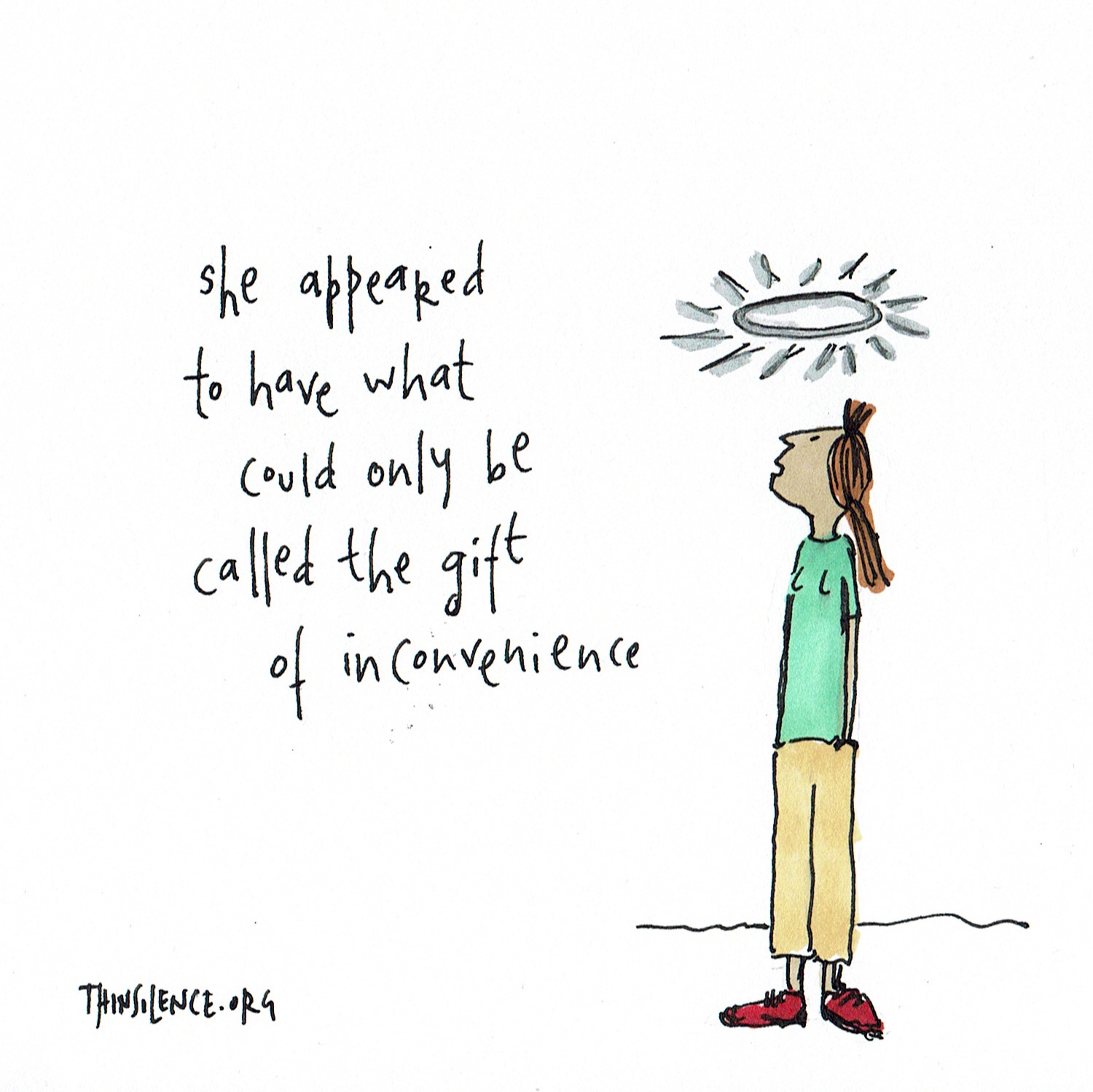
Leave the door open for the unknown, the door into the dark.  That’s where the most important things come from, where you yourself came from, and where you will go.*
(Rebecca Solnit)

When I begin writing in my morning journal, I’ve no idea what my prompting thoughts will be or where they will lead me.  It will include certain books over others, but which books?  What will I be thinking by the end of all of this, and what will I need to do as a result?

As I open myself to these new thoughts, some will excite me more than others.  It’s more than just thinking about different things, my heart is getting involved, too.

Nancy Kline tells of when she was gifted a Morning Glory plant, just a stem and two leaves, but soon that tiny plant would become a:

‘purple, blousy, blossom-festooned, soon-to-be-galloping glorious things, hundreds of them.’**

Her next words catch my interest more particularly:

‘They were in there […] not so much they were in there, as the means to make them.’**

From one stem and two leaves comes an incredible virulent mass of leaves and flowers.  Kline is thinking, as am I, how this is true of each of us.

We have generative hearts.

We become generative when we move from what we know to what we feel.  We find ourselves asking big, interesting, amazing, glorious, fantastic questions.^

Not answers.

Questions.

I am 59 and feel it more than ever.  I am encouraged by T. S. Eliot when he asserts:

“Old men ought to be explorers.”^^

It’s no wonder, then, that Brené Brown catches my eye when she tells me of her practice when setting out on research that’s going to challenge long-held beliefs or ideas:

‘In these uncertain and risky moments of vulnerability,  I search for inspiration from the brave innovators and disruptors whose courage feels contagious.  I read and watch everything by them or about them that I can get my hands on – every interview, every essay, every lecture, every book.’*^

We don’t explore what we know, we explore what we do not know.  It’s why questions are so important over answers.

Rebecca Solnit follows the words which open today’s post by quoting the philosopher Meno:

“How will you go about finding that thing the nature of which is totally unknown to you.”^*

Living out a question is a good place to begin.  While some want us to live in their answers, they certainly don’t want us to upset the status quo and ask our stupid questions:

‘”You’re doing it wrong.”  But at least you’re doing it.  Once you’re doing it, you have a chance to do it better.  Waiting for perfect means not starting.’⁺

You find yourself somewhere.

Somewhere you didn’t know existed before.

(*From Rebecca Solnit’s A Field Guide to Getting Lost.)
(**From Nancy Kline’s More Time to Think.)
(^I am indebted to Neil Gaiman for this phrase in Art Matters when he is thinking of mistakes rather than questions.)
(^^T. S. Eliot, quoted in Richard Rohr’s Falling Upward.)
(*^From Brené Brown’s Braving the Wilderness.)
(^*Meno, quoted in Rebecca Solnit’s A Field Guide to Getting Lost.)
(⁺From Seth Godin’s blog: You’re doing it wrong.)