entering the dark places

The “adjacent possible” is theoretical biologist Stuart Kauffman’s wonderful term for all the myriad paths unlocked by every novel discovery, the multitude of universes hidden inside something as simple as an idea.’*

‘Listen to your life. See it for the fathomless mystery it is.’**

I came across Stuart Kauffman‘s adjacent possible a few years ago and loved it straightaway.  It spoke to me of the multitude of universes I found hidden inside the lives of the people I met.

These dark and secret places open to our humility, as Edgar Schein so well identifies:

‘Humble inquiry maximises my curiosity and interest in the other person and minimises bias and preconceptions about the other person.’^

(*From Peter Diamandis and Steven Kotler’s Bold.)
(**Frederick Buechner, quoted in the Northumbria Community‘s Morning Prayer.)
(^From Edgar Schein’s Humble Inquiry.)

mtp

A massively transformative purpose.

‘Today, almost anyone with a passion has the power to bring real change into this world’*

The game has changed.

It used to be that we needed opportunity but only a few people were provided this.

When more were provided with opportunity then we needed to come up with a possibility, and idea, something we can make happen.

But now we have opportunities and possibilities and we must now initiate: to move from thinking it and feeling it, to doing it.

This is the hardest part and it begins with the first bold step.  (More tomorrow.)

(*From Peter Diamandis and Steven Kotler’s Bold.)


the back story

‘Many faiths believe that some day a messiah would appear and end all wars, famines, and even death itself.  But the notion that humankind could do so by discovering new knowledge and new tools was worse than ludicrous – it was hubris.’*

‘We are conditioned to search for similarities not differences.’**

Once upon a time there was a back story …

A back story is our way of explaining backwards why things are as they are now.  They’re often told by the people with the power or influence or kudos for why their belief, their political argument, their right to be leader is the right one.  These stories aren’t necessarily true but every day we believe them because we want to, because it’s easier than the alternative.

If Frans Johansson is right (the second quote, above) and we are conditioned to look for similarities – please conform – then we can also be re-conditioned to look for differences.

A forward story is a way of imagining what might be when we understand and express the power and idea we find within, and within a group of people working together.  It’s a story that recognises everyone has something to imagine, to make and to ontribute.  This will sound like chaos to some, but as John O’Donohue helps us see, nobility as a characteristic of being human, is something to be found in all kinds of wild and weird people who do not want to conform:

‘The Irish word “Uaisleacht” means nobility; it also carries echoes of honour, dignity and poise.  A person can be wild, creative and completely passionate and yet maintain Uaisleacht.’^

Richard Rohr argues that every thing has something to offer, too:

‘In fact, you can trust after a while that almost everything is a kind of guidance – absolutely everything.’^^

This is an expansive understanding of the universe and of our place with in it, one with flow in which we find ourselves exploring wonder and meaning.  Richard Sennett writes about anthropomorphism of the brick, blocks of clay built together being described as  a “shining mane of hare,” “mottled skin,” “an old man’s weathered face.”  Furthermore:

‘The attribution of ethical human qualities – honesty, modesty, virtue – into materials doesn’t mot aim at explanation; its purpose is to heighten our consciousness of the materials themselves and this was to think about their value.’*^

There’s something in this that speaks of how it’s possible to be emotionally connected to all people and all things, a way of engaging with our personal gift, too, seeing all kinds of ways for turning it into a contribution because we value it.

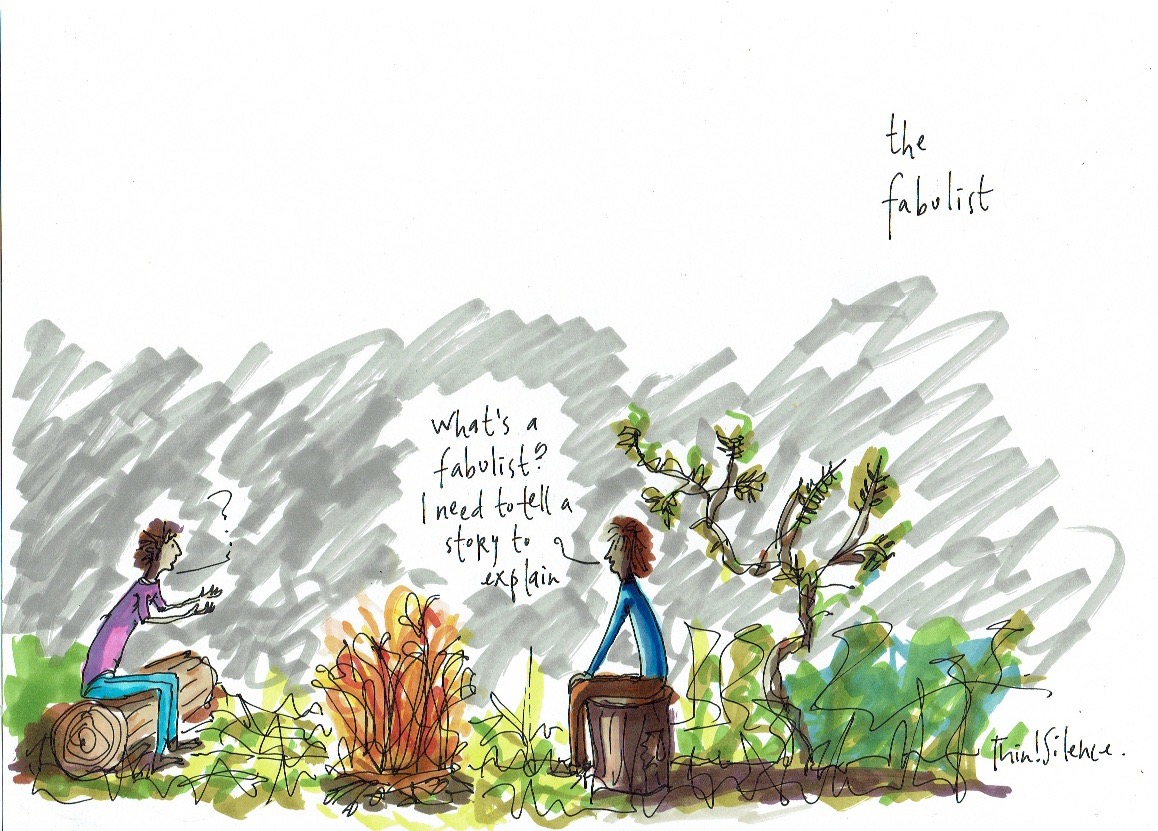
Time to be a fabulist and tell a different story.

(*From Yuval Noah Harari’s Sapiens.)
(**From Frans Johansson’s The Click Moment.)
(^From John O’Donohue’s Eternal Echoes.)
(^^From Richard Rohr and Mike Morrell’s The Divine Dance.)
(*^From Richard Sennett’s The Craftsman.)

what more can i do?

‘loosen my heart
until it becomes a wing,
a torch, a promise”*

We don’t know the extent of the we can do, the more – or magis as one group named it – we can bring.**  All we know is that the path to discovery is not an easy one and we can turn away.

There are those who want to get more out of us: more effort, more time, more commitment, more loyalty, more attention, more focus, more output.  This is not about magis.  It misses a trick, the desire that many of us have for doing something we love better, with imagination, innovation, and creativity – whatever it is.  If this is how businesses and companies and relationships operate then there will never be more.

When we step back from the way life happens on a day to day basis, we see how we are part of a universe that makes it possible to find and pursue something that keeps us up at night dreaming and imagining.  In his novel about creation physicist Alan Lightman has his character Uncle Deva speaking about the beauty brought into being by anticipated lifeforms:

“The beauty you speak of – the stars and the oceans and so forth – is part of their beauty, those living things.  And so much enhanced by their participation, by their absorption of that beauty and then the responsive outflowing of their own beauty.  It is a spiritual thing, don’t you see?

[…]

Intelligence, awareness, mindfulness are going to connect the pieces of the universe in a way that inanimate matter never could.”^

When we step back into the way life happens on a day to day basis, we see how we are missing out on the opportunities: in our education system, in our workplaces, in our families, in our societies, in our politics, in our own lives.

The group I mentioned at the beginning was the early Jesuit movement.  450 years ago there were no easy ways to get around the expanding world but within ten years the original group of ten were on four continents, sharing their joy in the new sciences and technology and maths.  They had made those seemingly impossible journeys through a process of self-awareness (what is my dream), innovation (all the different ways this dream can live), love (how can I share this with others?), and heroic deeds (making it happen).

Who wouldn’t want people to show up with this kind of energy, whether its meeting with friends, going to work, taking on a challenge, or being willing to see how much more there is inside each one of us.

‘Ingenuity blossoms when the personal freedom to pursue opportunities is linked to a profound trust and optimism that the world presents plenty of them.^^

(*Dawna Markova, quote in the Northumbria Community‘s Morning Prayer.)
(**Magis was a saying of the early Jesuits; see Chris Lowney’s Heroic Leadership.)
(^From Alan Lightman’s Mr g.)
(^^From Chris Lowney’s Heroic Leadership.)

what next?

There’s always what next?

It’s about being able to see it.

“If people would but do what they have to do they would always find themselves ready for what came next.”*

I’ve just ordered Dan Ariely’s Payoff after reading the following quote in Hugh Macleod’s gapingvoid blog:

“We’re motivated by meaning and connection because their effects extend beyond ourselves, beyond our social circle, and maybe even beyond our existence.  We care deeply about meaning, we care about it more as we become aware of our own mortality – and if we have to go to hell and back in search for meaning and connection, we will: and we will get satisfaction along the way.”**

Motivation opens up our “what next.”  There’s “flow” to these words, the flowing of something into us and flowing out through us – we might name this the “great flow” of life we’re all caught up in.  We participate when we make our small contribution, our “little flow” with all its messiness and mistakes and sometimes beautiful moments.

‘The Great Flow makes use of everything, absolutely everything.  Even our mistakes will be used in your favour, if you allow them to be.’^

I place these words from Richard Rohr side by side with some from Alan Lightman’s Uncle Deva character in his novel about creation Mr g.  The two are looking over the first forms of life, forms that would become intelligent and self-determining eventually:

‘Wouldn’t the beauty have more meaning with other minds to admire it?  Wouldn’t it be transformed by other minds?  I’m not talking about a passive admiration of beauty, but a participation in that beauty, in which everyone us enlarged.’^^

This is a dream about you and me though we doubt it or even refuse it.

One of the most beautifully dangerous things we can do to release our motivation, so that it reaches out across the limitlessness of space, is to write it out.  Social psychologist James Pennebaker has identified how ‘writing about emotional upheavals for just fifteen to twenty minutes on four consecutive days can decrease anxiety, rumination, and depressing symptoms and boost our immune system’.*^

It’s also one of the most powerful ways of releasing motivation and flow from its stuckness.  Writing out our hopes and disappointments, our challenges and questions, our mistakes and failures – staring all of these full on and not being overwhelmed – will lead us to our what nexts.  We connect to the great flow even as we discover the flow of our lives.

Through history literacy has threatened the “powers-that-be.”  Finding our own literacy, writing our story as unfolding drama rather than predictable script, joins us to the possibility of life growing larger.  I am not a very good writer but writing every day for the past nineteen years has constantly moved me in new directions.

The following words come from Ursula Le Guin‘s poem The Mind is Still and connect me with Michelangelo’s unfinished statues situated in Florence’s Gallery Academie.  When I first read of them,  figures wrestling themselves free from the stone which held them, epitomising my story of helping people to awaken to their dreams.  I knew I had somehow to see them and it took me more than four years to make to Florence, and while others rushed past them toward Michelangelo’s David, I gazed on them for more than an hour:

‘Words are my matter.  I have chipped one stone
for thirty years and still it is not done,
that image of the thing I cannot see.
I cannot finish it and set it free, transformed to energy.’

(*George MacDonald, quoted in the Northumbria Community‘s Morning Prayer.)
(**Dan Ariely, quoted in gapingvoid‘s blog Instant motivation.)
(^From Richard Rohr’s The Divine Dance.)
(^^From Alan Lightman’s Mr g.)
(*^From Brene Brown’s Rising Strong.)
(^*From Ursula Le Guin’s Words are my Matter.)

steadfast is changing

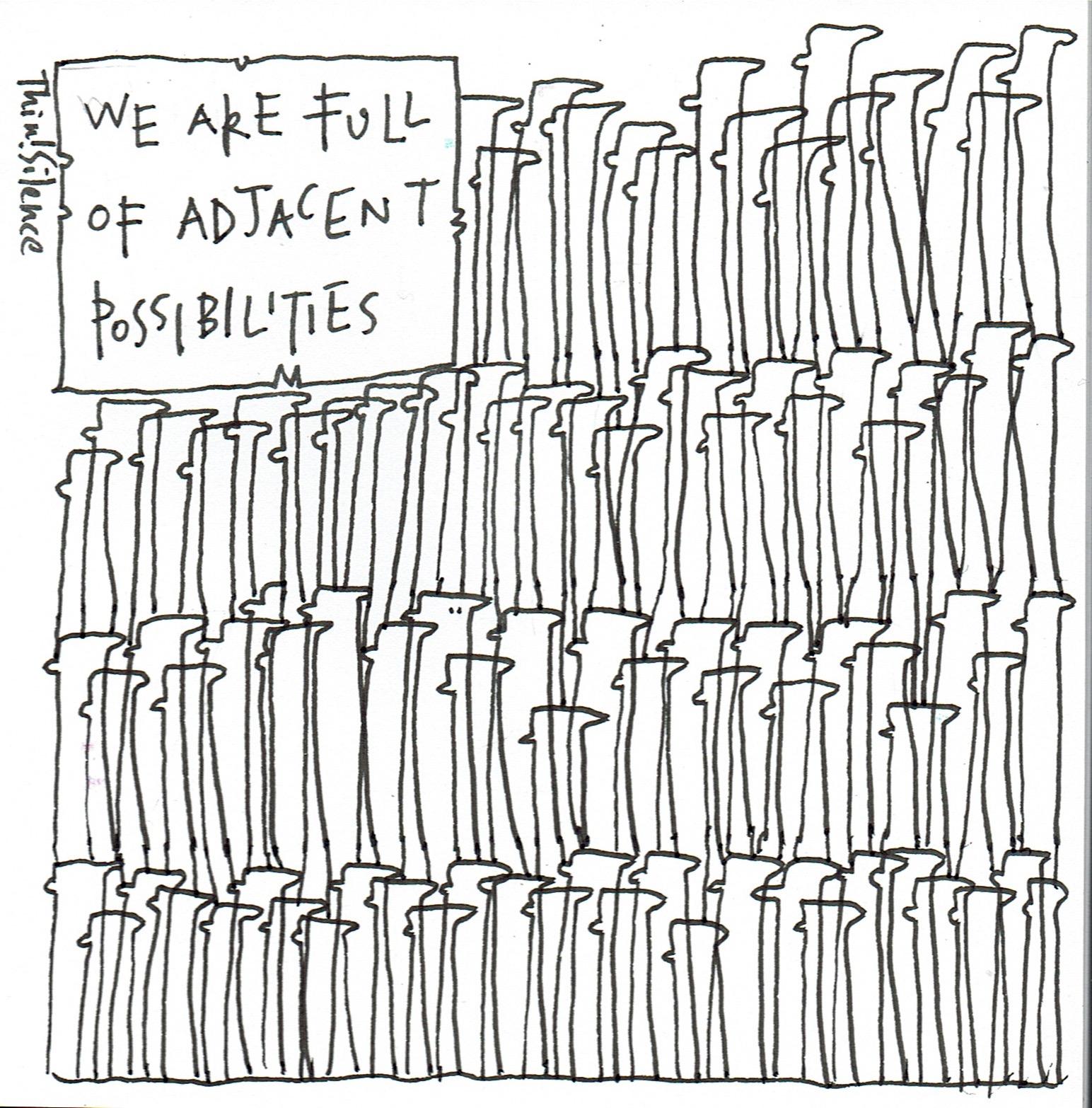
Firm, determined, resolute, steady, staunch, stalwart, stout, relentless, implacable, single-minded, unchanging, unwavering, unhesitating, unfaltering, unswerving, unyielding, unflinching, inflexible, uncompromising.

What in you is steadfast, continuing, headed in the same direction, the one good thing you have chosen?

We live in a world of change.  We always have but the speed of changing is growing ever faster:

‘Whatever the reasons change comes when it does, there seem to be at least three Events that ignite change: contact with Outsiders, significant events, and Epiphanies.’*

It’s hard to imagine a world in which these three Events are going to reduce in number.  We have as a species and as people continually changed – human becomings rather than human beings:

‘Each of us is becoming, becoming something better or something worse.  And we become what we teach or what we learn.’**

Against this, steadfast has never meant unchanging. It’s always been about knowing what we must do and living in its direction so that all change increases and grows our steadfastness.  It’s just more necessary than ever to be reflective people, interacting with our growing and developing selves as well as the outside Events.

‘The starting place for change is accepting oneself and taking an interest in one’s inner world.’^

(*From Alex McManus’ Makers of Fire.)
(**From Seth Godin’s blog Groucho runs deep.)
(^From Edward Deci’s Why We Do What We Do.)

not so fallow ground

Fallow can be growing nothing on purpose, though it could also be by neglect or uncertainty.

Sometimes fields are ploughed and harrowed; others are left to their own devices.

Fallowness works as a great metaphor for  thinking about our lives.

We’re waiting to do something.  We don’t know what to do.  There’s nothing that we can do.  Others will tell us what to do.   Something might happen of its own accord.  We’re resting and it’s hard to get going again.

Seth Godin’s recent blog is pretty pertinent.

‘If the railroad didn’t make it to your town, or if the highway didn’t have and exit, or if you were somehow off the beaten path, we wrote you off.

Now of course, if wireless signal can reach you, you’re in the middle of everywhere, aren’t you?’*

Also, the culture and education is changing.

When the ground is finally broken open and sown, the seed comes from a past harvest and its easier than ever for it to find its way to us.  Richard Rohr reminds me that the word person once meant the opposite of how we use it.  Per sonare originally meant to “sound through.”  We are what others have shared with us – seed from a past harvest.

Others argue that we’ve always had the seed – we’ve just never sown it.

And, as with so many things, a problem can be our godsend, bringing everything into focus:

‘Identify the key issue.  What problems keeps you up at night? […] Work to identify the market failures that led to this impasse.  Peel back the layers and determine what’s at the core.’**

Impasses and layers sound very similar to fallowness.  When it gets personal, the problem wakes us up to do something.

If we break open the ground of our lives, the harvest we bear will be shared by us with others: per sonare: a flowing in and a flowing out.  We welcome the seed and rain and sunshine to do their work:

‘And, remember, if it’s not flowing out of you, it’s probably because you’re not allowing it to flow toward you.’^

One more image: this breaking open, this being open to the flow, is also a first step in a quest:

‘The pace of words is the pace of walking, and the pace of walking is also the pace of thinking.’^^

A quest is only a series of steps in the direction of a challenge or need.*^

(*From Seth Godin’s blog: The middle of everywhere.)
(**From Peter Diamandis and Steven Kotler’s Bold.)
(^From Richard Rohr and Mike Morrell’s The Divine Dance.)
(^^From Geoff Nicholson’s The Lost Art of Walking.)
(*^In answer to Peter Diamandis and Steven Kotler’s question about what is my challenge, I found myself saying it is the Alchemy Quest, to offer a journey of transformation.)

in the long run

Time always catches up.

Before we know it we have run out of timethe time is upthe time has gone and, there’s no more time.

The opportunity has passed.  one day, it will be life itself that has drained away.

Bertolt is 500 years old.

Bertolt is also a tree, named by a young boy who befriends him in Jacques Goldstyn’s book that is ultimately about death.  The boy watches the scenes of the nearby town from Bertolt’s branches, makes friends with the other creatures making their home in the tree, learns about the seasons, and, then, one Spring, Bertolt doesn’t come into leaf as the other trees do.  Even Bertolt’s long life comes to an end.  But he must stand there for all to see, so the boy comes up with a plan from his own life.

He had once lost his mittens but from lost and found brings away two mismatched mittens – – for which he is derided by other children.  Now, the boy comes up with the plan to redeem the many odd mittens and. filling Bertolt’s branches with clothes lines, in the words of Maria Popova who has introduced this story to me:

‘we see Bertolt half-abloom with mittens.  Like Christmas ornaments, like Tibetan prayer-flags, they stand as an imaginative replacement for the leaves and blossoms that Bertolt’s fatal final spring failed to bring — not artificial, but realer than anything, for they are made of love.’*

As I read this, I understand I am not without some time, to understand the lives of others, to be friends with the world, to learn about living through the seasons, and to know myself in all of this.  I have wasted plenty of time but I also have time left.

(*From Maria Popova’s BrainPickings: Bertolt: An Uncommonly Tender Illustrated Story of Love, Loss, and Savoring Solitude Without Suffering Loneliness.   I have now bought the book Bertolt and imagine the story of the boy and this tree will reappear.)

find me here and find me there

Here is an important word.  It’s about being present, now.

Life becomes even richer when there s also a there, usually followed by a there to there to … .

Here is now.  There is about journeying into the unfamiliar, the new, the future.

Because we can.

Because we can dream in the daytime as well as at night.  Some feel this to be a curse: please leave them be, forget the becoming.

Hugh Macleod captures the urgency inhabiting our ability to dream.

‘Thought leadership should be about taking what you know and using it to help people around you.  To innovate.  To make your world a more meaningful place.’*

This thought or dream or hope is where it all begins:

‘Creating the future does not begin with a plan.  It begins with a dream.  And when someone acts on a dream, it creates a spark.’**

Cometh the spark, cometh the fire.

No-one dreams or hopes for what they already have.  It’s about the future, the journey from there to there.

I’m hopeless for remembering nighttime dreams.  And those I remember, I don’t pay much attention to.  I don’t know why.  Perhaps because they’re about my brain thinking about and sifting the past, but my daytime dreams are about the future.

To be human is to find me here and to find me there.

(*From gapingvoid’s blog: Teaching for the sake of what?)
(**From Alex McManus’ Makers of Fire.)

opportunity

In his novel about creation physicist and writer Alan Lightman names this universe of ours Aalam-104729 – one of an incalculable number of universes formed in the Void:

‘No matter what one was doing in the Void, no matter where one was in the Void, once could feel the crowd of new developments in Aalam-104729.  One could feel the rushing headlong into the future, even thought that future was faint and fraught with uncertainties.’*

This is our home.

Before reality there is probability and before probability there is possibility – with no certainty of success.**

This can be a long journey so what makes us go after it?

Obedience may take us some of the way but love helps us complete:

‘I work very hard for something I love to make sure I don’t have to work very hard doing something I hate.’^

To do what we love and love what we do but which comes first?

This is a mysterious thing.  The important element is to notice what we love, what we feel the rushing headlong into the future within.

In his wonderful book of words and pictures It’s Your Turn, Seth Godin points us what we must then do:

‘To be an artist is to be on the hook, total your turn, to do the things that might not work, to see connection, to embrace generosity first, to take responsibility, to change someone, to be human.’^^

Before there is certainty there is only uncertainty.

I came across Alan Lightman when I read his excellent Einstein’s Dreams in which he tells short stories about time.  This treasure of a boo interweaves time stories with Albert Einstein

finalising his Theory of Relativity.

In a world where people live forever the population is made up of Laters and Nows:

‘The Laters sit in cafés sipping coffee and discussing the possibilities of life.  The Nows note that with infinite lives, they can do all they can imagine.’*^

Ever wonder what your imagination is trying to tell you?

Passion is about being a Now, not a Later:

‘I walked away remembering that passion was a rare commodity.’^*

It needn’t be, it’s only a willingness to notice more away.

We begin with possibility and love carries us forward.

And before possibility there is opportunity.

Welcome to today.

(*From Alan Lightman’s Mr g.)
(**See Seth Godin’s short blog Possibility.)
(^From gapingvoid’s blog Making the Best of it.)
(^^From Seth Godin’s What To Do When It’s Your Turn.)
(*^From Alan Lightman’s Einstein’s Dreams.)