when we keep asking the questions

“Live the questions now.  Perhaps then, someday far in the future, you will gradually, even without noticing it, live your way into the answer.”*

This is about questions and quests.  One leads to the other.  Some quests are hardly noticeable, some alter the trajectory of ur lives – these are the ones I want to focus on.

Peter Diamandis tells of how he was inspired by the story of Charles Lindbergh whose imagination was captured by a competition to build an aircraft capable of crossing the Atlantic.  This in turn stirred Diamandis’s desire to create a craft that could travel into space: ‘my original use of incentive competitions stemmed from my desire to figure out how to get myself into space’.**

There’s something dynamic and exciting about finding the the right questions for our lives – where our deep gladness meets the world’s deep hinger.

This brings vulnerability and we have to move forward to understand vulnerability better.

‘A life that wishes to honour its own possibility has to learn too how to integrate the suffering of dark and bleak times into a dignity of presence. … Vulnerability risks hurt, disappointment and failure.’^^

Answers seek to overcome, domesticate, and civilise.  It’s perhaps why mythologist Joseph Campbell argues we’re lacking mythologies for enlarging our lives:

‘We can’t have a mythology for a long, long time to come.  Things are changing too fast to become mythological. … Myth opens the world to the dimension of mystery, to the realisation of the mystery that underlies all forms.’*^

Please, don’t give up on your questions.  We’re moving towards a new mythology as those who’re opening minds, hearts, and wills.

(*Rainer Maria Rilke, quoted in the Northumbria Community‘s Morning Prayer.)
(**From Peter Diamandis and Steven Kotler’s Bold.)
(^The more critical and significant the question, the more it will invoke five elemental truths in pursuing our questions: life is hard, we are not as special as we think, our life is not about us, we are not in control, and we are going to die.  See Richard Rohr’s Adam’s Return.)
(^^From John O’Donohue’s Eternal Echoes.)
(*^From Joseph Campbell and Bill Myers’s The Power of Myth.)
dreaming of conviviality

“If you want your dream to be, take your time, go slowly.  Do few things but do them well, heartfelt work grows purely.”*

‘The conviviality of working together protected us from “the damage caused by the fast life.” … Slow philosophy overall should not be interpreted … as “the contrast … between slowness and speed – slow versus fast – but rather between attention and distraction”‘.**

What kind of world do you dream of?

It’s unlikely to come quickly but will involve day after day of turning up in focus and hope and action.

‘We are not called to save the world, solve all problems, and help all people. But we each have our own unique call, in our families, in our work, in our world.’^

And when we find each other we can do more.

How we work together makes all the difference in the world.

Beyond debate lies dialogue and, if we can just slow down and listen to each other in deep openness, there is a generative conversation to be had, make it possible to be changed by the journey.  Such working spaces bring whispers of hope to our world, making it possible for everyone to bring their contribution in a spirit of conviviality.

(*Donovan Leitch, quoted in the Northumbria Community‘s Morning Prayer.)
(**From Maggie Berg and Barbara Seeber’s The Slow Professor, quoting Carlo Pettrini.)
(^Henri Nouwen, from the Henri Nouwen Society.)

the margins of our lives

‘[Boredom] can be a sign that the patient is avoiding a particular subject; that he or she is unable to talk directly about something intimate or embarrassing.’*

‘To see if you like where you are, without the chains of dependence, check if you are as happy returning as you were leaving.’**

Boredom may sometimes be our lives telling us we’re being too mainstream, avoiding some critical things pushed to the margins of our lives.  Every life has a world of stories within it: some lived, others unlived and discarded, pushed to the margins – where they can be found again.

And when we go to the margins we will not only find ourselves but others too

(*From Stephen Grosz’s The Examined Life.)
(**From Nassim Taleb’s The Bed of Procrustes.)

entering the silence

Once again, I woke up early.   Some time before 5am, I guess, but I wasn’t going to look at my watch.  I decided to use the time to listen to the silence as I explore more how silence is possibly brimming with all sorts of things.

I contemplated the senses. Touch, smell, and hearing – I couldn’t see anything and wasn’t aware of any taste.  Nevertheless, I found the silence contained information about how I was lying, and ideas, thoughts and memories that were going through my head, and pictures too.

The silence is always with us.  It’s at the edge of our being – we’re simply unaware of it most of the time.  Silence offers another way of inquiring and understanding what is still to be explored, especially what we don’t know yet, what we’ve forgotten, and what we have not looked too deeply into.  Here is where we hone our creativity.

(Wandering, then, becomes another way of exploring the silence: the breathing becoming present, opening the senses, and following an idea are ways to open the mind and heart towards opening the will.)

‘The world is changing, and creativity is our only hope.  There is nothing else.’*

I realised I’d had another, different, experience of entering the silence yesterday in a meeting with two others.  When I say silence, I don’t mean there can be no noise, no talking – sometimes there is.  Silence is more about openness than the absence or presence of noise.  There was such an openness, a willingness on all our parts to explore.  When I emerged it was with an idea I’ve got to pursue further today – I’ve no fear of silence as being a waste of time.  It often leads to some creativity, then action.

As I say, silence is about uncertainty.  We may think we need certainty  but we need both: life is found between the two.  What we find in the silence is the kind of story that makes it possible for us to live life strongly.  By strongly, I mean a story that benefits ourselves and benefits others.

‘A good novel gets under our skin, provokes us and haunts us long after the first reading, because we never fully understand the characters.  We sweep through the narrative again and again, searching for meaning.  Good characters must retain a certain mystery and unfathomable depth, even for the author.  Once we see to the bottom of their hearts, the novel is dead to us.’**

We are this story we can never plumb the depths of, and the silence of this is what we’re exploring.  These stories lie within other stories, about people and the world, about a galaxy and universe and the void beyond – silence full of mystery and possibilities.

‘wouldn’t it be amazing if we could somehow encourage acts of greatness?  Not order them, but create an environment where people feel they can embrace the superhero within and achieve great things’^

(*From Hugh Macleod’s gapingvoid.)
(**From Alan Lightman’s A Sense of the Mysterious.)
(^David Marquet, in 99U’s Make Your Mark.)

truth and routinism

“Show me the hidden things, the creatures of my dreams, the storehouses of forgotten memories and hurts.  Take me down to the spring of my life, and tell me my nature and my name.”*

‘From birth to death, from Monday to Monday, from morning to evening – all activities are routinised.  How should a man caught in the net of routine not forget that he is a man, a unique individual, one who is given only this one chance of living, with hopes and disappointment, with sorrow and fear, with the longing for love and the dread of the nothing and of separateness.’**

Routine for routine’s sake makes it difficult to answer to questions: Who am I? (which is also asking that you see me in this way) and What is my work?

We are creating new worlds with our expanding technologies: from the Sims, to Second Life, to Facebook and Twitter, and everything in between.  Whether these are truthful worlds is another matter.  They offer some semblance of control, of individuality, a kind of freedom from routinism (often a chance to groan about it) yet they may prove to be taking us further from the truth.

Promising a voice, an audience, an impact that can feel powerful – they may only be a new form of routinism.

The truth resides in the thin silence, listening to the quiet whispers telling us who we are and what is our work.

(*George Appleton, quoted in the Northumbria Community‘s Morning Prayer.)
(**From Erich Fromm’s The Art Loving.  Fromm uses the language of 1957 but means women as well.)

the last half of life

‘So get ready for some new freedom, some dangerous permission,some unexpected happiness, some stumbling stones, some radical grace, and some new and pressing responsibility for yourself and for your suffering world.’*

‘Decline starts with the replacement of dreams with memories and end with the replacement of memories with other memories.’**

If our aim in life is to identify the least challenging route then we’re going to be putting more and more distance between ourselves in the unknown, and somewhat mysterious, potential of our lives.  We just don’t know how far we can grow our thinking, relating, and actioning both personally and collectively, overcoming the decline and growing mastery.

It may just well be that a great life is the result of seeking out tension, not avoiding it.  A better life lies in our hands.  (Please note, I didn’t say a wealthier or more popular life.)

Of course, the easiest way of dealing with this is to do nothing.

(*From Richard Rohr’s Falling Upward.)
(**From Nassim Taleb’s The Bed of Procrustes.)

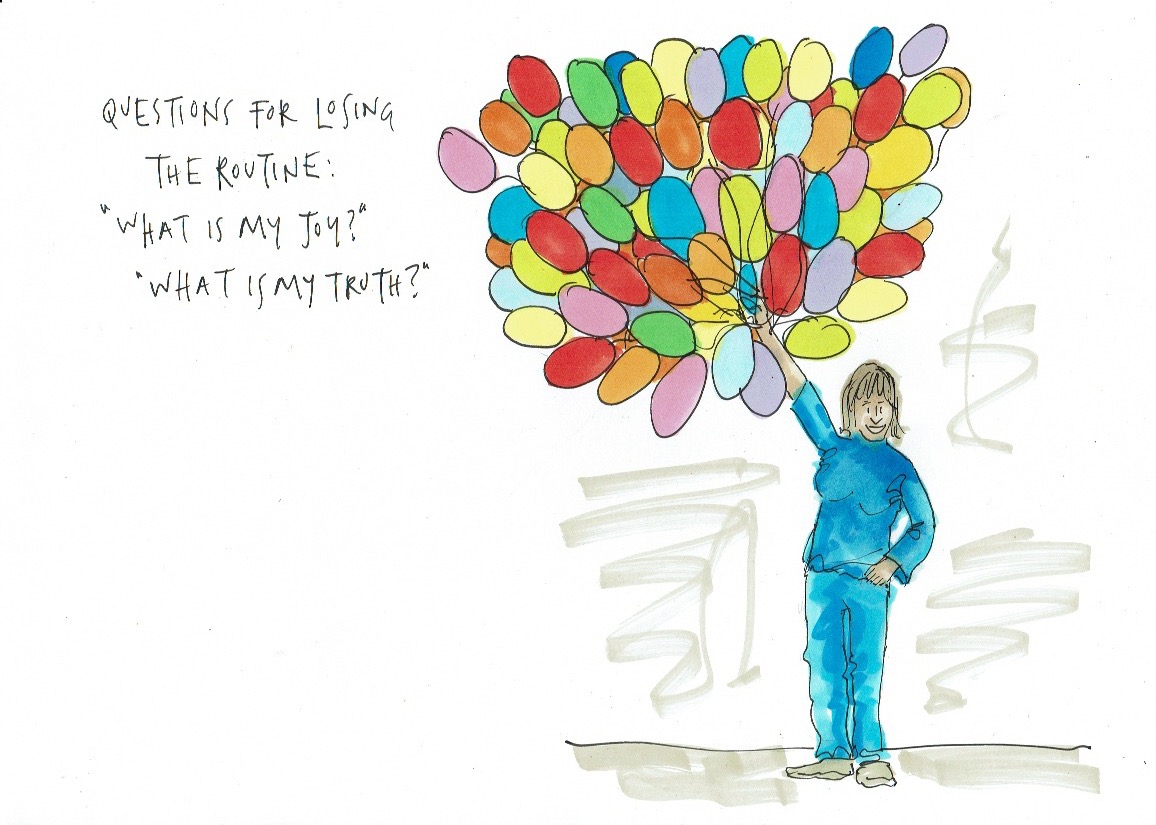
what is my joy?

5-were-all-emotional

“Notice, dream, connect, do.”*

‘What fools call “wasting time” is most often the best investment.’**

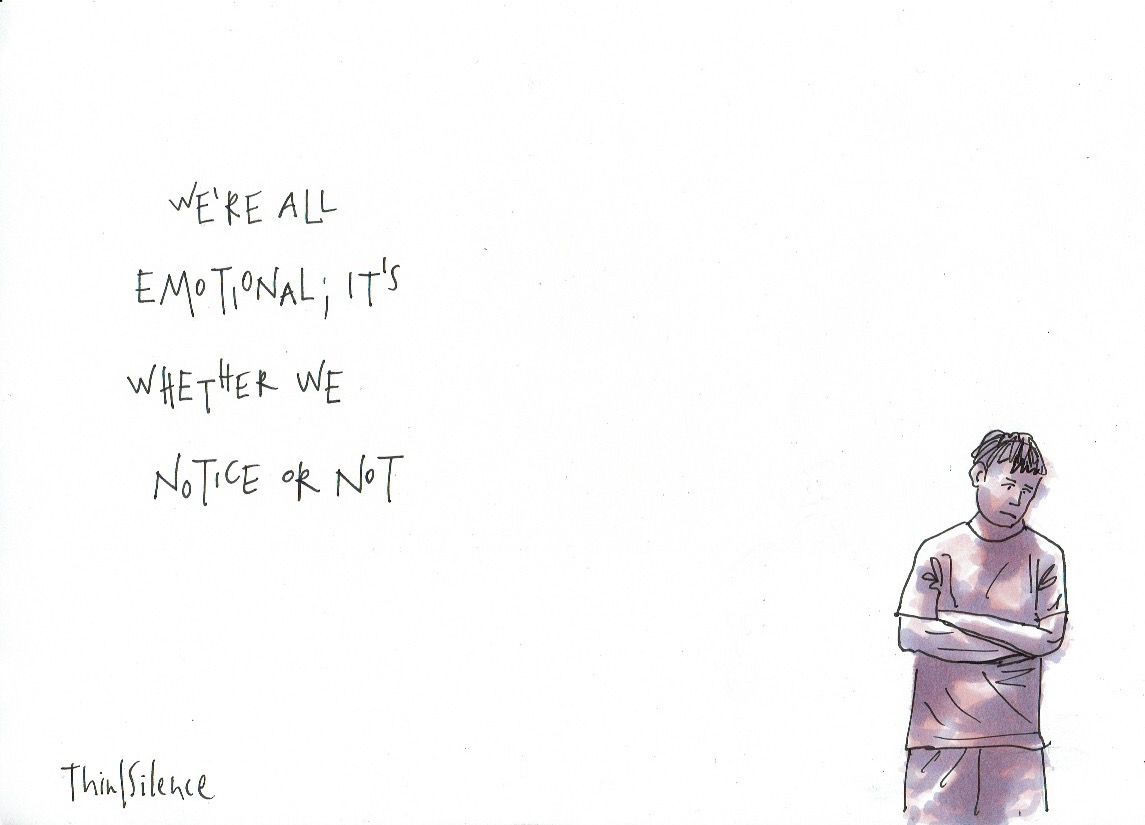
I grew up in a family that did not tend towards sharing emotions, never mind talking about how to handle them.  There wasn’t guidance on how to recognise what I am calling my joyful agitation, either – the emotional energy of my life.

That I find myself where I am,  listening to people’s lives, results from coming across others who’ve encouraged me to spend time looking at my life in specific ways.  When we notices our emotions then we are able to grow our curiosity and the adventure begins.

Brené Brown identifies several reasons why we don’t develop our emotional intelligence: it’s a sign of vulnerability, feel it but don’t share it with others, we don’t have the emotional language, it’s frivolous and indulgent, we can’t feel anyway, uncertainty is uncomfortable, you’re just inviting trouble.^

Wasting time towards noticing our emotions – a daily, reflective practice can help us do this – enables us to “slip our anchors,” the things which have held us in the one place for too long.

‘You don’t become completely free by just avoiding to be a slave, you also need to avoid becoming a master.’**

(*Monica Hardy, quoted in Seth Godin’s It’s Your Turn.)
(**From Nassim Taleb’s The Bed of Procrustes.)
(^See Brené Brown’s Rising Strong.)

distracted

4-there-are-two

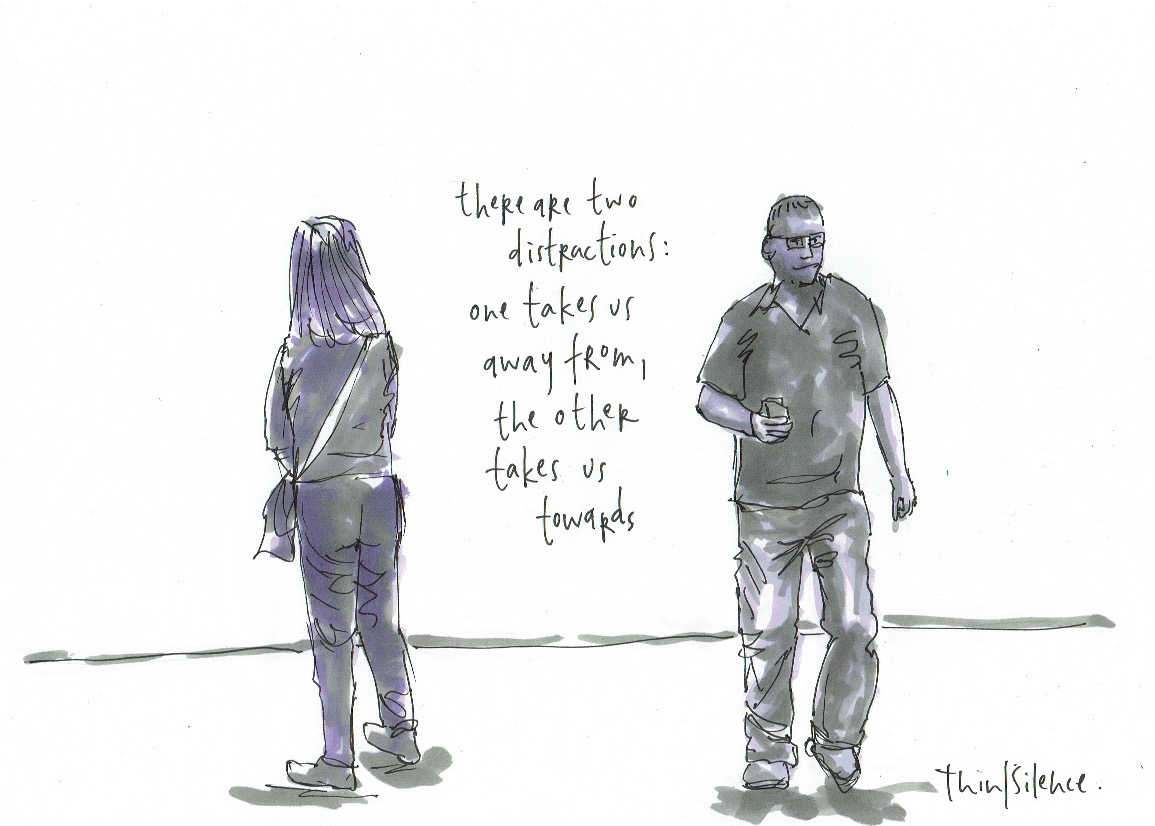
Distraction can be good and distraction can be bad.  It’s important to know which kind is which.

There’s something important you need to do, or some critical information you need to take on board but your mind is elsewhere.  Hopefully you can ask a question, feel embarrassed, and catch what you need to know when it’s repeated.

Sometimes, though, we go through life allowing ourselves to be distracted, consciously or unconsciously, at the most important moments. This is definitely not good.

Human life is an incredible thing; we simply don’t know what we’re capable of.  The wrong kind of distraction means we’ll never know.  Nothing is wasted, when it comes to the experiences of our lives, out of which can emerge some astonishing future possibilities for who we can be and what we can do.   It’s about reimagining all of this into what can only be described as art and contribution.  But there’s something very uncomfortable about this.  It’s about the unfamiliar.  It includes seeing the truth about ourselves.  It can be easier to allow ourselves to be distracted ted and watch some thoughtless TV instead:

‘They sit and stare and stare and sit
Until they’re hypnotised by it.
Until they’re absolutely drunk
With all the shocking ghastly junk.’*

Yet this possibility of human change and development is the closest thing we have to alchemy: a leaden life turned into something golden – I’m not thinking glitzy or celebrity.

There’s also a good sort of distraction.

The kind that’s curious about everything our lives contain, how we got to where we are – the work the relationships, the dreams … , what we can do with it, and how we feel about things.  This feeling stuff is what really trips us up.  Because curiosity in these things is about vulnerability and courage.

Curiosity, though, is another word for distraction.

The possibility of following the habit holes that our lives are riddled with, to find out the more about ourselves that can be life-changing.  It’s where we hear the deep whispers of our lives.

(*From Roald Dahl’s Songs and Verse.)

faith and fraud

3-keep-the-faith

There is a critical moment when non-movement turns into movement, between staying put and actioning – a tipping point moment in which something ‘exercises a disproportionate influence’* on what we do.

What is that something?

I wonder whether that something is our “faith.”  Something different in each one of us connecting our past, present but, especially, our future, enabling us to see what we cannot see and to move towards it.  It is about our past and present inasmuch as it extends what we are curious and concerned about into future developments and possibilities.

‘Too much collective value without a lot of individual value creates a lot of swiss cheese.’**

There are various collective values – political, religious, business, familial, sports – yet without the contribution of our personal ones, these are full of holes.

We can trust we’re on a journey of faith and not some ego-trip when we embrace the first movement: pride to humility, greed to gratitude, and foolishness to faithfulness.

When we’re moving – at last – something else happens.  We change.  Our interaction with all around us requires this of us.  Ideas are more energising, towns and cities are more interesting, people more wonderful, nature so  much more colourful.

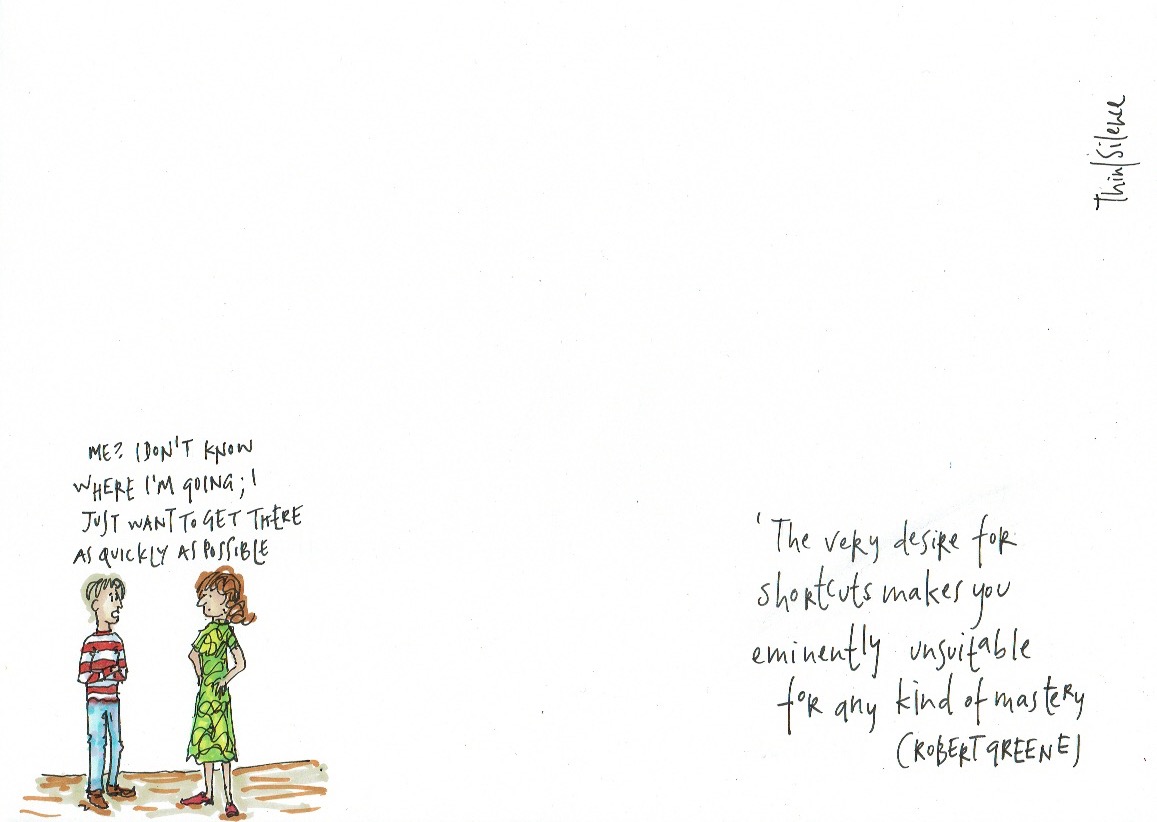
What is happening is we are opening our minds and hearts.  This doesn’t happen when we’re tempted to take shortcuts or move faster.

‘I suspect that the mind, like the feet, works at about three miles an hour.’^

Some have suggested that the opposite of faith is certainty, that is, a closed mind and heart, but in this context, I wonder whether it is also fraud.  When we are not being who we are and we are not doing what we ought to be doing.

Who am I?  What is my work?

(*Chan Kim and Renée Mauborgne’s Blue Ocean Strategy.)
(**From Hugh Macleod’s gapingvoid.com.)
(^From Rebecca Solnit’s Wanderlust.)

the beauty in silence

2-oh-my

“Drink in the silence.  Seek solitude.  Listen to the silence.  It will teach you.  It will build strength.  Let others share it with you.  It is little to be found elsewhere.’*

‘[I]n the psychoanalytic tradition, one speaks about narcissism not to indicate people who love themselves, but a personality so fragile that it needs constant support.’**

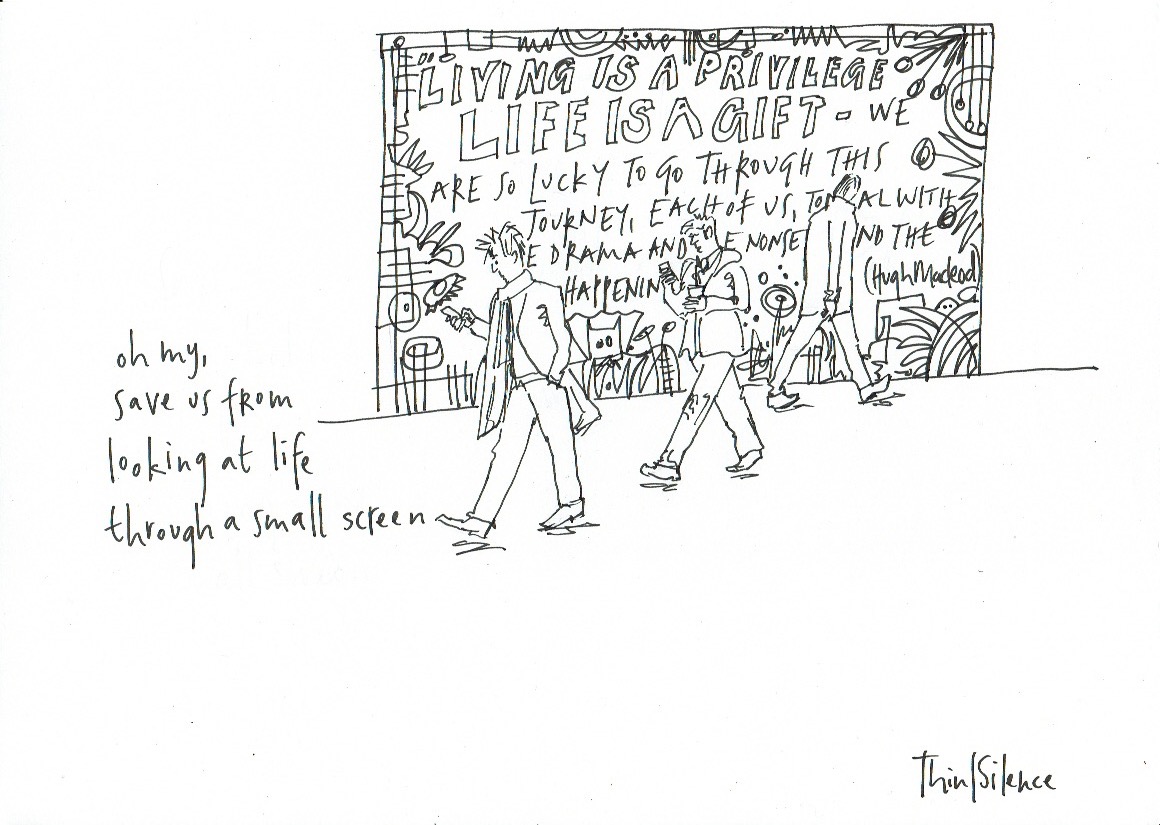
I’m challenged by the silence.  Where I live can be so quiet at night that if I waken I hear nothing at all – I even wear earplugs to keep the silence out (really it’s to manage the occasional sounds appearing louder in the quietness).   But I’m appreciating how silence isn’t empty, quite the opposite – how it’s is possible to tune into the inaudible or invisible, into the quantumness of it all.

‘And the set of possibilities being infinite as it is, if there is even a fraction of possibilities we cannot imagine, then there is an infinite number of possibilities we cannot imagine.”^

In the silence, we discover how life is more than we’ve been able to so far imagine.  How, then, do we listen, though, in a world which drowns out the silence?  In which silence and solitude are not valued or seen as useful?  In which our digital children have to be connected at all times, in danger of becoming Narcissus and on the other end of the call there is Echo^^ with ‘made-to-measure representations’ being received?**  That is, friends who say only what we want to hear.  Tom Rath’s Vital Friends names eight kinds of friend that make for healthier relationships, including with ourselves.*^  And so we make a real difference for one another.

‘Visonaries hold out for two and two making five, and they help people to turn their situations around.’^*

Life is richer through the silence.  It’s full of people and places and possibilities.  As we continue to be people in transition, I hope we’ll understand technology, as much fun as it is, is but a veneer covering our deeper and more ancient needs for significant relationships and service.

(*Frances Roberts, quoted in the Northumbria Community‘s Morning Prayer.)
(**From Sherry Turkle’s Alone Together.)
(^From Alan Lightman’s Mr g.  These are the words of the Stranger to the Creator in Lightman’s story of creation.)
(^^Erwin McManus labels this “the drowning pool”: ‘Narcissus’ greatest admirer was a nymph called Echo.  They were, after all, a perfect match.  He only spoke about himself, and she in turn could only repeat his self-indulgent praise.’  From McManus’s Uprising.)
(*^The eight kinds of friends/friendships are: Builders, Champions, Collaborators, Companions, Connectors, Encouragers, Mind-openers, Navigators.)
(^*From Harriet Harris’s Faith Without Hostages.)