the imagineer

10-buzzing-with-life

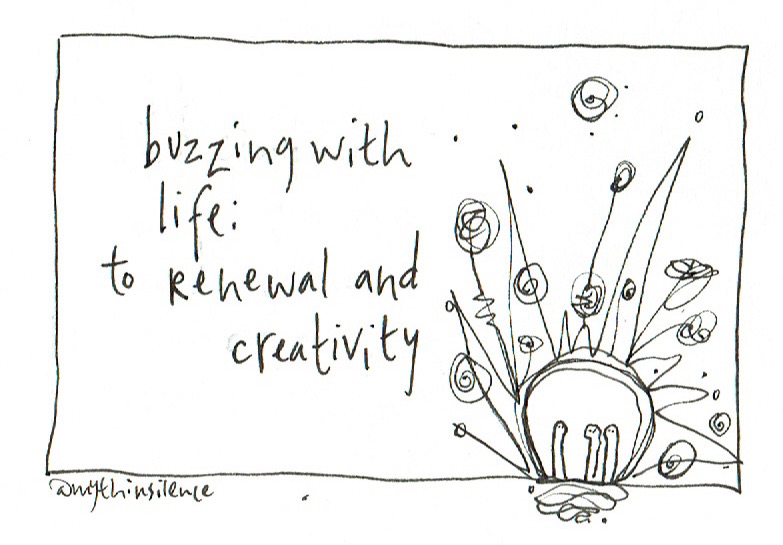
‘It’s that juncture between doing what’s safe and expected and doing what’s uncertain and unknown.  It’s a crux between fear and hope.’*

[W]hen some systems are stuck in a dangerous impasse, randomness and only randomness, can unlock them and set them free.’**

You are the one who looks on less than hopeful situations and imagine what can be.

Your mission, should you choose to accept it, is to bring your strongest and best self into these places, bringing renewal and creativity.

You know you cannot bring what someone else is able to, but you know it is your responsibility to bring what you can bring.

Your are an imagineer.

(*From Linda Rottenberger’s Crazy is a Compliment.)
(**From Nassim Taleb’s Antifragile.)

boredom

9-boredom-is-lifes-way

‘The only person who can give you permission to take risk[s] is you.’*

‘[P]art of me believes when the story of earth is told, all that will be remembered is the truth we exchanged.  The vulnerable moments.  The terrifying risk of love and the care we took to cultivate it.’**

In the beginning there was physics, and physics begat chemistry, and chemistry begat biology, and biology begat consciousness, and consciousness begat story.

There would be no story without consciousness.  Only a vast universe without eyes to pursue curiosity, without hearts beating wildly at all the beauty, without any dreams to become artists and makers.

Humans are the storytelling species, responding to infinite stimuli: worlds of colour and diversity and sound and smell and shape.

What a strange word boredom is within such a universe of possibility.

Perhaps, most of all, boredom is our lives telling us to find or create a better story.

We help each other to begin a different story, but at the end of the day the opening sentences, and where they lead, belong to us and us alone.  Amr Shady names this self-censorship.^

I’d found myself awake in the night, with some thoughts coming together of what I might say at the wedding celebration of friends tomorrow.  Like all of us, they are storywriters, creating a third story together, one which their personal stories will serve, but not replace.   They will give themselves permission to exchange truth (trust), share their vulnerability, and cultivate love.

‘Once upon a time … .’

‘A long time ago, in a galaxy far, far away … .’

‘When he was nearly thirteen my brother Jem got his arm badly broken at the elbow.’

‘Mr and Mrs Dursley of number four, Privet Drive, were proud to say that they were perfectly normal thank you very much.’

‘A busy and crowded station, full of people trying to go somewhere.’

‘In the beginning … .’

What might your opening line of a new story be?

(*From Linda Rottenberger’s Crazy is a Compliment.)
(**From Donald Miller’s Scary Close.)
(^Amr Shady found himself bored successfully running his father’s electrical engineering company in Cairo.  He found his greatest obstacle was himself.  His story is told in Linda Rottenberger’s Crazy is a Compliment.)

a world without people

8-listening-for-the

“You need to be generous to yourself in order to receive the love that surrounds you … a few inches away … at the edge of your soul … .”*

‘New social movements do not come from those in the centres of power.  The same will hold true for much of the leadership required to create a regenerative society.  Look to the periphery, to people and places where commitment to the status quo is low and where hearts and minds are most open to the new.’**

Words are vital to our existence.  We fill our days with words: speaking, writing, broadcasting, digitalising them.  Our technologies mean it’s possible for us to send our words faster and more accurately around the globe.  With the growth of information and experience industries, words are being commoditised like never before:

‘We live in the gossip of the moment and the rumours of the hour.  It is not as if we never hear the truth at all, but we don’t realise its overwhelming significance.  It is an extra, an aside.’^

Words rush over in in busyness, or comfort us in our tiredness, they reinforce us in our perspectives and worldview.  Sometimes, though, a new word comes to us, breaks through into our consciousness.

A gentle whisper.

A thin silence.

Coming from outside our familiar world, forming in the extremities of our consciousness, perhaps from a stranger, someone who brings a thought to us that no one else in our hermetically sealed world speaks.

Sherry Turkle poses many questions about the kind of world we are creating through our technologies.  We’re advancing our technology from the work place to relationships.  It is easier to send a text than phone someone, an email is easier than a meeting; in a sharp insight, Turkle proffers :

‘We ask technology to perform what used to be “love’s labour”: taking care of each other. … Philosophers say that our capacity to put ourselves in the place of another is essential to being human.  Perhaps when people lose this ability, robots seem appropriate company because they share this incapacity. … People are scarce, or have made themselves scarce.’^^

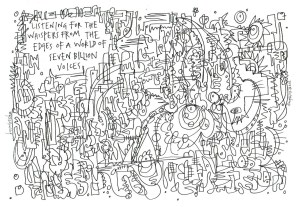
We live in a world of more than seven billion citizens, but as technology becomes increasingly immersive, those who bring us the enlivening word from the edge appear to be more scarce.

Last night, I was part of a small group of people, around a dozen, who’ll be coming together every week for the next two months.  Although there’s an online course at the centre of this tribe, offering incredible ideas and possibilities, this human gathering will be where the promise of possibility and transformation are found.

(*John O’Donohue, quoted in the Northumbria Community‘s Morning Prayer.)
(**From Peter Senge’s The Necessary Revolution.)
(^From Eugene Peterson’s Run with the Horses.)
(^^From Sherry Turkle’s Alone Together.  Turtle has earlier told of how Japan has decided not to care for its senior citizens through foreign labour, but will build robots to do it.)

today is day one

7-today-is-the

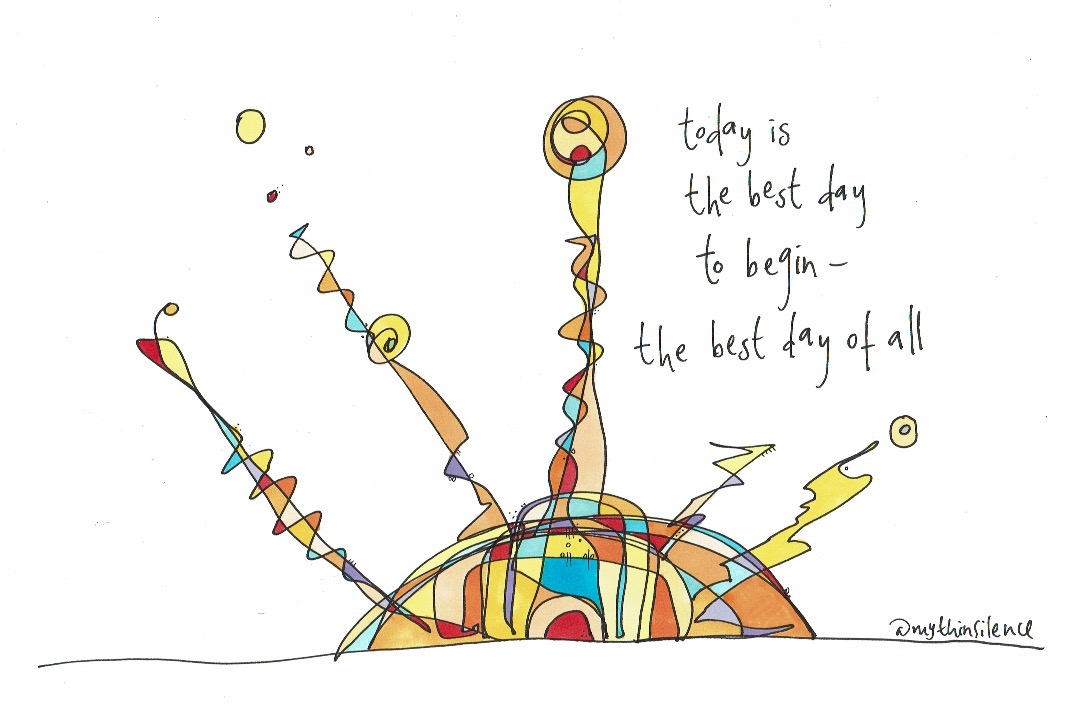
Those who come to the morning with alacrity awaken the day.

‘The word hashkem (“persistently”) has a sunrise in it.’*

‘Imagining possible futures is also where we must face both our deepest fears and greatest hopes.’**

It is the domesticated who come to the new day only expecting a repeat of yesterday.  There is a wildness, though,  to those who come with alacrity and expectancy.  Though the day is familiar in many ways to those preceding it, they live knowing something new will happen today.

And they are open.

Open in their looking and thinking, open in their feeling, open in their willingness to act.  Through practice, they have come to know that the future is more about being their best self than finding the best door:

‘It’s better to go through the wrong door with your best self than the best door with your wrong self.’^

While some are still waiting for the perfect opening, others develop their self every day, knowing that they don’t need a best door to move forward.

Their openness may sound like aimlessness, but the untamed eye, heart – knowing that who they are is more important than what they do – make new openings happen:

‘”A very original man must shape his life, make a schedule that allows him to reflect, and study, and create.”^^

“It’s still Day One.”*^

This is the world I love, not as some expert or teacher, but as an explorer with others.

(*From Eugene Peterson’s Run with the Horses.)
(**From Alex MacManus’s Makers of Fire – eBook version.)
(^John Ortberg’s All the Places to Go.)
(^^Gary Wills, quoted in Eugene Peterson’s Run With the Horses.)
(*^Jeff Bezos, quoted in Linda Rottenberger’s Crazy is a Compliment.)

to be a helper

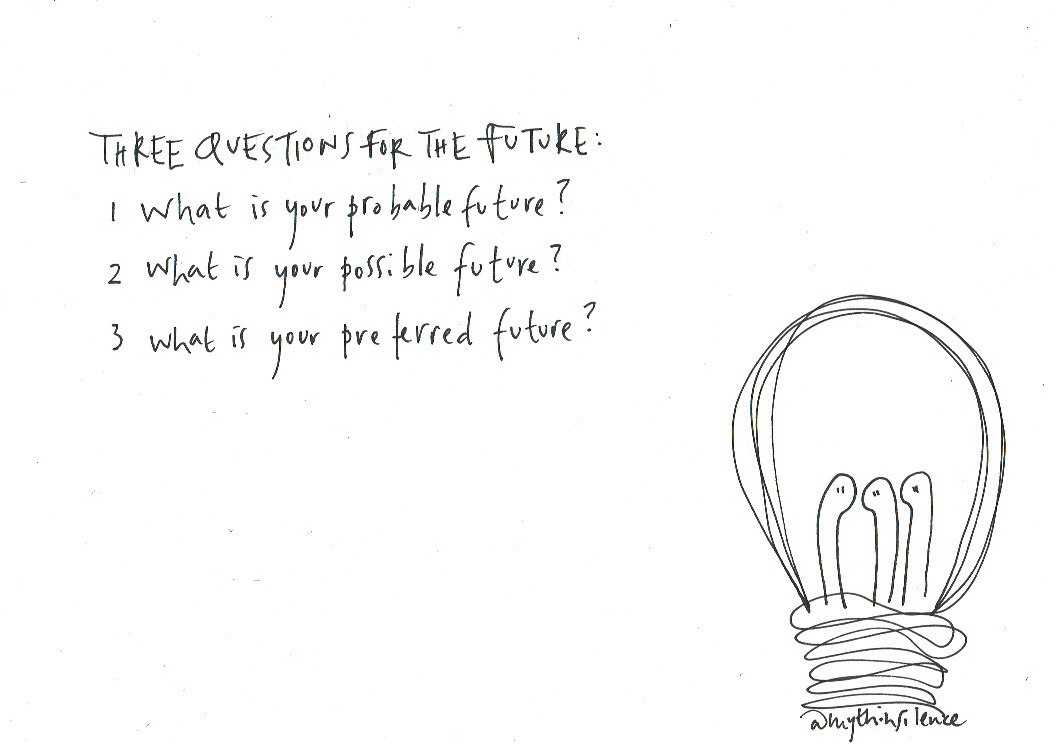
6 3 questions for the

[P]otential difficulties were avoided best through two processes: 1) self-inquiry to gain awareness of what was happening inside me in order to avoid falling into destructive traps, and 2) humble inquiry to get more information from my wife … .’*

‘[P]eople learn through failure, that where people do failure avoidance, they will never achieve the kind of courage and risk taking that lead to bold innovation.’**

To be a good helper is about more than providing what we think another needs, more than make available even what the other needs.

We have to recognise how helping others helps us to grow and meets our own needs, avoiding the kind of helping that leaves us a level or two up on the person we’re offering assistance to.

This also makes it possible for the other person to avoid taking responsibility, or feeling they have nothing to give to their own need-meeting.

Helping is something we undertake together, and is a beautiful art.

(*From Edgar Schein’s Helping.)
(**From John Ortberg’s All the Places to Go.)

the undertakers

5 in the beginning

‘Today’s ubiquitous web-based connections and social media support this longing for a personal identity that transcends the individual, the tribe, the nation, and religion.  A sense of self that includes “friends” from all around the world is emerging, a Social Self.’*

When I began my working life an undertaker was the name given to the person who undertook all the funeral arrangements on behalf of another.  Now, undertakers are funeral directors.

The French version of “to undertake” throws out another role, that of entrepreneur – now flourishing in many forms and expressions: micro entrepreneurs, copreneurs, intrapreneurs, mumpreneurs.  A very popular word.

The universe is open for beginnings.

In a world in which many more of us are getting the opportunity to explore and begin new things, it’s no wonder some are describing this period in history as a second Renaissance.

Edgar Schein uses the term status equilibrium when he imagines someone helping another: two people finding  themselves in the kind of relationship that progresses something. Disequilibrium, or lack of creative balance, is when I think you have all the answers, or when you’re not listening to me and think you have all the answers – and maybe you have, but their answers to someone else’s problem,

But what if the universe’s prime relationship is friendship?  What if we get to undertake something new together.

Work by Tom Rath on friendship came up with different types or styles of friendship.  Friends can be companions, connectors, energisers, and champions for us, but they can also be mind-openers, collaborators, builders, and navigators.**

Friendship maybe the most creative environment for making things begin.

(*From Alex McManus’s Makers of Fire – eBook version.)
(**See Tom Rath’s Vital Friends.)

hospitably yours

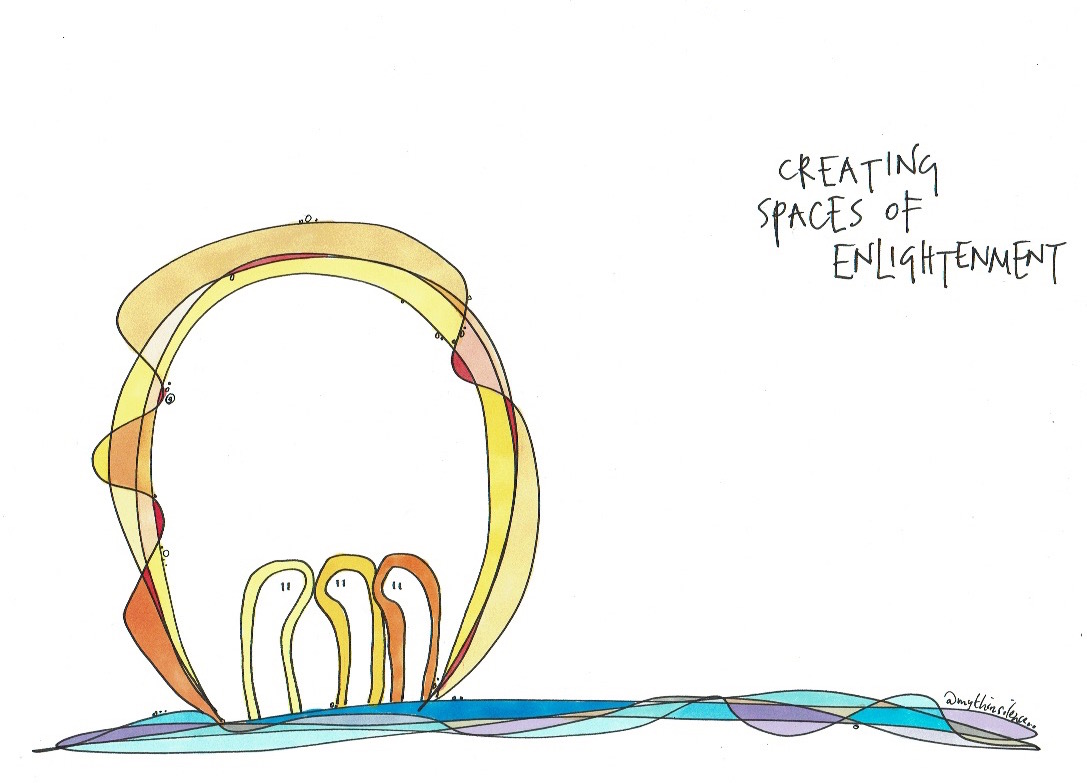
4 creating spaces of enlightenment

‘A tribe that communicates more quickly, with alacrity and emotion, is a tribe that thrives.’*

“Freedom is not the absence of structure … but rather a clear structure that enables people to work within established boundaries in an autonomous and creative way.”**

There are spaces for copying the performance of others – most spaces are like this.

And there are the spaces in which the host(s) make it possible for their guests to go beyond what they can teach.

One environment reacts to an immediate problem.

And the other initiates future solutions.

There’s great humility to be found in such spaces.  The host humbly encourages their guest(s) to surpass them.

The guest humbly acknowledges what they can become together with others is far more than they can become on their own.

Such places are enlightening in the true sense of the Enlightenment:  the shedding of light on our potential as Human Becomings: “in your light we see light.”^

(*From Seth Godin’s Tribes.)
(**Erich Fromm, quoted in Peter Senge’s The Necessary Revolution.)
(^A interesting phrase from Psalm 36.)

persistently opening

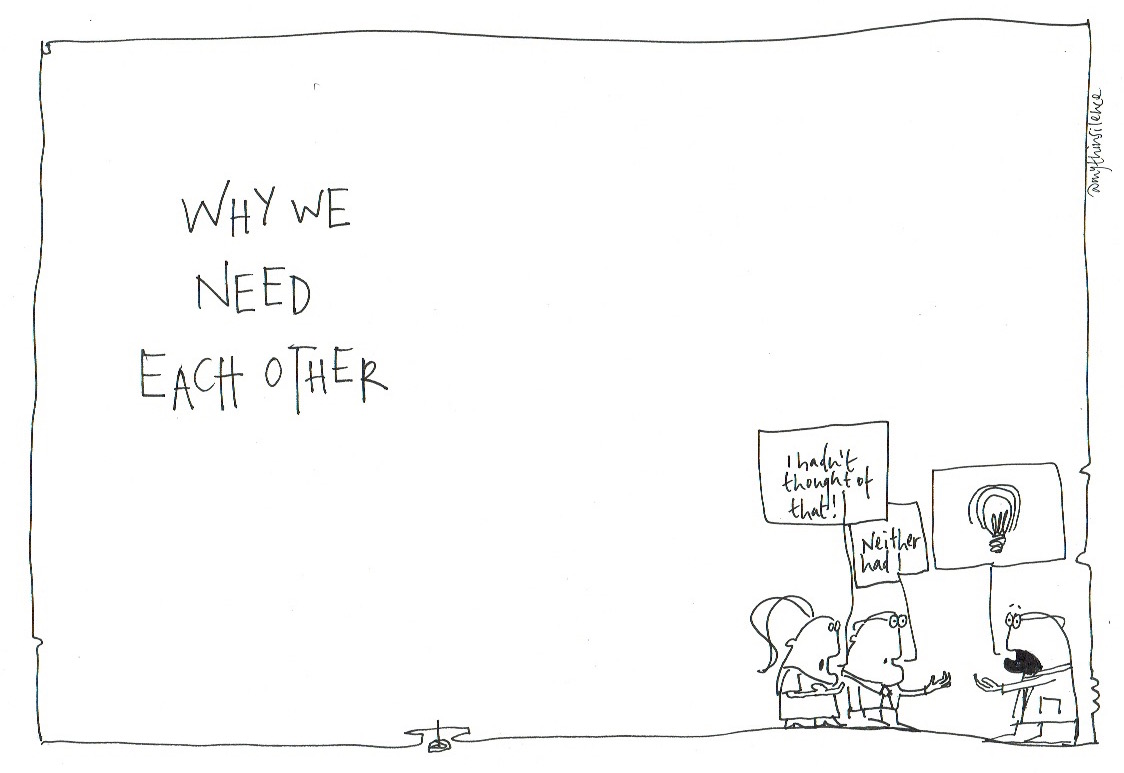
3 why we need each other

‘Answers cure you, answers help you.  Asking questions make you feel alive.’*

“If everybody is doing it one way, there’s a great chance you can find your niche by doing it in exactly the opposite direction.”**

For twenty three years, he’d been pointing out what was wrong in the system he and others were living in, but no one was listening.

His life had become persistence personified and there was a word that described this and meant so much to him.  It was a word had come to describe the labour of people who began their day before dawn so they would not be overcome by the heat of the day.  In his tongue the word was hashkem: to shoulder a burden or load.^

We need those who bring different perspectives to us, who ask the questions we hadn’t thought of asking.  We need these people to be persistent, to not give up when we charge them with not collaborating or being inaccessible because they’re not using the same words as everyone else, or doing the same thing.

When answers come too quickly, or they look a lot like what we want them to look like, or they satisfy us so that we don’t ask further questions, then we need to be wary.

If you are the one who sees things differently to everyone else, we need you.  You may want to try this word hashkem out for size; don’t give up.

Our imagining of a better future is our attempt to imagine a better now.

(*From Albert Espinosa’s The Yellow World.)
(**From Linda Rottenberg’s Crazy is a Compliment.)
(^Eugene Peterson unwraps this story of the Hebrew prophet Jeremiah’s persistence in his book Run with the Horses.)

welcome more than you ever imagined

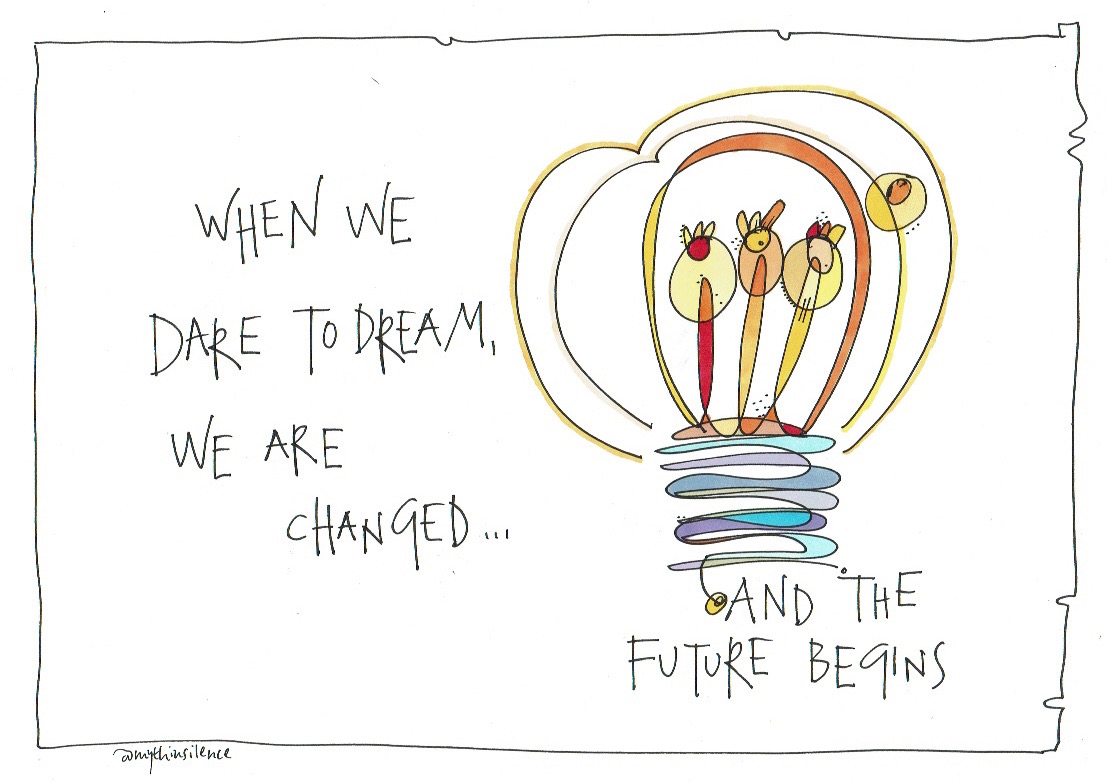
2 when we dare

“Poor people deserve to feel beautiful too.”*

‘I first had to recognise my passion. … My next step was to make time for it, to find ways to integrate my passion into my ordinary days, and to stop measuring myself against some irrelevant standard of efficiency.’**

Dare to Dream is the name of the Scottish International Storytelling Festival’s campaign to encourage schools and communities up and down Scotland to dream of a better future through story, as well as gather the stories they want to carry with them from the past.^

When I heard about this, I needed to check it out because daring to dream with individuals is where I love to be, living between the truth of people’s lives and the possibilities.  This isn’t daring to dream in a vacuum, but through talents and passions, including some of the most difficult things life can be:

“[E]ven the saddest things can become, once we have made peace with them a source of wisdom and strength for the journey that still lies ahead.”^^

Taking what is already there, we move it further.  We are here because of following our curiosities, developing practices around these, then deepening them, and forming creative habits – some less visible than others.  The more we are open, recognising and welcoming these things, then we’re welcoming more than we ever imagined and we are daring to dream.

(*Slum entrepreneur Leila Velez, quoted in Linda Rottenberg’s Crazy is a Compliment.)
(**From Gretchen Ruben’s The Happiness Project.)
(^This is an example of why I love living in this country.)
(^^Frederick Blechner, quoted in John Ortberg’s All the Places to Go.)

without appointment

1 all we have is love and imagination

“If you let yourself be absorbed completely, if you surrender completely to the moments as they pass, you live more richly those moments.”*

‘[T]he first thing I should do is to take a moment, to consider what is actually being asked for, to adopt an attitude of humble inquiry, to be a process consultant.’**

From today, “without appointment” is how I’m recorded within my institution.

I am now officially on my own to pursue the work I have felt called by for some time.  It’s a new story, a new land to be journeyed into.  Whilst there are a number of things I know this new direction will include, there are many people and things I’ve no idea I will come upon.  These will emerge from the future, inviting me to be attentive, the become, to act.

This will mean, in order to keep journeying, there will be things I must let come, as well as things to let go – and maybe even some of the hopes I hold right now.

‘A world that works for everyone does not exist, except in our imagination.  So we must feed the imagination.’^

The future asks of me, “What can you imagine?”

Imagination isn’t solely a mental process, but one that combines heart and mind: ‘the heart may perceive future events before the brain does … at the very least it implies that the brain does not act alone in the perception of future events.’^^

We exist in an age when we’re discovering and developing our perceptual skills, being open to others, our world, and our future self.  It is the appointment I’m seeking to be busy in.

Ramez Naam imagines what this will mean – I echo his sentiment, though add the heart to this:

‘We stand poised on the brink of the largest ever explosion of human mental power, a second renaissance more transformative, more far-reaching, and more inclusive than the first.’*^

(*Anne Morrow Lindbergh, quoted in the Northumbria Community‘s Morning Prayer.)
(**From Edgar Schein’s Helping.)
(^From Alex McManus’s Makers of Fire – ebook version.)
(^^From Joseph Jaworski’s Source.)
(*^From Ramez Naam’s The Infinite Resource.)